

Braze welding vs brazing is a terminology and filler-placement comparison, not a complete manufacturing specification. The AWS Brazing Handbook public excerpt distinguishes deposited brazing filler from conventional capillary distribution, while TWI’s current article describes an arc-brazing route that also discusses wetting and capillary flow. That difference means the buyer should ask which actual route, joint geometry, filler, base materials, and acceptance evidence a specialist is proposing. The name alone does not establish equipment, process qualification, strength, corrosion performance, or Koitor capability.
What does braze welding vs brazing compare?
Both terms describe joining methods that use a filler metal whose melting behavior differs from the parent material; they are not simply alternate names for fusion welding. The cited handbook describes braze welding as depositing filler to build the joint, while conventional brazing is commonly distinguished by filler being drawn or distributed through a suitable joint by capillary action. That gives a buyer a practical starting point: ask how the filler reaches and occupies the joint.
The AWS public handbook excerpt describes the base metal as unmelted in its definition of braze welding and contrasts deposition with capillary action. TWI’s article describes a particular arc-brazing process in which molten filler wets surfaces and flows across or between them through capillary action, while the parent material does not undergo significant melting or fusion. These sources are not necessarily using the label at the same level of specificity. The difference is important enough to state plainly rather than flatten into one universal definition.
For a sourcing conversation, braze welding vs brazing is not just a vocabulary comparison. Ask: “What is the proposed joining mechanism for this specific joint, what does the supplier call it, and what evidence will show it meets the drawing?” A specialist should be able to explain the intended route and point to the controlled drawing, procedure, or product-specific qualification that applies. A buyer should not infer a process from a bead shape, filler color, or the word “weld” in a quotation.
This distinction is separate from a comparison between brazing and fusion welding. A fusion-welding article may discuss parent-material melting, joint form, or heat effects, but those are not a substitute for identifying how the brazing filler is distributed in a braze-welded or capillary-brazed joint. The buyer should keep the process family and the joint design as separate questions in the RFQ.
The term braze welding also appears in different technical contexts. The handbook excerpt is a bounded, older educational reference; TWI’s article is a current specialist introduction focused on an arc process. A buyer-facing guide should explain that scope difference. It should not claim that every current standard or every shop uses the terms identically, and it should not turn a two-source comparison into a normative classification.
How do the filler route and joint geometry differ?
In the conventional distinction presented by the handbook, braze welding uses filler that is placed or deposited along the joint rather than relying on capillary action to distribute filler through a close-fitting joint. In ordinary capillary brazing, joint design and clearance are relevant because the filler must wet and enter the intended interface. Those broad mechanisms help explain why a drawing needs to show the joint and why a process name alone leaves too much unspecified.
| Buyer comparison point | Deposited braze-weld description | Conventional capillary-brazing description | What the buyer should clarify |
|---|---|---|---|
| Filler placement | Filler is deposited along the joint in the cited handbook definition | Filler is distributed through an appropriate interface by capillary action | What route does the specialist mean for this joint? |
| Joint geometry | The filler may build a visible external joint profile | The designed interface and fit are part of the route description | Which drawing detail defines the joint and fit? |
| Parent material | The handbook describes the base material as not melted | Brazing also relies on a filler route distinct from fusion welding | What does the proposed procedure say about the parent material? |
| Heat source or process | The term can encompass more than one process route in the handbook | Conventional brazing can be performed through different heating routes | What exact process and procedure are being quoted? |
| Acceptance evidence | Appearance alone does not qualify the joint | A close-fitting joint alone does not prove the result meets requirements | What inspection or qualification evidence applies? |
This table is a conceptual procurement aid, not a process instruction. It gives no dimensions, joint gaps, temperatures, current, gas, flux selection, filler recipe, or structural design criteria. The AWS excerpt and TWI article discuss specific process contexts; neither source establishes a universal buyer acceptance rule for bathroom or home-storage hardware.
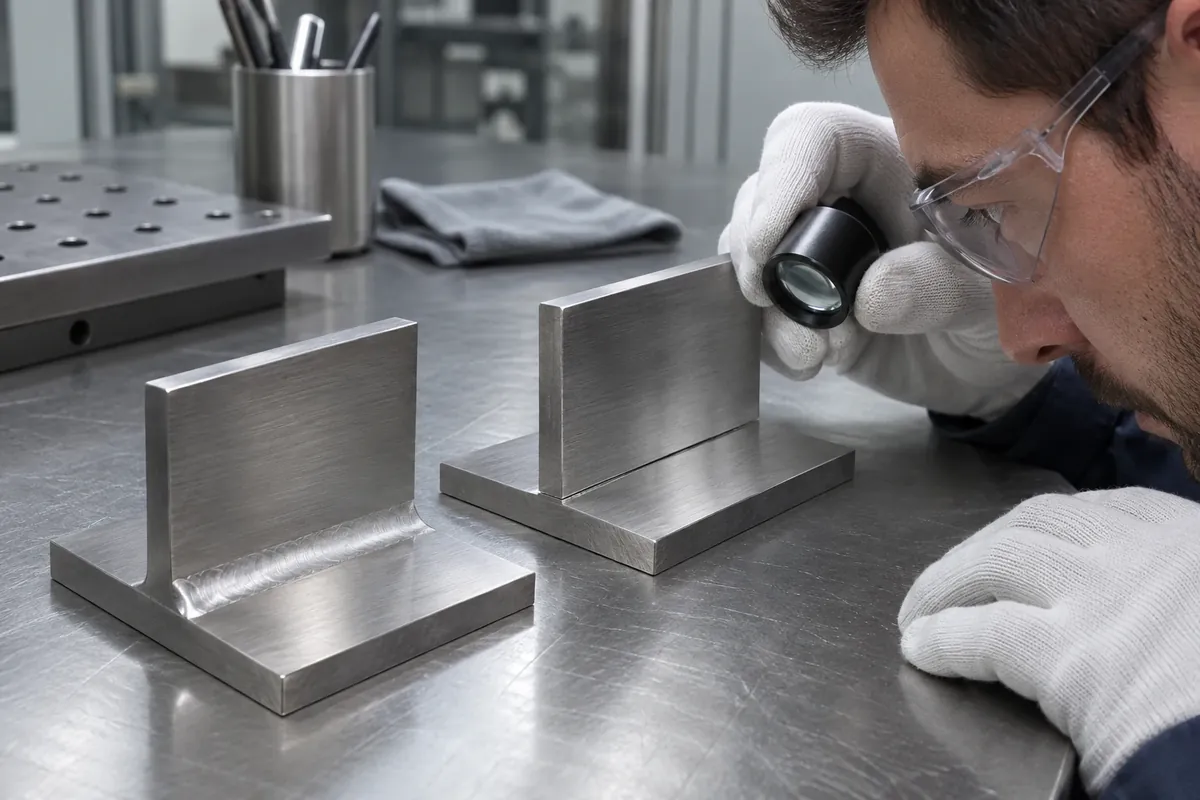
The joint drawing should show enough information for the responsible specialist to identify the design intent. Depending on the application, that can include the component boundaries, joint location, materials, finished surfaces, accessible sides, cosmetic surfaces, and any dimensions or tolerances the design authority considers critical. If the proposed process needs a different preparation or access condition, the supplier should identify the proposed change for review rather than altering the geometry silently.
Filler placement also affects how the buyer thinks about the visible result. A deposited profile can be present on the exterior; a capillary joint may be less visible once assembled. But appearance is not a measure of strength or quality by itself. A large bead does not prove the design is adequate, and an inconspicuous seam does not prove that the intended interface was filled or inspected. The acceptance criterion must come from the controlled drawing, product requirements, and the responsible engineering or quality owner.
TWI’s description of an arc-brazing variant uses capillary-flow language, which is why buyers should avoid a rigid word-only decision tree. The source context can use “braze welding” for an arc process and still describe the filler wetting and flowing between surfaces. A supplier should be asked to define its exact route, not forced into a label based on a simplified web summary.
Why should the buyer ask the specialist to define the route?
A buyer often sees process names in quotations, supplier capability statements, drawing notes, or sample discussions. The same label may not tell two suppliers the same thing, and two different labels may describe routes that share some mechanisms. The commercial risk is that the buyer prices or approves an undefined outcome while assuming the supplier interpreted the phrase in a particular way.
A useful clarification request can identify:
- The process name used by the supplier and the specific route behind that name.
- Whether filler is deposited along the joint or distributed through a designed interface.
- The base materials, filler identity, and component configuration covered by the proposal.
- The drawing or sample revision to which the proposed process applies.
- Any joint-preparation or access assumption that could change the part.
- The planned acceptance evidence and the party responsible for interpreting it.
- Any deviation from the buyer’s drawing or approved sample.
This is a request for definition, not a demand that every supplier disclose proprietary settings. The buyer needs enough information to understand scope and decide whether the proposal fits the design. A specialist process owner can protect confidential details while still clarifying the route, material scope, approved geometry, and evidence relevant to the purchase.
The request should separate the process, joint, und result. The process describes how the supplier intends to join the parts. The joint describes the geometry and interface. The result describes the acceptance condition required by the buyer. If these are mixed into one phrase, a disagreement can surface only after a sample is made or an order is underway.
For example, “braze weld the bracket” names a process family but does not show the joint position, base materials, filler type, required appearance, or how the buyer will accept the finished assembly. “Brazed joint on the approved drawing” still may not explain whether the source means capillary filling or a deposited fillet. A short marked drawing, supplier response, and controlled approval record can make the purchase scope clearer without inventing a procedure.
The buyer should also identify who has authority to approve changes. The product designer may own the geometry; the joining specialist may own process feasibility; the quality representative may define inspection evidence; and the importer may control the purchase-order revision. When the supplier recommends a different route, the decision record should show which party approved the change and what evidence was reviewed.
What information belongs in an RFQ or drawing review?
The goal is not to force a particular joining process before the design has been reviewed. The buyer should provide the information that allows a qualified supplier to assess the joint and identify assumptions. The exact content depends on the product and the supplier’s defined scope.
Identify the components and materials
Name the parts that meet at the joint and reference their controlled drawings or part numbers. Identify the base-material grades or specifications where known and approved, along with any finish or coating that affects the joined surfaces. If a material is not yet selected, mark it as an open input rather than allowing the supplier to assume one. The research sources do not authorize a generic filler recommendation for any specific metal combination.
A material callout should also distinguish the product substrate from the filler metal. A supplier’s description of the filler does not establish the exact base material, and a coating or surface finish does not substitute for the material designation. If an existing finish must be removed, retained, repaired, or restored, that requirement should be assigned to a qualified process owner and documented for the particular product.
Show the joint location and design intent
The drawing should make the joining location, orientation, access, adjacent components, and cosmetic faces understandable. If the joint is hidden after assembly or visible to the end user, note that condition. Mark any dimension or surface that is functionally important. Do not invent an unverified gap or edge preparation; instead, ask the specialist to identify any geometry needed for the proposed route.
For parts that will be assembled with other hardware, include the surrounding envelope and sequence where it affects access. A joint may be physically possible in isolation but difficult to produce or inspect after nearby components are added. The buyer can invite the supplier to flag a manufacturability concern and request approval for a defined alternative.
Ask for the proposed process and evidence
The supplier should identify the process label it uses, explain the route in plain language, and reference the procedure or capability evidence appropriate to the order. The buyer can ask what inspection record, sample, or qualification evidence will be provided, but should not assume every product requires the same test. A visual sample may confirm appearance; it does not necessarily prove hidden joint conditions or a structural load requirement.
If the buyer needs a measurable acceptance criterion, define the requirement with the responsible engineering authority. This article does not set strength targets, destructive test methods, test frequencies, or allowable defects. Those depend on the product’s function, risk, specification, and qualified process review. A supplier should not be asked to guarantee a result that the drawing does not define.
Control changes from quotation through repeat orders
A quotation should state the process assumption and identify any proposed deviation. A sample record should connect the sample to the drawing and process version reviewed. A purchase order should reference the agreed revision rather than an email phrase. For repeat orders, any change in material, component source, joint geometry, filler, process route, or acceptance method should be assessed by the designated owner.
When the buyer compares multiple quotations, normalize the scope before comparing price. One supplier may have priced a different joint geometry or an alternate process. Ask each bidder to state its assumptions against the same drawing. This does not guarantee the lowest quote is technically suitable; it makes the differences visible for review.
What does the available evidence establish—and what does it not?
The AWS public excerpt supports a particular conceptual distinction: braze welding uses deposited filler rather than the capillary distribution described for brazing in that text. It also says, in its definition, that the parent metal is not melted. That is useful educational evidence, but the preview is an older handbook chapter excerpt and does not establish the latest normative terminology, a complete standard, or a qualified procedure for a specific buyer’s part.
TWI’s current specialist article describes a MIG/MAG-derived arc-brazing route and notes that the filler melts, wets surfaces, and can flow between joined surfaces by capillary action without significant parent-material melting or fusion. That explanation reveals why the terminology needs context. It does not make every use of the term “braze welding” identical, and it does not supply the buyer’s product-specific design or acceptance criteria.
Together, the sources support a bounded buyer takeaway: process names alone may not reveal the actual filler distribution or joint definition. The buyer should ask the specialist to state the process route, joint, materials, and applicable evidence. The sources do not support numerical process settings, joint gaps, strength rankings, service-life claims, zinc-protection guarantees, or repair instructions.
The sources also do not establish that Koitor performs brazing or braze welding. A manufacturing article about a process is not proof of factory equipment, personnel qualification, production history, or current capability. If a project requires this route, the buyer should verify the proposed supplier’s actual capability and evidence for the product and process in question.
A buyer can therefore use the comparison as an RFQ conversation guide while keeping final technical decisions with the responsible process specialist. If the application is safety-critical or performance-sensitive, involve the qualified design or engineering authority before approving a sample or substituting a joining route. That boundary protects the buyer from converting an educational description into an unverified production instruction.
Which sourcing mistakes create confusion?
Assuming the label defines the joint. “Braze weld” or “brazed” may be incomplete without a drawing and process explanation. Ask how the filler is applied and which interface is intended.
Treating every source as if it uses the words identically. The AWS excerpt and TWI article illustrate different levels of terminology and process description. State the source context and ask the supplier for its precise usage.
Confusing braze joining with fusion welding. The article compares braze-welding terminology with brazing, not with every form of welding. Do not infer parent-metal fusion, heat input, or joint quality from a word in isolation.
Using a visible bead as acceptance evidence. A visual profile can help describe appearance, but it does not prove a hidden interface was made to the drawing or that the joint meets a functional requirement.
Assuming a capillary route is automatically superior. The sources describe mechanisms, not a universal ranking. Geometry, materials, application, access, inspection, and the buyer’s requirement determine what should be reviewed.
Accepting an alternative without design approval. A supplier may propose a different joint shape or route for manufacturability. The buyer should compare the proposal with the controlled drawing and obtain approval from the designated owner.
Assuming a published article proves a supplier’s capability. General technical sources do not establish Koitor’s equipment, qualification, or in-house brazing service. Confirm the supplier, personnel, process scope, and project-specific evidence.
Requesting a strength guarantee without a defined basis. A process label does not supply a design load, material condition, test method, specimen, acceptance limit, or lot requirement. If strength matters, the product authority should define the requirement and qualified evidence.
Letting process records drift apart. If the quote, drawing, sample approval, and purchase order use different labels or revisions, the parties may be discussing different routes. Reconcile them before release.

Buyer checklist for a joining-route quotation
Use these questions to create a clear handoff. They identify the details to discuss; they are not a procedure or technical approval checklist.
- What exact process route does the supplier mean by the quoted term?
- Is filler deposited along the joint, distributed through a designed interface, or described another way?
- Which components, base materials, filler identity, and drawing revision are included?
- Where is the joint, and which surfaces or nearby features affect access or appearance?
- What assumptions about geometry, preparation, or sequence need buyer approval?
- What process or qualification record applies to this supplier and product?
- What acceptance evidence will be delivered, and which requirement does it address?
- Who is authorized to accept a design or process deviation?
- Does the approved sample represent the same materials, joint and process proposed for production?
- Are the quotation, sample record, drawing and purchase order aligned to the same revision?
- What project-specific question remains open, and which supplier or specialist owns the answer?
A complete review may be brief for a simple non-critical part or more formal for a demanding assembly. The level of evidence should be set by the product risk and buyer requirement. The key is to avoid letting an undefined word become the only record of a technical decision.
Häufig gestellte Fragen
Is braze welding the same as brazing?
Not necessarily. The AWS handbook excerpt distinguishes braze welding by deposited filler and contrasts it with capillary distribution in conventional brazing. TWI’s current article describes an arc-brazing process that also discusses capillary flow, so the terms need context. Ask the supplier to define the actual route for the joint.
Does braze welding melt the parent metal?
The AWS excerpt describes its braze-welding definition as not melting the base metal. TWI describes its particular arc-brazing process as involving no significant melting or fusion of the parent material. The exact process and terminology should be confirmed with a qualified specialist; this article is not a procedure.
Does a braze-welded joint always have a visible fillet?
A deposited filler route may result in a visible profile, but appearance varies with the specific joint and design. A visible feature does not by itself prove that the joint meets a specification or performance requirement.
Can a buyer choose a joining route from a photograph?
No. A photograph may help identify the general appearance of a sample, but it does not establish materials, filler, joint design, hidden interface, process record, or acceptance. Use the controlled drawing, supplier explanation and appropriate evidence.
Which route is stronger?
This article does not rank the routes. Joint performance depends on the actual materials, geometry, process, workmanship, load and acceptance basis. Have the responsible engineer define the requirement and evaluate a qualified supplier’s evidence.
Does the term “braze welding” mean the same thing in every technical source?
The sources reviewed show why a buyer should not assume perfect consistency. The AWS excerpt emphasizes deposited filler as the distinction from capillary distribution; TWI describes an arc-brazing route and also discusses capillary flow. Preserve the source context and ask the supplier what the term means for its proposal.
Does Koitor offer brazing or braze welding?
No such in-house capability is confirmed in the project’s approved company facts. This guide does not claim Koitor provides brazing. Buyers should verify the responsible joining supplier and its project-specific capability and records.
What should a buyer put in the RFQ if the process is not yet selected?
Provide the component drawings, material information, joint location, functional and appearance requirements, and any known acceptance need. Ask the supplier to explain its proposed route and mark assumptions for review. The qualified process specialist and design owner should resolve the final technical selection.
Sources
- AWS Brazing Handbook, Chapter 19 public preview — older public excerpt used for the deposited-filler versus capillary-distribution distinction. It is not treated as the latest normative terminology or a full handbook.
- TWI: Braze Welding — current specialist description of an arc-brazing route, including filler wetting and flow; source-specific claims about settings, strength and performance are not adopted here.
Arbeiten Sie mit Koitor Hardware zusammen
Reviewing a Joining Detail for Custom Metal Hardware?
Share the controlled drawing or sample and the specific manufacturing question. Koitor can discuss a verified bathroom or home-storage hardware scope; a specialist joining supplier and qualified design authority must confirm process capability and technical acceptance.
OEM / EIGENE MARKE
Verwandeln Sie diesen Beschaffungsleitfaden in ein Produktdossier
Teilen Sie uns Ihr Zielprodukt, die Größe, die Oberflächenausführung, die Bestellmenge und Ihre Verpackungsanforderungen mit. Ihr Team erhält vor der Angebotserstellung eine praxisorientierte Prüfung der Herstellbarkeit.


 English
 Español
 Português
 Français
 Deutsch
 العربية