

After sample approval, a buyer-requested design change should begin with an impact review, not an informal instruction to “use the new drawing.” Buyers searching for “buyer requested design change after sample approval manufacturing” need a project-level answer: what changed, when it takes effect, what happens to committed inputs, and what approval evidence is needed. The right cost, schedule and revalidation answer depends on the exact feature, production stage and project agreement.
For custom bathroom and home-storage hardware, a seemingly small change—moving a wire, changing a hole, adjusting a bend, revising a finish or adding a component—can affect fit, tooling access, assembly, packaging and inspection. It may also have no physical manufacturing effect if the request only clarifies a note or corrects a document. Buyers should request a specific assessment rather than assume either outcome.
Why should sample approval create a controlled baseline?
An approved sample is useful only when everyone can identify what was approved. Link it to the product or SKU, drawing revision, material and finish callouts, included components, packaging configuration and the order or development stage it represents. Keep a dated approval record and the actual reference files. A photo alone may not show hidden dimensions, material grade, joint details or permitted variation.
This baseline does not mean that the design can never change. It gives the buyer and manufacturer a clear “before” state for assessing a proposed “after” state. Without that reference, teams can discuss the same part while comparing different drawings, samples or packaging versions. A buyer may believe a change is only a cosmetic adjustment while production is using a released drawing with a different bend location or hole pattern.
Configuration management guidance, including ISO 10007, treats identification, change control and implementation status as connected practices. This article is practical sourcing guidance, not a claim that a particular company or product is certified to that standard. The useful principle for a buyer is simple: record the current configuration, authorize the revision, and be able to tell which lots or orders use it.
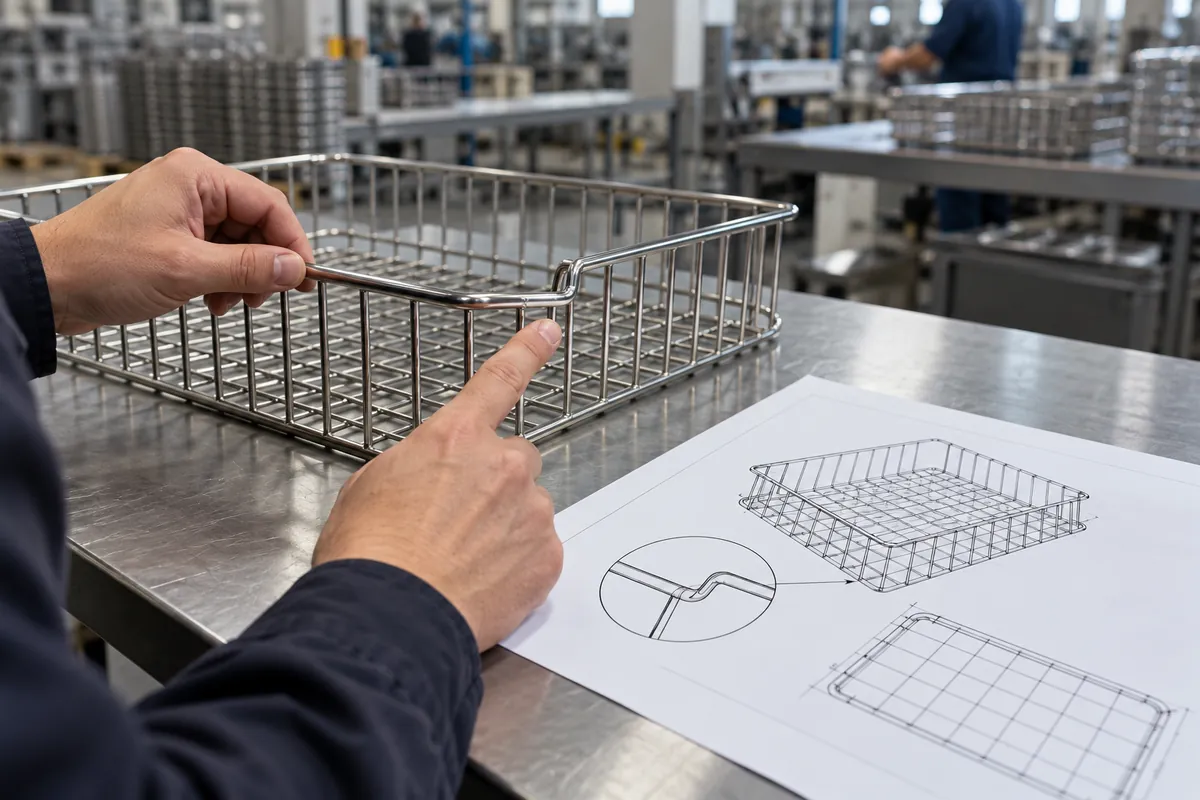
For a custom wire basket, for example, identify whether the approved sample has a particular rail height, wire route, corner radius, weld location, surface finish and hook arrangement. If a buyer later requests a wider opening, mark the changed feature on the drawing and state why it is needed. The manufacturer can then assess whether the change affects a forming fixture, weld sequence, fit check or pack-out. Do not rely on a verbal description such as “make the front a little lower.”
Is a buyer change the same as a factory correction?
No. A buyer-requested scope change and a supplier correction are different commercial and quality situations. Keep them separate before discussing price or delivery responsibility.
A buyer change modifies an approved requirement. Examples include asking for a different dimension, adding a hook, changing a material or finish, altering carton contents, or revising a private-label instruction. The buyer should state the business reason and desired effectivity, while the factory reviews manufacturability and evidence needed. Responsibility for cost, schedule and existing stock is governed by the project agreement and the facts of the order; this article cannot assign it universally.
A factory correction responds to a confirmed nonconformance against the approved requirement. If a sample or production lot does not match the released drawing, first document the deviation and agree containment and corrective action. Do not relabel that correction as a buyer design change merely because the drawing is being discussed. Conversely, if the buyer changes the requirement after approval, record it as a proposed revision even if it appears easy to accommodate.
A supplier-initiated process or material change is also distinct. Koitor has separate guidance on supplier change notification for OEM metal hardware. The current topic is buyer-led: the buyer requests a change and needs to understand scope, cost, timing, inventory and reapproval before directing implementation.
How can a requested revision affect tooling, cost, schedule and stock?
The assessment should follow the actual change through the product and the order. Treat a buyer requested design change after sample approval manufacturing as a change-control event, not as a fixed-fee or fixed-delay category: the effect depends on geometry, tooling ownership, purchased inputs, current production stage, quantity and agreed commercial terms.
| Change area | Questions for the factory and buyer | Possible consequence to assess |
|---|---|---|
| Drawing or note only | Does the physical part, acceptance criterion or work instruction change? | Document control only, or a needed clarification sample |
| Hole, bend or wire route | Does the change alter a fixture, forming sequence, weld access or assembly fit? | Tool/fixture adjustment, revised sample or measurement plan |
| Material or thickness | Are current purchased inputs still suitable and traceable to the revised requirement? | New sourcing, different forming/welding behavior, quote or schedule review |
| Finish or color | Does the change affect pretreatment, masking, coating, appearance approval or packaging protection? | New finish sample, added process step or rework feasibility review |
| Added or removed component | Does the BOM, assembly operation, instruction or carton content change? | Component commitment, labor, packing and inspection changes |
| Label or packaging artwork | Are the product revision, label, carton and market documents still aligned? | Artwork correction, repack work or a new release date |
A tooling effect is not automatic. A drawing adjustment may be achievable using an existing adjustable fixture, while a change to a formed or stamped feature might need a tool modification or new tooling. Ask the factory to identify the affected tool or operation and distinguish a one-time engineering or tooling charge from any recurring unit-price change. Request a revised quotation with assumptions stated—such as quantity, material, finish, packaging and effective revision—so it can be compared with the old scope.
For metal storage hardware, the review should consider the sequence as well as the final geometry. Moving a hole closer to a bend can change access or measurement references. Changing a wire route can affect how parts sit in a fixture or meet at a welded joint. A new finish can affect fit where components mate. These are prompts for project-specific evaluation, not claims that every change causes a defect or requires new tooling.
Schedule impact depends on the operations still ahead. Before material is purchased, the team may only need to agree revised inputs and sample timing. After material or components are committed, the assessment may include supplier availability, usable quantity and whether an existing input can be used under the revised specification. During production, the factory may need to segregate work in process, determine whether parts can be reworked, and avoid mixing revisions. After packing, relabeling or repacking may be a separate task. Microsoft’s engineering change management overview similarly describes assessing change impacts against open orders, production and inventory; it is a reference for the decision categories, not a promise about any supplier’s software or process.
Ask for quantities and status rather than a general statement that “stock is affected.” Useful categories include unpurchased demand, supplier-committed material, received material, work in process, finished goods, packed goods and goods already shipped. For each, agree one disposition: use under the old revision with written approval, rework, hold pending decision, scrap where commercially agreed, or convert to another approved use if technically and contractually acceptable. Record who approved the disposition and which order, lot or SKU it covers.
An engineering-change record does not need a single prescribed format for every small project, but a controlled record is valuable. At minimum, define which revision applies to future production, open orders and remaining old stock. If both revisions are temporarily acceptable, state the allowed period or quantity and how each version will be identified. Never assume that a new drawing automatically changes work already released to a production line.
Which changes need a revised sample or additional inspection?
Revalidation should be proportional to what the change can affect. A revised sample or targeted inspection may be appropriate when the change affects form, fit, function, appearance, installation interface, material, finish, assembly or a buyer’s acceptance criteria. The responsible design authority and factory should agree on the evidence; a generic checklist cannot determine project-specific engineering approval.
Start by asking what evidence supported the original sample approval. If approval depended on a dimension, assembly trial, finish reference, packaging configuration or load requirement, determine whether the change can invalidate that evidence. A note correction that does not alter the physical product may only require controlled document approval. A changed mounting interface may need a fit review. A new finish color may require an appearance sample. A shift in a wire route may need a dimension or assembly check. These are examples, not universal rules.
The buyer and factory should name the reference sample and the inspection points for the new revision. If tooling or a manufacturing sequence changes, consider whether a first-off or pre-production sample represents the proposed production condition. Ask the supplier to describe what is being checked, the measurement method where relevant, the acceptance limit and the sample identity. A photo can support a discussion but should not replace a required measurement or agreed test.
The revised sample should not silently become “approved” because it was sent. Record who reviewed it, the date, the revision and whether approval is conditional. If a deviation is accepted temporarily, state its scope and expiry or quantity. If evidence is incomplete, hold the affected production release rather than letting the old and new requirements coexist in different email threads.
What should a controlled buyer change request include?
A complete request gives the factory enough information to assess the change without guessing. Send one revision-marked package and ask for a written impact response before authorizing implementation.
Include:
- Purchase order, project, SKU or part identifier and current approved revision.
- Proposed new revision, issue date and a marked drawing or image showing every changed feature.
- Reason for the change and the required decision or effective date.
- Whether the request affects geometry, material, finish, components, assembly, inspection, packaging, label or instructions.
- Quantity already ordered, material or components already purchased, work in process, finished goods, packed goods and open supplier commitments, where known.
- A request to identify affected tooling, fixtures, programs, work instructions or process steps; the factory should confirm which actually apply.
- Revised sample or inspection evidence requested, with sample identity and acceptance criteria.
- Separate one-time charges and recurring price impact, if any, with assumptions and quotation validity.
- Schedule and shipment implications for open orders, including any split between old and new revisions.
- Agreed disposition of affected stock and the person authorized to approve it.
- The new effectivity point: a stated order, lot, date or other traceable boundary after which the new revision applies.
- A list of superseded files and confirmation of the single current file set.
A concise request can use this structure:
Project/SKU: [identifier]
Current approved revision: [revision and sample ID]
Proposed revision: [revision and date]
Change shown at: [drawing view or marked feature]
Reason and desired effectivity: [business reason and requested boundary]
Please assess: tooling/process, material/components, sample and inspection, quotation, schedule, open stock and packaging/document changes.
Please do not implement until the authorized approver confirms the revised scope and effectivity in writing.
This is a communication template, not a legal contract or a guarantee that every factory uses the same engineering-change form. The purchase agreement, quality agreement and each buyer’s approval authority still govern. If the buyer’s document conflicts with a purchase order or approved sample, pause and resolve the controlling requirement before release.
How can a small-batch OEM manufacturer support the review?
A specialized OEM manufacturer can review a buyer’s drawing or physical sample, explain which product features may affect the manufacturing route, and clarify what information is missing before the parties confirm scope. Koitor Hardware is a family-owned factory focused on bathroom and home-storage hardware and supports custom manufacturing discussions from buyer drawings or samples. The exact feasibility, process route, fixture requirements and cost for any proposed change must be confirmed for that specific project.
Small-batch development can make it practical to discuss trial quantities and revised samples, but it does not make every late change free, immediate or technically simple. A buyer should share the current approved configuration, target quantity, finish, packaging and requested revision early. The factory can then respond to the defined request rather than estimating from an incomplete description. Any sample, tooling or inventory commitment should be agreed in the project quotation and written approvals.
For broader development context, review Koitor’s Informationen zur Herstellung von OEM-Hardware für die Heimspeicherung. When discussing a real product, send the current drawing and sample reference through the Koitor contact page and state that the request is a proposed buyer change, a correction to a nonconformance, or a supplier-proposed deviation. That distinction helps the parties route the discussion correctly.
Buyer checklist before approving a design revision
- Confirm the old and proposed revision identifiers and the approved sample they refer to.
- Mark the requested feature on a controlled drawing; avoid verbal-only dimensions.
- Separate a buyer-requested change from a factory correction or supplier-proposed deviation.
- Ask what physical manufacturing, tooling, finish, assembly and inspection steps actually change.
- Request a separate one-time and recurring cost assessment where applicable.
- Review schedule effects against the real production stage, not a generic lead-time estimate.
- List material, components, WIP, finished goods, packed goods and open orders that may be affected.
- Decide in writing whether old stock will be used, reworked, held, scrapped or otherwise dispositioned.
- Agree whether a revised sample, first-off review or targeted inspection is needed.
- Set a clear effective order, lot, date or quantity boundary for the new configuration.
- Remove superseded files from the active release set and record who authorized the change.
The approval should connect the decision, evidence and effectivity. A marked drawing without a stock decision can leave old and new versions mixed. A revised sample without an identified revision may be impossible to match to production. A new quote without a defined quantity or package scope may not be comparable with the original. Close those gaps before the next production release.

Häufig gestellte Fragen
Does every buyer-requested design change require new tooling?
No. Some changes affect only documentation or can be handled with an existing adjustable setup; others may alter a die, fixture, forming operation or assembly sequence. Ask the manufacturer to identify the actual tooling effect for the specific design and quote one-time costs separately.
Will a change after sample approval always delay shipment?
No universal delay can be stated. Timing depends on the change, current production stage, material or component commitments, sample review, tooling and the project schedule. Ask for a revised milestone plan tied to the affected order and agreed scope.
Who pays for existing material or finished products?
The answer depends on the purchase and development agreements, the cause of the change and the status of the goods. Distinguish buyer scope changes from supplier nonconformance, then record an agreed disposition for each affected quantity before work resumes.
Can the buyer release production from a revised drawing without a new sample?
Sometimes document approval is enough; sometimes the changed feature affects fit, finish, assembly, installation or acceptance evidence. The buyer and factory should decide based on risk and the original approval basis, then document which evidence supports release.
How should old and new revisions be separated?
Use a stated effectivity boundary such as a specific order, lot, date or quantity, and link it to product identification and the approved files. If both revisions remain temporarily acceptable, document the permitted scope and how the goods will be distinguished.
What is the first step when the change request is urgent?
Send the current and proposed revisions together, mark the exact feature, identify the affected order and requested date, and ask the factory for an impact assessment. Do not treat urgency as approval to use an unreviewed revision.
What should a buyer requested design change after sample approval manufacturing review establish?
It should establish the revised requirement, the affected order or stock, any tooling or process impact, the evidence needed for approval, and the effective point for the new revision. No single fee or delay applies to every project.
Discuss a buyer-requested product change
Share the current drawing revision, approved sample reference, proposed change and order stage so the project scope can be reviewed.
OEM / EIGENE MARKE
Verwandeln Sie diesen Beschaffungsleitfaden in ein Produktdossier
Teilen Sie uns Ihr Zielprodukt, die Größe, die Oberflächenausführung, die Bestellmenge und Ihre Verpackungsanforderungen mit. Ihr Team erhält vor der Angebotserstellung eine praxisorientierte Prüfung der Herstellbarkeit.


 English
 Español
 Português
 Français
 Deutsch
 العربية