
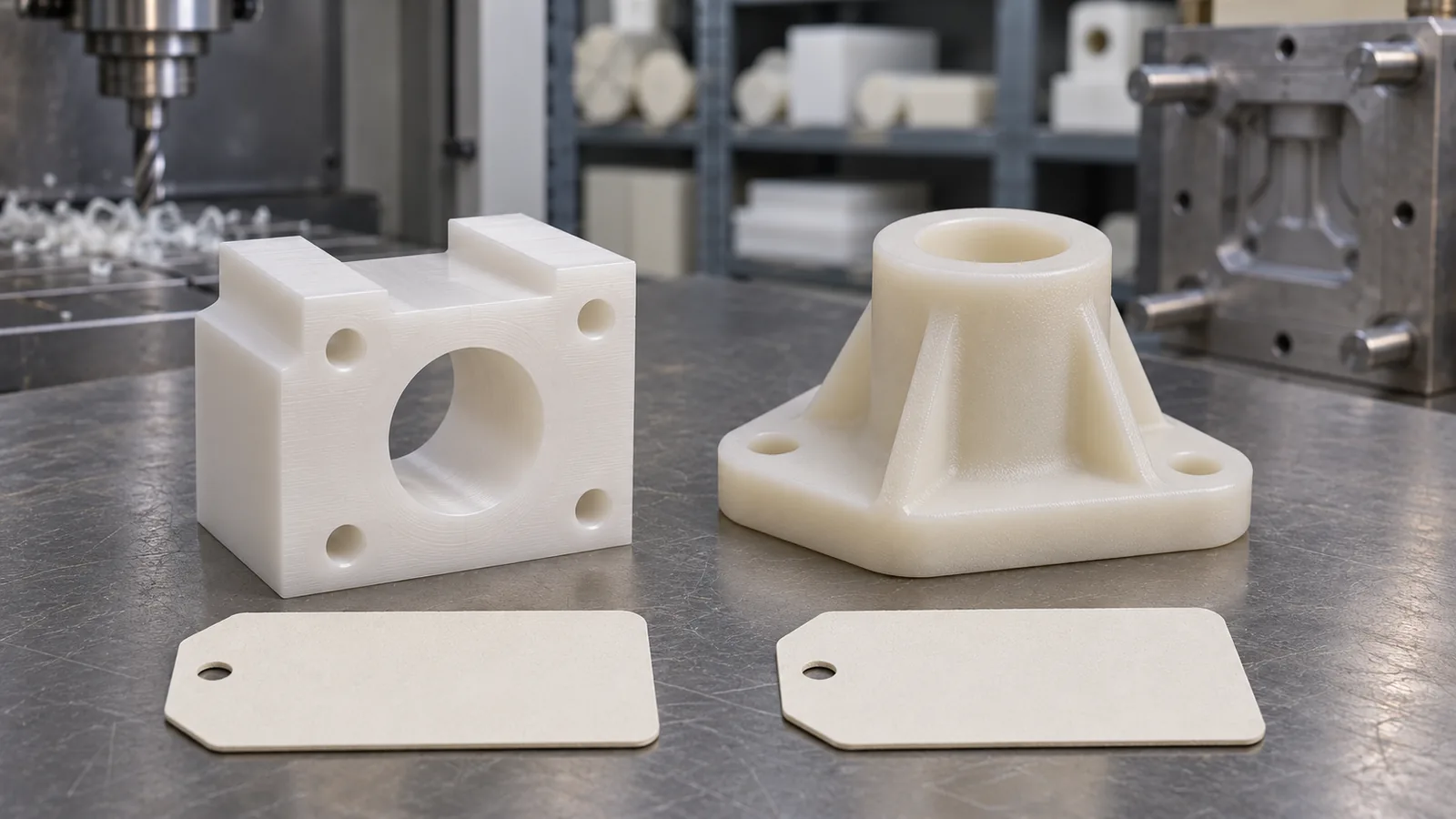
Delrin vs nylon is not a comparison between two single, fixed materials. Delrin is a brand associated with acetal homopolymer (POM-H), while nylon is a broad name for polyamides that include different families and commercial grades. A useful buyer comparison therefore identifies the exact Delrin grade and the exact nylon grade, then matches formulation, product form, processing route, moisture condition, geometry, and test method. The names alone do not establish that one material is stronger, more durable, or a drop-in replacement for the other.
This distinction matters when a product drawing or supplier quote names a spacer, guide, roller, insert, bushing, or other bought-in polymer component. A supplier may use a brand name for acetal while another uses “nylon” without a grade. If the comparison stops at those labels, the sourcing team does not yet know what products are actually being compared. The first task is to turn each description into a supplier- and grade-specific identity and determine what the component must do in the assembly.
First clarify what “Delrin” and “nylon” mean
Delrin is a trade name, not a generic term for every acetal. The brand owner’s technical material identifies Delrin with POM homopolymer and offers different grade families. Acetal materials also include other commercial grades and copolymer products from different suppliers. A buyer should not treat the Delrin name as interchangeable with every material that might be described casually as “acetal,” nor assume that all acetal products share one formulation.
“Nylon” is broader still. It can refer to PA6, PA66, and other polyamide families, with grades that may be unfilled, reinforced, modified, lubricated, stabilized, or otherwise formulated. The exact designation changes the scope of the comparison. A generic nylon offer cannot be evaluated fairly against a fully specified Delrin product.
The supplier should identify the manufacturer, complete grade, revision, form of material, and any modifiers relevant to the offer. If the part is molded, request the grade used for that molded component. If the reference is machined from stock shape, identify that product form and supplier. A data sheet for one product route may not describe another route or finished geometry.
A buyer’s comparison matrix
The following matrix helps organize the question without implying a universal material ranking.
| Dimension | Acetal / Delrin side | Nylon side | Why the buyer should record it |
|---|---|---|---|
| Material identity | Exact maker and Delrin grade, or other identified acetal grade | Exact PA family and nylon grade | Brand and family labels do not identify every commercial formulation |
| Formulation | Homopolymer or other acetal family, additives, fillers and modifications as stated by maker | PA6, PA66, other family, filler, reinforcement and modifiers | A grade’s properties cannot be inferred from the family name alone |
| Product form | Molded component, machined stock, or other supplied form | Molded component, stock shape, or other supplied form | Product route changes which data is relevant to the finished part |
| Conditioning | Test state and environment stated by source | Dry, as-molded or conditioned state stated by source | Nylon data in different moisture states is not directly comparable |
| Geometry | Wall thickness, ribs, bosses, hole and contact configuration | Same project geometry, not merely same polymer family | A material table does not capture the component’s design |
| Function | Guide, spacer, insert, or defined mechanism role | Same defined function for the proposed replacement | “Better” depends on what the assembly requires |
| Evidence | Current supplier datasheet and grade reference | Current supplier datasheet and grade reference | Source and method must apply to the actual grade and form |
| Decision owner | Named reviewer for acetal option | Named reviewer for nylon option | Purchasing data comparison is not technical substitution approval |
This matrix is an original decision aid, not a test standard. It helps prevent a common mistake: comparing an identified branded grade with a generic polymer family as if the descriptions represented equal levels of detail.
Why a general property ranking is unreliable
Material comparison articles often summarize broad differences to orient a reader. Such summaries can be useful when they are scoped, but they do not identify the best material for every component. A particular application may prioritize dimensional fit, wear, stiffness, impact, friction, chemical exposure, cost, processing, appearance, or availability. The relative importance of those requirements depends on the part and project.
Protolabs’ material comparison discusses Delrin and nylon in a manufacturing context. The Delrin brand-owner information explains product identity and grade families. Those sources are useful for understanding the names, but neither is approval for a buyer’s component. Avoid copying promotional superlatives, universal property rankings, numerical limits, or application certifications from a general article into a purchase requirement. Use current maker data for the named grades, and confirm how the data was measured.
A proper comparison checks whether each source refers to the same type of specimen, manufacturing route, conditioning state, test method, and units. If one figure is for a dry unfilled sample and another comes from a reinforced or conditioned grade, the numbers do not form a like-for-like comparison. Label the difference and ask the technical owner whether the available information can answer the project question.
The same caution applies to friction and wear. A material name does not guarantee a service life, a coefficient under the real mating surface, or behavior in a specific mechanism. A test result may depend on load, speed, surface finish, lubrication, temperature, contamination, geometry, and the test method. Do not infer a component’s lifetime or maintenance interval from the polymer family alone.
Product geometry and environment change the decision
Suppose a small spacer holds a metal component at a defined distance. A different spacer material may change fit or performance, but the actual result depends on its geometry, tolerances, mating surfaces, process route, and environment. A molded clip with a snap feature raises a different question from a machined washer. A sliding guide differs from a static insert. These examples illustrate why function and shape must accompany the material comparison; they are not claims about Koitor’s current products.
For nylon, moisture conditioning can affect material data and dimensional considerations. The exact implication depends on grade, specimen, part geometry, exposure, and acceptance criteria. Acetal and nylon should not be ranked on moisture or dimensional behavior without matched, relevant evidence. For a deeper discussion of nylon conditioning and fit, see the separate nylon moisture absorption and dimensional stability guide. It owns that specific moisture question, while this article focuses on branded acetal versus polyamide identity and a comparable-grade decision.
If the project involves bearing-like movement or a bushing, other factors may govern. The page on PTFE-filled acetal wear and creep owns a related acetal wear topic. It does not establish that every Delrin or nylon grade behaves similarly. The guide on nylon versus PTFE treats a different material pairing. Use those articles for their specific questions instead of stretching this comparison to cover every polymer design issue.
How to compare supplier proposals
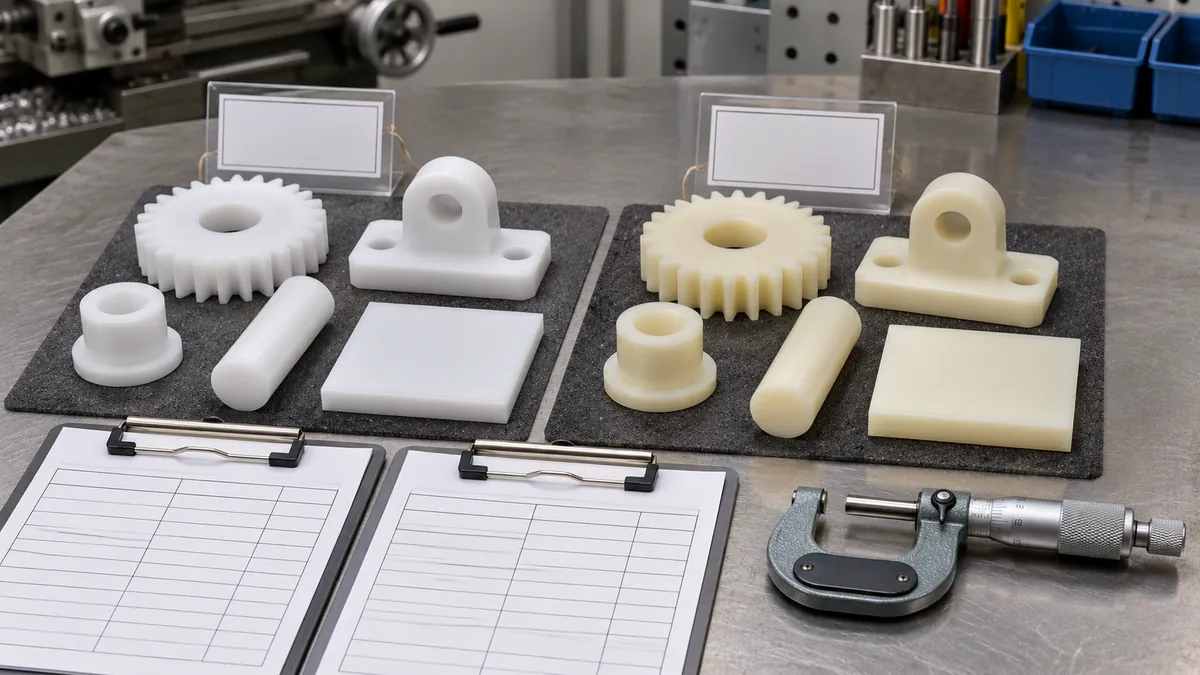
When the two supplier proposals are presented as a Delrin vs nylon choice, compare the documented grades and form before reviewing price.
When two suppliers quote different materials, make the comparison traceable. Preserve the wording on each quotation, then add the exact manufacturer and code, product form, formulation, document revision, key requirements, and unresolved questions. A side-by-side table should not replace the supporting grade documents; it should make gaps visible.
1. Define the component’s job
Write a plain-language description of what the component does in the assembly and what failure or unacceptable behavior would mean. Does it locate, guide, separate, retain, protect, or provide an interface? Avoid jumping immediately to “which resin is better.” The use determines which properties may be relevant and which reviewer should be involved.
2. Establish the approved reference
Collect the released drawing, current material callout, part number, revision, supplier, and any identified grade documents. If the current drawing only says “nylon” or “Delrin,” mark the specification gap. Do not invent a grade based on a past quote or an unlabeled sample. If there is a physical reference, record its source and revision and determine whether the organization treats it as an approved sample.
3. Identify the proposed alternative completely
Request the maker and exact grade for the alternative. Ask whether the supplier is proposing Delrin specifically, another POM homopolymer, an acetal copolymer, PA6, PA66, or another polyamide. Record fillers, modifiers, color, and product route where those details matter. If a supplier says “equivalent,” request the evidence and note the scope of that claim.
4. Align the evidence
For each cited property, record the test method, specimen, product form, conditioning, and data type (for example, typical value or specified limit). Avoid mixing one manufacturer’s dry specimen figure with another manufacturer’s conditioned molded part. If no comparable value exists, write “not comparable from available data” rather than creating a score.
5. Map data to the design
Ask the engineer or product owner which part-level properties and dimensions govern the decision. A material data sheet cannot resolve a tight press fit, a clip retention geometry, or an assembly issue without the actual design context. Establish whether the buyer needs a document review, sample check, test, or other evidence before approval; do not prescribe an unsupported universal protocol.
6. Decide who approves the change
Name the technical owner, procurement owner, and supplier responsible for the proposed material. State who updates the drawing and bill of materials, and which purchase lot or order is affected. Do not allow a material substitution to occur through an informal description change that bypasses the buyer’s approval process.
A comparison worksheet can record:
| Field | Approved reference | Proposed alternative | Status / decision owner |
|---|---|---|---|
| Supplier and manufacturer | Exact name | Exact name | Verify source and traceability |
| Polymer identity | Brand / family / grade | Brand / family / grade | Resolve generic wording |
| Formulation | Fillers or modifiers | Fillers or modifiers | Identify differences |
| Product route | Molded, stock, or other | Molded, stock, or other | Confirm data applies to part |
| Condition basis | Test state and method | Test state and method | Align or document mismatch |
| Part function | Controlled use | Same or changed use | Confirm performance need |
| Drawing and sample | Revision / approved sample | Proposed revision / sample | Keep identity linked |
| Approval | Current change owner | Required reviewers | Record decision before order |
Sample review and incoming identification
A sample is useful, but it has a defined evidentiary boundary. A buyer can examine visible condition, shape, interface, and fit with the mating part. A sample does not automatically reveal the exact polymer chemistry, verify that a production lot uses the same grade, or prove an in-service lifetime. Tie a sample to the supplier, material designation, date, part revision, and the question it was intended to answer.
If material identity is critical, ask the supplier what documentation or qualified verification is appropriate. A color match or tactile impression cannot prove whether the component is a branded acetal, another POM grade, PA6, PA66, or a modified compound. Where incoming checks are needed, define the method with the responsible quality or engineering owner and ensure the result can distinguish the requirement at issue.
Keep the original and proposed materials separate in records until the substitution is accepted. Use a controlled disposition: accepted, rejected, or held for additional evidence. If held, state what is missing and who will provide it. This avoids a common record problem in which a quote is treated as a material approval because no one documented the open question.
No universal laboratory, certification, or test service should be assumed. The exact test method depends on the property and requirement. If a supplier submits a certificate or test report, verify which material, lot, method, and sample it covers. A document that refers to a resin family generally may not establish that a particular finished component meets a buyer’s dimensional or functional requirement.
Common sourcing mistakes
Treating Delrin as a synonym for all acetal
The brand name identifies a branded material range. Other suppliers may sell acetal grades with different names and formulations. Specify and compare the actual grade rather than using the brand name as a generic category.
Treating nylon as one grade
Nylon covers multiple polyamides and formulations. “Nylon” without a family and grade cannot support a precise comparison. Ask whether the offer is PA6, PA66, another polyamide, and whether it is reinforced or modified.
Comparing unlike material conditions
A conditioned PA data point and a dry specimen from another form are not a direct ranking. Record the condition and test method. Seek comparable data or make the limitation explicit.
Assuming one family is always best for friction or wear
These outcomes depend on grade, counterpart surface, load, speed, environment, and geometry. Material-family labels do not establish a universal coefficient or service interval. Use application-specific engineering evidence.
Approving a substitution by fit alone
A sample that assembles may still differ in other requirements, such as intended function, approved material, or controlled document scope. Fit is one check, not automatic approval of a material change.
Using a data sheet beyond its scope
Published data is tied to grade and test conditions. It does not necessarily describe another grade, molded geometry, supplier lot, or finished product. Keep evidence linked to the exact part under review.
Leaving change ownership unclear
If engineering, quality, purchasing, and supplier responsibilities are not named, a proposed alternative may enter production without a documented decision. Define who reviews the evidence and who releases the updated specification.
What a custom metal hardware supplier can contribute
A metal hardware supplier can help clarify the surrounding part’s drawing, interface, fabrication scope, surface finish, assembly, and packaging where those tasks are within its confirmed capability. Koitor Hardware is a family-owned custom metal bathroom and home-storage hardware factory that discusses customization from buyer drawings or physical samples. This does not establish that Koitor manufactures Delrin, compounds nylon, machines acetal, provides polymer testing, or approves polymer substitutions.
When a project includes a bought-in polymer component, send the metal drawing and identify the polymer interface and who supplies it. Ask the metal manufacturer to confirm the metal-side dimensions and the scope it can quote. Keep polymer identity and data with the responsible material supplier or technical owner. This division makes the project handoff clearer and prevents one supplier’s fabrication quote from being misread as a complete material engineering approval.
For small-batch development, the buyer may be able to discuss drawing clarification, sample revisions, and private-label requirements for the metal product. Whether a specific component or operation fits the actual project must be verified; no general MOQ, production time, price, or tooling commitment follows from this article. A useful RFQ states quantity range, controlled drawing, finish, packaging, and the exact question the supplier is expected to answer.
A supplier can also use a generic brand comparison in marketing while quoting a specific grade on the commercial document. Save both records, but use the exact grade and revision in the purchase specification. If a part is later sourced from a second supplier, repeat the identity and evidence review instead of assuming that the former comparison covers the new source.
For another polymer test-method topic, see the plastic impact test comparison for hardware buyers. It does not determine acetal/nylon interchangeability.
Buyer checklist before requesting a quotation
- Is “Delrin” the exact brand grade, or is another acetal being offered?
- Which nylon family and complete grade is proposed: PA6, PA66, or another polyamide?
- What manufacturer, code, revision, formulation, and product form identify each option?
- Are fillers, modifiers, colorants, or reinforcements part of either grade?
- What is the component’s function and geometry in the assembly?
- Which dimensions, interfaces, or behaviors are critical to the design?
- Are the cited properties measured using comparable methods and conditions?
- Is the nylon data dry, conditioned, or otherwise prepared?
- Is the proposal an exact match, a deviation, or an unapproved substitute?
- What sample, test, or document review would answer the open question?
- Who has authority to approve the material and drawing change?
- How will the supplier, grade, lot, drawing revision, and purchase line remain traceable?
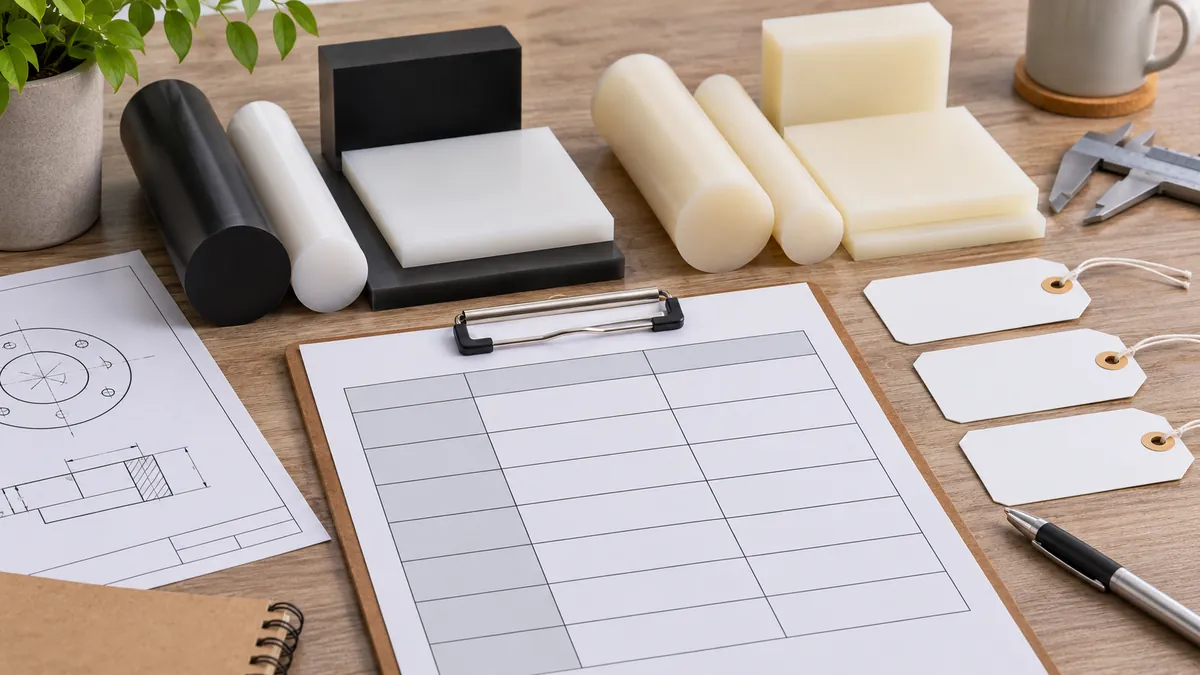
A delrin vs nylon comparison should name the actual acetal brand grade and the actual polyamide family. This avoids reading a brand name as though it were a material family opposite to nylon.
Häufig gestellte Fragen
Is Delrin the same as nylon?
No. Delrin is a brand associated with acetal homopolymer (POM-H); nylon refers to polyamide materials. They are distinct polymer families. Compare exact commercial grades rather than treating the names as two interchangeable options.
Is Delrin the same as every acetal?
No. Delrin is a brand, while acetal is a broader material description used across suppliers. Other acetal grades may have their own identity and formulation. Ask for the exact manufacturer and grade.
Is Delrin always stronger than nylon?
That cannot be concluded universally from the names. Properties vary by grade, formulation, product form, conditioning, test method, and part geometry. Compare relevant data for the actual candidates and intended function.
Can Delrin replace PA6 or PA66 in a molded component?
Not from the family names alone. A substitution should be reviewed against the exact grades, geometry, processing, conditioning, and functional requirements. The responsible technical owner should approve any change.
Why does nylon conditioning matter?
Moisture can affect polyamide dimensions and measured properties. The impact depends on the grade, form, geometry, and exposure. Match the conditioning basis in the comparison and consult the dedicated moisture-fit guide for that separate topic.
Does a datasheet prove a finished part will work?
A data sheet describes a specific material under stated test conditions. It does not alone prove that a particular geometry, supplier lot, or assembled product meets its requirement. Connect material documents to the actual part and project acceptance criteria.
What information should I ask from a supplier?
Request the manufacturer, complete grade and revision, formulation where relevant, product form, current technical data, test methods and conditions, deviations, and traceability to the quoted component. Also ask whether the offer is a proposed substitution and who supports the comparison.
Who approves an acetal-to-nylon change?
The project’s designated product or technical owner should review the material and part-specific evidence and approve the change under the buyer’s control process. Purchasing can coordinate the quote but should not infer technical equivalence from a commercial description.
Arbeiten Sie mit Koitor Hardware zusammen
If a custom metal hardware design includes a bought-in polymer part, share the controlled drawing or sample, its interface dimensions, intended use, and the exact material question. Koitor can discuss the confirmed metal hardware scope; the material supplier or qualified technical owner must support polymer identity and performance decisions.
Discuss material and component scope with Koitor Hardware.
Send your drawing, sample, target quantity, finish, packaging, and project questions for a scope discussion.
OEM / EIGENE MARKE
Verwandeln Sie diesen Beschaffungsleitfaden in ein Produktdossier
Teilen Sie uns Ihr Zielprodukt, die Größe, die Oberflächenausführung, die Bestellmenge und Ihre Verpackungsanforderungen mit. Ihr Team erhält vor der Angebotserstellung eine praxisorientierte Prüfung der Herstellbarkeit.


 English
 Español
 Português
 Français
 Deutsch
 العربية