
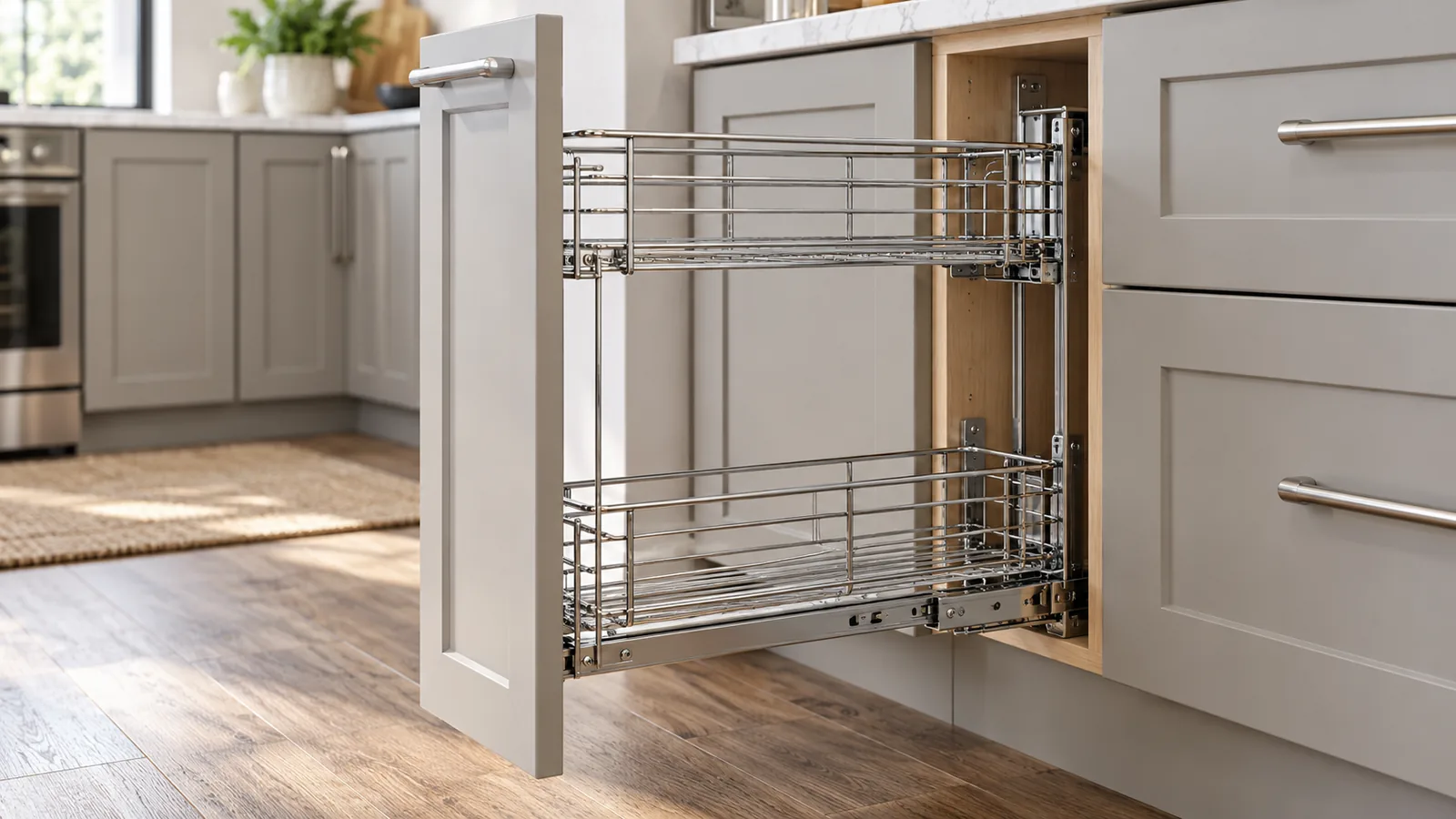
For a filler pull out spice rack cabinet project, first distinguish the between-cabinet module from an in-cabinet rack: they are different installation architectures even when both look like a narrow sliding basket. Resolve that distinction before comparing width or requesting a quote. A filler unit is designed to occupy a planned gap between adjacent cabinet units, generally with its own support and finished front arrangement; an in-cabinet organizer mounts within an existing cabinet opening and depends on that cabinet’s inside dimensions and attachment points. The buyer must tell the supplier which structure will carry the module.
For a filler pull out spice rack cabinet project, begin with the surrounding cabinet layout, not a retail product label. Confirm whether a cabinet box exists at the opening, what supports the slide or frame, how the front is finished, and which party supplies the neighboring panels and hardware. Rev-A-Shelf’s base-accessory guide distinguishes filler applications from normal cabinet applications; its cabinet-application overview likewise separates product families by where they install. These sources clarify the interface, but do not establish universal cabinet dimensions or approve a particular OEM design.
Start with the installation architecture
Ask one simple question: will the organizer install inside an existing cabinet box, or will the module occupy a gap between two cabinets? If the organizer mounts inside a cabinet, the opening’s clear width, depth, height, side-wall material and fastening zones govern the fit. If the unit occupies a filler gap, the adjacent cabinets, floor or toe-kick, upper support, finished front and slide structure may all become part of the installation system.
The word “filler” can describe a narrow visual strip, a gap, a cabinet accessory or a complete pull-out assembly depending on the supplier’s catalog. Avoid assuming that a product called a filler rack includes the cabinet panels or that a narrow rack can be mounted between cabinets without a specified support arrangement. Put the architecture in the RFQ and show it on an installation drawing.
| Design question | Between-cabinet filler module | Organizer inside an existing cabinet |
|---|---|---|
| What surrounds the module? | Two cabinet sides or adjacent furniture structures, plus any planned filler space | An existing cabinet box and its clear internal opening |
| What supports the slide/frame? | May depend on a dedicated frame, adjacent panels, floor support or a project-specific structure | Usually depends on the cabinet’s interior surfaces and agreed mounting points |
| What forms the visible front? | May include a door/front panel or a finished filler face supplied by a cabinet or module party | May use a cabinet door or remain inside the cabinet; clarify how access occurs |
| Which dimensions matter? | Gap width, module envelope, adjacent-panel spacing, floor/toe-kick and front alignment | Clear opening width, depth, height, cabinet wall thickness/material and clearances |
| Who owns integration? | Must be divided between cabinet supplier, hardware supplier and buyer | Buyer and organizer supplier must align the cabinet opening and attachment method |
This is a planning comparison, not a claim that every catalog uses identical terms. The exact load path and attachment arrangement depend on the proposed product. For a filler pull out spice rack cabinet RFQ, require a section or assembly drawing that shows the module relative to the cabinet structure instead of accepting a product image alone.
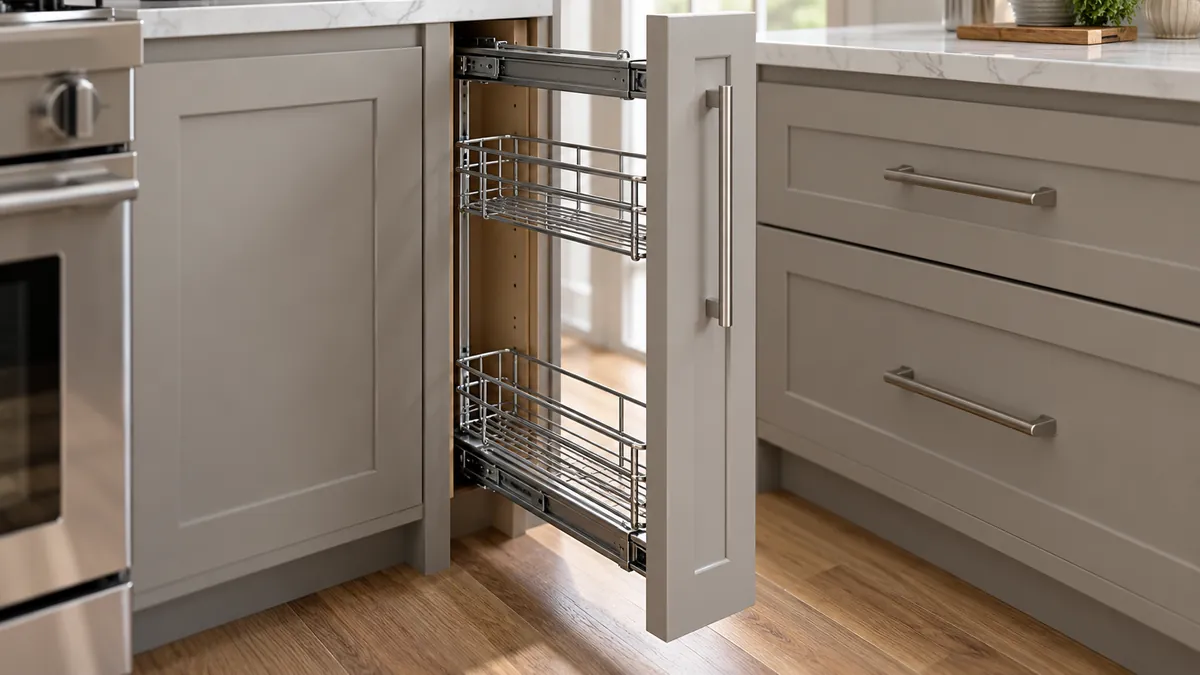
Why nominal width is not enough
A nominal size may refer to a product’s outside width, a recommended cabinet size, a clear installation gap or a catalog category. Those values are not interchangeable. A rack that measures a certain width on its own may need more clearance for slide hardware, a front panel, mounting brackets or assembly access. A cabinet opening that matches the rack’s outside dimension may still fail to provide the required clearance at the runners or fasteners.
For an in-cabinet organizer, measure the narrowest clear opening across the relevant height and depth. Note protruding hinges, face frames, screw heads, door overlays, plumbing, shelves and other obstructions. Confirm how the buyer defines the opening: between the cabinet’s inner sides, between a face frame, or after a door and hinge are installed. The drawing should identify the datum and the point where the clearance applies.
For a filler module, establish the finished gap after adjacent units are positioned. Identify whether the cabinet sides are parallel, which surfaces the slide attaches to, whether a separate frame is included, and how the front aligns with neighboring doors. A spacer or filler strip can affect the usable envelope and appearance. State who provides that part and who verifies its final position.
The module’s travel path also matters. A pull-out needs room to extend without colliding with a door, handle, countertop projection, neighboring cabinet, toe-kick or floor trim. A static width check does not establish that the moving assembly clears its surroundings through the full travel. Include the open and closed positions in the integration drawing and sample review.
Coordinate component and cabinet responsibilities
Before pricing, divide responsibility for every part of the system. A buyer may expect one supplier to provide the wire basket and slides, while another assumes the cabinet maker supplies a frame, filler panel or fasteners. If the interface is not explicit, the quote can look complete while excluding the parts that make installation possible.
Ask the module supplier to identify supplied components and interfaces: basket or rack, slides, brackets, fasteners, frame, stops, soft-close components if applicable, and front panel or mounting plates. Ask the cabinet supplier to define the opening, structure, material, thickness, finish, hinge envelope and fastening zones. The buyer should reconcile the two drawings and record which company owns each unresolved dimension. That comparison is the practical core of a filler pull out spice rack cabinet specification.
| Interface or component | Buyer should define | Supplier evidence to review |
|---|---|---|
| Cabinet opening or filler gap | Finished width, height, depth, datum and allowable variation | Dimensioned installation envelope and assumptions |
| Support and fastening | Panel material/thickness, frame or floor support, fastener responsibility | Section drawing, mounting details and component list |
| Slide and travel | Required extension, direction, neighboring obstructions and stop position | Assembly drawing and movement review on the intended structure |
| Finished front | Who supplies the front, alignment target, reveal and handle clearance | Front interface dimensions and representative assembly |
| Metal rack or basket | Product envelope, usable width, finish, wire/edge details and intended contents | Drawing revision, sample and inspection points |
| Packaging and instructions | Disassembled/assembled pack, protective materials, hardware labeling and install steps | Pack layout, component identification and instruction review |
The matrix should be completed for the actual project, not copied as a default allocation. Different suppliers can offer different systems; compare them only after confirming which parts and services are included. If the module depends on the cabinet manufacturer’s side panels, the RFQ should make that dependency visible so sample approval can use the same interface.
Approve the integration drawing and sample together
Use a coordinated drawing package. One drawing should show the cabinet or filler opening; another can show the rack, slides, supports and front. The assembly view should connect them and identify the critical datums. Include both closed and extended positions, any required service access and the parts supplied by each company. If one supplier owns the entire system, still ask for a drawing that reveals how it attaches to the surrounding cabinet.
During sample approval, check the finished opening and the intended mounting structure. Confirm that installation can be completed in the expected sequence, that fasteners are accessible, that the frame is square enough for the moving parts to operate as intended, and that the front aligns with neighboring cabinets. Document whether the sample uses the production-intent slides, frame, fasteners, finish and cabinet material. If it does not, list the differences and what still requires confirmation.

Check movement across the full intended travel using the approved configuration. Observe binding, interference, uneven gaps, unwanted contact and access to the contents. This is a functional review of a specific sample, not a universal cycle-life or load test. If a buyer requires a defined load or durability procedure, agree its method, loading arrangement, number of samples and acceptance threshold separately; do not infer these from an ordinary fit check.
Record the approved cabinet drawing revision, module drawing revision, sample identification, photographs and any open actions. A signed sample should not leave the interface ambiguous. If the cabinet supplier later changes side thickness, opening width, hinge position or finished front, determine whether the approved module still fits before production release.
What to specify in the OEM RFQ
Provide enough information for suppliers to quote the same architecture and configuration:
- State “between-cabinet filler module” or “organizer inside existing cabinet,” and include a simple plan or section view.
- Give the finished opening or gap dimensions, measurement datums, cabinet construction and any face-frame or overlay details.
- Identify the module’s mounting surfaces, fasteners, support frame and the party responsible for each item.
- Show the rack, slide, front and adjacent obstruction envelopes in closed and fully extended positions.
- List target contents and any required access pattern; do not use “spice rack” as a substitute for product dimensions.
- Identify material and finish requirements only where known; ask suppliers to state assumptions and alternatives.
- Define sample stage, drawing revision, fit review and any separate functional or durability test requirements.
- Require change notification for any adjustment to opening, frame, slide, fastener, front or mounting geometry.
Use the same package with each candidate supplier. Ask each to mark conflicts or missing inputs before quoting. This avoids comparing a complete module with an incomplete basket-only price, or comparing a cabinet-mounted organizer against a between-cabinet system that requires different support work.
What changes should trigger a new review?
Revisit the integration whenever a change can affect the structure, clearance, alignment or movement path. Examples include changing the cabinet opening, adjacent panel thickness, filler gap, face-frame or overlay, slide type, bracket position, fastener, front panel, rack width or required extension. A finish or assembly revision can also change a tight interface, so ask the supplier to assess the affected dimensions instead of assuming a revision is cosmetic.
Use revision control across both cabinet and module drawings. Keep a simple change record listing what changed, which interface it touches, what evidence is needed, who approves it and whether the sample must be rechecked. If the cabinet and rack come from different suppliers, assign one person to coordinate the combined approval and distribute the current drawings to both parties.
Do not treat a past installation as approval of a new cabinet. It only reflects the opening, components and assembly reviewed at that time. The buyer’s repeat-order release should reference the correct version and identify any changes since sample approval.
How can Koitor support a metal-rack discussion?
Koitor’s verified scope covers bathroom and home-storage hardware. Its metal-rack and OEM experience can support discussion of a metal organizer’s product brief, drawings, sample and manufacturing interfaces. Cabinet woodworking, cabinet-box manufacture and proprietary filler-slide systems are not verified capabilities and should not be assumed from this article.
For relevant metal storage products, see Koitor’s custom kitchen storage rack manufacturing und OEM home-storage hardware pages. An inquiry is more useful when it includes the cabinet opening, intended mounting architecture, rack drawing or sample, target finish and responsibility split. The final product concept and all component suppliers should be confirmed for the individual project.
Häufig gestellte Fragen
Is a filler pull-out the same as a narrow organizer installed inside a cabinet?
Not necessarily. A filler application may occupy a gap between adjacent cabinets, while an in-cabinet organizer uses the inside of an existing cabinet box. Ask what structure supports the slide and module before comparing sizes.
What should be measured before requesting a quote?
Measure the finished opening or gap, height and depth, relevant cabinet structure, slide clearance, front alignment and nearby obstructions. State the datums and provide a drawing so suppliers are quoting the same interface.
Does an approved basket sample confirm the cabinet fit?
No. The fit depends on the complete assembly, mounting hardware and the actual cabinet opening. Review a sample with the intended slides, supports and surrounding structure, or clearly document what remains unverified.
Who should provide the front panel and mounting frame?
There is no universal allocation. Identify the responsible supplier in the RFQ and ensure the quote, drawing, packaging and installation instructions match that responsibility split.
Arbeiten Sie mit Koitor Hardware zusammen
For an OEM metal-storage project, share the intended installation architecture and the cabinet-side interface so the product discussion can focus on the actual rack and mounting requirements.
Developing a kitchen storage rack?
Share your cabinet opening, rack drawing or sample and component responsibility plan to discuss OEM feasibility.
OEM / EIGENE MARKE
Verwandeln Sie diesen Beschaffungsleitfaden in ein Produktdossier
Teilen Sie uns Ihr Zielprodukt, die Größe, die Oberflächenausführung, die Bestellmenge und Ihre Verpackungsanforderungen mit. Ihr Team erhält vor der Angebotserstellung eine praxisorientierte Prüfung der Herstellbarkeit.


 English
 Español
 Português
 Français
 Deutsch
 العربية