
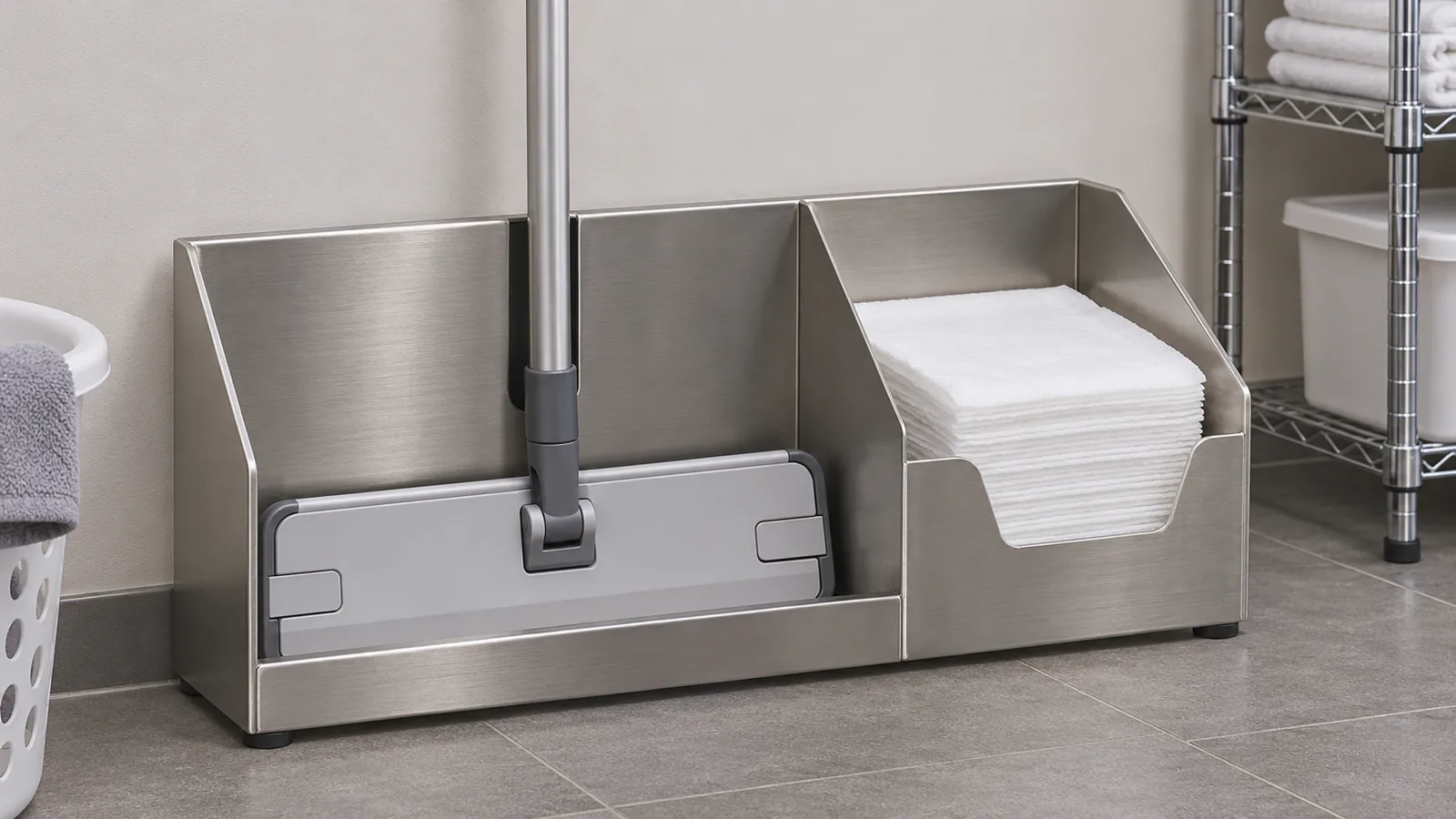
A buyer approving floor wiper stand head compatibility should evaluate the actual flat head in its intended stored position, the holder’s entry opening, the usable interior and the route used to retrieve it. A holder’s overall width or a tool’s headline head width does not establish that the whole head can enter and leave without interference. Importers should identify the specific wiper model and revision, review the handle or joint position, and record whether any replacement-sheet compartment remains accessible. This guide covers a passive floor-supported metal storage accessory, not cleaning performance, wall installation or universal pole-grip behavior.
Why Does the Actual Stored Tool Matter?
A flat floor-wiper head may have end caps, a joint, a locking feature, a replaceable pad or an attached sheet that changes its profile. The head’s outer width alone may not show the height, thickness, projection or orientation that matters when it enters a holder. A product may be sold with a handle that articulates or folds, but buyers should follow the tool maker’s actual instructions and intended storage state.
The storage holder also has several different dimensions. The outside envelope describes the whole housing. The entry opening defines the path through which the head moves. The usable interior describes what remains after any internal divider, lip or folded edge. The clear floor area and surrounding obstacles can affect how the head is placed or removed. These measurements answer different questions and should not be collapsed into a single “fits mop” field.
A buyer should therefore supply a reference tool rather than ask a supplier to infer compatibility from a category word. Identify the exact SKU, revision and any permitted stored configuration. If the tool is not available, mark the review as preliminary and ask what dimensions or photographs would support an initial estimate. Do not present that estimate as a passed sample check.
Yamazaki’s product information illustrates why storage architecture matters: one floor-supported product describes separate compartments for a floor-wiper head and other cleaning items, and lists an opening dimension for a supply compartment. A different magnetic housing has separate internal dimensions and stated mounting modes. Those details belong to their specific models; they do not establish universal dimensions, compatible heads or a single combined design. See the actual maker pages for a floor-supported storage product und a separate magnetic holder.
| Fit layer | Reference to identify | Approval question |
|---|---|---|
| Tool identity | Manufacturer, SKU and revision | Is this the exact tool expected in the assortment? |
| Stored pose | Head, joint and handle state per instructions | What state is the holder designed to accommodate? |
| Entry opening | Width, height, shape and approach direction | Can the head enter in the approved orientation? |
| Usable interior | Interior boundaries and obstructions | Does the full head envelope fit once inserted? |
| Retrieval route | Direction and available hand access | Can the buyer perform the intended removal action? |
| Adjacent storage | Sheet packet or accessory package | Does the additional item fit and remain accessible? |
This table sets up a buyer’s review; it does not provide a universal allowance or handling test. Product fit and user safety are separate decisions. The responsible product parties should set criteria for the intended application.
How Should an Importer Identify the Reference Head?
A reliable fit record begins with a particular tool. Capture the maker, model code, revision and product configuration. If the tool includes a detachable handle or joint, identify the position used for storage. If an attached cleaning sheet is part of the intended assortment, clarify whether it remains on the tool during storage and whether the tool maker permits that condition.
Do not use “flat mop” or “floor wiper” as the only product identifier. Different heads may share a general category but have different edge shapes, joints, thicknesses or accessories. An importer working with a private-label tool can provide a controlled drawing or physical sample, with permission to use it for the review. If multiple tool families are in scope, list them separately and test or review each configuration.
Record head dimensions with their locations named. “Head width” might mean the widest rigid body, the cleaning sheet, a projecting latch or a soft pad. Ask the tool supplier which features are part of the approved envelope and which vary in use. If a drawing lacks a key dimension, request clarification rather than using a photograph as a scale reference.
A useful reference sheet includes:
- Tool name, code, revision and sample ID.
- Overall head width and thickness at identified points.
- The handle or joint position specified for storage.
- Any pad or sheet condition required for the review.
- Projections, tabs or movable parts that affect entry.
- The source and date of each dimension.
- The person responsible for confirming the stored configuration.
These fields prevent a product team from approving a holder against a head that later changes. A new supplier, tool revision or attachment can affect the interface. Revalidation should be considered whenever a change touches the relevant envelope or stored pose.
How Do Entry Opening and Interior Space Differ?
A compartment may have a large interior but a smaller mouth. A head that could occupy the interior once placed there may not pass through the opening in its intended orientation. Conversely, a wide mouth may still lead to a restricted pocket or an obstruction. The importer should evaluate both the entry route and the final stored space.
Ask the holder supplier to mark the entry opening and internal dimensions on a drawing. Record where the measure begins and ends. Identify folded lips, dividers, supports or stops that reduce the usable area. Do not rely on outside dimensions to estimate internal clearance; wall thickness, bends and assembly features consume space.
Use the actual reference head in the sample if possible. Follow the manufacturer’s instructions for the tool. Move the head into the holder using the intended approach, without forcing, bending or detaching a part unless the tool maker permits that step. Observe contact points and document any interference. If the holder is not yet manufactured, a drawing review can identify questions, but should be labeled as a design review rather than physical fit approval.
The sample record should distinguish:
- “Opening appears to admit the head in the specified orientation.”
- “Head is positioned in the intended pocket.”
- “Handle or joint sits in the expected state.”
- “Removal path is clear in the sample setup.”
- “Sheet package fits the separate compartment.”
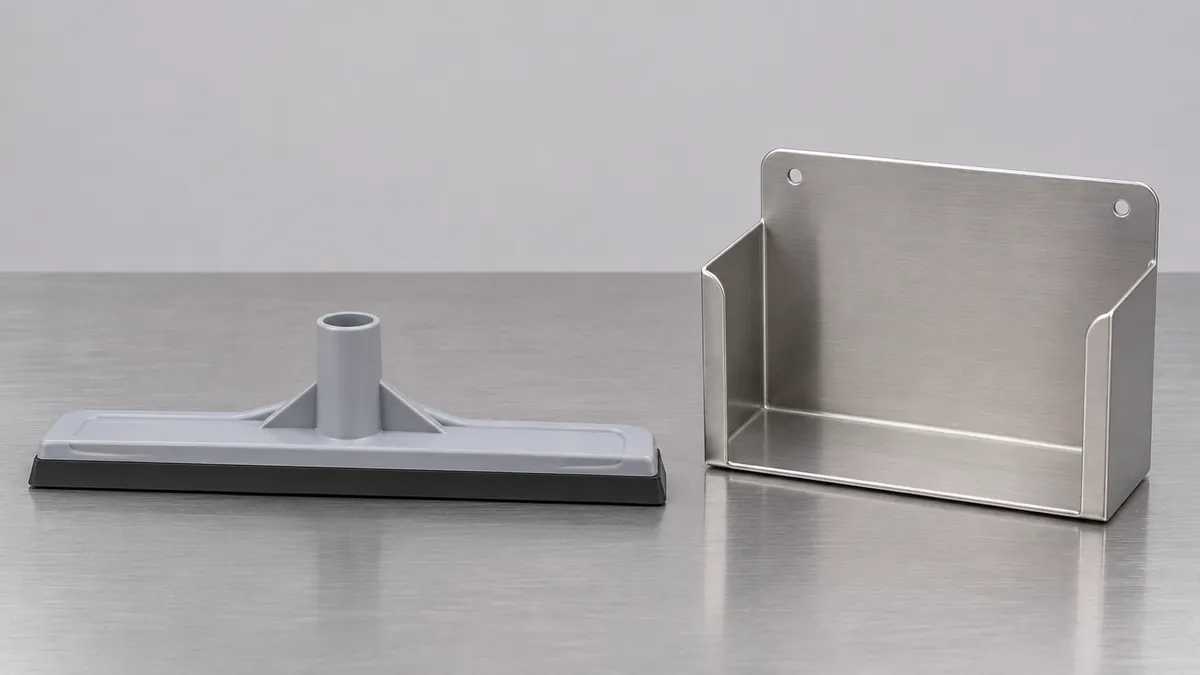
Each statement applies to the exact configuration observed. Avoid a single “compatible” pass if some functions remain untested. A cover photograph showing a head beside a holder does not establish entry, interior fit or removal.
How Should the Stored Pose and Handle Position Be Approved?
The buyer should identify the tool’s permitted storage position from product instructions or supplier confirmation. Some heads are designed to lie flat, stand upright or articulate at a joint; the buyer should not assume that folding or rotating is allowed. A holder concept must be judged against the intended and supported state.
Record the head orientation, handle position and any required space around the joint. If the handle remains attached, include its projection and the clearance needed around it. If the handle is detached, state where it is stored and whether that is part of the offered product arrangement. Do not make a holder appear compatible by using an unapproved pose in an image or sample.
The storage position may affect which side of the head faces outward. If the cleaning surface is covered, ask whether this is intended and whether the tool maker provides maintenance guidance. Do not infer drying, sanitation or hygiene outcomes from a storage arrangement. This article addresses fit and access, not cleaning efficacy or microbial performance.
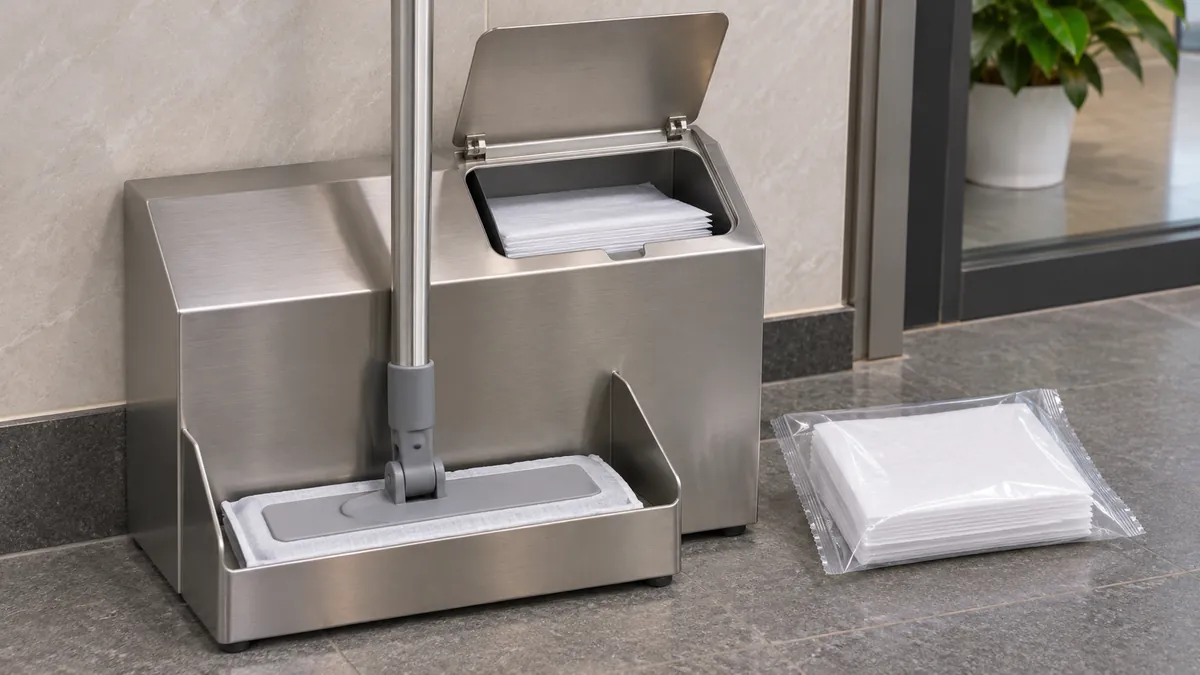
During review, photograph the sample from an entry view and a side view. Record the head and holder identities in the image file or accompanying record. Do not use a generated product image as proof of a real fit; generated visuals are illustrative only. The actual reference-tool review is what supports a compatibility statement.
If multiple variants are sold, identify compatible combinations in a product matrix. A short, bounded note such as “reviewed with tool X, revision Y, stored in pose Z” is more useful than “universal flat mop storage.” If a buyer wants to claim compatibility beyond the tested examples, the buyer must define what evidence would support that scope.
How Can the Buyer Review Retrieval Without Overstating Results?
Insertion and retrieval are distinct actions. A head may enter a compartment but be difficult to grasp, or it may catch on a lip when pulled out. Observe the intended removal direction and whether nearby items block access. The person conducting the review should follow the buyer’s agreed procedure and avoid forcing the sample.
The review can document contact, snagging or movement, but should not infer a cycle life, user-force limit or stability rating. A single handling observation answers only what occurred in that sample under that setup. If a buyer needs repeatability, ergonomic, load or product safety evidence, define a separate protocol with qualified parties.
For each review, note:
- The tool model and revision.
- The holder sample and drawing revision.
- The intended stored pose and entry direction.
- Whether the head entered without alteration or force.
- Any contact or obstruction observed.
- Whether the handle/joint remained in the required state.
- The removal action and visible access.
- Any open point that needs a supplier response.
Avoid changing the tool by folding, detaching, compressing or removing a feature unless the product documentation supports it. A supplier should not be asked to “make it fit” through an undocumented modification. If the concept requires a different head state, obtain confirmation from the tool maker and product owner before updating the acceptance criteria.
| Observation | Record it as | Do not claim |
|---|---|---|
| Head enters the opening | Fit observed for named sample and pose | Universal fit |
| Head occupies the pocket | Internal placement observed | Long-term retention |
| Head comes out as expected | Removal observed in setup | Ergonomic suitability for all users |
| No visible snag occurred | No snag observed in that trial | A cycle-life result |
| Holder remains in place | Position observed on review surface | Stability or floor safety rating |
This wording protects the distinction between a sample observation and an engineering conclusion.
What Should Be Checked for a Replacement-Sheet Compartment?
A sheet or pad compartment introduces another interface. Its outer size does not necessarily equal the opening through which a refill package must pass. If the holder is designed for loose replacement sheets rather than a retail packet, state that difference. If the buyer expects an unopened package to fit, use the exact package reference and check its dimensions and orientation.
Confirm whether the compartment is intended to hold a specific supply or merely provide storage. A listing that says “refill storage” should correspond to a defined package or product set. The buyer should record the compartment opening, internal space and access route separately. A wide inner pocket may still have a narrow opening.
Observe whether accessing the sheets requires removing the floor-wiper head or moving another stored component. If so, decide whether that is acceptable for the intended assortment and describe it accurately. Do not assume that a hidden or covered compartment is easy to reach because it appears spacious in a product image.
Keep refill compatibility separate from other product features. This topic is not a guide to roller refills, cleaning effectiveness, chemical compatibility or a broader integrated wall station. Those are different product questions and require their own references. Avoid mixing data from one model architecture into another; two products from the same brand can have different mounting or storage designs.
Which Storage Architecture Is Being Quoted?
A floor-supported compartment and a wall-mounted or magnetic housing are not interchangeable simply because both hold a cleaning head. The mounting mode changes the surrounding geometry and may introduce different installation responsibilities. This guide focuses on a passive floor-supported holder and excludes wall-station layout, magnet performance and installation claims.
The RFQ should say whether the holder stands on the floor, attaches to another product or is fixed to a surface. Identify any feet, base, dividers, handles or included accessories. Confirm which parts are included in the quote and whether the sample shows the actual configuration. If the holder requires a supplied mount or purchased component, name the supplier responsible for it.
Do not combine internal dimensions or supported head claims from different product models. A floor-standing design may have a different opening and arrangement from a wall housing. The importer must review the exact SKU being sourced. If a supplier proposes an alternate architecture, start a new fit record and verify the reference tool again.
For retail assortments, classify the storage architecture in SKU data and imagery. Customers may interpret a floor-standing item as portable or expect a wall product to include mounting parts. Avoid unsupported claims such as “secure,” “stable,” “space-saving” or suitable for a specific surface unless the product documentation and applicable evidence support those statements.
How Should the Buyer Specify the Metal Housing?
A metal housing specification can include the outside envelope, entry geometry, interior dividers, edge condition, finish, assembly and packaging. The buyer should identify cosmetic faces and any contact areas where burrs, sharp edges or finish damage would be unacceptable. Define these with a drawing or visual reference rather than relying on a vague “premium” description.
The drawing should show the head pocket and sheet compartment separately. If a divider or bent edge affects insertion, identify it. If the handle clearance depends on an opening or notch, dimension it with a clear datum. The buyer should provide the actual reference tool and explain which contact relationships matter. Do not ask a fabricator to infer a functional allowance from a catalog photograph.
Material and finish claims need their own specification. A picture of a coated surface cannot establish corrosion performance, cleaning-chemical resistance or a particular metal grade. Ask the supplier for the proposed specification and relevant evidence if the application requires it. This guide does not recommend a grade or finish for a wet or chemical environment.
The packaging plan should protect visible faces and prevent loose parts from damaging the housing in transit. State whether the product is packed assembled or in components, how accessories are identified and what retail package or carton data is needed. Packaging affects the delivered condition but does not prove damage-free transport; any distribution test must be separately defined.
For custom development, state target quantities, sample rounds, private-label needs, instructions and delivery assumptions. Ask the supplier which details are needed to confirm tooling, manufacturability and quotation. Do not assume a particular process or capability until the manufacturer confirms it.
What Should the Sample Approval Record Include?
The approval record should connect the reference tool to the actual holder and its revision. A simple matrix can capture the relevant decisions:
| Approval field | Required record |
|---|---|
| Buyer tool | Exact head/handle model, revision and sample ID |
| Stored pose | Manufacturer-supported position and orientation |
| Holder | Supplier model, sample ID and drawing revision |
| Opening | Marked dimensions and approach direction |
| Interior | Usable pocket and internal obstructions |
| Sheet compartment | Package reference, opening and access observation |
| Fit result | Specific observed contacts, interference or open questions |
| Claim scope | Named combinations the record supports |
| Change trigger | Tool, housing, divider, finish or accessory revision |
| Approver | Buyer role, supplier contact and date |
Use status labels such as “drawing review,” “sample reviewed,” “supplier clarification pending” and “approved for named reference.” A fit observation should not be recoded as safety approval or performance certification. Retain the record with the purchase specification so it remains available to the reorder team.
If a sample fails, state the location and condition instead of asking for a generic redesign. For example, note that the reference head contacts a particular side of the entry in the documented pose. The supplier can then assess whether a drawing change is feasible. The buyer remains responsible for confirming that any revised version still meets intended product requirements.
What Sourcing Mistakes Create Rework?
The first mistake is selecting by outside size alone. It misses the entry opening and internal pocket. The second is measuring the head without its intended joint or sheet condition. The third is approving insertion but not removal. The fourth is assuming the refill package fits because the interior compartment is large.
A fifth mistake is mixing a floor-standing holder’s dimensions with a wall-mounted product’s fit claim. A sixth is using one generated image or product photograph as proof of compatibility. A seventh is claiming “universal fit” from one reference head. An eighth is treating a quiet sample observation as evidence of cycle life, retention or user safety.
Another mistake is making unverified claims about cleaning or moisture. A holder that stores a wiper does not necessarily improve drying, sanitation or cleaning results. These claims need product-specific evidence. The product sheet should describe storage function, not infer performance beyond the product’s documented use.
A final mistake is assuming that a metal bathroom and home-storage factory already makes the exact floor-wiper holder. Koitor’s general production positioning does not prove a current floor-wiper SKU, magnet system or complete household-cleaning product range. A buyer must send the drawing or reference and get a confirmed capability response.
How Can a Small-Batch OEM Manufacturer Help?
A specialized OEM manufacturer can review a drawing or sample, discuss the metal housing, folded edges, dividers, finish, assembly and packaging requirements, and identify missing information before quotation. This can be useful when an importer is developing a private-label item or testing a new storage assortment. The exact product scope and processes must still be confirmed.
Koitor Hardware is a family-owned custom metal hardware manufacturer specializing in bathroom and home storage hardware. Its documented experience supports practical discussion of metal-part drawings, sample development, finishing, assembly and small-batch OEM coordination. That positioning does not establish that Koitor currently manufactures a floor-wiper holder, floor-cleaning tool, magnet assembly or complete cleaning station.
For a product-specific review, provide:
- The reference head and its current model/revision.
- The intended stored pose and any attached accessory.
- Opening and interior requirements.
- Whether a separate sheet pack must fit.
- Desired material and finish requirements.
- Packaging, labels and instructions.
- Sample quantity and target production quantity.
- Market and private-label requirements.
- Any claims that the final listing is expected to make.
Ask the manufacturer to confirm the metal housing scope and name any bought-in components. If a plastic insert, magnet or cleaning tool comes from a different supplier, preserve that responsibility in the BOM. Do not assume the metal-part factory owns the performance of the complete assortment.
The buyer should record floor wiper stand head compatibility against the named sample and revision rather than a generic product label.
Keep the floor wiper stand head compatibility decision limited to the references actually reviewed and the approved configuration.
Buyer Checklist Before Requesting a Quotation
- Name the actual floor-wiper head model and revision.
- Provide a physical sample, controlled drawing or reliable dimension record.
- State the manufacturer-supported stored pose and handle/joint position.
- Separate holder outside dimensions, entry opening and usable interior.
- Review insertion and removal using the actual head.
- Identify any internal lip, divider or edge affecting the path.
- Specify whether sheets or a retail refill package need to fit.
- Confirm whether the architecture is floor-supported or fixed.
- Define material, finish, cosmetic face, packaging and label requirements.
- Record sample ID, drawing revision, reviewer and open issues.
- Limit claims to the reference configurations actually reviewed.
- Confirm Koitor’s scope before describing a current product capability.
Häufig gestellte Fragen
Does the tool head width tell a buyer which holder to order?
No. It may be one input, but the buyer should also define thickness, projections, stored pose, entry opening, interior space and retrieval path.
Can a floor holder and wall holder share one fit approval?
Not automatically. They are different configurations with different openings, support arrangements and possibly different installation responsibilities. Review the exact model.
Does fitting the head prove the holder is easy to use?
No. It records a particular fit observation. User experience, ergonomics and performance require separate criteria and review.
Should the holder be approved with a replacement-sheet package?
If the buyer’s assortment promises that package will be stored in the holder, test the actual package and access opening. Interior space alone does not prove the packet passes through the opening.
Can a holder guarantee that a wiper dries or stays clean?
No such claim follows from storage fit. Drying, hygiene and cleaning performance require product-specific evidence outside this guide.
Does Koitor currently manufacture floor-wiper holders?
This guide does not confirm a current Koitor SKU. Koitor can review a documented metal housing requirement within its confirmed production scope.
Arbeiten Sie mit Koitor Hardware zusammen
For a metal storage housing or custom hardware brief, share a drawing or actual reference sample, intended stored configuration, finish, target quantity and packaging needs. Koitor can confirm whether the specific metal-part request fits its production scope.
Discuss a Metal Storage Housing Brief
Send the actual reference tool and drawing so interface requirements can be reviewed within confirmed scope.
OEM / EIGENE MARKE
Verwandeln Sie diesen Beschaffungsleitfaden in ein Produktdossier
Teilen Sie uns Ihr Zielprodukt, die Größe, die Oberflächenausführung, die Bestellmenge und Ihre Verpackungsanforderungen mit. Ihr Team erhält vor der Angebotserstellung eine praxisorientierte Prüfung der Herstellbarkeit.


 English
 Español
 Português
 Français
 Deutsch
 العربية