

A folding hotel luggage rack should be approved in both its open and folded positions, because each position answers a different buyer question. The open envelope helps a hotel team assess room use; the folded envelope helps them plan the actual closet, wall, cart, or central storage location. The physical sample must then demonstrate the exact fold sequence and included parts described in the product documentation.
The buyer does not need one universal hotel dimension or housekeeping workflow. Before approving a model, define where the rack will be used, who will fold and move it, and where it will be stored. Then ask the supplier to document the exact rack and check that model against the buyer’s real storage measurements. A catalogue’s “folds flat” claim is not enough to establish that a particular unit will fit a particular closet.
Why does the folded envelope need its own specification?
The folded rack is not simply the open product with one measurement reduced. Its overall height, depth, protruding feet, backrest, straps, hinge, or fasteners may change the stored envelope and the surface that contacts a wall or neighboring item. A rack can look compact in a product photo yet still be too tall, wide, or deep for the storage point selected by the buyer.
Published product literature shows why the buyer should treat these as separate states. The JVD Hotel Catalogue 2026 gives one modern metal rack’s open dimensions as 515 mm wide × 465 mm high × 405 mm deep, and its folded dimensions as 515 mm wide × 612 mm high × 45 mm deep. Those figures describe that listed model only; they are not a hotel-room standard or a recommendation for another design. The JVD Hotel Catalogue 2026 is useful as an example of the kind of paired product data a buyer can request.
The example also shows why dimension order matters. The folded rack is taller than the open rack in the listed orientations, even though its depth is much smaller. If a buyer reads three numbers without their orientation labels, a useful storage comparison can turn into a misread specification. Request width, height, and depth in a stated order for each state, and label which direction is “up” while the rack is stored.
A second supplier document, the Northmace standard luggage-rack sheet, describes a rack for hotel use and lists product features and dimensions. Like any supplier literature, it is evidence about the model it describes, not independent proof of hinge durability, load performance, or universal housekeeping practice.
For buyers, the folded envelope should be part of the approved product specification, not a note copied into a purchasing spreadsheet after the sample arrives. It determines whether the intended stowage plan is plausible and whether the product can be handled as the buyer expects. If the storage location has a maximum opening, shelf, recess, or clearance, measure that location first and give the supplier the actual usable dimensions.
Which dimensions and parts should the supplier identify?
Ask for the envelope of the exact model in both positions, with the measurement convention and included parts stated. A supplier quote that gives only “open size” or says “compact when folded” leaves the buyer unable to compare models or check a real storage location. A listing for a folding hotel luggage rack can use the word compact without answering the storage-envelope question; verify the named model and both dimension sets.
| Product state or feature | What to request | What to confirm |
|---|---|---|
| Open rack | Overall width, height, and depth in a named order | Whether the backrest, straps, feet, and all intended parts are installed |
| Folded rack | Overall width, height, and depth in the stored orientation | Which members protrude and whether any part must be removed first |
| Moving feature | Hinge/pivot location, stop or end position, and fold direction | Whether the sample reaches the documented open and folded positions |
| Contact points | Frame-to-frame, rack-to-wall, and foot/pad contact areas | Whether finish or pads touch, rub, or change position during the buyer’s sequence |
| Separate components | Straps, backrest, feet, fasteners, or removable pieces | Whether each is included, attached, folded, or packed separately |
| Shipping pack | Carton dimensions and packed quantity | Whether carton size is distinct from the folded product envelope |
The drawing should distinguish product dimensions from storage-clearance requirements. For example, “folded rack depth” describes the product in its defined folded position; “available closet depth” describes a buyer’s location. The buyer should compare them using the actual orientation and needed clearance, rather than assuming that a nominally thinner rack will fit every storage point.
State whether the figures include straps, a backrest, rubber feet or pads, a protruding hinge pin, protective caps, and any parts that must be removed before folding. If a part is removed, say where it is stored and whether it ships inside the same carton. If a rack is supplied with more than one option, identify which configuration the drawing measures. A product family name alone is not enough when widths, backrests, strap layouts, or fold directions differ.
The item should also have an agreed measurement datum. A buyer might measure an overall envelope from the outermost frame points, but a supplier’s drawing may omit a small protrusion, pad, or open-end cap. Request a side and top view, or another view that makes the envelope clear. The goal is not to impose a specific drawing format; it is to make the end points visible enough that supplier and buyer can compare the same physical feature.
If the product is intended for several hotel room types, do not assume the rack will suit all of them because one sample fits a selected room. Ask the project team to provide the smallest relevant storage opening or the particular back-of-house location. A buyer can then compare the model-specific folded envelope with that supplied limit. Do not invent a closet dimension or claim a rack fits a hotel room without a project measurement.
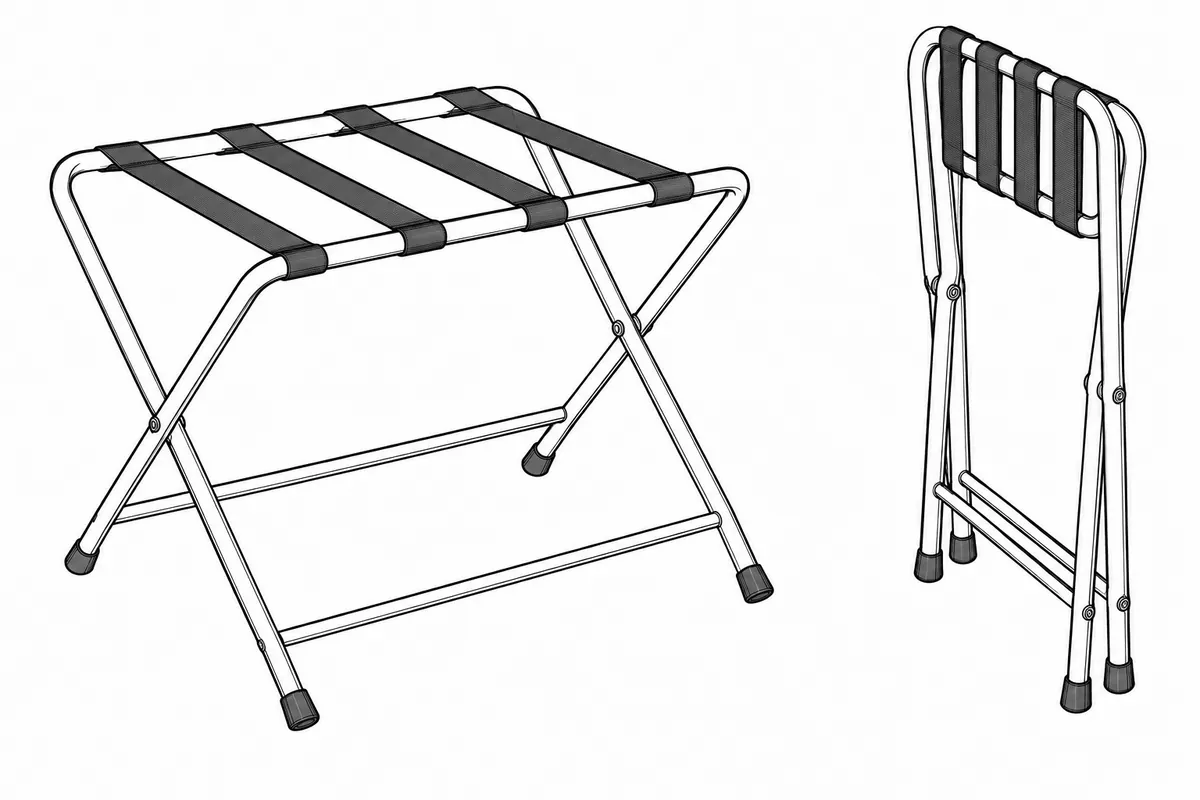
Conceptual open/folded comparison only. The outlines contain no dimensions and should not be used as a product drawing or fit template.
Which storage sequence should the sample demonstrate?
A sample review should follow the buyer’s intended storage and handling sequence, rather than a supplier’s untested assumption about how hotel staff will use the product. The sequence may be guest-room fold-and-stow, housekeeping movement to a closet, or centralized storage after room turnover. These are different workflows, and not every property uses the same one.
Write down who moves the rack, where it starts, what must be removed, how it is folded, where it is carried, and how it rests when stored. Then have the sample reviewer perform that sequence using the exact model and configuration under discussion. Note any step that needs a tool, a loose pin, two people, a particular orientation, or extra clearance. Record the observation; do not turn a single sample demonstration into a safety certification or a universal use claim.
The reviewer should compare each endpoint with the drawing. Does the rack sit in the intended open position? Does it reach the folded state shown in the supplier document? Do straps or a backrest remain attached? Does the hinge or frame stop the rack at the expected orientation? If the model has more than one folded position, which one defines the published envelope? These checks make the open/folded dimensions reproducible for procurement and packaging.
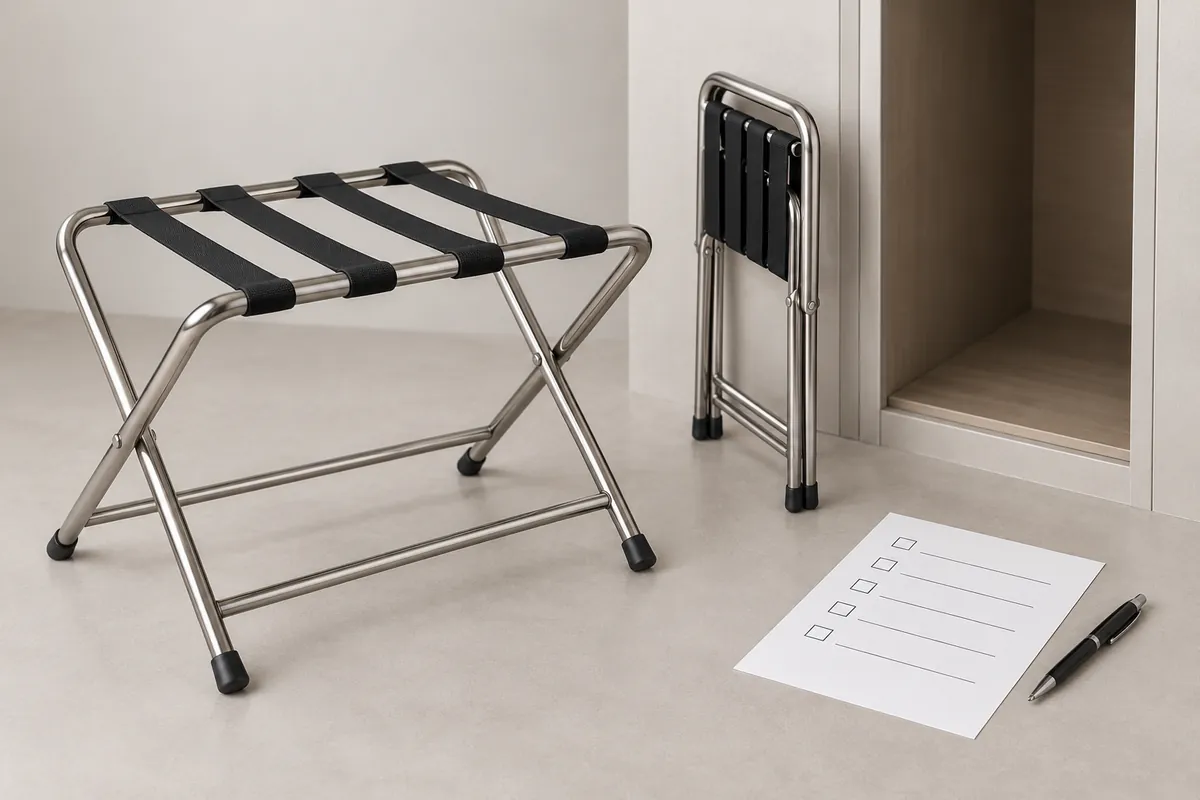
A buyer can also place a simple physical outline, carton mock-up, or measured storage opening beside the folded sample. That does not require a laboratory test. It is a practical way to check whether the sample’s outermost points align with the planned location. If the buyer’s storage plan depends on multiple units standing or nesting together, verify the actual arrangement with the intended quantity and orientation before writing “stackable” or “fits in closet” into a purchasing brief.
Do not add an arbitrary hinge-cycle requirement just because a product folds. A cycle count should come from a buyer specification, applicable project protocol, or qualified engineering assessment. If the supplier provides a cycle test, ask what model, setup, load or condition was used and what criterion defined failure. The article does not set a universal durability test or imply that a few manual openings prove service life.
What should buyers inspect around the hinge and contact surfaces?
Inspect the movement and contact areas on the exact sample, but keep those observations separate from load rating and structural acceptance. A buyer can confirm that parts align, move through the described positions, and do not visibly rub in the intended sample sequence without claiming that the rack has passed a particular strength or long-term durability test.
Start with the pivot or hinge assembly shown on the drawing. Check that the same parts are present on the sample and that the fold direction matches the instruction. Look for visible interference between frame members, loose pieces, snag points, or an unexpected stop. The supplier should clarify whether an adjustment or fastener is intended to remain accessible. Do not infer hinge life, material grade, or safety status from appearance alone.
Next, examine the surfaces that touch when the product is folded or stored. Frame-to-frame contact can affect finish appearance; a foot pad or protective cap may shift the contact point; a strap may be trapped between members if the fold sequence is not shown clearly. Ask the supplier to identify which pads, caps, or protective components are included and whether they remain in place when the unit is folded. If the package omits a protective piece, do not write an instruction that assumes it is supplied.
The buyer should also note visible finish changes after the agreed handling sequence: a fresh scratch, rubbed area, chipped coating, or displaced pad can be recorded against the sample and reviewed with the supplier. These observations identify a question for the product team; they do not prove a universal finish failure or predict how a rack will perform after a particular number of uses.
Load-related questions belong to a separate approval gate. A fold check alone does not prove the frame or support straps meet a load claim. For that separate decision, see the live guide on hotel luggage-rack load capacity and evidence buyers should request. Keep the load value, test setup, and supporting evidence tied to the exact model rather than combining them with the folded-storage discussion.
How should folded product dimensions stay separate from carton dimensions?
Record the folded product envelope and the shipping carton as two different sets of measurements. A box may be larger because of protection, orientation, accessories, or packing material; the folded rack may not be positioned in the carton the same way it stands in a closet. Conversely, a rack that appears thin when folded may need extra space around a hinge, strap, or finish-protection insert during shipping.
Ask the supplier to identify:
- folded rack width, height, and depth in the stated stored orientation;
- whether those dimensions include pads, straps, backrest, fasteners, and protrusions;
- carton width, height, and depth, with units and a clear order;
- units per carton and any separate accessory packs;
- whether the rack is placed open, partly folded, or fully folded in the carton;
- which surfaces need separation or protection to reduce contact during transit; and
- the carton revision that matches the approved sample and product configuration.
These are specification fields to confirm, not guarantees that a particular carton prevents damage. Do not use product folded dimensions as carton dimensions in a quote, freight calculation, or warehouse plan. If a hotel group will store units centrally after arrival, the receiving team may need the folded product envelope; a distribution or freight team needs the packed-carton envelope. Both should be clear in the item data.
If a buyer compares quotes, request the same orientation and measurement convention from every supplier. A comparison of one supplier’s folded width-height-depth with another’s folded width-depth-height is not useful until the axes are aligned. Similarly, compare only the same configuration: with or without a backrest, same strap count, same feet/pads, and the same parts included.
What belongs in the RFQ and sample-approval checklist?
Before selecting a folding hotel luggage rack, send the supplier the intended room or storage context and ask for a model-specific open/folded drawing and sample plan. The checklist should capture the dimensions and approval basis that the hotel, distributor, and receiving teams will use.
- Identify the target SKU, configuration, product revision, finish, and included components.
- State the intended use location and the buyer-measured storage opening or envelope, if storage fit is required.
- Request open and folded width, height, and depth in an explicit unit and axis order.
- Ask which protrusions, straps, pads, backrest, and removable parts are included in each measurement.
- Request the fold direction, sequence, end position, and any tool or loose-part requirement shown in the instructions.
- Compare the sample with its drawing and carry out the buyer’s stated fold-and-stow sequence.
- Record visible hinge alignment, contact points, finish scuffing, pad movement, and any mismatch with the drawing.
- Keep load-rating evidence in a separate, model-specific approval record.
- Request carton dimensions, pack quantity, and the product/carton revision link separately from folded product dimensions.
- Retain the approved sample, drawing revision, instruction sheet, and carton information together.
Does “folds flat” tell a hotel buyer enough?
No. It signals that a product can fold, but it does not give the actual stored envelope, fold direction, included-part condition, or fit against a particular closet or storage point. Request the dimensions and confirm them on the exact sample.
Should folded product dimensions be measured with straps installed?
The supplier should state the configuration used. If straps remain attached in the intended stored state, include them in the sample review and describe how they lie or are secured. If they must be removed, identify that step and the separate storage location.
Does a fold check prove the rack’s load capacity?
No. Folding operation and load performance are different decisions. Review model-specific load evidence separately, using the buyer’s stated test or approval requirements.
Can one folded size be used for every rack in a product family?
Only if the supplier confirms the relevant variants share the same configuration and envelope. A changed width, backrest, foot pad, hinge, or strap arrangement can alter the folded size. Approve the exact variant rather than transferring measurements from a similar-looking model.
Is Koitor currently a hotel luggage-rack supplier?
The current approved product map does not confirm a Koitor hotel luggage-rack SKU. This article is buyer education about sourcing and sample documentation, not a claim that Koitor currently manufactures or stocks this product. A project discussion should first confirm product type and scope.
Arbeiten Sie mit Koitor Hardware zusammen
Need a project-specific hardware discussion?
Share the product drawing or sample, model revision, intended storage context, and folded-envelope requirements. Koitor Hardware can first review whether the product type fits its current verified scope; this is not a claim of a current hotel luggage-rack SKU.
OEM / EIGENE MARKE
Verwandeln Sie diesen Beschaffungsleitfaden in ein Produktdossier
Teilen Sie uns Ihr Zielprodukt, die Größe, die Oberflächenausführung, die Bestellmenge und Ihre Verpackungsanforderungen mit. Ihr Team erhält vor der Angebotserstellung eine praxisorientierte Prüfung der Herstellbarkeit.


 English
 Español
 Português
 Français
 Deutsch
 العربية