
Buyer specification guide | Folding home-storage hardware
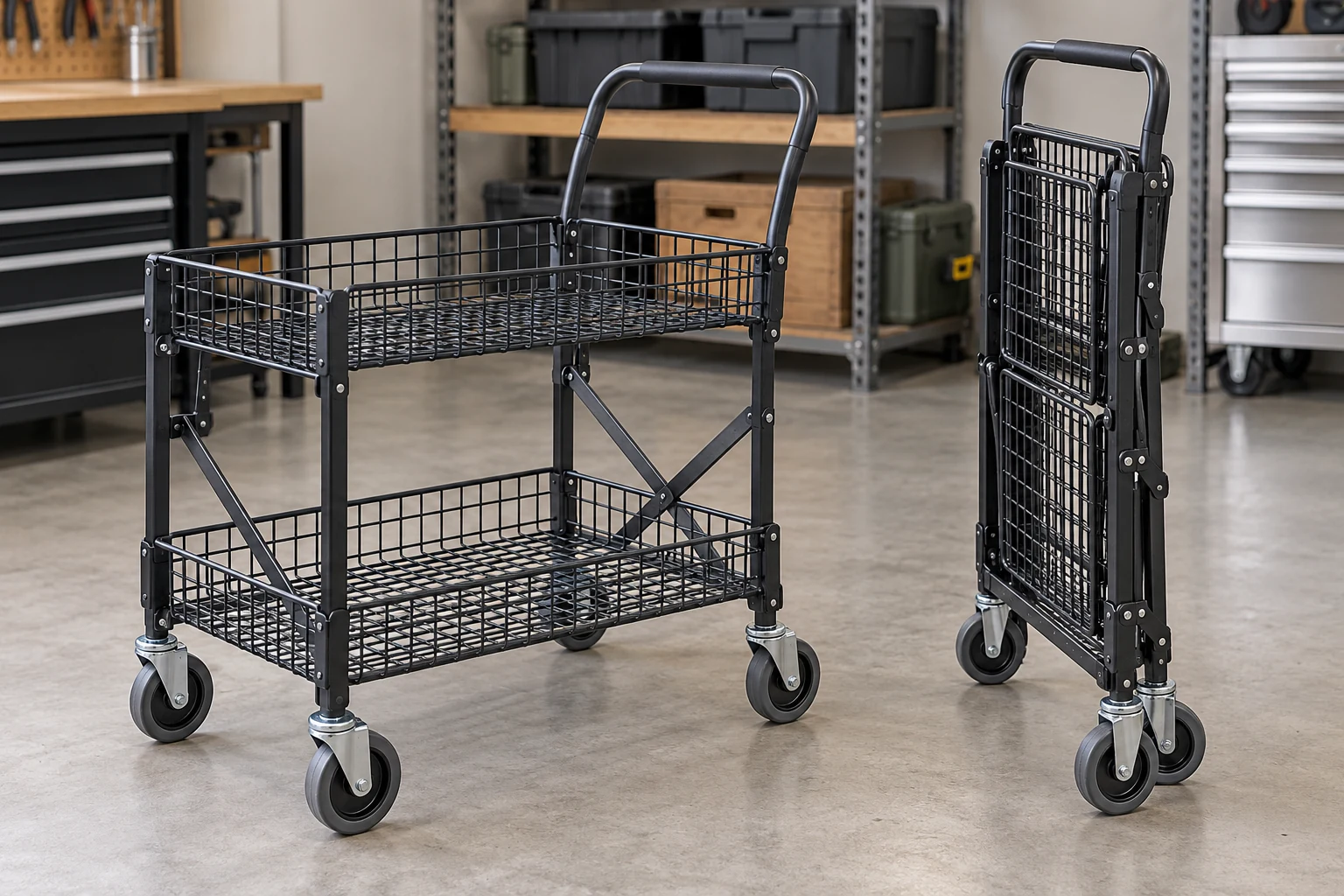
For folding utility cart folded dimensions wheels cannot be treated as an afterthought: a cart may fold its shelves while casters, handle or latch still define the storage envelope. A private-label buyer should approve the open and fully stowed length, width and height with the actual wheel assembly fitted. Record caster orientation, folding and locking sequence, and the intended closet or transport opening on the same sample worksheet. A folded product dimension is not its shipping-carton dimension, and neither should be inferred from an empty frame photograph.
What does “folded size” mean for a wheeled cart?
It should mean the maximum outside envelope of the finished product in a named stowed configuration. That includes parts protruding beyond the collapsed shelves: wheel forks, handles, locks, hinges, guards and fasteners. A seller might also report shelf panel thickness or carton size, but those answer different questions. A buyer comparing potential suppliers needs each measurement clearly labeled and made under a repeatable configuration.
First-party examples show why one folding architecture cannot stand in for another. Luxor’s steel-wire cart specification reports separate open and folded dimensions, casters and carton information. The Luxor product page identifies that model as a collapsible wire cart. Welcom Products’ specification describes a different architecture with wheels that automatically fold out. These are model-specific designs, not a universal mechanism or a specification for Koitor.
A user asking for folding wheels while a load platform remains usable points to a related but different requirement. “The cart folds” can refer to shelves, frame, handle, wheels or some combination. An RFQ that says only “folding cart” leaves a supplier to guess which part must move and which part must remain functional. Turn the use problem into two explicit states: operating and stowed.
Separate open, stowed and packed configurations
The open envelope describes the cart as used, including its handle and wheel sweep when turning. The stowed envelope describes the fully folded product as a user would place it in storage, with its standard parts still fitted unless instructions clearly say otherwise. The packed envelope describes what fits inside a shipping carton, possibly disassembled or protected by inserts. A slim carton does not prove the assembled cart can be stored in a slim closet.
If caster removal is expected for stowing, that is a user task, not an invisible measurement assumption. State the removal method, tool requirement, loose-part storage and reassembly risk. If the product is intended to fold quickly after each use, removable wheels may not satisfy the intended experience. Conversely, a cart that stores only after disassembly may be acceptable for seasonal or institutional use if the retail claim is precise.
On the drawing, show open L/W/H, folded L/W/H and carton L/W/H as three labeled sets. Draw the folded side and top views. Indicate which edge faces the storage opening and which end remains accessible for retrieval. Keep tolerances and measuring datums specific to the product; do not borrow a margin from an unrelated cart.
How do casters change the folded envelope?
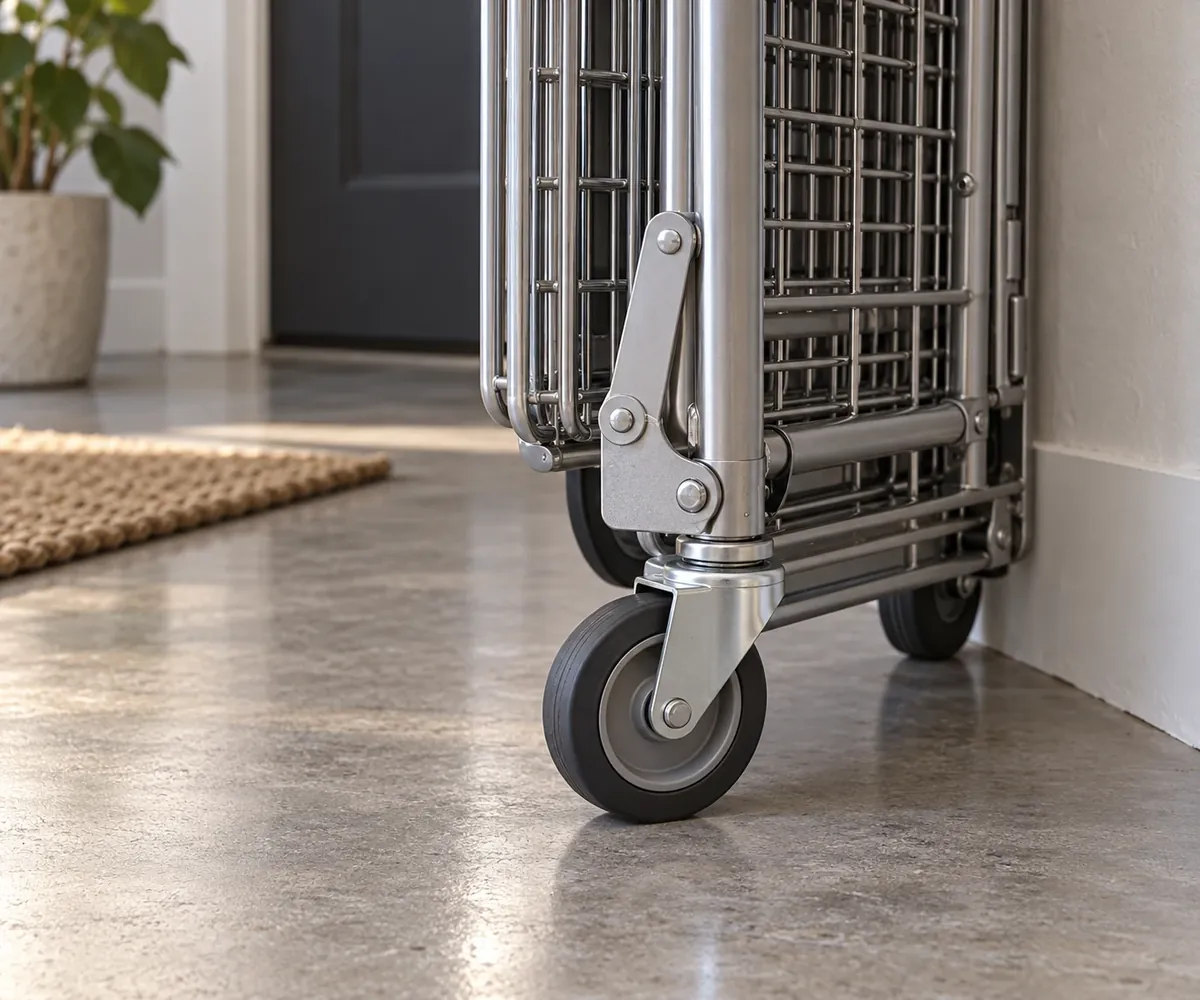
A caster can remain in the same position, swivel under the frame, swivel outward, or retract through a dedicated mechanism. A nominal wheel diameter cannot fully describe its stowed projection. The fork, mounting stem, brake lever and swivel radius may be the actual widest point. If the caster has a lock, its lever may change the external outline in one position. If it folds, the hinge and retained wheel require room inside or beside the frame.
For a buyer seeking folding utility cart folded dimensions wheels should be included in both drawing views and physical sample measurements. Ask whether the stated folded width assumes the wheels facing forward, turned inward, or free to swivel. If users must manually rotate each wheel to fit a storage slot, that instruction and its practicality matter. A wheel can rotate during lifting or placement, so the critical dimension may be the full swivel envelope rather than a best-case orientation.
Do not treat a retractable caster concept as inherently superior. It adds components and an operation that must be reviewed for the actual use case. A fixed caster may make the cart wider when stored but simpler to fold. A swiveling caster may reduce width in a chosen position yet protrude unpredictably if unrestrained. A wheel-folding design may address a very narrow storage slot, but its joint and operation need project-specific evaluation. The best choice depends on target storage space, user frequency, load and product cost, not a generic rule.
Check the handle, hinges and latches too
The push handle may rise above the folded shelf stack or project sideways after the cart collapses. A fixed handle can define the stowed height, even when the wheels define width. A folding handle introduces its own hinge and latch condition. Mark the handle’s final position on the drawing and verify whether the user can grip it to move the folded cart.
Hinges and latches can also protrude or snag a closet surface. A folding cart should not rely on an unrealistically tight drawing that ignores fastener heads, protective caps and finish. Inspect the actual metal sample for sharp edges in the handling zone. If a latch keeps the cart closed during storage, record its engaged state for dimensional approval and its release motion for user access. A product that meets a slot width only with a loose latch may not stay within that width in ordinary handling.
The folded product may not stand upright without support. That is a separate design question from maximum width. If the packaging or product page pictures freestanding vertical storage, verify that exact position on the production-intent sample under the intended conditions; do not infer it from a staged photo. The buyer may instead specify leaning storage, a wall restraint or horizontal storage, but the claim and instructions should match the approved state.
Which dimensions belong in the RFQ?
Begin with the buyer’s target storage slot, not the supplier’s catalog number. Record the opening width, depth and height at its narrowest point, including trim, door swing or an adjacent shelf. Define whether the cart enters folded upright or on its side and whether it must be turned inside the compartment. These details determine which dimension is limiting.
Then specify the cart states and component assumptions. Request an assembly drawing with the proposed caster part, wheel position, handle position, latch state and outer measurements. Provide intended use, product category, likely contents, desired finish and private-label packaging needs. Do not invent a load capacity from a similar cart; ask the supplier to propose and evidence the value required by the buyer’s project.
| Required dimension or state | Drawing / sample question | Buyer decision supported |
|---|---|---|
| Open overall L/W/H | Are handle and caster sweep included? | In-use passage and operating space |
| Folded overall L/W/H | Which wheel, handle and latch positions apply? | Closet or transport-slot fit |
| Maximum wheel projection | What is the full swivel or retracted outline? | Narrowest-side clearance |
| Folded stance | Can it stand, lean or lie as pictured? | Safe and practical storage claim |
| Carton L/W/H | Is the cart shipped assembled or partly disassembled? | Logistics and retail package planning |
| Folding sequence | Which locks are released and in what order? | Sample acceptance and instructions |
Keep a side and top view for both open and folded states. If the storage slot is only slightly wider than a calculated dimension, a production-intent sample and tolerance review become especially important. Do not use an arbitrary “one-inch allowance” as a universal rule; agree a project-specific requirement with the buyer and supplier.
Clarify what the customer actually stores
The cart may be used for laundry, cleaning supplies, pantry goods, craft materials or stockroom items. Some contents remain on the shelves during storage; others are removed before folding. That difference can determine whether shelves can collapse while loaded, whether wheel retraction is feasible and what user instructions must say. The Reddit wheel-folding request, for example, concerns keeping a platform usable while the wheels fold. A two-shelf collapsing cart is a different response to that user problem.
Do not write “folds while loaded” without product-specific evidence. If that capability matters commercially, make it an explicit development and test requirement. Otherwise, state that the cart is emptied before folding and show the emptied configuration in instructions. The supplier should not be asked to infer a handling sequence from a product category word.
Koitor’s Fertigung von maßgefertigten Metallregalen und OEM home-storage hardware context can support a conversation about frame geometry, wire shelves, metal interfaces and sample development. The topic does not establish that Koitor currently manufactures folding carts, owns a patented wheel mechanism or has certified a cart load rating. Confirm the actual project scope and components before making a capability claim.
How should a production-intent sample be checked?
Set up a sample review with the final-intent metal frame, caster type, handle, latch and assembly instructions. Assign a sample ID and drawing revision. Record open dimensions with the handle in use. Fold the cart according to the supplied sequence and record folded length, width and height in the specified storage orientation. Include the most protruding wheel/lever position that can occur under the agreed ordinary handling conditions.
Place the folded sample at the intended storage slot. Observe whether it enters without forcing, whether the door or adjacent furniture can close, and whether a user can pull it out. Then unfold and relock it. Look for binding, sharp contact, loose parts or a wheel position that changes unexpectedly. A sample that fits only after a technician manually manipulates every caster may require an instruction or design change for a consumer retail SKU.
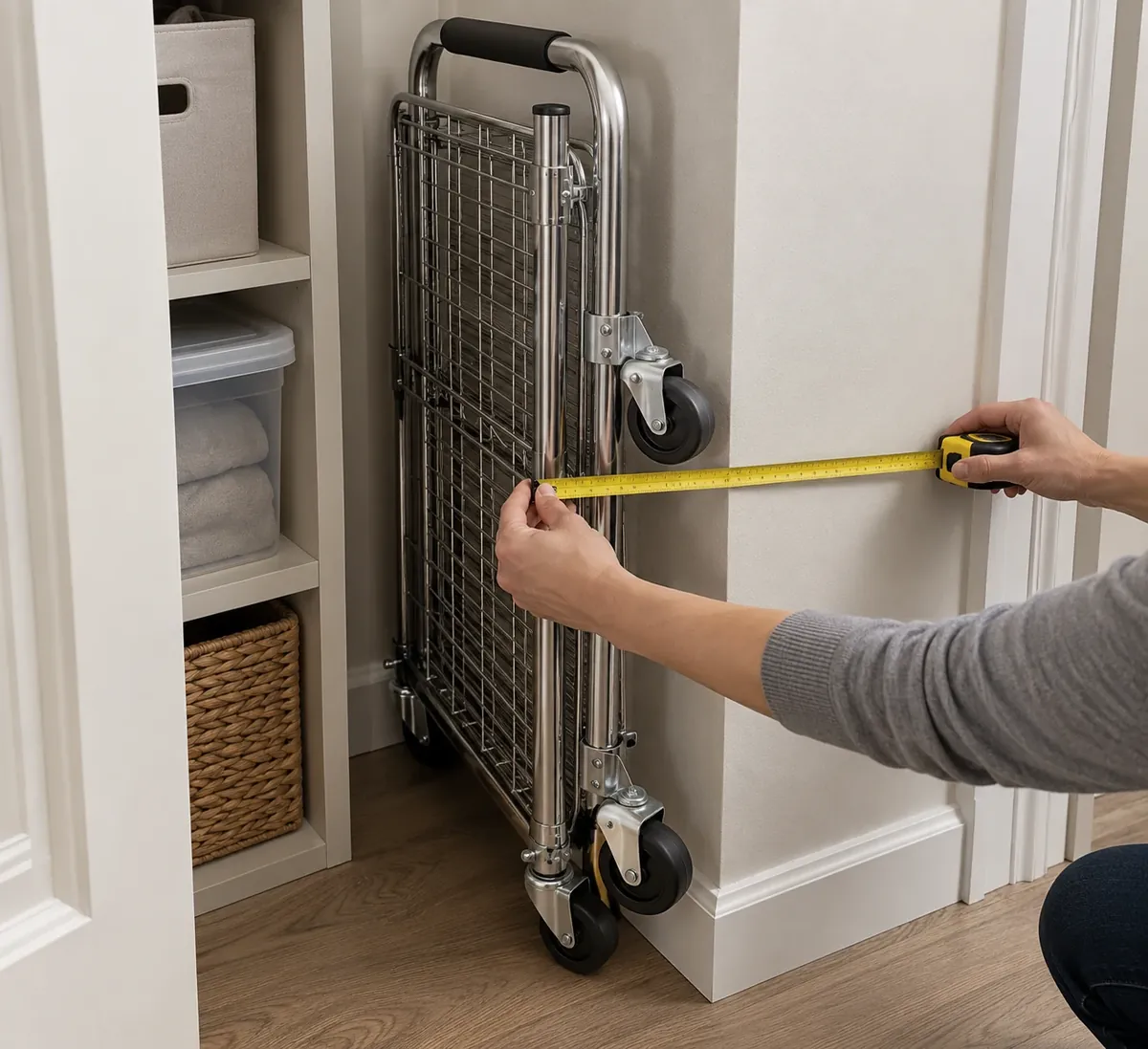
Photograph the folded sample from the front, side and top with a scale or dimension record. Record whether the caster is free-swiveling, locked or deliberately folded. Compare the actual sample with the drawing and with the carton specification. If a handle or wheel differs from the intended production component, do not treat the sample as fully representative for fit approval.
The acceptance statement should be operational. For example: the identified sample folds using the supplied sequence, fits the named slot in the stated orientation without contact or part removal, and can be removed and reopened by the normal user method. This is a suggested buyer framework, not a claim that a given Koitor product passed such a check. A separate structural or load requirement needs its own evidence and method.
Keep change control tied to the envelope
A different caster, brake lever, handle grip, hinge cover, shelf wire, frame bend or protective cap may shift the folded outline. Packaging changes can also alter what arrives assembled or which parts the user must install. If a supplier proposes a change after sample approval, compare the affected dimension and folding sequence before accepting it. An unchanged product name does not guarantee unchanged fit.
Identify who owns the drawing and which change must be approved by the buyer. In a repeat order, trace the approved sample and part revision. If a component is sourced separately from the metal frame, assign responsibility for its dimensions and assembly. This makes the private-label promise about compact storage more defensible and reduces disputes based on two different definitions of “folded.”
Buyer checklist before approving production
For folding utility cart folded dimensions wheels are part of the question, so use a checklist that connects geometry with normal operation:
- Define what folds: shelves, frame, handle, wheels, or a combination.
- State whether contents must be removed before folding.
- Provide the target closet or transport slot’s narrowest usable opening.
- Request open, folded and packed L/W/H as separate labeled measurements.
- Show the actual caster, swivel position, brake lever and handle on the folded drawing.
- Check a representative sample with production-intent components and instructions.
- Fold, insert, retrieve and reopen the cart in the intended user sequence.
- Record the sample ID, drawing revision and any conditional wheel position.
- Confirm whether retail photos and packaging claims match the approved configuration.
- Recheck relevant dimensions after changes to caster, handle, latch, frame or carton assembly.
These steps turn a vague “compact cart” brief into an inspectable buyer decision. They do not establish a universal folded ratio, storage clearance, load rating or safety certification. Those claims require project-specific evidence.
Häufig gestellte Fragen
Does folded width include the swivel casters?
It should if the wheels remain attached in the advertised stowed condition. Record the wheel orientation and maximum likely projection, not only the folded shelf stack. If wheels are removed or retracted, state that clearly and check the required user steps.
Are carton dimensions the same as folded product dimensions?
No. Carton dimensions can include protection, inserts or partly disassembled parts. The folded assembled product should be measured independently in its intended storage orientation.
Does every folding wire cart have retractable wheels?
No. First-party product examples use different architectures. A buyer must specify whether fixed, swiveling or retracting casters are desired and inspect the proposed sample rather than assuming a category standard.
Can a buyer approve the folded size from a product photo?
A photo can show the concept but rarely establishes the exact maximum width, wheel sweep or handle projection. Ask for labeled drawing views and verify the production-intent sample in the target storage slot.
What changes require another fit check?
Any change that affects the outer outline or folding sequence: wheels, forks, brake lever, handle, latch, frame geometry, shelf stack or assembled-versus-carton state. Review the specific change against the approved drawing and sample.
Developing a Custom Metal Storage Cart?
Send Koitor a drawing or sample, open and folded envelope targets, wheel and handle concept, storage-slot dimensions, finish, packaging and order quantity. The factory team can discuss the metal structure and practical small-batch OEM development options. Any folding or load claim should be verified for the exact approved design.
OEM / EIGENE MARKE
Verwandeln Sie diesen Beschaffungsleitfaden in ein Produktdossier
Teilen Sie uns Ihr Zielprodukt, die Größe, die Oberflächenausführung, die Bestellmenge und Ihre Verpackungsanforderungen mit. Ihr Team erhält vor der Angebotserstellung eine praxisorientierte Prüfung der Herstellbarkeit.
 English
 Español
 Português
 Français
 Deutsch
 العربية