
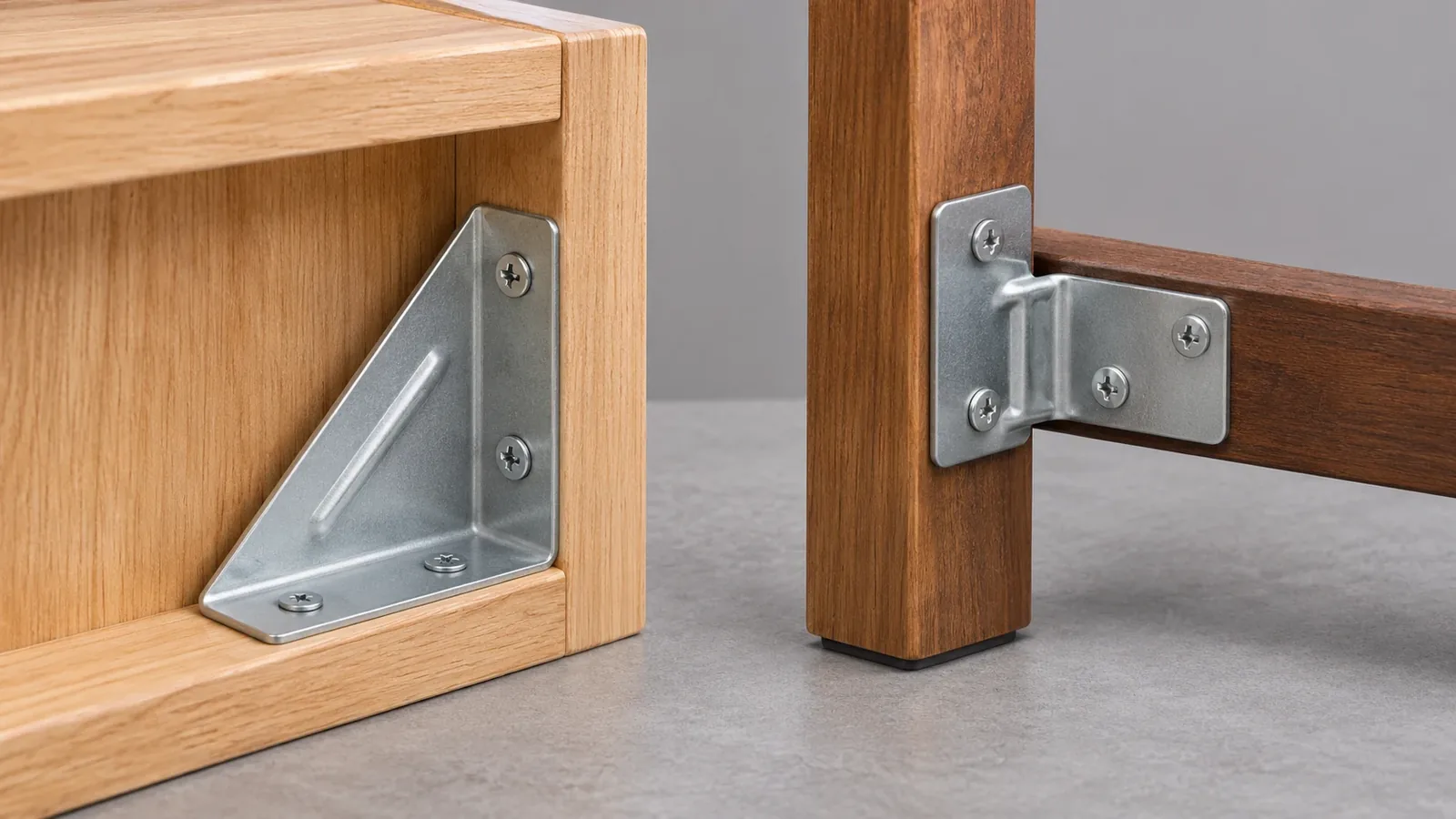
A corner brace should be selected by naming the two parts it must connect and the job the component performs. Some products described as corner braces reinforce an existing angled joint; other furniture fittings connect a leg to a frame through a defined receiving feature. Those are different connection roles, so a buyer should not compare them as interchangeable parts merely because both appear near a corner. Identify the joint, the selected model, the receiving-part preparation, and the evidence still needed before requesting a quote.
This guide focuses on household furniture and storage-component sourcing. It does not cover structural building connectors, furniture repair instructions, load design, or a strength ranking. The cited examples document named products and maker descriptions only.

What problem does a furniture corner brace decision solve?
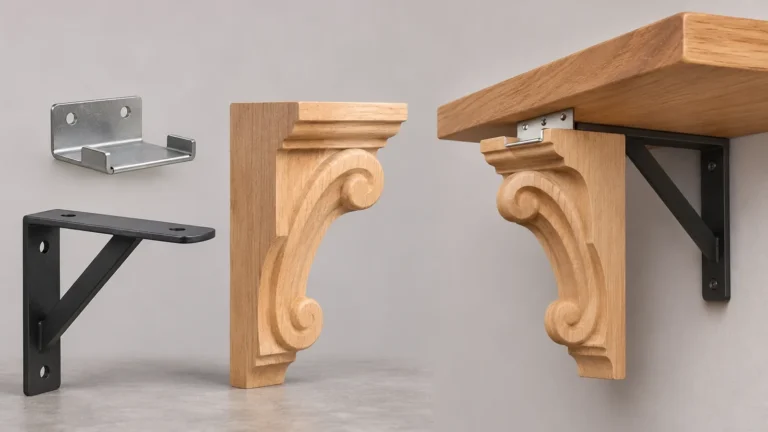
The buyer must distinguish the connection function before asking whether a proposed accessory is a suitable substitute. A product called a corner brace may be intended to reinforce members that already meet at an angle, while a different fitting may form part of the connection between a leg and a surrounding frame.
Catalog terminology can be broad. A purchasing brief may say “corner bracket” or “leg brace” without identifying the two members, the joint that already exists, or the receiving feature that the accessory needs. A supplier may then quote a product that looks plausible but performs a different role from the one the designer intended.
This difference matters in furniture and home-storage programs because a component is only one part of a larger assembly. The surrounding frame, leg, panel, apron, groove, screw locations, and assembly sequence may be controlled by different suppliers. If the buyer chooses the component first and tries to infer the joint later, it becomes difficult to compare quotations or decide whether a sample represents the final design.
The research pack reviewed three maker examples with different documented roles. National Hardware describes model N351-498 for inside-angle reinforcement and identifies an offset or extended reach. Its separate N351-497 description says that its own model permits inside or outside corner application. A Häfele furniture catalog describes a table-leg fitting that attaches table legs to frames, with a groove-insertion and screw arrangement and a stated ability to disassemble for transport or storage. These descriptions help illustrate different architectures; they do not establish universal compatibility, current availability, strength, or dimensions for another model.
The core procurement question is therefore: Am I reinforcing an existing corner, or specifying the component that attaches a leg to a frame? Once that is answered, the buyer can request the relevant model information and receiving-part drawing from the responsible supplier.
What should buyers identify before selecting a component?
Start by identifying the members that meet at the proposed joint. Then state whether the joint already exists and whether the accessory reinforces it or forms a different connection between those members.
Use a connection-role record:
- Member A: name the first part, such as a leg, side panel, rail, apron, or frame member.
- Member B: name the part it must connect to or reinforce.
- Current joint: state whether the parts already meet and how the current design joins them, if known.
- Required role: select “reinforce an existing angled joint,” “connect a leg to a frame,” or “other—describe.” Avoid using “corner brace” as the only functional description.
- Candidate model: capture the maker, model, revision, and current product documentation.
- Receiving features: identify which drawing or supplier controls the holes, groove, cutout, or other mating preparation.
- Open evidence: list unknown dimensions, fasteners, assembly steps, application limits, and performance requirements for the responsible reviewer.
This record prevents product images from substituting for an engineering definition. It also gives each supplier enough context to explain whether a model is intended for the requested role, rather than simply offering a similarly named part.
| Buyer decision | Reinforcing an existing angle | Attaching a leg to a frame |
|---|---|---|
| What already exists? | The two members already meet at an angled joint | The design calls for a leg-to-frame connection using a selected fitting architecture |
| What is the accessory asked to do? | Support or reinforce the existing connection as documented for its model | Form or complete the specified relationship between leg and frame |
| What receiving information matters? | The geometry and attachment details for the actual members and model | The frame or leg preparation defined by the selected system maker |
| What must not be inferred? | Capacity, universal inside/outside use, or equivalent strength | Groove dimensions, interchangeability, load performance, or universal assembly instructions |
| Who confirms the design? | Responsible furniture designer and component maker | System/fitting maker and the owner of the receiving frame or leg preparation |
The table is a functional comparison, not a selection by visual shape. A bent angle and a grooved-frame fitting may occupy similar regions of a furniture assembly while doing different jobs.
How do the documented component architectures differ?
The National Hardware examples are described as braces used at inside or outside corners, while the Häfele example is described as a fitting for attaching table legs to frames. The buyer should keep each statement attached to its named source and model.
National Hardware’s N351-498 offset leg bracket description identifies inside-angle reinforcement and an offset or extended reach. The same maker’s N351-497 square bracket description says that model permits an inside or outside corner application. These are model-specific descriptions. The manufacturer’s marketing language is not treated here as independent comparative test evidence, and the examples do not support a universal statement that every bracket works in both orientations.
The Häfele Thailand catalog reviewed in the research pack describes models 641.00.901 and 641.00.910 as table-leg fittings attached to frames by a groove-insertion and screw arrangement. It also describes disassembly for transport or storage. The catalog’s technical drawing was not visually inspected, and no geometry or dimension recommendation is taken from it. The prose supports the distinction between a corner reinforcement and a leg-to-frame fitting; it does not provide a general installation instruction for other furniture systems.
These examples show why a category label is not enough. For the proposed component, the buyer needs a current, legible model drawing and the preparation requirements from the supplier that owns the receiving part. If the design depends on a groove, the frame or panel owner must confirm that preparation. If the design is an existing angle joint, the responsible designer must identify the intended members and the specified reinforcement role.
The furniture leg mounting-plate guide covers a separate hole-pattern and fastener compatibility decision. Use it when the selected architecture is a leg mounting plate; do not treat it as proof that a plate, an angle brace, and a grooved connector are substitutes.
How should a buyer compare a bracket with alternatives?
Compare candidate parts only after they are documented as serving the same role. A shared name, similar outline, screw count, or apparent metal thickness is not enough to establish equivalence.
For each candidate, ask the maker to identify the intended connection and the parts it connects. Then obtain the current drawing or product documentation. Confirm who controls the receiving features and whether the proposed model is being offered for the actual material and assembly in the buyer’s design. Keep each assumption visible in the quotation comparison.
The following matrix helps separate facts from unknowns:
| Comparison item | What to record | What the record does not prove |
|---|---|---|
| Connection role | Existing angle reinforcement or leg-to-frame fitting | Structural capacity or system suitability |
| Named model | Manufacturer, model, revision, and source document | Availability or application beyond the documented scope |
| Members connected | Leg, apron, panel, rail, or frame member identifiers | That all listed combinations have been evaluated |
| Receiving preparation | Drawing owner and current hole, groove, or interface specification | That another model shares the same preparation |
| Fastener scope | Fastener type and quantity if the maker’s document specifies them | Universal fastener suitability or installation advice |
| Sample status | Which exact model and revision was reviewed | Load, durability, compliance, or long-term performance qualification |
| Offene Entscheidung | Responsible party and follow-up evidence required | Approval merely because the row is populated |
If a supplier proposes a substitute, request a written mapping from the original function to the replacement’s documented purpose. Ask which receiving features change and who updates the controlled drawing. A substitute can have a similar name while requiring a different frame preparation or serving a different connection role.
For a useful quote comparison, give each candidate a separate row rather than grouping all “corner hardware” together. Record the proposed role, the members it connects, the maker’s description, the receiving-feature owner, the applicable document revision, and the unresolved evidence. If one bid is for an angle reinforcement and another is for a leg-to-frame fitting, mark them as different architectures instead of declaring one the cheaper equivalent. The buyer can then decide whether the second option is a design change that needs review or an out-of-scope quotation. This keeps price comparison tied to the same job and gives engineering a clear reason to accept, reject, or investigate a proposed alternative.
Do not create a numerical strength comparison from catalog photographs. The source pages reviewed for this article do not establish a consistent test method, application, material condition, or load data across the named products. The buyer must not infer that a larger angle, thicker sheet, more screws, or longer reach automatically delivers a particular system outcome.
What should the receiving-part review include?
The receiving part should be checked by the supplier or designer who controls its drawing. The accessory cannot be approved in isolation if the selected architecture depends on a specific groove, hole pattern, or mating surface.
For a leg-to-frame system, ask the fitting maker for current assembly documentation and ask the frame supplier to confirm the relevant preparation. For a reinforcement part, ask the designer to identify the intended members, existing joint, and required interface. This guide intentionally does not transfer groove sizes or fastener instructions from an uninspected drawing.
Capture the review with revision control:
- Record the furniture assembly drawing number and revision.
- Record the candidate fitting’s manufacturer, model, and documentation revision.
- Identify the owner of each receiving feature on the leg, frame, or panel.
- Attach only the current model drawing or instruction approved for the project.
- List any unanswered interface, fastener, material, finish, or assembly-sequence question.
- Mark who must resolve each open item before sample approval or bulk release.
- Reopen the review if a candidate model, receiving preparation, or assembly configuration changes.
This is a document-control workflow, not a step-by-step installation procedure. The responsible furniture-system designer and component maker determine whether the actual configuration is suitable and how it must be assembled.
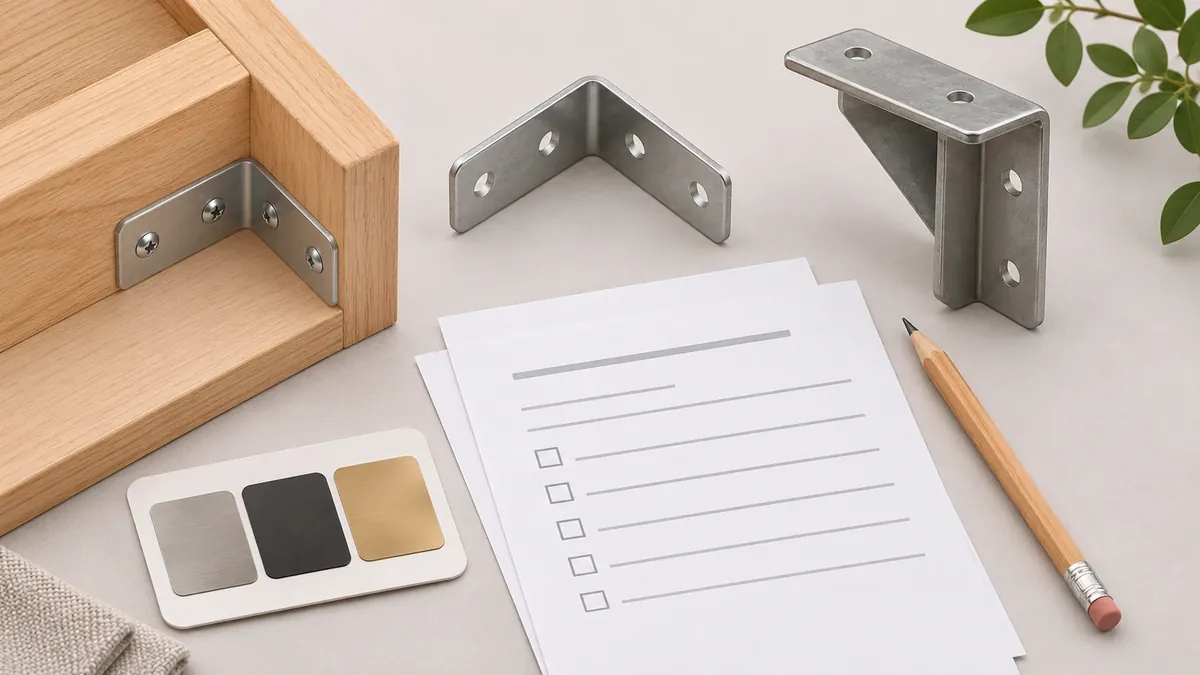
The component-role distinction should remain visible in both drawings and purchasing records. National Hardware documents separate angle-brace and leg-to-frame product descriptions for named models. Häfele’s older catalog excerpt similarly describes a distinct leg/frame fitting. These examples help explain why “corner bracket” can be an incomplete buying description; they do not prove that the parts are interchangeable or that one architecture provides a particular strength.
When reviewing a proposed part, annotate the two connected members and the joint location on the current furniture drawing. Record which product face meets each member, the mounting orientation shown by the supplier, and whether the quotation covers one brace, a pair, fasteners, or another configuration. If the product sheet does not show the receiving frame or leg, request a current drawing or written confirmation before sample approval. Do not infer fit from an attractive product photo or a generic name.
A replacement review should also identify the existing hole pattern and the construction of the receiving members. Those are inputs for the responsible furniture designer and supplier to confirm, not a basis for this article to prescribe dimensions or a universal fastener. A change from a corner reinforcement to a leg-to-frame connection may alter the parts that need to be evaluated together. The buyer should therefore compare each option against the intended joint function and assembly scope, then leave strength and structural suitability to supporting product-specific evidence.
For an assortment, preserve the manufacturer, model, revision, application description and included parts beside the approved image or sample. If a distributor later substitutes a visually similar fitting, ask for a fresh interface review. A part can look similar in a catalog while being intended for a different connection. Keeping the documentation attached to the SKU reduces the chance that a catalog description, quotation and sample refer to different component roles.
What mistakes make quotations difficult to compare?
A quotation comparison fails when each supplier prices a different function or supply scope. Buyers can prevent this by requiring the same connection-role record, model references, drawing revisions, and component responsibility from each bidder.
Using a generic label without naming the connected parts. “Corner bracket” does not say whether the item reinforces an existing angle or attaches a leg to a frame. Write the two members and the required role in the RFQ.
Comparing a brace and a system fitting as direct substitutes. A connection at a similar physical location does not prove the components do the same job. Ask the maker to document the intended role and required receiving features.
Treating an inside/outside statement as universal. The N351-497 source describes its own model’s application. It does not establish that all brackets can be installed in both orientations or that the same result applies to another design.
Relying on a catalog drawing that was not reviewed. The Häfele catalog diagram was not visually inspected during research. This article does not use it for dimensions or assembly directions. Obtain a current drawing and have the appropriate reviewer interpret it for the project.
Assuming the accessory supplier controls the frame. A fitting maker may define its product, but a separate frame or panel supplier may own the receiving feature. State which party approves each interface and drawing change.
Asking for “stronger” without a defined requirement. A comparative strength claim needs an agreed application and evidence. The reviewed source material does not establish a common test basis, so do not use visual size or thickness as a substitute for a responsible design review.
Leaving fasteners out of the quote. Confirm whether fasteners are included, specified, or supplied by the buyer. If the source documentation does not define them for the project, list the question for the component maker or designer rather than inventing a prescription.
Treating sample fit as final approval. A sample can help compare the identified parts and confirm the configuration under review. It does not establish structural capacity, product life, compliance, or suitability for every end-use condition.
Buyer handoff and next steps
How can Koitor support a related metal-component inquiry?
Koitor Hardware can discuss metal part drawings, forming, joining, finishing, assembly, and packaging within its confirmed bathroom and home-storage hardware scope. That does not establish that Koitor currently manufactures a particular bracket, furniture connector, table leg fitting, or complete furniture system.
For an adjacent inquiry, specify which metal component is being considered and which part is controlled by another supplier. Share a drawing or physical sample, the desired connection role, material and finish requirements, quantity, packaging, and the current mating-part reference. Koitor can then confirm whether the defined metal request fits its current manufacturing capability before preparing a quotation.
If the request involves a wood groove, furniture-system design, load-bearing decision, or a specialized connector architecture, identify the responsible system supplier and obtain its current drawings and instructions. Koitor’s metal fabrication knowledge does not replace a furniture engineer’s design authority or a fitting maker’s product qualification.
Small-batch OEM production may suit a buyer developing a defined metal storage component or testing a product concept. MOQ, sample timing, bulk lead time, finish, and packaging depend on the actual product and order details. Koitor’s published order guidance gives conditional planning ranges, but those ranges should not be represented as a promise for an unconfirmed brace or furniture fitting.
For a clear handoff, review the OEM home-storage hardware scope and ask Koitor to confirm the actual component before treating it as an available product.
Buyer checklist before requesting a quotation
Include the information that lets each supplier evaluate the same connection function:
- Product or furniture assembly reference and drawing revision.
- The two members being connected, identified separately.
- Whether the joint already exists and whether the accessory reinforces it or creates a different connection.
- Proposed component maker, model, and current documentation revision.
- Owner and revision of the receiving part’s holes, groove, or mating preparation.
- Any available approved drawing or physical sample, with confidential information protected.
- Required material, finish, quantity, package, and private-label scope for the metal part.
- Fastener inclusion or responsibility, if relevant to the actual maker documentation.
- The unresolved technical questions and the responsible reviewer for each one.
- Any evidence required before sample acceptance or production release.
Ask suppliers to identify assumptions, deviations, and excluded scope in their quotations. Do not compare total price until the proposed connection role, component set, receiving preparation, and supplier responsibility are aligned.
Häufig gestellte Fragen
Does “bracket” always mean an L-shaped bracket?
No. The term can be used for different furniture hardware. A named manufacturer’s product description may identify an angle-reinforcement role, while another fitting may connect a leg to a frame through a different architecture. Review the exact model and its stated purpose.
Does a leg-to-frame fitting replace an ordinary corner reinforcement?
Not automatically. The two products may serve different connection roles and require different receiving features. Ask the component maker and furniture-system designer to confirm the intended architecture before comparing or substituting parts.
Can matching metal thickness prove that two braces are equivalent?
No. Thickness alone does not establish connection function, geometry, fastener interface, material, design suitability, or load performance. Compare only models with documented roles and obtain evidence for the actual system requirements.
Can a component fit review prove furniture capacity?
No. A fit or drawing review identifies a proposed interface; it is not a load qualification. The responsible furniture designer and component maker must determine what evidence is required for the specific product and use.
Arbeiten Sie mit Koitor Hardware zusammen
Define the Connected Parts Before Requesting a Metal Quote
Share the current assembly drawing, the two members being connected, the proposed component reference, metal scope, finish, quantity, and packaging. Koitor can confirm whether a defined fabrication request fits its capabilities; the fitting maker and furniture designer remain responsible for the connection system.
OEM / EIGENE MARKE
Verwandeln Sie diesen Beschaffungsleitfaden in ein Produktdossier
Teilen Sie uns Ihr Zielprodukt, die Größe, die Oberflächenausführung, die Bestellmenge und Ihre Verpackungsanforderungen mit. Ihr Team erhält vor der Angebotserstellung eine praxisorientierte Prüfung der Herstellbarkeit.
 English
 Español
 Português
 Français
 Deutsch
 العربية