
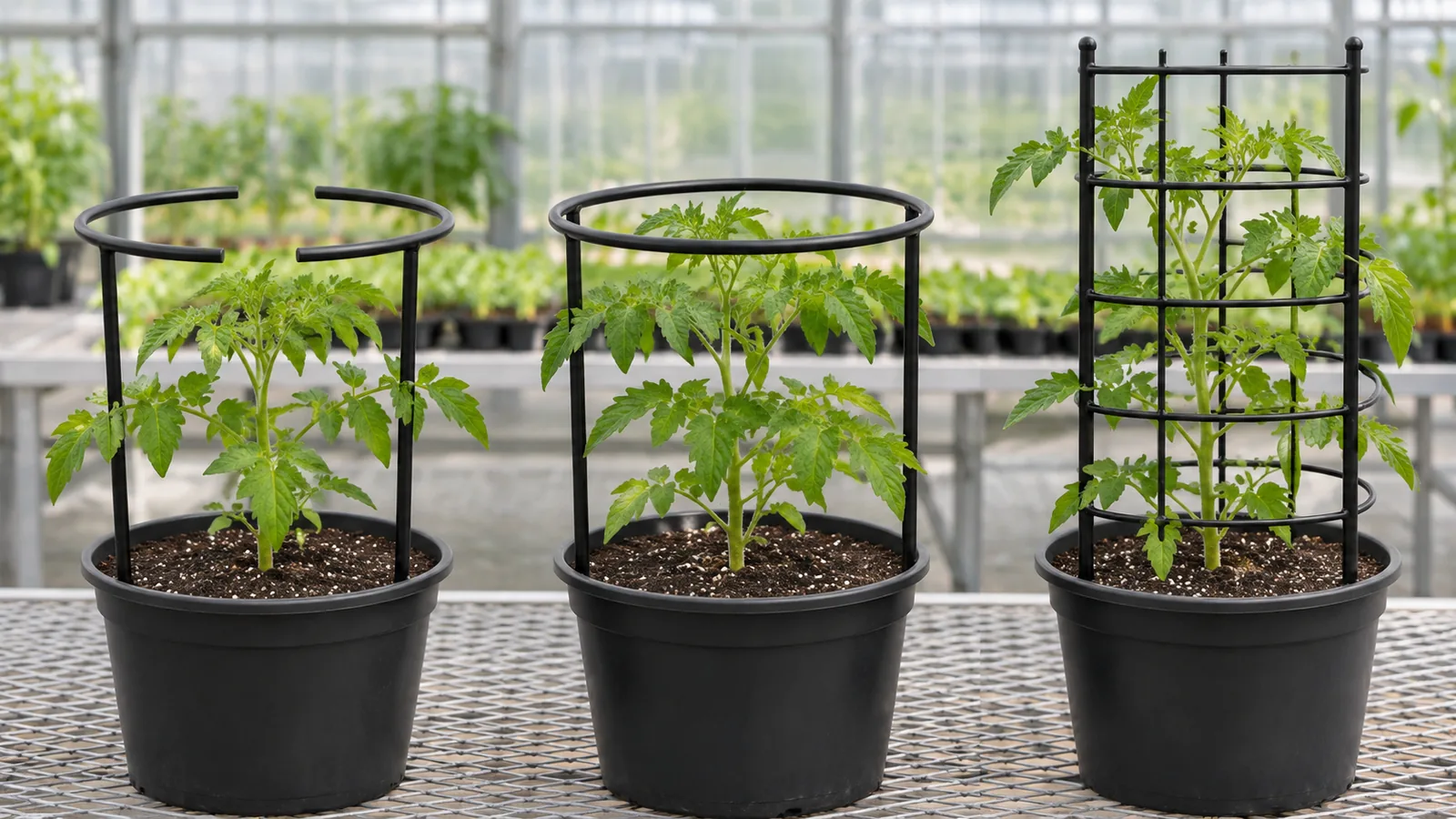
The choice in grow through plant supports vs hoops is primarily about how a buyer wants the plant to enter or be enclosed by the support, and what exact frame components are included in the quoted SKU. A grow-through form is intended to let stems develop through a support structure, while a maker-described opening ring can be placed around existing stems and then closed or released according to that product’s instructions. These are different access sequences. Neither is a universal substitute for the other, and the product listing alone may not tell a distributor whether legs or joining parts are sold separately.
For an importer, the sourcing decision has two parts: specify the architecture that matches the intended use stage and identify the complete sellable kit. Record the ring or grid form, frame dimensions, leg attachment, pack contents, finish, and model-specific use notes. Request evidence for the exact configuration instead of inferring a safe opening angle, plant compatibility, wind resistance, or service life from a photo. This is a buyer-side specification guide; it does not establish garden performance or Koitor’s manufacture of plant supports.
Here, grow through plant supports vs hoops refers to the exact buyer decision and product scope described in this guide.
Grow through plant supports vs hoops: what is the actual difference?
“Grow-through” usually describes an access concept in which stems grow through a grid, ring structure, or frame as the plant develops. A buyer assessing this form should ask how many support levels exist, whether the ring or grid is continuous, what openings are present, whether legs detach, and which stage of plant growth the maker says is appropriate. The term by itself does not define dimensions, species suitability, installation depth, or the load the product can carry.
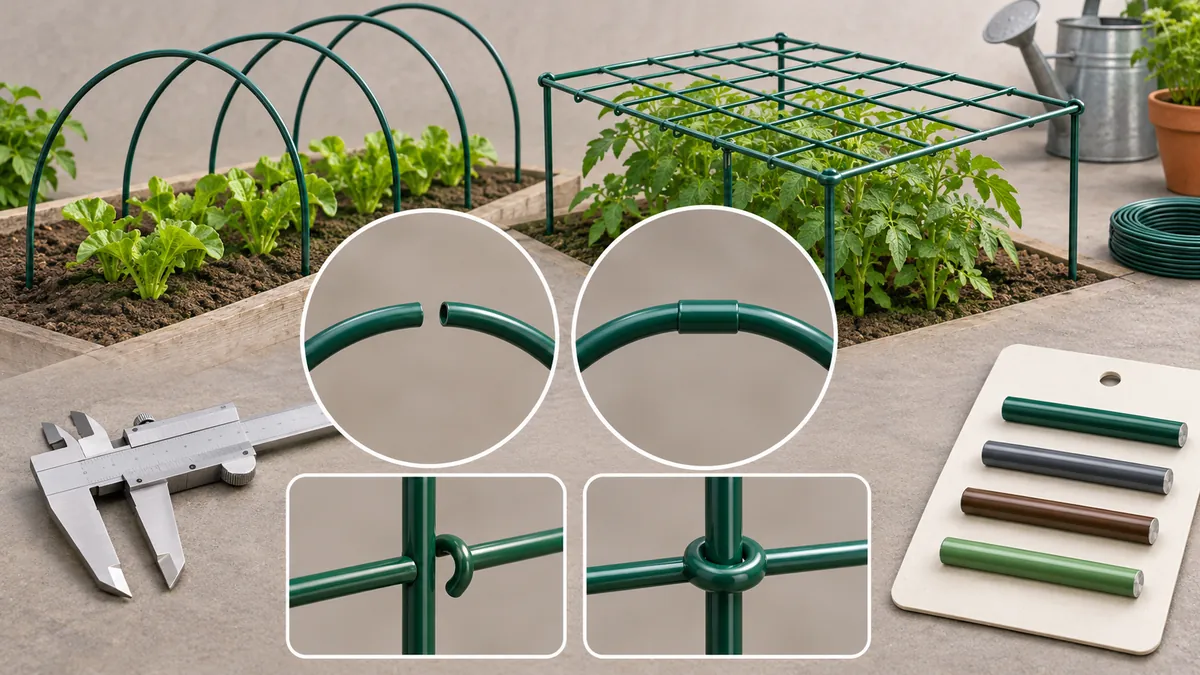
An “opening ring” describes a different access sequence only when the maker confirms that the ring opens. The user may bring an open part around existing stems and then let it return or secure it in a specified way. The product’s actual hinge, spring, latch, loop, or flexible segment must be described by the manufacturer; do not infer a fatigue-rated spring or permitted deflection from the silhouette. Some ring supports may instead be fixed loops or non-opening arches. The word “ring” alone does not guarantee opening behavior.
These differences matter to a retailer’s range. A grow-through frame may serve an early-season placement brief, while an opening form may address a buyer who needs to surround an already established plant. A distributor should verify the maker’s stated purpose and not turn a product example into universal horticultural instruction. Plant type, growing method, exposure, support plan, and local conditions can change the choice. If those questions exceed the supplier’s product data, the buyer should seek appropriate horticultural guidance rather than inventing a rule.
| Buyer question | Grow-through support | Opening-ring support | What must be confirmed |
|---|---|---|---|
| How does the plant enter the support? | The structure is positioned so growth can pass through its openings | A maker-described opening may allow placement around existing stems | Exact product instructions and opening mechanism |
| What is the main interface? | Grid or ring openings, frame, and any legs | Ring closure, support leg, and any joint or latch | Drawing or model-specific description |
| Are legs part of the offer? | May be integral, detachable, or separate by model | May be integral or a different support format | Quoted bill of materials and package list |
| What does the name establish? | A product family description | A product family description | Not performance, dimensions, or universal plant fit |
The table is a comparison frame, not a design standard. A buyer should replace each general description with verified details for the actual supplier model.
Decide the access sequence before selecting a shape
Start with the purchasing problem, not a catalogue photograph. If the item will be placed before significant growth, the buyer may prioritize the opening pattern and the way the plant can develop through it. If the support needs to be put around a plant that is already present, the buyer should ask whether the ring truly opens and how the exact model is secured. If the plant or retail use case is not specified, do not choose on behalf of the end user; define the intended use with the customer or product manager.
Make the access sequence reviewable. Describe the intended placement stage, the plant-support form, whether a ring should remain open or closed in use, and what the maker instructs the user to do. Ask for a sample or drawing showing the relevant joint. If the product has detachable legs, identify how they connect and whether they are included. If different sizes or styles exist, map each to its own item code rather than letting a family image stand in for all variants.
This approach prevents a common quote mismatch. One supplier may quote a grid with legs; another may quote only a wraparound ring. Both may call their products “plant supports,” but the included components and user actions differ. Their prices, cartons, assembly steps, and retail descriptions are not comparable until the offer is normalized. A short buyer brief should state whether a frame, ring, legs, connectors, stakes, or instructions are included, and where the supplier expects the buyer to source any excluded part.
If a component is purchased separately, name the component supplier and the model it is intended to match. Do not combine a ring from one maker and a leg from another in a specification unless compatibility is explicitly confirmed and evaluated. The existence of a detachable fitting on one model does not establish compatibility with another supplier’s parts. Model-specific connector profiles, wire diameters, attachment methods, finish, and package quantity all matter to fit and commercial responsibility.
Confirm the complete retail kit and quotation boundary
Product architecture and pack scope should be checked independently. A garden catalogue may list a wraparound ring and support legs as separate line items. A product description may show detachable legs without promising they are included in every retail pack. Buyers should inspect the actual order code, current catalogue, quotation, and package content rather than assume the image contains the complete offer.
Record at least the following:
- Main ring, grid, frame, or other support structure and its model code.
- Number and style of legs, stakes, connectors, clips, or other fittings.
- Whether each component is included, optional, or sold separately.
- Quantity per retail unit and units per master carton.
- Assembly requirement and user instruction responsibility.
- Finish or color variant, its controlled description, and packaging protection.
- Whether the offer is a complete kit, replacement component, or accessory only.
- Which maker drawing or catalogue revision controls the scope.
Do not treat a marketing bundle photo as proof of an included part. Do not recreate a competitor’s exact product design or copy its catalogue dimensions into a new product definition. The buyer’s task is to document the functional scope and ask the selected supplier to quote its own offer. If one market requires a complete ready-to-use pack and another allows separate components, keep those pack variants and barcodes distinct.
The commercial effect of an omitted part can be larger than the line-item price. A missing leg or connector can make the retail kit unusable, generate return claims, require a new assembly instruction, or force a distributor to source a second component. A quotation comparison therefore needs both unit price and contents. Compare the landed or retail-ready offer only after the buyer has included all required parts, packaging, labeling, and handling assumptions in a consistent way.
Which dimensions and interfaces belong in the specification?
Use supplier-defined datums and avoid unsupported universal sizes. A buyer may need overall height, ring or grid dimensions, spacing between support levels, opening width, leg length, and attachment features. But the applicable measurements depend on the chosen architecture and use. Ask the supplier to show where each measurement begins and ends. A dimension copied from a product image may describe the outer frame, not the usable opening.
For grow-through structures, a drawing should make the usable openings, rail positions, frame shape, and leg attachment visible. For an opening ring, it should identify the open state, closed state, joint or closing arrangement, and any attachment to the support leg. These observations help the buyer compare actual designs; they do not create an engineering acceptance tolerance. If a critical feature requires a limit, the buyer and supplier must agree the tolerance and method in the project specification.
The specification should distinguish nominal, measured, and fit-critical dimensions. If the quote says “large,” record the actual model reference or ask for the supplier’s controlled dimensions. If the legs are detached for packing, confirm their included count and assembly method. If dimensions vary by product family, do not mix different variants in one table without model identifiers. Sample approval should identify the sample code and revision so production and later reorders can be traced.
Consider finish and environment only to the extent supported by the selected supplier’s data. A coating color name does not establish coating chemistry, corrosion performance, or outdoor life. Ask for the declared finish and any evidence the buyer’s market requires. Do not use a visual image as proof of substrate or treatment. Similarly, a heavier wire or more supports does not automatically prove a better product for every plant or setting. Define the application and request evidence for any specific performance claim.
Sample review without turning a photograph into a test
A sample review is most useful when it follows a written checklist. Inspect the form, opening pattern, frame joints, ring closure, leg interface, finish, included parts, packaging, and instructions against the exact model. Record the sample’s identifier and photograph the same areas consistently. If the buyer compares two supports, examine both using the same sequence and note any unknown or supplier-dependent feature.
A sample can reveal obvious misalignment, missing components, sharp visible edges, finish damage, or an opening mechanism that differs from the submitted description. It cannot by itself establish long-term fatigue, wind stability, safe load, plant health, coating life, or compatibility across all plant varieties. Those claims require an agreed method and a qualified basis. Avoid loading or bending a product in an improvised way and then presenting the result as a standardized test.
For detachable parts, verify what the seller says about removal and assembly and follow its instructions. Do not repeatedly force a connector beyond its documented use or invent a cycle count. For opening rings, ask the maker which opening and closing operation is intended. A supplier should own evidence for any specific durability claim. The buyer should retain the sample, report, drawing, and instruction version that define the approval boundary.
Packaging should preserve the support shape and finish through the expected distribution route. Ask how components are separated, whether contacting surfaces can rub, and whether loose legs can scratch the frame or carton. The image of a neat showroom product does not show how it arrives after shipping. If a product is packed knocked-down, check that the number of parts and assembly instructions match the retail pack. If it is packed assembled, check carton clearance and the protected areas most likely to contact.
Common purchasing mistakes
The first mistake is treating “plant support” as a complete specification. It says little about access, component scope, or dimensions. The correction is to define the growth-stage question and the exact user action required before comparing models.
The second is assuming every hoop opens. A closed ring, arch, wraparound form, and maker-described opening ring can look similar in a thumbnail. Ask the supplier to identify the actual configuration and provide the use instructions. Do not assume a hinge or spring based on a visual cue.
The third is assuming that “detachable” means the parts are included. The catalogue may describe a leg attachment while selling legs separately, or a retailer may create a bundle. Confirm current model numbers and each order-code’s contents in the quotation and package listing.
The fourth is mixing supplier parts without compatibility evidence. Similar nominal sizes do not prove a connector fit or safe use. Identify the matching ring, leg, and any coupling and approve the complete combination from the responsible suppliers.
The fifth is translating a supplier’s product description into a broad performance promise. “Strong,” “windproof,” or “suitable for every plant” needs a defined scope and evidence. Avoid universal statements when the research only supports one maker’s description or a particular design example.
The sixth is setting numeric acceptance criteria from an illustration. A graphic can help locate a dimension but does not provide an agreed tolerance. Put the correct datums, limits, measuring method, and sample identity into the RFQ or drawing before a result is treated as pass or fail.
The seventh is overlooking packaging and labeling. A support that arrives with a missing leg, a damaged finish, or incomplete instructions may not match the quoted user experience. Confirm kit content, carton count, bagging, protective separation, and item labels as part of the purchase scope.
Buyer checklist before an RFQ
Before asking for a final quote, attach or list:
- Intended plant-support access sequence and use stage, stated by the buyer.
- Preferred architecture: grow-through grid, fixed ring, maker-described opening ring, or another defined form.
- Exact overall and critical opening dimensions with datums or a reference sample.
- Frame, legs, connectors, and accessories required in each retail SKU.
- Supplier model codes for components sold separately and compatibility evidence if combined.
- Finish, color, market, package configuration, and units per carton.
- Instructions and product-claim owner for the target market.
- Sample plan, drawing revision, inspection criteria, and change-control owner.
- Any plant-performance or outdoor-use statement requiring technical substantiation.
For buyers exploring the broader distinction between a trellis and related metal support structures, Koitor’s metal garden trellis importer guide covers a separate climbing-support and panel specification question. It does not establish plant-support compatibility or Koitor capability for this adjacent product. Buyers with an existing metal-storage project can contact Koitor for an initial scope review rather than assuming that an adjacent category is already offered.
Compare cost only after the offer is normalized
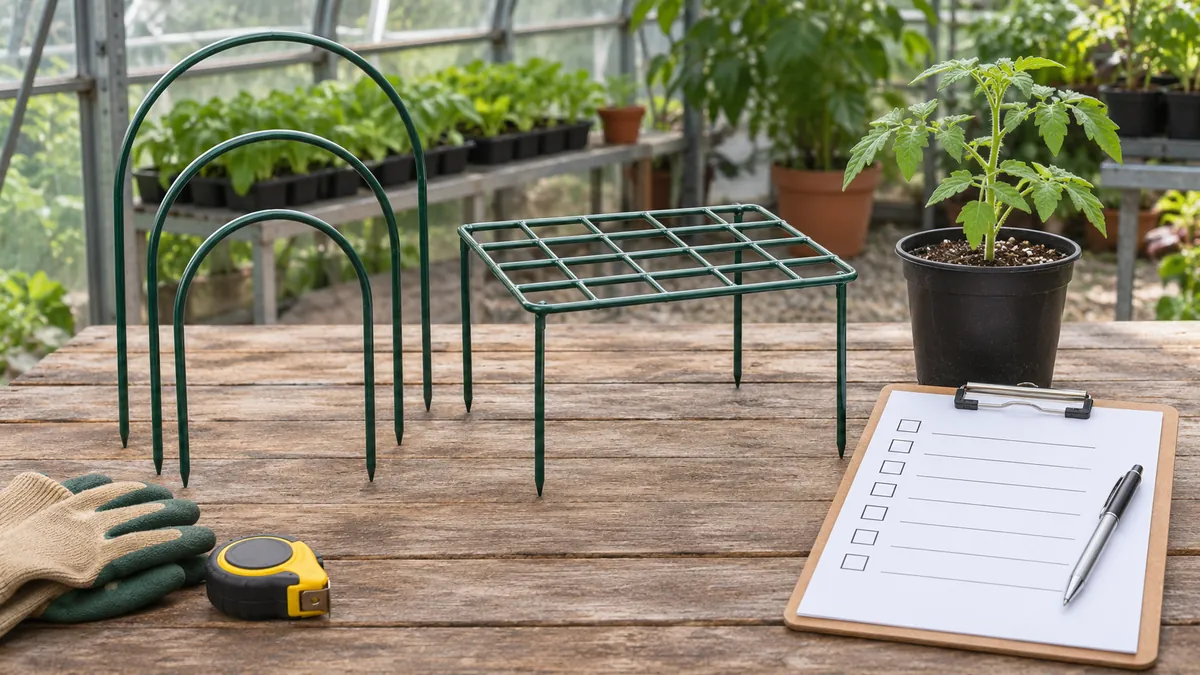
Price comparisons can be misleading when one quotation covers a complete support and another covers only the ring or frame. Normalize the bill of materials first. Count the main structure, all legs, connectors, instructions, retail packaging, and any optional accessory. If a component is supplied separately, record its separate item code, minimum quantity, carton pack, and lead time. Then calculate the price of the buyer’s intended retail set rather than comparing one supplier’s product price with another supplier’s bundle price.
The same discipline applies to variants. A model with detachable legs may be easier to pack or stock in a particular channel, but the buyer needs the actual packing configuration and cost basis before calling it more efficient. A grid with more openings may serve a different selection need, but the buyer should not assume that extra wire means better plant support. A finish option may change the retail positioning, but it does not establish outdoor durability. Ask each supplier to quote the same architecture, component scope, color, pack count, and evidence requirement wherever possible.
If a supplier proposes a substitute to meet cost or availability, review the effect on the buyer question rather than accepting the same family name as equivalence. Changing a fixed ring to a wraparound form changes access. Changing the leg or attachment can change assembly and kit scope. Changing the pack may move an assembly task to the importer or retailer. The quotation should identify the substitution and the buyer should approve it before the order is released.
For a private-label buyer, the approval record should connect the selected item code to the approved image, product description, dimensions, included parts, package, and instructions. If the assortment includes both grow-through and opening-ring models, use clearly differentiated product names and item identifiers. That helps customer service, replenishment, and returns teams answer questions accurately. Avoid combining two architecture descriptions under a single SKU when the actual offers differ.
Maintain a controlled product-family record
Once the initial selection is complete, preserve a simple product-family record for later purchase orders. It should identify the buyer-owned SKU, supplier model code, drawing revision, component list, current instruction, finish, pack configuration, and approved substitution status. Store the dated supplier references that supported the claim. If the supplier changes the form, connector, legs, or finish, compare the new offer against the approved brief and decide whether a fresh sample or claim review is needed.
This record is useful even if the buyer does not operate a formal product-lifecycle system. A spreadsheet or shared specification sheet can make the accepted scope visible to purchasing, product management, quality, artwork, and customer service. The essential feature is traceability: a team member should be able to determine which ring design, leg supply, packaging, and use statement were accepted for a particular purchase order.
Separate observations from conclusions. “Legs were present in the approval sample” is an observation. “Legs are included in every future shipment” is a contractual conclusion that must match the order terms. “The ring opened during the demonstration” is an observation. “The ring can be reopened for the full service life” is a performance claim requiring appropriate evidence. Maintaining these distinctions prevents buyer records from becoming broader than the data they preserve.
Häufig gestellte Fragen
Are grow-through supports better than opening hoops?
Neither is inherently better for every application. The choice depends on when the support is placed, how the plant is expected to interact with it, and which design the actual maker offers. Define the buyer’s intended access sequence and confirm the exact model instructions.
Do all opening-ring supports include a separate leg?
No universal kit rule should be assumed. Some offers may include a leg as part of the product; other catalogues may list support legs separately. Check the current order code, quotation, and package contents for the selected supplier.
Can legs from one maker be paired with another maker’s support ring?
Do not assume so based on nominal size or visual similarity. Require supplier confirmation and evidence for the exact combination, attachment interface, and intended use. Otherwise, quote and approve the components as a matched set from one responsible source.
What does a grow-through product name establish?
It signals the maker’s described product architecture or use concept. It does not establish dimensions, plant suitability, safe load, wind resistance, finish life, or included accessories. Obtain the relevant model information and any evidence needed for a specific claim.
Does Koitor currently make plant supports?
Current approved Koitor facts confirm bathroom and home-storage metal hardware, not this garden-support product family. No plant-support SKU or outdoor performance capability is claimed here. A specific drawing or sample can be reviewed only to determine whether any metal-component scope fits confirmed capabilities.
Sources
- Eastwold grow-through supports — manufacturer description of a named grow-through format and detachable-leg detail.
- Eastwold ring supports — manufacturer description of the named ring’s access sequence.
- Garland 2026 Trade Catalogue — dated catalogue showing a ring and separately listed support legs; it is not evidence of cross-brand compatibility.
- Harrod plant supports — category context only, not evidence of Koitor customer demand.
- Koitor metal garden trellis importer guide — separate existing owner for climbing-plant trellis sourcing.
Arbeiten Sie mit Koitor Hardware zusammen
Discuss a confirmed metal hardware scope
Share the drawing or physical sample, target application, metal-component requirements, and intended order range. Koitor will first confirm whether the product fits its established bathroom and home-storage manufacturing capabilities.
OEM / EIGENE MARKE
Verwandeln Sie diesen Beschaffungsleitfaden in ein Produktdossier
Teilen Sie uns Ihr Zielprodukt, die Größe, die Oberflächenausführung, die Bestellmenge und Ihre Verpackungsanforderungen mit. Ihr Team erhält vor der Angebotserstellung eine praxisorientierte Prüfung der Herstellbarkeit.


 English
 Español
 Português
 Français
 Deutsch
 العربية