

China home storage product sourcing clusters can help an importer decide where to begin a supplier search, but a regional label cannot verify a particular factory. For metal kitchen and bathroom storage, public evidence points to different starting contexts: Jiangmen has documented household-product and kitchenware activity, Jieyang has a broader hardware and stainless-products base with product-specific rack examples, and Foshan has a wider home-furnishing ecosystem. Use those signals to shape a shortlist, then verify each supplier’s actual legal entity, production site, process, sample, inspection plan and export responsibility.
This is a buyer map, not a ranking of cities or a directory of approved suppliers. It does not establish that every district makes wire racks, that one city offers lower prices or shorter lead times, or that Koitor operates in any of the locations discussed. The practical question is narrower: which regional context is relevant to the product family you need, and what evidence must still come from the individual supplier?
Start with the product family, not the city name
Before searching by location, write down what you intend to buy. “Home storage” can mean a welded wire basket, a tube-framed dish rack, a sheet-metal shelf, a wall-mounted bathroom organizer, a cabinet accessory or a mixed assortment. Those products may share a retail aisle while requiring different material, forming, joining, surface-finishing, assembly and packaging decisions.
Make a short product-family brief before choosing search terms:
| Buyer input | Example of what to define | Why it changes the search |
|---|---|---|
| Product forms | Countertop dish rack, wire basket, shower caddy, towel shelf | A supplier’s category label may be broader than its demonstrated product range. |
| Construction | Wire, tube, sheet, welded combination or purchased components | It indicates which process and engineering questions to confirm. |
| Material and finish | Buyer-approved grade or material, finish appearance and relevant environment | A city reputation does not prove the material or coating on a quoted SKU. |
| Mounting and use | Countertop, screw-fixed, adhesive, suction or another specified interface | Fit and verification depend on the actual mounting design and surface assumptions. |
| Commercial scope | Assortment size, target market, private-label pack and order plan | The supplier must quote the same product and packaging scope for comparison. |
Search results for China home storage product sourcing clusters may reveal trade-fair coverage, regional reports, supplier directories and individual company pages. Each source answers a different question. A government report can support broad regional context. A manufacturer website can show what that business says it offers. Neither source by itself confirms that a specific plant can make your drawing, handle your finish or meet your inspection and packaging requirements.
Jiangmen: a useful signal for household wireware searches
Jiangmen is a reasonable starting point when the target list includes household products, kitchenware or wire-based storage items. A municipal report about local businesses at the 2026 Canton Fair describes home-product activity and examples connected with stainless kitchenware and bathroom equipment. Treat this as evidence of participating businesses and displayed categories at an event—not a census of Jiangmen factories or proof that every subdistrict specializes in your exact basket or rack.
Some Jiangmen companies also publicly describe home and kitchen wireware, baskets, dish racks and OEM or ODM services. Those pages can help identify companies for an initial review, but the statements are self-descriptions. Ask for the legal entity behind the website, the address of the facility that will make your product, and the role of any trading or export entity. If a product is outsourced, establish which company controls the process and who is responsible for inspection and corrective action.
For a Jiangmen shortlist, compare actual product examples against your construction brief. Ask whether the quoted product is made from wire, tube, sheet or a combination; which operations are performed at the named facility; and which processes are subcontracted. Request a sample or production evidence tied to a specific model and revision. A supplier’s broad “kitchenware” category is a lead to investigate, not a capability verdict.
Jieyang: broad hardware context needs product-level proof
Jieyang appears in public regional information for hardware and stainless-product activity. Local government reporting describes hardware and stainless products as traditional industrial strengths, and recent industrial summaries also refer to hardware and electromechanical activity. These sources support a broad industrial context. They do not show that every stainless-related business makes bathroom storage, uses the grade you specify, or has the same welding, polishing or finishing capability.
Individual Jieyang companies publish kitchen and bathroom rack examples. Use those examples to find possible suppliers, then check whether the listed items are current products, made by that company and relevant to your target construction. A rack photographed on a product page may be an original design, a catalog item, a trading assortment or a product assembled from components; the page alone may not distinguish those arrangements.
If the product is stainless steel, do not let the regional label substitute for a written material and finish specification. Identify the required grade or approved alternatives, the cosmetic surface, relevant product environment and any inspection evidence the purchase requires. Ask how a material claim is linked to the supplied batch and whether the sample represents the quoted production construction. The appropriate checks depend on the product and buyer’s risk plan; a regional reputation cannot answer them.
Foshan: broader home-furnishing ecosystem, not a wire-rack guarantee
Foshan can be relevant when the buying program spans more than metal storage hardware. A regional profile published by Macao’s Economic and Technological Development Bureau and attributed to the Foshan government describes differentiated home-related clusters, including furniture and home furnishing, household appliances, ceramics and aluminum. That context may help a buyer planning a wider home-product assortment or complementary sourcing activity.
The reviewed evidence does not establish Foshan as a dedicated wire-rack cluster. Do not infer that a nearby furniture, appliance, ceramic or aluminum supplier can manufacture your bathroom basket. Instead, use Foshan as a broader ecosystem search when the product brief includes those adjacent categories, then verify any metal-storage supplier separately. If a company presents itself as a one-stop source, ask which legal entity and plant handle each item and how quality responsibility is divided across suppliers.
This distinction matters for an assortment with several materials or product families. One regional trip may surface useful contacts, but geographical convenience does not make different factories a coordinated supply chain. Confirm sample ownership, packaging compatibility, order milestones, carton identification and shipment handoff for every supplier in the program.
Compare regional signals against your sourcing task
The simplest way to use a Guangdong map is to connect a region to a search hypothesis, then test the hypothesis at company level. Do not turn this table into a scorecard: the public evidence is not a controlled comparison of city output, cost or supplier performance.
| Starting context | What the reviewed evidence supports | Useful next search | What it does not establish |
|---|---|---|---|
| Jiangmen | Event-level examples of household products, kitchenware and bathroom-related businesses; company self-descriptions include wire household products | Search for the specific wire basket, dish rack or bathroom organizer form and inspect the producing entity | Total city capacity, every district’s specialization, price, MOQ, quality or lead time |
| Jieyang | Broad local hardware and stainless-product context; individual companies show kitchen or bathroom rack examples | Check the target rack construction, material specification, finish route and sample against the actual facility | That all suppliers make racks, use the requested grade or have equivalent finishing capability |
| Foshan | Wider home-furnishing context including furniture, appliances, ceramics and aluminum | Use when the buying scope includes complementary home categories, then qualify metal-storage products independently | A dedicated wire-rack cluster or a single coordinated supplier network |
For China home storage product sourcing clusters to be useful, the buyer should be able to state what each region is a lead for and what evidence would confirm or reject that lead. If you cannot define the product and evidence needed, a city comparison is premature. Start with drawings, sample photos or a structured product list and build the shortlist around those details.

Qualify the actual supplier before requesting a final quote
Once you have candidate companies, move from regional research to supplier qualification. Use the same questions for every candidate so responses can be compared on equivalent scope.
Confirm the business and production site. Record the company’s legal name, registered or operating address, sales contact, factory location and export entity. Ask whether the quoted goods are made at that location or by a subcontractor. When a visit is not practical, request a live video walk-through or dated process evidence for the relevant product family; treat it as partial evidence and follow up on what cannot be observed remotely.
Map the process to the product. Ask which operations apply to your item—wire or tube forming, cutting, bending, welding, grinding, polishing, surface finishing, assembly and packing—and which are performed by the supplier. The answer should be product-specific. A general list of machines or a broad capability brochure does not show the route for your design.
Define the material and finish. Put the required grade or material, thickness or wire diameter where relevant, finish appearance, cosmetic faces and any approved substitutions into the RFQ. Ask what evidence the supplier can provide for the actual lot and process. Avoid relying on magnetism, weight or a polished photo as sole proof of composition or performance.
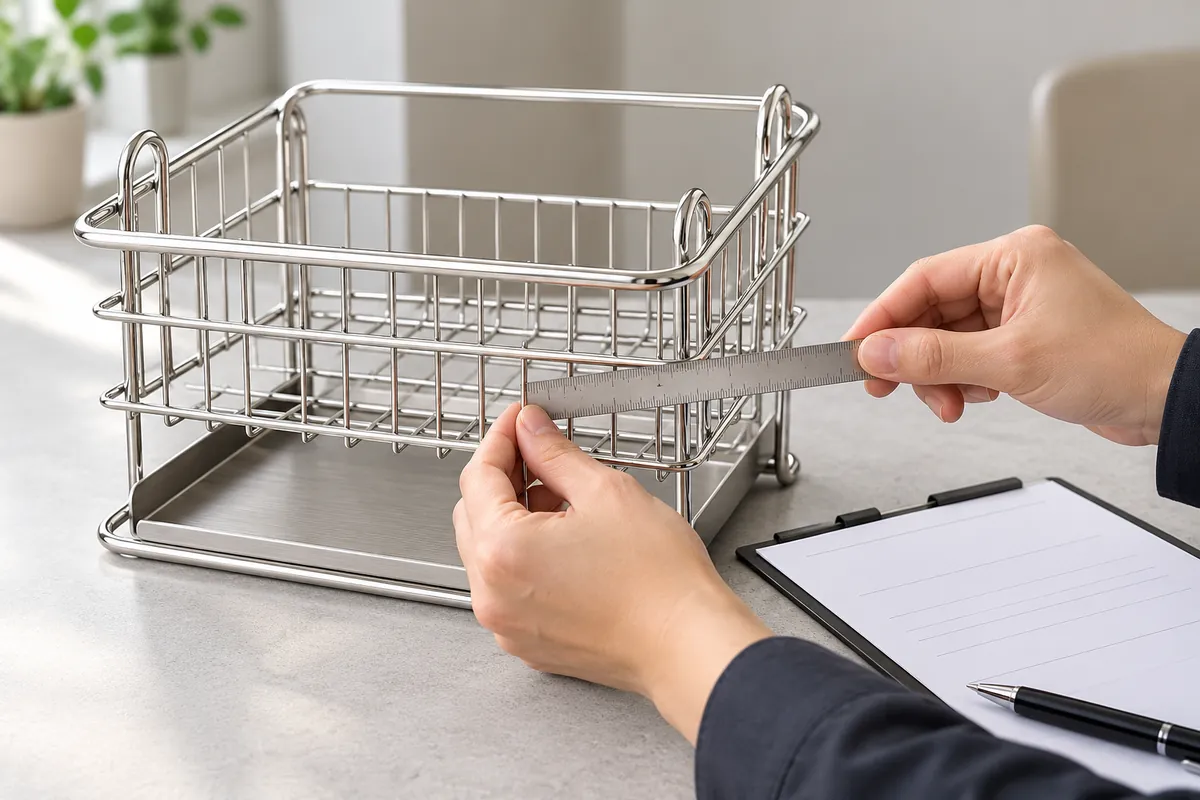
Approve a representative sample. Identify the model, drawing revision, sample date, material, finish and included components. Mark critical dimensions, fit interfaces, appearance areas and assembly checks. If the production process or finish differs from the sample route, ask what will change before approval. A sample approval record should tell the factory what is frozen and what remains open.
Agree on inspection and pack-out. Specify the checks, method, sampling approach, acceptance criteria, responsible party and timing. Define surface protection, included hardware, instructions, labels, carton configuration and any buyer-required photos or records. Do not rely on a generic statement such as “100% QC” without knowing what was checked and against which revision.
Use regional research and make the RFQ comparable across locations
A useful RFQ lets different suppliers price and discuss the same product scope. Send the drawing or sample reference, target dimensions, tolerances for critical interfaces, material and finish requirements, assembly details, packaging configuration, forecast or order scenario and target-market needs. Identify open items as questions instead of silently letting each supplier assume a different answer.
Ask every candidate to separate what it makes from what it buys or subcontracts. Request the proposed process route, sample plan, tooling assumptions if any, inspection records available for the relevant product, packaging proposal and named export party. If a supplier cannot confirm an item yet, record it as open. A clear unknown is more useful than an unsupported assurance.
Quote comparison should track the same model and revision, product configuration, accessories, material, finish, packaging and shipment terms. If one quote excludes assembly or retail packaging while another includes it, the totals do not describe the same offer. Ask suppliers to identify assumptions and exclusions in writing before deciding which proposal is comparable.
The goal is not to demand every document from every candidate. Match the evidence request to the product risk and the decision at hand. For an early shortlist, company identity and product fit may be enough to decide who receives a detailed RFQ. Before a sample or production order, material, finish, revision control, inspection, packaging and responsibility boundaries need more specific answers.
Keep regional research in context
Regional sourcing pages often compress complicated local economies into neat categories. Government sources, trade-fair reports, company profiles and supplier product pages can all be useful, but each has a different scope and date. A trade-fair report describes a sample of participants. An industrial summary describes broad activity. A manufacturer page describes that company’s own claims. None should be stretched into a universal statement about all factories in a city.
Keep a short source note beside each lead: what the source actually says, who published it, when it was published, and what question remains unanswered. For example, “local event report names household-product exhibitors” is a bounded observation; “the city is the best place for all bathroom racks” is an unsupported conclusion. This discipline makes later supplier checks faster because the team can see why the company entered the shortlist.
Recheck regional information when the sourcing program changes or when older background becomes central to a major decision. Industrial mixes and supplier websites can change. If fresh evidence is unavailable, say so and make the next step a direct company-level verification rather than presenting an old profile as current proof.
Questions buyers ask about Guangdong sourcing clusters
Which city is best for bathroom storage hardware?
The reviewed evidence does not support an overall winner. Jiangmen and Jieyang have useful public signals related to household wireware, hardware or stainless products; Foshan is better described here as a broader home-furnishing ecosystem. Choose a search starting point from your product construction and verify the individual supplier.
Does a stainless-steel cluster prove that a rack supplier uses the grade I need?
No. Regional industrial context does not verify a company’s material, a product’s construction or the supplied lot. Put the material requirement and acceptable evidence in the RFQ, then link the sample and production records to the specified model.
Can a city visit replace factory qualification?
No. A visit may help you understand a site or meet a supplier, but it does not replace a product-specific process review, sample approval, inspection plan and written responsibility boundaries. A visit also may not show subcontracted finishing or the entity that exports the goods.
Should I choose the region before I finish my product brief?
Usually not. Define product forms, materials, construction, finish, mounting, packaging and target-market needs first. Then use regional signals to focus searches and prepare comparable questions.
Does Foshan belong on a shortlist for metal storage products?
It may, especially when the program includes broader home-furnishing categories. The evidence reviewed here does not establish a dedicated Foshan wire-rack specialization, so qualify any candidate’s exact metal-storage capability directly.
For an importer, China home storage product sourcing clusters are a way to organize discovery—not a substitute for evidence about a named supplier and product. Start from the SKU and process, use Jiangmen, Jieyang or Foshan as bounded search contexts, and compare candidates against one RFQ and sample-approval standard. Koitor’s OEM home storage hardware manufacturer page describes its product scope. If you have a drawing or sample, Kontaktieren Sie Koitor to discuss the product requirements and manufacturing questions.
Shortlisting a Metal Storage Hardware Supplier?
Share your product list, drawing or sample, material and finish expectations, and packaging scope. Koitor can discuss the metal hardware requirements for a buyer-led supplier review.
OEM / EIGENE MARKE
Verwandeln Sie diesen Beschaffungsleitfaden in ein Produktdossier
Teilen Sie uns Ihr Zielprodukt, die Größe, die Oberflächenausführung, die Bestellmenge und Ihre Verpackungsanforderungen mit. Ihr Team erhält vor der Angebotserstellung eine praxisorientierte Prüfung der Herstellbarkeit.



 English
 Español
 Português
 Français
 Deutsch
 العربية