
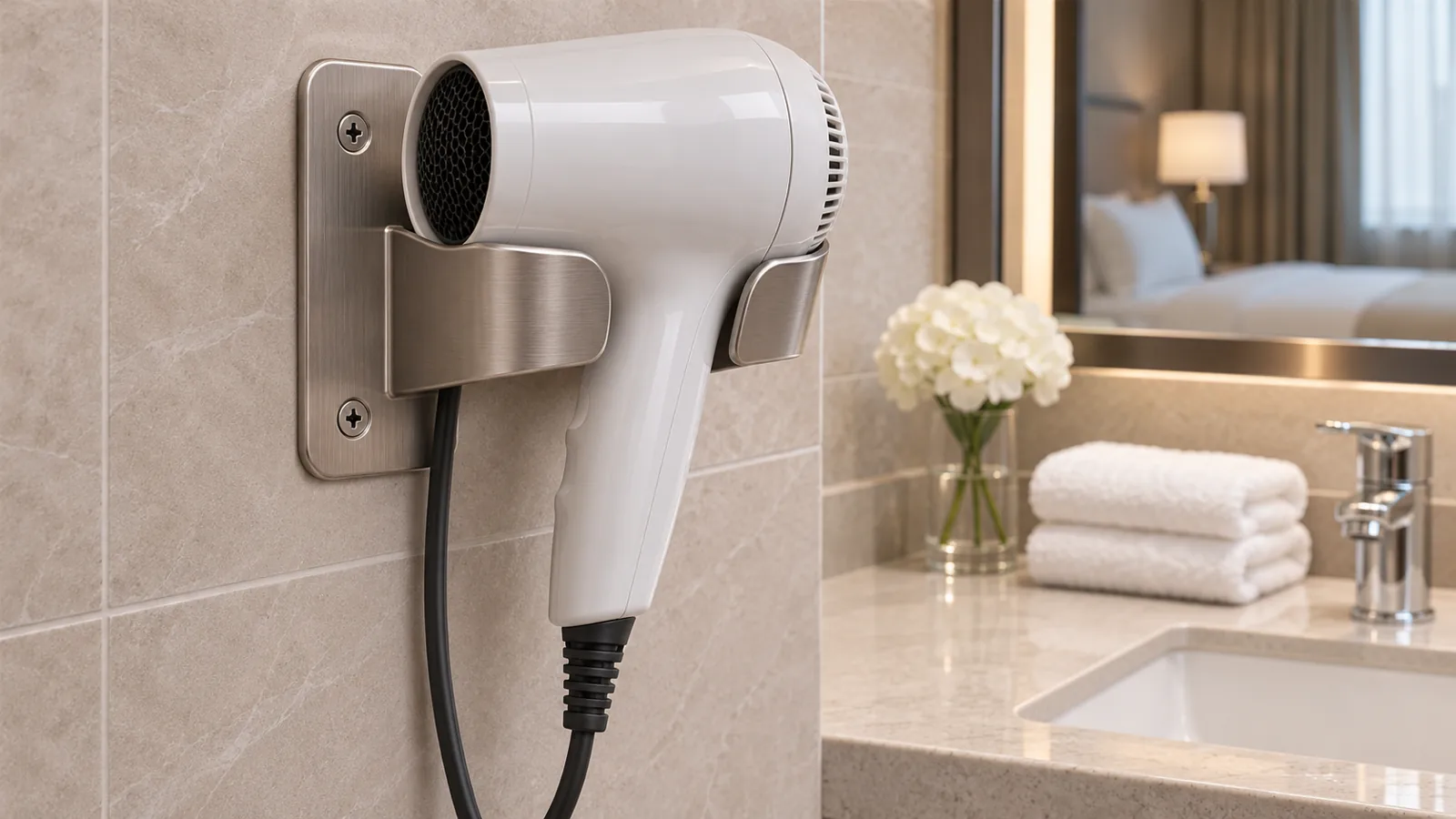
Buyer Decision and Project Scope The buyer should document hotel hair dryer replacement wall bracket as a named requirement. The buyer should record the exact "hotel hair dryer replacement wall bracket" requirement in the sourcing file.
Buyer Decision and Project Scope
Build an asset register before standardizing a replacement
A replacement program often begins with one room, one maintenance request, or one discontinued component. Before scaling it across a property group, the buyer should determine whether all locations actually use the same dryer and wall bracket. Hotel brands may have several room generations, refurbishment dates, regional appliance codes, and locally purchased replacements. A title such as “standard guest-room hair dryer” does not prove that the installed population is uniform.
The asset register can be simple, but its fields should let procurement distinguish known configurations from assumptions. At minimum, record property, room type, approximate installation period if known, dryer maker and model, visible revision or asset code, bracket part code, holder type, wall-mount pattern reference, finish, and the source of each field. Use “unknown” where a site has not confirmed a detail. Avoid filling gaps with a product listing that only appears similar.
If the maintenance team surveys rooms, ask it to photograph the appliance and bracket together, then capture a close view of labels and cord exits. Photos should include a scale or controlled reference only when the survey procedure permits it. Record orientation so left and right are unambiguous. A photo is useful for triage; it does not replace dimensions, maker compatibility evidence, or an approved physical sample.
Group installations only after comparing the critical interfaces. Two rooms may share an appliance brand but use different revisions. Two holders may look alike but have different wall patterns. A finish can also differ across refurbishment phases. When the evidence does not support grouping, keep separate configuration rows until the project owner resolves the difference.
This register supports a buyer’s rollout decision, not a technical declaration. It helps determine how many sample combinations are needed, which spare parts need separate codes, and where field verification is necessary. It does not establish product performance, safe installation, or suitability of a wall substrate.
Choose an approval status that cannot be misread
Compatibility status labels should be explicit enough for purchasing and hotel maintenance teams. “Approved” without a scope is ambiguous. A useful status vocabulary might distinguish: unreviewed, documentation reviewed, sample fit observed, approved for named configuration, superseded, or rejected. The hotel should choose its own controlled terms and define what evidence is required for each.
Documentation reviewed means a responsible reviewer compared the referenced models or drawings, but may not have handled a physical pair. Sample fit observed means a named dryer and bracket were assembled and the observed fit was recorded. Approved for named configuration should identify the precise appliance and bracket revisions and the scope of the approval. None of these labels should imply electrical, security, load, lifecycle, or bathroom compliance unless those separate checks were performed under an approved procedure.
The status record should include reviewer, date, property or project scope, sample identifier, drawing revision, and remaining limitations. If the review excluded the wall interface or cord route, say so. If the appliance sample was a different production revision from the room inventory, mark that difference. This prevents a fit note from becoming a broad, unsupported marketing statement.
A supplier may provide a compatibility list, but the buyer should retain its source and version. If the dryer maker updates the model or the holder supplier changes the geometry, the old status may no longer apply. A controlled register helps identify which approvals need review rather than relying on email searches after a maintenance issue.
Plan the field survey around decisions
A field survey should gather information that affects a decision, not create an archive of unstructured photos. Before visiting rooms, the hotel buyer should decide whether the goal is to confirm model population, compare wall patterns, inspect a reported mismatch, or estimate spare-part demand. Different purposes require different records.
For a population check, survey a defined sample of rooms and document the selection method. Do not call a convenience sample representative of every property unless that conclusion is justified. For a single repair, focus on the actual room configuration and confirm whether neighboring rooms share it. If the project spans several countries, properties, or refurbishment generations, preserve those groupings in the data.
Field staff should not remove electrical equipment or disturb existing fixtures unless their role and site procedures authorize it. The survey can collect externally visible model information and measurements approved by the property. Questions about concealed wiring, outlet location, fixing suitability, or wall condition belong to qualified project personnel.
The survey form should include an uncertainty note: “observed,” “measured,” “copied from maker documentation,” or “reported by site.” A buyer can then judge which entries are ready for an RFQ and which need follow-up. This is especially helpful when maintenance teams use shorthand such as “old round holder” or “black version,” which may not identify the exact code.
Use a controlled fit-review worksheet
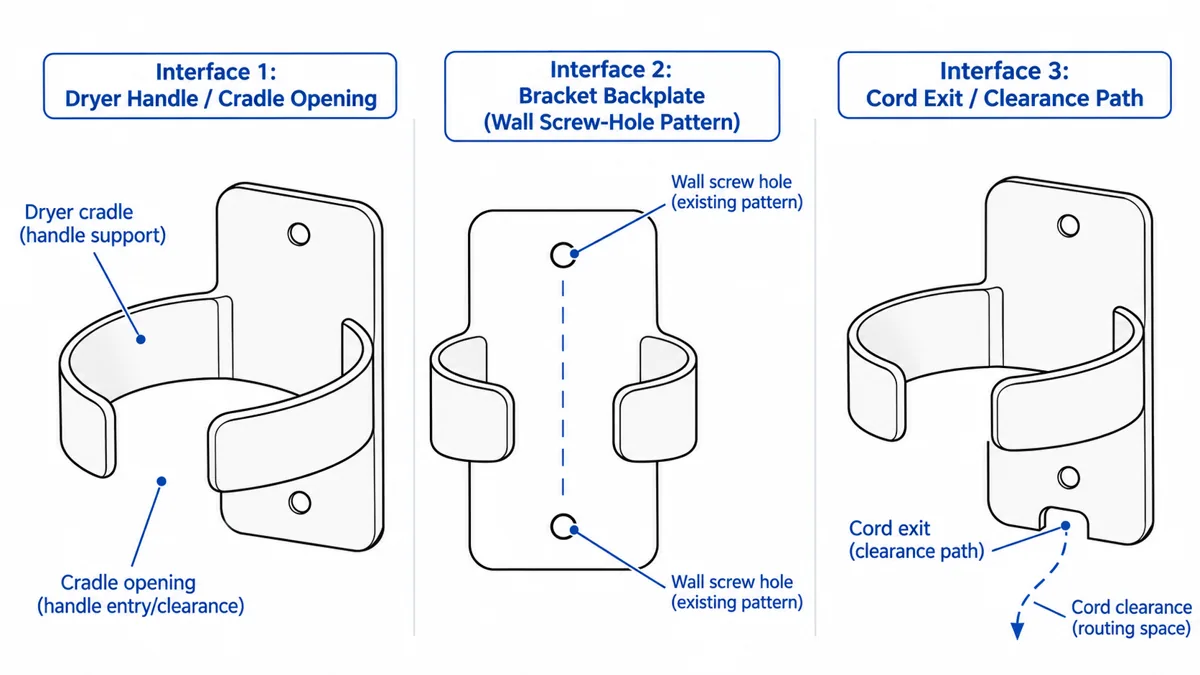
The review worksheet should tie the three interfaces to one configuration. A compact row can contain:
| Record field | What to capture |
|---|---|
| Dryer identity | Maker, model, revision, asset or part code, source |
| Holder identity | Maker, part code, drawing revision, passive/electrical classification |
| Contact interface | Orientation, support points, insertion/removal path, observed interference |
| Wall interface | Existing reference, hole pattern, finish footprint, project owner |
| Cord interface | Exit direction, slack/route input, any separate retention feature |
| Sample evidence | Sample ID, date, reviewer, photographs, open points |
| Status and scope | Exact approved configuration and excluded claims |
Treat this as a buyer record template rather than a universal engineering form. The hotel may add fields required by its quality system. Do not invent numerical acceptance limits; define them from the product and project requirements with the responsible technical parties.
For every observed issue, distinguish description from disposition. “Handle touches opening during insertion” is an observation. “Supplier to revise opening per drawing revision B” is a disposition. “Will fit all dryers” is an unsupported generalization unless a defined model family and evidence support it. Keeping those statements separate improves clarity during supplier communication.
Manage sample shipments and handling
When the buyer ships a dryer, existing holder, or other reference item to a supplier, the project should define ownership, identification, packaging, return or disposal, and handling. The supplier should not receive an unmarked appliance and infer which model matters. The buyer can attach a non-damaging tag or reference sheet showing the asset code and configuration, subject to its own property rules.
For sensitive or valuable appliances, a controlled drawing and maker documentation may be preferable to shipping the unit. If physical review is necessary, document the item’s condition at handoff and return. Do not use the sample to perform electrical operation or heating tests unless the relevant owner has established a safe, qualified test procedure. The bracket fit review described here is passive mechanical observation only.
Sample photos should include the bracket code and dryer identity in the frame or accompanying log. Avoid publishing property room details, guest information, security-sensitive layouts, or confidential asset records. A buyer may share anonymized evidence with suppliers while preserving its own internal identifiers.
If the physical reference differs from the final production appliance, record that limitation. A bracket developed around a temporary sample should remain conditional until the intended model is checked. Procurement should not release a broad rollout based only on a provisional sample note.
| Buyer input | Record before approval |
|---|---|
| Named product or component | Exact model, code, and revision |
| Interface or project condition | Reference sample, drawing, or site input |
| Evidence and owner | Source, reviewer, and unresolved questions |
| Release status | Approved scope and excluded claims |
Set an approval and escalation path
A replacement project benefits from naming decision owners before the RFQ. Procurement may own scope and commercial terms; the appliance owner may confirm model identity; engineering or the bracket supplier may review passive geometry; facilities or a qualified installer may assess wall fixing; and the hotel’s electrical professional may own all electrical questions. These assignments vary by organization, so the buyer should write down the actual names or roles.
Define which party can accept a sample, approve a drawing revision, close a compatibility question, and release a purchase order. A supplier’s manufacturing approval does not automatically represent the hotel’s field or electrical approval. A purchasing email that says “looks good” may be insufficient if it does not identify the reviewed model, revision, or criteria.
Escalate when the bracket appears to include a switch or electrical connection, when the dryer cannot be identified, when the wall interface differs from the documented pattern, when a cord route is unclear, or when a proposed feature is described as anti-theft without supporting evidence. The escalation should pause only the affected decision, while other unrelated procurement information can continue to be prepared.
Record closure in the same controlled file as the open issue. If the buyer accepts a deviation, identify the person authorized to do so and the configuration it affects. Do not allow a temporary workaround or one-room exception to become a silent standard for every property.
Product Fit and Specification
Buyer checks for hotel hair dryer replacement wall bracket
Coordinate finish and appearance across room programs
Even when fit is acceptable, a visible metal holder may not match the existing bathroom accessories or room palette. Provide a controlled finish reference, identify the visible faces, and state whether the target is a visual match, a specified color, or a functional metal finish. Those are different requests. A digital color sample or supplier photograph may support discussion but should not be treated as a final appearance approval unless the project accepts it as such.
If the original unit is plastic or a coated metal assembly and the replacement concept uses a different material, record the appearance and cleaning expectations. Do not infer corrosion resistance or chemical compatibility from color or gloss. The hotel’s cleaning products and procedures should be identified by the project owner, and any compatibility claims need appropriate evidence.
For multi-property programs, decide whether one finish will be used everywhere or whether regional/brand variants require separate codes. Separate finishes can affect samples, packaging labels, minimum production quantities, and reorder planning. The procurement team should make this decision before approving a single sample as representative of all versions.
Keep installation responsibility visible in commercial documents
The RFQ, quotation, drawing, and purchase order should identify where the passive bracket supplier’s scope ends. The supplier may quote a metal part and its packaging. The buyer must specify whether any screws, cover plates, spacers, or other components are included. If included, list them and state the project’s source for their selection; do not let an assumed screw set imply suitability for every substrate.
The installer or project owner determines the actual fixing method and site acceptance. If a buyer needs holes to align with an existing plate, provide the controlled reference and ask the supplier to document the bracket pattern. That is a geometry request, not permission for the supplier to decide that a wall can safely support the installation.
Commercial documents should also separate delivery of the bracket from appliance service, electrical work, wall repair, and security obligations. If a hotel expects any of those activities, assign them to the responsible party and describe the separate evidence required. This avoids a dispute where the bracket vendor is assumed to have approved work outside its supply scope.
For import programs, agree on packaging quantities, part identification, and carton labeling. A replacement holder can be confused with an entire hair dryer if the SKU name is vague. Include the compatibility scope and the fact that appliance or fixing components are excluded when that is the case.
Spare-parts strategy for a multi-property buyer
A spare strategy should reflect actual installed variants. Count confirmed configurations, estimate service demand using the hotel’s own maintenance data where available, and avoid pooling different brackets under a single item code simply because they look similar. The article does not supply failure rates or demand benchmarks; the buyer should use its own records.
For each spare SKU, record the associated bracket drawing revision, finish, included components, and named compatible dryer scope. If one bracket is approved for multiple dryer versions, preserve the basis for that approval. If compatibility remains unknown, maintain a separate status and do not ship it as a known replacement.
The hotel can decide whether parts are stocked centrally, held by a distributor, or ordered per repair. That decision depends on property count, lead time, service model, and internal inventory policy. If a supplier offers a replacement kit, itemize its contents and identify any pieces that are model-specific. A kit label should not imply installation suitability beyond the buyer’s defined scope.
For discontinued configurations, decide whether to maintain the old part, convert rooms to a new configuration, or replace the full appliance. Each option has different maintenance and procurement consequences. Compare the actual costs and operational constraints rather than assuming a new bracket is always the simplest or least expensive answer.
The return process should identify the old code, reason for replacement, room type, and condition if the hotel uses those records. If field reports show repeated fit issues, update the compatibility matrix and supplier change request. A buyer should not use anecdotal maintenance notes as proof of a product-wide defect without reviewing their representativeness and cause.
Practical rollout plan
- Define the population. Identify properties and room types in scope and list known dryer/holder variations.
- Resolve identity gaps. Obtain model codes, drawings, or approved field observations for each distinct configuration.
- Classify the old unit. Confirm whether the scope is passive metal support or includes electrical functions owned elsewhere.
- Freeze the buyer brief. State contact geometry, wall reference, cord-route inputs, finish, packaging, and included components.
- Request evidence. Ask for model-specific compatibility information and a controlled bracket drawing.
- Review a paired sample. Record the exact dryer, holder revision, review conditions, observations, and excluded claims.
- Close installation questions. Route wall and electrical decisions to the qualified project owners.
- Approve controlled scope. Release only the configurations represented by the approved evidence.
- Label and stock parts. Tie cartons and spare records to exact bracket and compatibility codes.
- Review changes. Reassess after any relevant dryer or bracket revision.
This sequence is not a test standard; it is a procurement workflow to prevent an unverified product name from becoming a blanket fit statement.
Cost and schedule questions buyers should ask
A replacement bracket may be quoted as a standard item or a custom metal component, but a buyer should compare like-for-like scope. Include material, finish, mounting pattern, packaging, sample work, included hardware, quantity, delivery terms, and required documentation. Do not infer a price premium or saving from the fact that the product is metal or model-specific.
If the existing hole pattern needs to be reproduced, the buyer should provide controlled dimensions and clarify who approves the drawing. A new pattern, cover plate, or cosmetic footprint can add development steps, but actual effects depend on design and supplier process. Ask the supplier which design inputs are needed before a firm quote and whether a provisional quote relies on assumptions.
The schedule should identify sample review, revision closure, production release, and any field trial or project approval owned by the buyer. The supplier’s manufacturing lead time does not necessarily include the hotel’s internal review, appliance procurement, installation coordination, or site access. Keep those activities visible so the purchasing date reflects the whole project path.
When a buyer compares several suppliers, use a common RFQ matrix and note exclusions. One quote may include packaging or samples while another assumes buyer-provided references. A lower headline number cannot be interpreted as lower total cost without scope normalization and actual commercial terms.
Sample Review and Change Control
Documenting a mismatch without overclaiming
If the sample does not fit, document the exact pair and the observed condition. State whether the issue involves insertion, resting position, removal, wall alignment, cord route, finish, or visual footprint. Include the sample ID and drawing revision. Avoid vague descriptions such as “bad fit” that do not help a supplier identify the affected feature.
Separate objective observation from cause. A bracket may not accept a dryer because the wrong model was supplied, the sample used the wrong revision, or the geometry differs. The evidence may not identify which explanation is correct. The next step is to verify identity and compare controlled references before changing the design.
A mismatch record should say what evidence would close the issue: corrected model label, updated drawing, new sample, maker compatibility statement, or installer review. If the issue is electrical, structural, security-related, or site-specific, route it to the relevant qualified owner. Do not revise a passive bracket to compensate for an unverified appliance or wall assumption.
The supplier response should identify the proposed change and revision. The buyer then decides whether to inspect a new sample, approve a drawing-only change, or retain the original configuration. The type of evidence depends on the changed interface; do not create a universal rule that every small revision needs the same test.
A concise buyer checklist
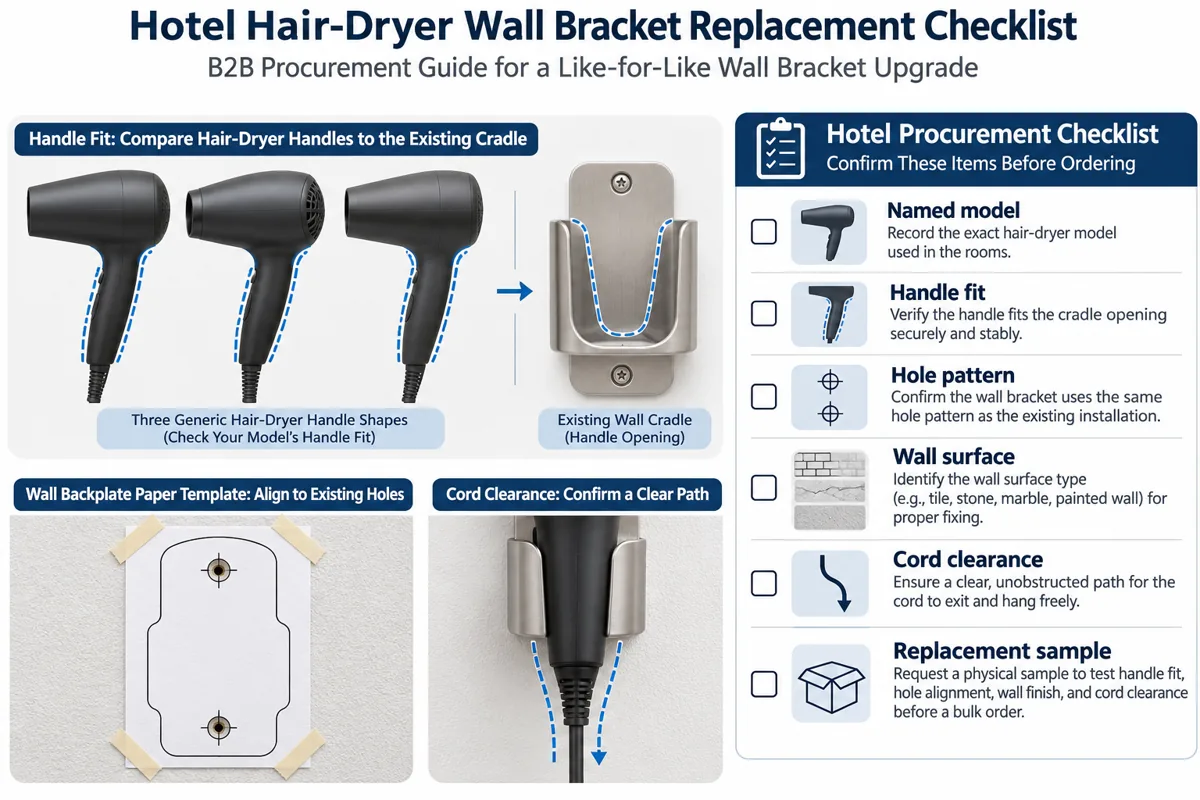
Before an RFQ, confirm that the brief names:
- The target buyer and hotel/property scope.
- Exact dryer maker, model, revision, and source.
- Whether the old wall unit is passive or electrically functional.
- The dryer contact surfaces and insertion/removal orientation.
- The existing bracket code and controlled mounting reference.
- Cord exit and route information from the responsible project owner.
- Finish, cosmetic faces, cleaning inputs, and packaging needs.
- Whether screws or other fixing pieces are included.
- Sample evidence required and who can approve it.
- Compatibility status terminology and the exact approved scope.
- Change notification and replacement SKU rules.
- Questions assigned to installer, appliance maker, or electrical professional.
If those inputs are incomplete, the buyer can still request an information-only feasibility discussion, but the supplier should mark assumptions and avoid a final compatibility claim. This distinction protects both the buyer and supplier from confusing concept review with final approval.
More questions hotel procurement teams ask
What evidence is enough to list a holder as compatible?
The hotel should define its acceptance basis. It may require a dryer-maker compatibility statement, controlled dimensional review, or a paired physical sample. The evidence must identify the actual models and revisions; a general product category is not enough.
Is a photograph enough to reproduce an old mounting pattern?
A photograph can help identify the arrangement but usually does not provide controlled dimensions or prove site conditions. The responsible party should provide or verify the mounting reference and decide how the new pattern is accepted.
Should a hotel keep the old bracket for comparison?
If property procedures allow, retaining a labeled reference part can help compare geometry and finish. It should be identified by location and removed only by authorized staff. Keeping it does not prove it is safe or suitable for reuse.
Purchasing Questions and Practical Decisions
Can a distributor certify the replacement for the hotel?
A distributor can provide product and supplier documentation within its role, but the hotel should name who owns appliance compatibility, wall installation, electrical matters, and final project acceptance. “Certified” should not be used without a defined authority and evidence.
What if the supplier’s model list is not current?
Ask the supplier to identify its document date and revision, then confirm with the appliance maker or a paired sample. Record the unresolved status until the project owner accepts current evidence.
Do different finishes require separate compatibility approvals?
They may share the same geometry, but the buyer should confirm whether finish buildup or surface treatment affects contact or opening dimensions in the specific design. Do not assume all cosmetic variants are identical without supplier confirmation and relevant sample review.
Can a bracket be sold as a universal replacement?
Only if the supplier defines the supported model range and evidence. “Universal” by itself is too vague for a hotel procurement record and may conceal exceptions.
How long should the hotel retain the sample record?
Follow the buyer’s document-control and service-parts policy. The record should remain available for as long as the hotel relies on the compatibility approval and needs to identify revisions, but this article does not prescribe a regulatory retention period.
Closing decision
The buyer’s goal is a controlled replacement scope. First establish the installed dryer and holder population. Then confirm the passive-versus-electrical boundary, the three mechanical interfaces, and the responsible owners. Review the exact sample, record the compatibility status narrowly, and link every spare SKU to the approved configuration. This provides a repeatable purchasing path without assuming that appearance, product naming, or one sample proves universal fit.
For a metal bathroom hardware concept, share the controlled drawing, exact dryer reference, mount information, cord-route input, finish specification, and quantity plan. Koitor can discuss custom metal parts within its confirmed product scope; it does not claim a specific hotel replacement bracket, appliance compatibility, installation approval, or security performance. See the custom bathroom hardware manufacturer page oder Kontaktieren Sie Koitor.
Review a Hotel Bracket Interface Before Sampling
Share the dryer model and revision, bracket drawing, wall-mount reference, cord route, finish target, and quantity plan. Koitor can discuss metal-part feasibility; appliance and installation approvals stay with their responsible project owners.
OEM / EIGENE MARKE
Verwandeln Sie diesen Beschaffungsleitfaden in ein Produktdossier
Teilen Sie uns Ihr Zielprodukt, die Größe, die Oberflächenausführung, die Bestellmenge und Ihre Verpackungsanforderungen mit. Ihr Team erhält vor der Angebotserstellung eine praxisorientierte Prüfung der Herstellbarkeit.
 English
 Español
 Português
 Français
 Deutsch
 العربية