
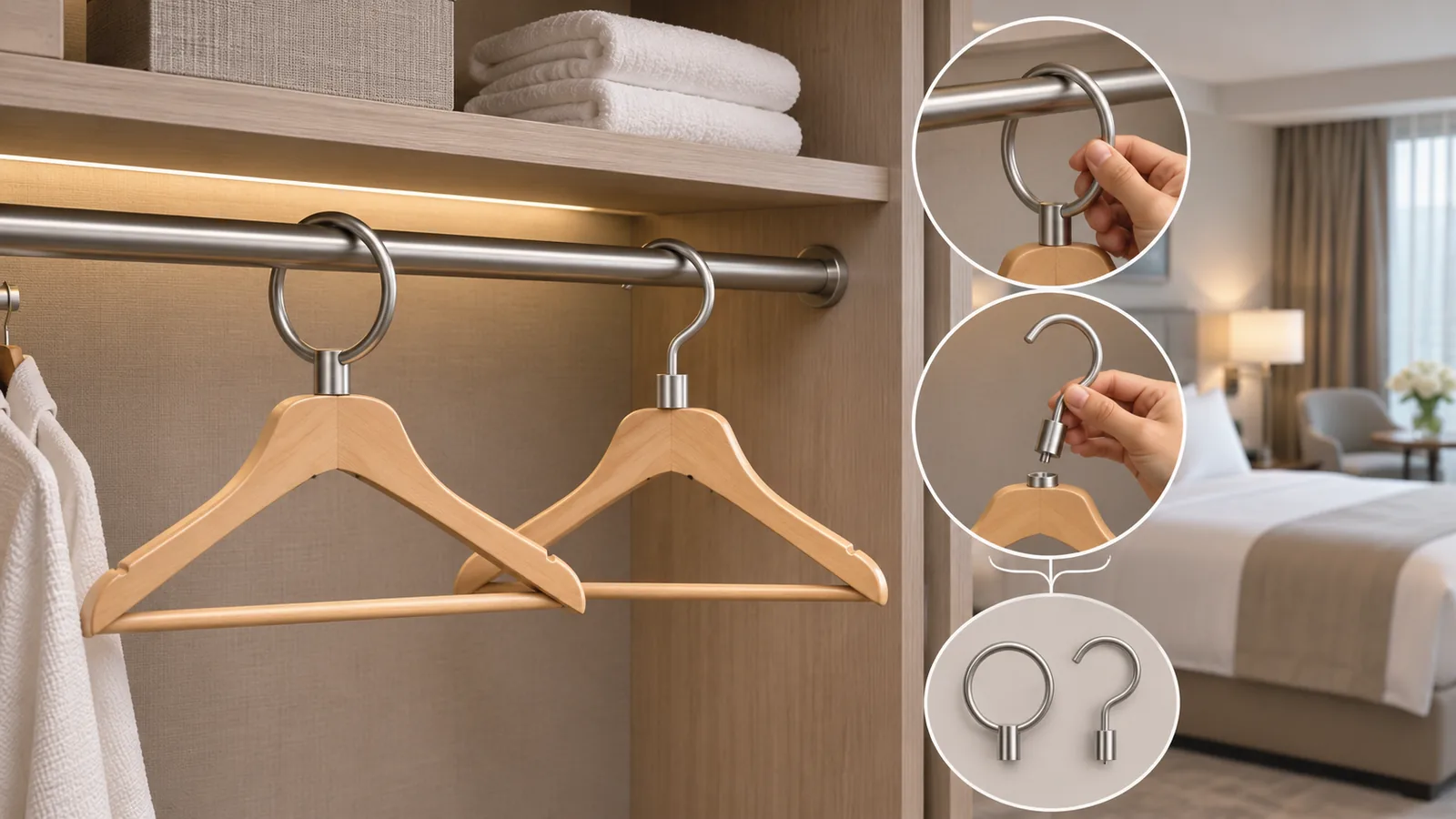
Hotel hanger ring compatibility depends on three connected interfaces: the wardrobe rail and its installation access, the ring’s approved opening or attachment, and the mating hanger head. A ring that appears to fit a rail may not accept the intended hanger, and a correctly paired ring may still be impossible to install on an inaccessible fixed rail. Buyers should approve a named rail, ring, and hanger combination on a physical reference assembly, then describe only the compatibility actually documented. This guide does not provide security, anti-theft, load, or tamper-resistance claims.
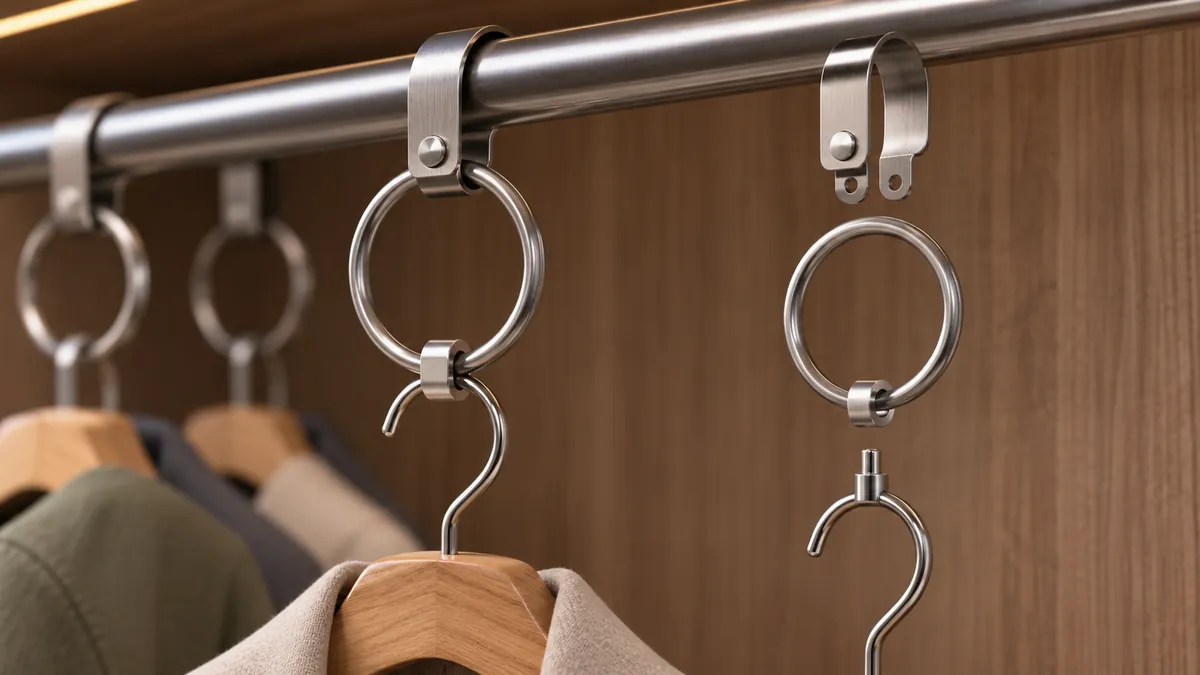
Why is the rail, ring, and hanger a three-part system?
Hospitality buyers may source hanger rings as part of a new room set or as replacement parts for an existing wardrobe rail. In either case, “hanger ring” alone does not define the interface. The rail may be removable or fixed; the ring may use a particular opening or attachment architecture; and the hanger head must seat in the intended ring. If any of these components is described only by a broad category name, a quotation can omit the detail that determines installation and use.
Commercial catalogs show product-specific distinctions. One supplier describes an A-ring intended for a new installation with a removable dowel and a defined hanger-head family. Another listing describes a B-ring for an existing, non-removable dowel. These A/B names are that supplier’s catalog terms; they are not a universal industry standard. The examples demonstrate why buyers should identify the actual rail access and paired hanger rather than assume a naming convention or copy a catalog’s fit statement across brands. Hotel hanger ring compatibility therefore depends on the quoted rail, supplier-specific ring, and matching head—not on the letter used in one product family.
“Anti-theft” may appear in a product category name, but it is not evidence of theft prevention, tamper resistance, or security certification. This article focuses only on component identity and mechanical fit. Buyers should not infer security performance from the presence of a ring or a restricted hanger head.
What information belongs in a retrofit survey?
Before requesting a replacement ring, identify the installed rail and determine whether the responsible property or maintenance team is permitted to remove or access it. Record the rail cross-section or diameter using a reliable drawing, current supplier reference, or physical inspection. Include its finish and mounting configuration where those details affect access. Do not guess a dimension from a photograph or dismantle a fixed installation without authorization.
Next, identify the existing ring and hanger head. Record their supplier or model references, revision if known, and whether the ring is solid, split, captive, or another documented design. Use the supplier’s approved drawing and instructions for installation. Do not infer an installation method from a product photo or explain how to defeat, bypass, or alter the mechanism. If the rail cannot be accessed under the existing installation, raise that constraint with the responsible supplier and site team before selecting a replacement.
The hanger head deserves its own reference. A similar-looking hook or pin may not seat in the same ring. Capture the relevant geometry from a controlled drawing or a sample approved for comparison. Note the seat, neck, or contact feature shown by the supplier and observe the actual engagement only under the current authorized instructions. The buyer should not assume cross-brand interchangeability because two components share an approximate nominal size.
Also confirm the purchasing scope. Is the order for rings only, complete hangers, rail assemblies, or a spare kit? State the number of rings per room or pack, included components, and labeling. Hotel properties may need replacements over time, so the spare-part identity should map to the installed product model and approved revision.
| Survey field | What to capture | Warum das wichtig ist |
|---|---|---|
| Existing rail | Profile, size source, finish, and access condition | Identifies the installed interface and retrofit constraint |
| Ring | Supplier/model, revision, opening design, and finish | Prevents category names being mistaken for dimensions |
| Hanger head | Exact reference and mating feature | Confirms the paired component rather than the rail alone |
| Installation scope | New rail, removable rail, or fixed inaccessible rail | Determines what supplier instructions apply |
| Supply scope | Ring-only, hanger, rail, or complete room kit | Aligns quote, pack, and order quantity |
| Evidence boundary | Observed fit, exclusions, and separate load/security claims | Keeps compatibility separate from performance claims |

How should hotel hanger ring compatibility be approved?
Use the actual rail reference, ring, and hanger head for the proposed configuration. Confirm the revision and component identity against the quote before testing. Where the installation uses a fixed rail, do not improvise a disassembly procedure. The responsible supplier should provide applicable instructions, and the property team should authorize any work on the installed fixture.
Following the supplier’s current instructions, observe whether the ring can be assembled to the named rail and whether the hanger head seats in the intended position. Check the intended movement along the rail and the removal or replacement sequence described by the supplier. Record interference, assembly limitations, and whether tools or access are required. Do not force the ring, alter a component, or substitute a hanger head to make the sample pass.
Photograph the rail-ring-head combination from consistent views. Note sample ID, supplier references, dimensions taken from controlled sources, and any approved exceptions. If the sample is only a loose bench assembly rather than the installed wardrobe system, say so. A bench fit does not establish feasibility in an inaccessible hotel installation.
A successful pairing confirms only what was observed for the named parts and conditions. It does not prove retention strength, supported garment load, long-term wear, finish life, corrosion performance, or security. Those require separate product-specific evidence from the responsible manufacturer. Do not assign a force, number of cycles, load, or theft-prevention level without a qualified method and documented result.
If the property is replacing an installed component, review whether the reference rail represents the actual site configuration. A loose sample rail can make assembly access straightforward, while a fixed wardrobe rail may prevent the same installation. Record that distinction and route any unresolved access question to the property’s maintenance or installation team. Do not improvise a removal method or tell hotel staff to modify a fixture based on a compatibility article.
Which ring details should not be generalized?
Catalog labels such as A-ring and B-ring belong to the supplier that uses them. One catalog may use those labels to distinguish new-installation access from retrofit access, while another supplier may use different terms or dimensions. Do not call one style an industry-wide standard or assume a ring from a different brand follows the same naming. Quote the supplier’s part number and drawing revision.
Finish descriptions also need verification. A category title may mention galvanized metal, but the quoted component may have a product-specific finish or variant. Confirm the actual substrate and finish from the current specification rather than applying a generic category claim. Appearance alone does not establish corrosion resistance, coating thickness, or service life.
The ring and hanger head may be sold separately. A replacement listing that shows the ring by itself does not mean a hanger is included. Check the BOM, pack count, and retail description. If a hotel distributor sells a kit, specify how many complete pairs are included and how each ring is identified for later replacement.
Avoid claiming that a particular ring prevents theft. Supplier catalog language is not a verified security assessment. The hotel buyer should use the maker’s current product documentation and any relevant qualified security evidence if that feature is a commercial requirement. This article neither teaches mechanism bypass nor makes a security conclusion.
What are common retrofit and purchasing mistakes?
The first mistake is measuring only the rail. Rail fit is one interface; hanger-head fit is another. A replacement may mount to the rail yet fail to accept the installed hangers. Keep both pairs on the approval record. If the supplier changes the ring, hanger head, rail, or finish after approval, compare the revised part identifiers with the accepted sample. A change to one interface may leave another unchanged, but buyers should not assume that without checking. Update the approved pairing matrix and any spare-part label or listing. This is especially important when separate purchase orders are used for rings and hangers, because a replenishment order may otherwise repeat an older, incompatible pair.
The second mistake is ignoring installation access. A ring intended for a removable dowel may not be appropriate for a fixed, inaccessible rail under the existing site conditions. Do not choose based only on a product name. Ask the supplier to confirm the architecture and installation condition, then coordinate with the site team.
Another mistake is assuming cross-brand interchangeability based on photographs or broad dimensions. Similar profiles may conceal different openings or seats. Require a drawing comparison or authorized physical sample. If the evidence is incomplete, mark compatibility as unconfirmed.
Buyers may also mistake the number of ordered rings for the number of complete hanger sets. Confirm whether the quote includes matching heads, rails, fasteners, and any accessories. Ensure product images and packaging reflect what is actually delivered.
Finally, do not translate a fit review into load or security approval. A ring that engages a hanger does not prove it will retain a specific garment, resist removal, or meet a property’s security requirement. Scope those claims separately and obtain the appropriate evidence.
How can an OEM project discussion be kept in scope?
Koitor Hardware is a family-owned custom metal hardware manufacturer specializing in bathroom and home storage hardware. Current hotel hanger ring or hanger production, specialty security mechanisms, wood or plastic hanger manufacture, and theft-resistance testing are not confirmed. A buyer should not assume that Koitor offers a stock ring system. Any adjacent metal concept needs a project-specific feasibility and component-sourcing review.
For an inquiry, provide a lawful rail drawing or reference, the existing hanger head, installation-access constraint, selected ring architecture, finish direction, quantities, and packaging requirements. Identify which components are purchased from a specialist supplier and who controls the mating geometry and instructions. Ask the metal supplier to confirm the actual part or process it can undertake and which security or load claims are out of its scope.
The existing closet rod socket guide addresses rod-to-socket retention and intentional rod removal, not the ring-to-hanger head interface. A closet valet rod guide concerns cabinet mounting and pull-out movement. Koitor’s OEM home storage hardware page describes general supplier scope; it does not confirm this adjacent hotel hanger product. Confirm feasibility and responsibilities before making an availability claim.
What should the buyer include in an approval request?
- Existing rail profile and the reliable source of its dimensions.
- Whether the rail can be removed and what installation access exists.
- Ring supplier, model, revision, opening architecture, and finish.
- Mating hanger-head reference and documented seat or contact feature.
- Current supplier assembly instructions for the intended condition.
- Sample ID, observed fit, movement, removal, and any site constraint.
- Ring-only versus complete hanger or room-kit scope and pack count.
- Replacement mapping to the installed model and revision.
- Separate evidence requirements for load, durability, corrosion, and security.
- Clear exclusions for unreviewed brands, rails, hanger heads, or installation conditions.
Häufig gestellte Fragen
Does an A-ring or B-ring mean the same thing across suppliers?
No. These names may be supplier-specific. Use the exact model, drawing, and installation instructions for the quoted component.
Will a ring that fits the rail fit every hanger?
Not necessarily. Confirm the actual hanger-head interface as well as the rail-to-ring fit.
Can a replacement ring be installed on a fixed rail?
It depends on the product architecture and site access. Follow the responsible supplier’s current instructions and confirm any work with the property team.
Does a ring prove anti-theft performance?
No. A category label does not establish security performance. Request current product documentation and qualified evidence for any required claim.
Does Koitor currently offer hotel hanger rings?
No current ring or security-hanger product capability is confirmed. A buyer can submit a lawful interface brief for project-specific feasibility discussion.
Discuss a Defined Hospitality Hardware Brief
Share a lawful rail reference, mating hanger head, installation-access constraints, component responsibilities, and packaging scope for a feasibility review.
OEM / EIGENE MARKE
Verwandeln Sie diesen Beschaffungsleitfaden in ein Produktdossier
Teilen Sie uns Ihr Zielprodukt, die Größe, die Oberflächenausführung, die Bestellmenge und Ihre Verpackungsanforderungen mit. Ihr Team erhält vor der Angebotserstellung eine praxisorientierte Prüfung der Herstellbarkeit.

 English
 Español
 Português
 Français
 Deutsch
 العربية