

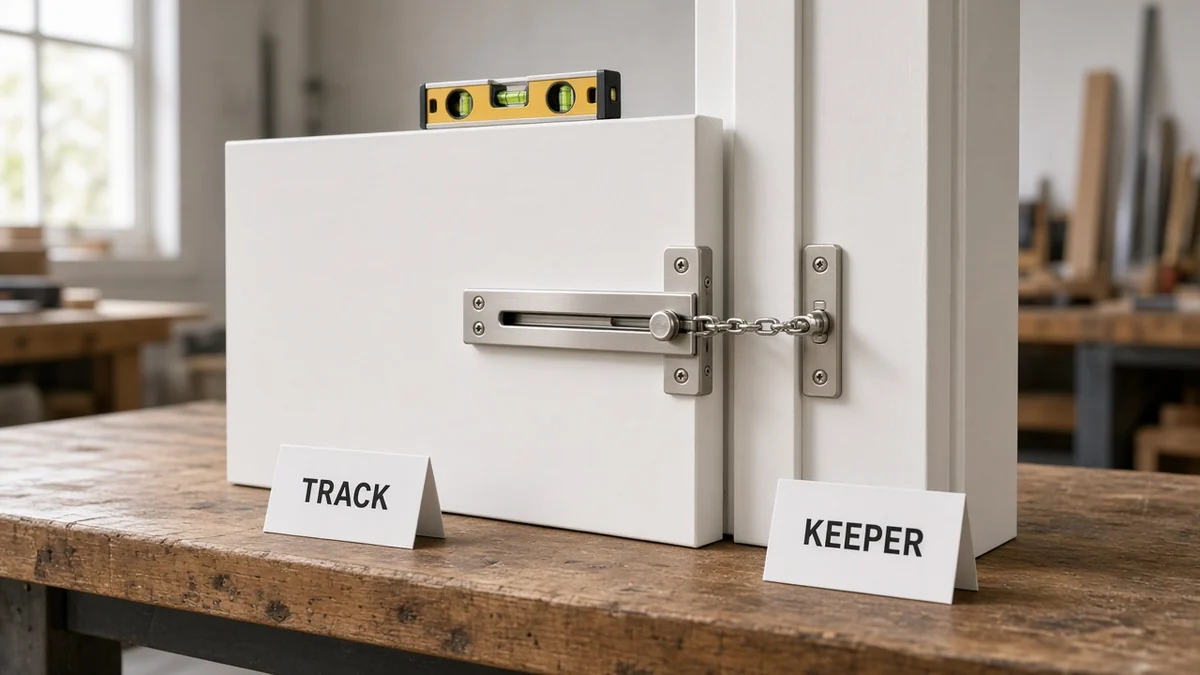
An install sheet can only explain how to install a door chain once it names the parts in the packed kit and the door and frame they are meant for. A door chain guard is usually three parts: a slide track fixed to the door face, a chain with a knob or end piece, and a keeper fixed to the frame. The chain end slides in the track and the other end is anchored at the keeper.
The parts only work together when the track and keeper are aligned so the chain slides freely and engages fully. Most install problems come from fixing the keeper first in a convenient spot and then finding the track will not line up, or from screws that do not suit a hollow or metal door. The sheet prevents that by naming the kit and the stack first.
This guide is for importers, distributors and private-label teams selling door chains or door hardware sets. Koitor Hardware is a family-owned China OEM manufacturer of custom metal bathroom and home storage hardware. The guide covers the install sheet. It makes no security-performance claim, and it does not cover storm-door wind chains.
Neighboring door hardware has its own first-hang guides. The published how to install a door peephole und how to install a door knocker guides cover those products. This page covers only the chain guard.
What does how to install a door chain depend on first?
It depends on the packed kit and the door and frame stack. The kit decides how the parts mount and which way the track runs. The stack decides whether the packed screws will hold and where the parts can physically go.
Door chain kits vary. Some have a track that mounts on the door face with the chain fixed at the frame; others reverse that arrangement. The track may run horizontally or at a slight angle. Some kits include a key-operated chain release; others do not. The sheet must describe the kit that was packed.
The stack is the door and frame material and construction at the mounting points. A solid timber door and frame take wood screws well. A hollow-core door has thin skins and little to screw into away from its edges. A metal door may need different fasteners. A frame with a thin casing over a stud may need longer screws to reach solid material.
For a brand, the question is what the listing promises. “Easy to install” assumes the packed screws suit the buyer’s door and frame. If the kit only includes short wood screws, buyers with metal or hollow doors will need other fasteners. The sheet should say which stacks the packed fixings are for.
Start the sheet with a kit block: photos of the track, chain and keeper, the screws supplied for each, and any spacer or reinforcement plate. Then add a stack block listing the door and frame types the packed screws are intended for, in the supplier’s words. If a stack is not covered, say so.
Where on the door the chain goes
Door chains are usually fitted at a convenient height on the lock side of the door, near the existing lockset, with the track on the door face and the keeper on the frame casing. The exact height is the owner’s choice within the limits of the door’s construction and the supplier’s drawing. The sheet should not invent a standard height.
How are the track, chain and keeper aligned?
Alignment is the heart of the sequence. The chain must slide along the full length of the track and reach the keeper without being so tight that it binds or so loose that it does not engage. A typical documented sequence fixes one part, then uses the chain itself to locate the other.
Fix the keeper or the track first, as documented
Many supplier sheets fix the keeper on the frame first. With the chain anchored at the keeper, the door is closed and the chain end is held where it will sit in the track. The track position is then marked on the door. Other sheets reverse the order. The sheet should copy the supplier’s order.
Mark with the chain engaged
The key step is marking the second part with the chain engaged. If the track is placed by measurement alone, a small error leaves the chain too short to reach the track end or too slack to hold. Marking with the chain in place sets the correct position for that specific door.
Keep the track level and clear
The track should be level or at the angle the supplier specifies, and clear of the door edge, the lockset and any trim. A track that overhangs the door edge or sits on a raised panel will not seat flat. The sheet can tell the user to check flatness before drilling.
Drill pilot holes as documented
Pilot holes help screws hold and prevent splitting, especially near door edges. The sheet should give pilot hole sizes only if the supplier documents them. Otherwise, it can say that pilot holes suited to the screws and the material should be drilled, without inventing a size.
Test before finishing
With all screws in, the user should slide the chain along the track, close the door, engage the chain and open the door to the limit of the chain several times. The chain should run smoothly and the door should stop where expected. If it binds, recheck alignment before tightening further.
Why the chain length matters
Chain length sets how far the door opens when the chain is engaged. A chain that is too long lets the door open wider than the owner expects; one that is too short may not reach the track end at all. Length is fixed by the kit, so the alignment step has to work with the chain supplied rather than adjust it.
If the supplier offers kits with different chain lengths, the sheet should name the length in the kit block and show the resulting opening only if the supplier documents it. The sheet should not suggest cutting or adding links, which changes the product.
Inswing and outswing doors
Most door chains are designed for doors that swing inward, with the track and keeper on the inside face. Outswing doors place the hardware differently and may not suit a standard chain guard. The sheet should state which swing the kit is designed for and exclude the other unless the supplier documents it.
Doors with weatherstrip and thick casings
Weatherstrip and deep casings change the distance between the door face and the frame face. If the keeper sits on a casing that projects beyond the door face, the chain angle changes and the track may need a spacer. Some kits include spacers for this reason. The sheet should show when and how to use them, as documented.
What should a door chain install sheet list?
A complete install sheet is mostly the kit block, the stack block and a short sequence. The table is a template. It carries no screw lengths or strength claims, because those belong to the supplier’s drawing for a named kit.
| Field | What to write | Source |
|---|---|---|
| Kit parts | Slide track, chain with end piece, frame keeper, and any spacer or plate | Packing list and drawing |
| Fixings packed | Screws for each part, with type and finish | Packing list |
| Stacks covered | Door and frame types the packed fixings are intended for | Supplier sheet |
| Mounting side | Which part goes on the door and which on the frame | Supplier drawing |
| Alignment step | Fix the first part, engage the chain, mark the second part | Supplier sheet |
| Clearance check | Lockset, trim, panel edges and door swing | Supplier sheet; general practice |
| Test step | Slide, engage and open to the chain limit | Supplier sheet |
| Exclusions | Storm-door wind chains, fire-rated doors, and any security rating | Brand policy |
Screws and door construction
The screws are where most installs fail. Short screws in a hollow-core door pull out easily, and screws in a frame casing may not reach the stud behind it. The sheet should state what the packed screws are for and advise the user to choose suitable fasteners for other constructions, without naming lengths the supplier has not documented.
Metal doors
Metal doors may need self-tapping screws or a different fixing method, and some have reinforcement only in certain areas. If the supplier does not cover metal doors, the sheet should list them as needing project-specific fixings and give no drilling advice.
Doors with glass or decorative panels
Doors with glass panels or deep moldings may not have a flat area where the track can sit. The sheet should tell the user to confirm a flat mounting area before buying, and should not suggest mounting on glass or trim.
Keep parts and screws together
Chain kits contain small screws of different lengths for the door and frame. Packing them in labeled bags, and labeling them on the sheet, prevents users from putting short screws into the frame and long ones into the door edge. The hardware kit packing inspection checklist covers that control.
Finish and environment
Door chains on entry doors may face humidity, coastal air or cleaning chemicals. The finish should suit the environment, and the sheet can mention cleaning with a soft cloth if the supplier recommends it. It should not claim corrosion resistance beyond the supplier’s data.
Removing an old chain first
Many buyers are replacing an existing chain. The old screw holes may not line up with the new kit, and reusing them can leave the screws loose. The sheet can suggest filling old holes in timber before marking the new positions, or offsetting the new parts slightly, without naming a filler product.
Matching a chain to a lockset finish
Buyers often want the chain to match the lockset and hinges. Finish names vary across brands. A listing that shows the finish with a photo and the supplier’s finish code helps buyers match, and avoids returns caused by a “satin nickel” that looks different from the lockset beside it.
Which doors and claims must the sheet exclude?
A door chain is a convenience device that limits how far a door opens. It is often bought for peace of mind, which is why listings drift into security language. The sheet should describe the product honestly and exclude doors and claims it cannot support.
Security and forced-entry claims
A door chain’s resistance to a forced opening depends on the chain, the track, the screws and above all the door and frame it is fixed to. Unless the brand has tested a complete assembly and documented the result, the sheet should not use words like “secure,” “reinforced” or “break-in resistant.”
Door hardware in the United States is often graded under ANSI/BHMA standards. The Builders Hardware Manufacturers Association maintains those standards. A door chain sheet should not claim a grade unless the product has been certified.
Egress and life safety
In many commercial and multi-occupancy buildings, door hardware must allow occupants to leave quickly in an emergency. Life safety codes such as NFPA 101 address egress. The sheet should not claim a door chain is suitable for any door where egress rules apply, and should refer users to the building owner.
Fire-rated doors
Fire-rated doors are tested as assemblies, and adding hardware by drilling the door can affect the rating. The sheet should exclude fire-rated doors and refer users to the building owner or door supplier.
Storm-door wind chains
Storm doors and screen doors often use a wind chain that stops the door blowing open too far. That is a different product with a different purpose. The door chain sheet should not include wind-chain steps or suggest the chain guard can do that job.
Where do related door hardware questions belong?
A chain guard sheet stays clear when it points to other documents for related questions.
A peephole lets the user see who is at the door before opening it. Its install steps belong on the door peephole install guide. A knocker is a decorative and functional item with its own install guide.
Door stops limit how far a door swings into a room, which is a different job from a chain guard. The types of door stops guide covers them.
Pull plates and other surface-fixed door hardware raise similar fixing-architecture questions. The door pull plate mounting page discusses confirming the fixing architecture before an RFQ, which is useful background for chain guard programs too.
Key-operated chain releases
Some chain guards include a keyed release that allows the chain to be disengaged from outside. Those kits have extra parts and a different sequence. The sheet should cover them only when that kit is packed and should copy the supplier’s steps for the keyed part.
Hotel and multi-unit programs
Hotels and apartment operators may install chain guards on many doors. In that setting, a maintenance card with the kit block, the alignment step and the exclusions is useful. Any building rules about door hardware remain the operator’s responsibility.
Accessibility and ease of use
Chain guards are operated by hand, often by older users or people with limited grip. A knob that is easy to hold and a track that releases smoothly matter more to them than appearance. The sheet can suggest mounting at a height the household finds comfortable and testing the release with the person who will use it most.
The sheet should not claim the product meets any accessibility standard unless the brand has evaluated it. Describing the operating action clearly, such as “slide the knob to the open end of the track to release,” is enough.
Children and the chain height
Some households fit chains high on the door so young children cannot reach them, or low so they can. That is a household decision. The sheet should not recommend heights for child safety, which would be a safety claim, and should leave the choice to the owner within the supplier’s mounting limits.
Documenting the install for rentals
In rental properties, a record of where the chain was installed and which screws were used helps when the door is repaired or the chain replaced. A photo kept with the property file is enough. The sheet can suggest it for landlords and property managers.
What must a door chain install sheet not print?
Check the sheet against this list before release.
- Security, strength or forced-entry claims without tested data for the full assembly.
- BHMA or other grades the product does not hold.
- Universal screw lengths or pilot hole sizes not in the supplier’s drawing.
- Suitability claims for fire-rated doors or doors subject to egress rules.
- Storm-door wind-chain steps.
- Mounting on glass, trim or decorative panels.
- Peephole or knocker steps copied into the chain sheet.
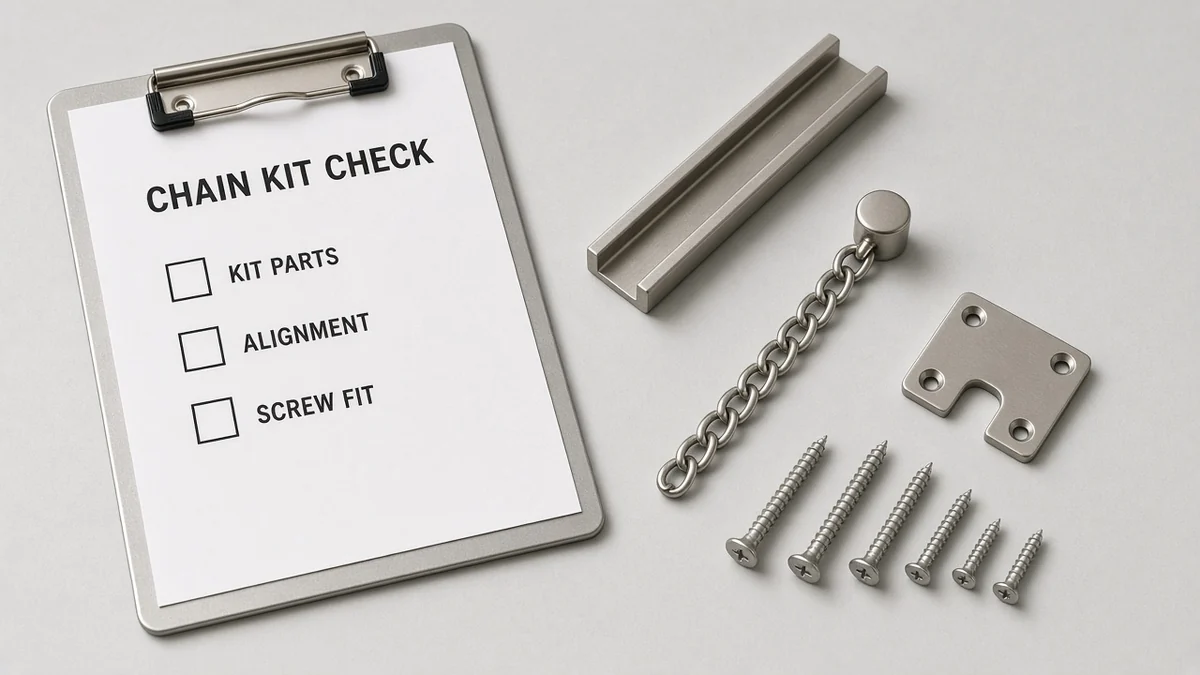
After the list check, install the kit on a sample door and frame following the sheet. If the chain slides, engages and stops the door as expected, the sheet is ready.
Translation and pictograms
Door chain leaflets often rely on drawings. The alignment step is the one to draw carefully: the first part fixed, the chain engaged, the second part marked. Keep that drawing in every language version.
Sign-off
The brand approves the wording and the supplier confirms the kit data. Koitor can review the install sheet against the packed kit and flag security language, missing stack notes or mixed products.
When to rewrite
If the existing sheet was written for a different kit, rewrite it from the kit and stack blocks. A short alignment sequence, a test step and the exclusions are enough for a complete sheet.
Frequently asked questions about door chains
Does the chain or the track go on the door?
It depends on the kit. In many kits the track is on the door and the chain is anchored at the frame keeper. The supplier’s drawing decides.
How high should a door chain be installed?
There is no single standard height. It is usually near the lockset on the lock side, at a height convenient for the users. Follow the supplier’s drawing and check clearance with the lockset.
Can I install a door chain on a hollow-core door?
Possibly, but the packed screws may not hold well in thin skins. Follow the supplier’s advice for hollow doors or use suitable fasteners for that construction.
Why does my door chain not reach the track?
The second part was probably positioned by measurement instead of with the chain engaged, or the keeper sits on a projecting casing. Recheck the alignment step and use any spacer the kit provides.
What tools do I need to install a door chain?
Usually a pencil, a drill with bits suited to the pilot holes and a screwdriver. A level helps keep the track straight. The supplier’s sheet should list the tools for the kit and any special bits for metal doors.
Can I reuse the old screw holes?
Only if they line up exactly and the screws bite firmly. Loose holes in timber should be filled and redrilled, or the new parts placed slightly away from the old holes.
Does a door chain stop someone forcing the door?
The sheet should not claim that. Performance depends on the whole assembly, including the door and frame, and needs tested data.
Is a door chain the same as a storm door chain?
No. A storm door wind chain stops a door blowing open. A chain guard limits how far an entry door opens. They are different products.
Does Koitor make door chains?
Koitor makes custom metal bathroom and home storage hardware and reviews install wording for parts in its programs. Whether a door chain is part of a specific program is confirmed on the packing list and quote.
Arbeiten Sie mit Koitor Hardware zusammen
Review a door chain install sheet
Send the door chain drawing, the packing list and the current install sheet. We can review whether the wording names the packed kit, the door and frame stack and the documented alignment. We will not issue a security rating or a forced-entry claim.
OEM / EIGENE MARKE
Verwandeln Sie diesen Beschaffungsleitfaden in ein Produktdossier
Teilen Sie uns Ihr Zielprodukt, die Größe, die Oberflächenausführung, die Bestellmenge und Ihre Verpackungsanforderungen mit. Ihr Team erhält vor der Angebotserstellung eine praxisorientierte Prüfung der Herstellbarkeit.


 English
 Español
 Português
 Français
 Deutsch
 العربية