
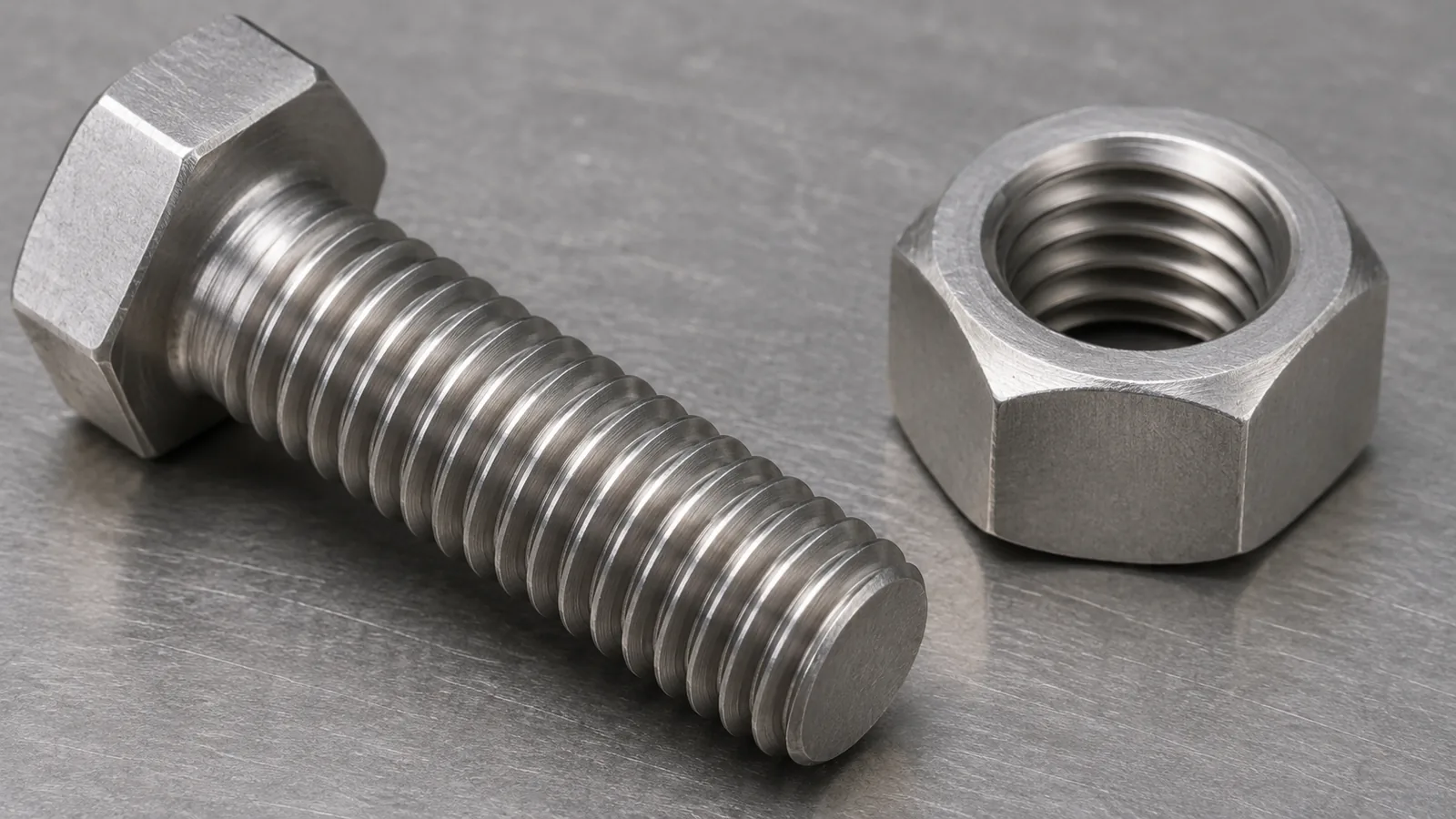
A left-hand thread is a helix whose direction is opposite that of an ordinary right-hand thread. In a sourcing query, “left hand thread” refers to that helix handedness, while the direction explanation also needs a fixed viewing point. For a simple screw entering a stationary, matching nut, look from the screw head along the screw axis toward the nut: a left-hand screw advances away from the observer when turned counterclockwise and backs out toward the observer when turned clockwise. If the same physical screw is viewed from the opposite end, the rotation labels reverse because the observer has changed sides. State the viewing point and which part is fixed before writing a turning instruction.
Thread hand describes the helix; it does not identify the thread diameter, pitch, fit class, material, fastener head or intended retention design. A left-hand male thread must mate with a suitable left-hand female thread of the correct thread family and size. Matching pitch alone is not proof of compatibility. For a hardware drawing, kit sheet or replacement request, record the complete designation and confirm the actual mating components rather than relying on a bare instruction such as “turn left.”
What Does “Left-Hand Thread” Mean?
The left-hand or right-hand label describes the direction in which the thread helix winds along the axis. It is a property of the thread form, not a statement that every fastener with a particular head or application turns the same way. A left-hand thread remains left-hand when a viewer changes position, even though the viewer may see the same rotation as clockwise from one side and counterclockwise from the other.
The simplest way to explain the distinction is to set one reference view. Imagine the screw head in front of you and the stationary nut farther away on the same axis. From that viewpoint, counterclockwise turning of a left-hand screw advances the screw away from you into the nut; clockwise turning backs it out. For the ordinary right-hand pair, the advance and retract directions reverse under the same viewing convention.
| Thread hand | Viewer position | Physical condition | Turning direction for advance |
|---|---|---|---|
| Left-hand | At screw head, looking toward the stationary nut | Screw advances away from viewer | Counterclockwise |
| Right-hand | Same view, same fixed mating part | Screw advances away from viewer | Clockwise |
This table is meaningful only with the viewing direction and the moving part stated. “Counterclockwise advances” is incomplete unless the reader knows where the observer stands and which component is turning. In an assembly, a nut may turn on a stationary screw, or both parts may be accessible from different sides. The physical relationship should be described before translating it into an instruction.
A useful verbal form is: “Viewed from the screw-head end toward the fixed nut, the left-hand screw advances away from the viewer when turned counterclockwise.” For a drawing note, use the thread designation and the project’s approved notation. Avoid a bare “left turn” arrow on a component diagram if the view or moving part is ambiguous.
Why Does the Same Rotation Look Different from the Other End?
Clockwise and counterclockwise are observer-relative labels. If you stand at the screw head and look along the axis, you see a rotation one way. If you move to the nut side and look back toward the head, the same physical rotation appears reversed. The thread helix did not change; the viewpoint did.
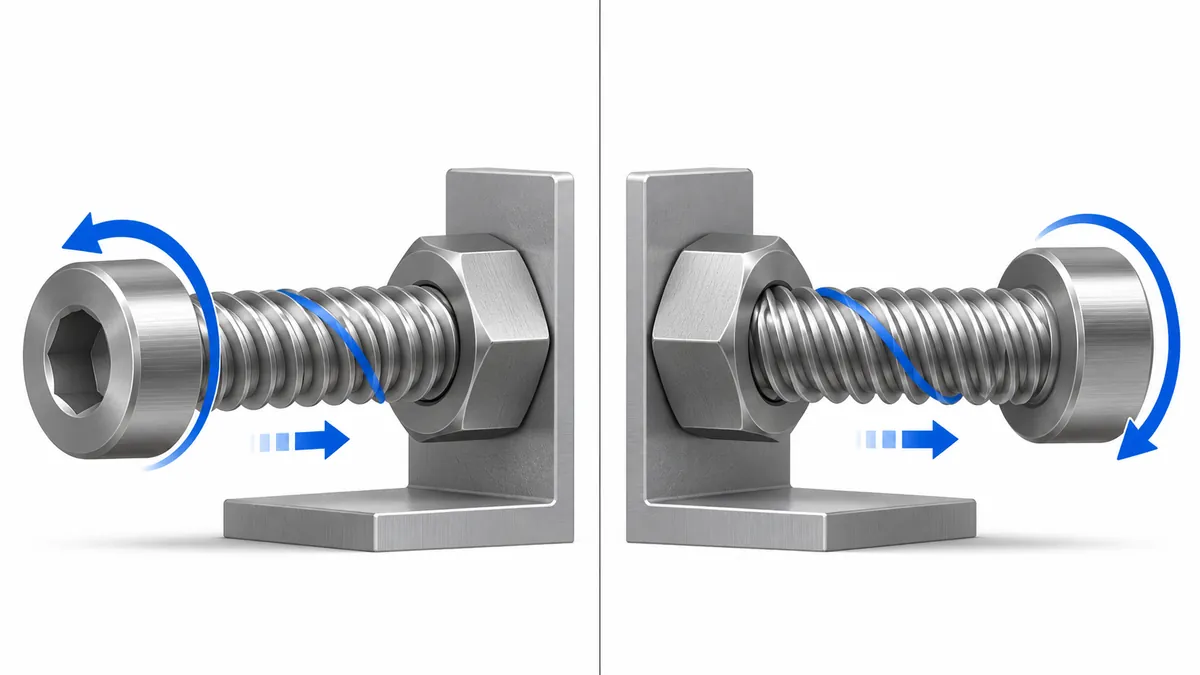
Use a two-view thought experiment:
- View A: Stand at the screw head and look toward the fixed nut. The left-hand screw advances away from you with counterclockwise rotation.
- View B: Stand at the opposite end and look back toward the screw head. The physical rotation is the same, but its clockwise/counterclockwise label appears opposite from this end.
- Invariant: The helix remains left-hand. Only the direction from which the rotation is observed has changed.
This is a communication aid, not a machine operating instruction. It helps product teams identify why a drawing arrow or assembly note may seem contradictory. Before changing a note, check the drawing view, the part that moves, the part held stationary and the direction of axial movement.
A photograph can also be misleading. A mirrored image, a view from the opposite end, or a partially hidden thread can change how the helix appears. A picture should be read with its orientation and the actual component, not as proof of a thread hand by itself. If a component is unmarked and the view is uncertain, confirm it through the controlling drawing, supplier designation or appropriate part identification procedure.
How Can You Distinguish Thread Hand from Other Thread Details?
Thread hand is one field in a larger specification. The diameter, pitch, thread family or profile, internal versus external thread, fit requirements and revision all matter when choosing a mating part. A thread pitch gauge can help compare spacing between thread features, but it does not identify all of those properties by itself.
A useful designation review separates the fields:
| Field | What it identifies | What it does not establish alone |
|---|---|---|
| Thread hand | Helix direction, such as left-hand or right-hand | Diameter, pitch, fit or application |
| Nominal diameter | Size designation for the thread | Thread hand or complete compatibility |
| Pitch or TPI | Spacing convention for the specified thread family | Correct hand, thread profile or mating fit |
| Thread family/profile | Governing geometry and designation system | A complete project-approved replacement |
| Internal/external | Whether the thread is in a hole or on a shaft/screw | The correct counterpart |
| Revision and source | Which drawing or part definition controls | Automatic approval of a substitute |
A pitch gauge is useful for examining spacing where the thread family and measurement context are understood. It cannot establish handedness or certify fit alone. Koitor’s thread-pitch-gauge guide explains the limits of that tool. The broader thread profile and series guide covers the separate question of thread families and their functions.
When a buyer needs a replacement for a left hand thread component, compare the full drawing callout with the candidate part. Two parts can share a nominal pitch and still differ in hand, diameter, profile, fit or intended mate. A product name or commercial description may omit details that are important to the assembly. If the designation is incomplete, request the missing specification rather than infer it from appearance.
Looking at the helix slope can be a clue, but orientation matters. Hold the component in a known direction and compare the helix to its axis using an established reference. Do not identify hand from a cropped image without confirming that the image was not mirrored. If the assembly cannot be identified confidently, keep it unapproved until the drawing owner or qualified supplier confirms the actual designation.
Does a Left-Hand Thread Prevent Loosening?
The label alone does not establish an anti-loosening result. Thread hand is a geometric characteristic. Whether an assembly remains secure depends on the design and service conditions, and the information summarized here does not provide a universal retention rule. Do not select a left-hand thread solely because someone assumes it will prevent loosening.
A buyer should separate three questions:
- What thread is present? Confirm hand, family, size, pitch and the drawing revision.
- What motion is intended? Identify which component moves, which is held, and the axial direction of advance.
- What retention requirement applies? Follow the actual design authority’s specification for the assembly rather than inferring a result from hand alone.
This guide does not set torque, load, locking compound, vibration behavior, or retention requirements. It does not authorize reversing a design or replacing one hand with another. If a joint requirement is uncertain, the product owner or qualified engineer must resolve it using the actual assembly information.
This boundary is especially important in a multi-part metal storage product. A screw, insert, threaded support and mating component may come from different suppliers or be referenced in different documents. A short note that says “LH” without identifying which component carries the external thread may not be enough for an order. State the exact part, male/female role and counterpart, and keep the approved revision attached to the request.
How Should Buyers Specify a Threaded Hardware Component?
For a bathroom or home-storage hardware project, threaded components may secure an insert, connect parts, or support an assembly. This contextual example does not imply Koitor manufactures reverse-thread screws or provides a special tapping process. The practical sourcing task is to communicate the correct component definition and avoid a mistaken replacement.
Before requesting a quote or sample, provide:
- The actual drawing or part specification and its revision.
- Whether the thread is internal or external.
- The thread hand stated in the controlling documentation.
- The complete thread family, nominal size and pitch or TPI.
- The mating part or matching designation.
- The material and finish requirements when specified by the project.
- The view reference for any rotation or assembly note.
- The source of the approved information: drawing, bill of materials, supplier specification or sample.
- The change approval authority if a proposed replacement differs.
If a physical sample is the only available evidence, label it and request identification from the responsible supplier. A sample can help confirm geometry, but it does not always supply the complete designation, material or acceptance criteria. A measurement should be recorded with its tool and method where relevant; do not convert a quick observation into an assumed standard callout.
For drawings, a dimensioned view should make the axis, relevant end and moving component clear when direction matters. If an assembly instruction is included, pair the turning direction with the observer’s position and the axial outcome. Avoid relying on a standalone arrow that may be interpreted from another side of the assembly.
A buyer can also document whether a thread-hand change is a proposed engineering change or merely a replacement request. Those are not the same. An alternate part may affect assembly sequence, mating components or an existing design decision. The article does not provide an approval for any change. Keep the drawing owner involved and check the complete assembly before releasing the replacement.
What Errors Commonly Cause a Wrong-Hand Replacement?
A common communication error is using “left” without defining the viewing point. One team may mean counterclockwise from the fastener head; another may be looking from the other side. The words appear contradictory even though both refer to the same physical rotation.
Another error is confusing thread hand with thread pitch. The spacing between thread crests can be similar while the helix direction differs. A pitch gauge may help identify spacing, but it cannot replace the remaining checks. Likewise, a thread that appears to start correctly may still be the wrong family or size.
A third error is treating a sales label as a complete technical designation. A supplier listing that says “left-hand screw” may not show all parameters required for the intended mating part. The buyer should not assume that the callout in a catalog matches an older drawing or a different supplier’s part without checking the controlling details.
A fourth error is to infer hand from the drive recess, head style or presumed service motion. Those features do not define the helix. The left-hand property belongs to the thread. Confirm the actual part designation or inspect the helix with a known orientation.
Finally, a buyer may try to force an unidentified screw or nut because it appears close. Do not force an uncertain part into a mating component. A fit attempt is not a substitute for identifying the thread and may damage the part. Stop and resolve the designation with the drawing owner or qualified supplier.
What Does the Manufacturer Explanation Support?
Accu’s educational comparison explains thread handedness with a defined viewing direction and describes the matching-hand requirement for ordinary screw-and-nut engagement. That makes it useful for clarifying why an observer’s view matters. It does not turn the article into a fastener-selection standard or certify an unidentified part. The article uses the source to explain the geometry, then keeps the actual replacement decision with the controlling drawing and the responsible part supplier.
This evidence boundary matters because thread hand is often only one field in the assembly record. A correct hand paired with the wrong diameter remains wrong. A correct pitch on the wrong profile remains wrong. A part with the expected head shape can still have a different thread. A drawing note that says “LH” without a mating identifier can leave a buyer with a designation that is directionally meaningful but incomplete for procurement.
An importer can write a replacement comparison as a side-by-side record rather than a free-text email:
| Approved component field | Original part | Proposed replacement | Review status |
|---|---|---|---|
| External or internal thread | Controlling document | Supplier document or measured sample | Match / unresolved |
| Thread hand | Explicit callout | Explicit callout | Match / unresolved |
| Thread family and size | Full designation | Full designation | Match / unresolved |
| Pitch or TPI | Controlling value | Supplier value | Match / unresolved |
| Mating part | Artikelnummer und Revisionsnummer | Identified counterpart | Match / unresolved |
| Drawing authority | Name or project role | Approval recorded | Approved / pending |
This is a sourcing record format, not a standard form or a claim that every project requires identical fields. It makes missing information visible. A status of “unresolved” is more reliable than a guessed match based on a partial catalog label.
If the buyer has only a sample, record the viewing end and photograph orientation. A measurement of pitch or diameter may add evidence, but it will not reconstruct every drawing requirement. A changed replacement can require approval even when the visible helix appears similar. Do not make a technical substitution solely to resolve an ambiguous instruction; first confirm what the design intended.
Record the Axis and the Axial Result
When a buyer or engineer describes motion, name the axis and the axial result in plain words. “Viewed from the head end, counterclockwise moves the screw toward the nut” is more actionable than a free-floating rotation arrow. If the nut is the moving component instead, rewrite the note around the nut’s motion; do not assume the reader will mentally reverse the screw’s advance direction. A drawing may use a chosen view convention, but a written assembly note should make that convention legible to the person using it.
For a replacement request, identify both the part number and its mating part. A thread’s nominal designation can be copied correctly while its relationship to the assembly remains unclear. Keeping the axis view, turning part and axial direction together helps prevent a supplier from interpreting a direction phrase differently from the buyer. It also avoids treating a photograph from one side as if it were a universal orientation reference.
Buyer Checklist for Left-Hand Thread Review
Use this checklist before approving a screw, insert or replacement for a hardware assembly:
- Is the thread explicitly identified as left-hand or right-hand?
- Which drawing view defines the observer’s position?
- Which component is stationary and which component is turning?
- Is the stated outcome advance or retraction along the axis?
- Is the candidate male or female, and what is its actual mate?
- Are thread family, size and pitch/TPI all identified?
- Does the drawing revision match the current project?
- Is the pitch gauge being used only for spacing, not as a complete compatibility test?
- Has any proposed thread-hand change been reviewed by the design authority?
- Are material, finish and component scope supported by the project specification?

How Should the Thread Viewing Datum Be Recorded?
Die Accu explanation of left-hand and right-hand threads defines the handedness distinction around the helix and the direction of advance, but a buyer still needs to state the viewing direction for a drawing or assembly instruction. Record which end of the fastener the observer faces, which mating component is held stationary, and which movement counts as advance or removal. If the assembly is viewed from the opposite end, the apparent clockwise description reverses even though the thread itself has not changed.
For a replacement request, pair the left-hand callout with an arrow or a written datum, a part number and revision, the thread family, diameter, pitch and mating component. Ask the supplier to confirm the complete designation rather than relying on an isolated photograph or the phrase “reverse thread.” The reference article supports the naming convention; it does not approve a particular Koitor assembly, establish a universal reason for left-hand threads, or show that a left-hand thread prevents loosening. Those decisions belong to the actual product design and its responsible reviewer.
For adjacent thread-cleaning and thread-forming context, see Koitor’s thread chaser versus tap guide, und form tapping versus cutting taps guide.
Häufig gestellte Fragen
Which way does a left hand thread turn?
With the viewer at the screw head looking toward a stationary matching nut, a left-hand screw advances away from the viewer when turned counterclockwise and backs out clockwise. State the viewing direction because the labels reverse from the opposite end.
Does left-hand thread mean the screw is turned counterclockwise from every side?
No. Clockwise and counterclockwise depend on the observer’s view. The same physical rotation looks opposite when viewed from the other end of the axis.
Is left-hand thread the same as reverse thread?
“Reverse thread” is an informal phrase that may be used to contrast a thread with the assumed right-hand default. For a purchase or drawing, use the exact thread-hand designation and all other required thread details rather than relying on informal wording.
Can a pitch gauge tell whether a thread is left-hand?
No. A pitch gauge compares spacing. It does not determine thread hand or establish the complete thread family, size and mating fit.
Can a left-hand screw mate with a right-hand nut of the same pitch?
Do not assume it can. The male and female threads must have matching hand and the correct family, size, pitch and fit requirements. Confirm the actual part specification.
Does a left-hand thread automatically prevent loosening?
No universal retention claim follows from the hand designation. Retention depends on the actual design and service requirements. Use the approved joint specification.
Should I force a screw that seems close to fitting?
No. Stop and identify the thread and mating component. A forceful fit attempt is not an identification method and may damage the hardware.
What should an assembly note say about rotation?
Name the viewpoint, the component being turned, the component held stationary, and the direction of axial advance or retraction. This avoids an ambiguous “turn left” instruction.
This reference should remain unambiguous.
Arbeiten Sie mit Koitor Hardware zusammen
Reviewing a Threaded Component for a Hardware Assembly?
Send the controlling drawing, revision, mating-part details and sample when available. Koitor can discuss the confirmed bathroom and home-storage hardware manufacturing scope and the project information needed for a component review.
OEM / EIGENE MARKE
Verwandeln Sie diesen Beschaffungsleitfaden in ein Produktdossier
Teilen Sie uns Ihr Zielprodukt, die Größe, die Oberflächenausführung, die Bestellmenge und Ihre Verpackungsanforderungen mit. Ihr Team erhält vor der Angebotserstellung eine praxisorientierte Prüfung der Herstellbarkeit.


 English
 Español
 Português
 Français
 Deutsch
 العربية