
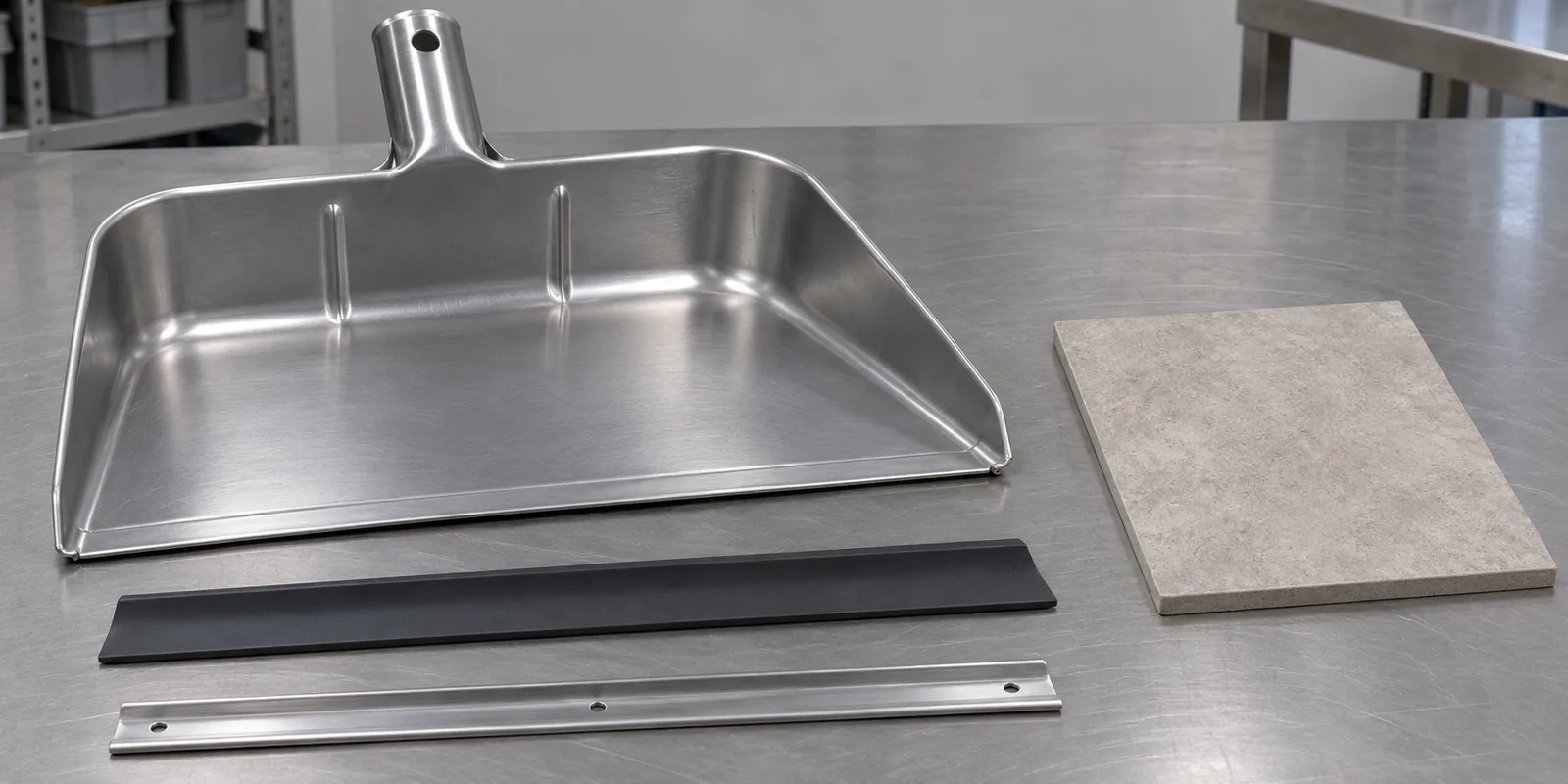
A metal dustpan rubber lip is only one part of a finished pickup interface. The metal pan’s leading edge, the lip’s profile and attachment, the reference floor and the material being collected all affect what the buyer is evaluating. A listing that says “with rubber lip” does not establish the exact component, whether it can be replaced, or how the assembled pan behaves on a defined surface.
For an importer, define the purchased unit first: a pan only, a pan with a fitted lip, a complete pan-and-brush set, or a replacement lip for a named dustpan model. Then match the edge and lip against a reference floor and sample a clearly described dry-debris condition. Avoid universal claims such as “picks up all dust” or “fits every floor.” This is a B2B specification guide, not a consumer repair tutorial or an industrial/hazardous-material handling recommendation.

Define the metal dustpan rubber lip purchase scope
A dustpan may be supplied alone, packaged with a brush, or offered with a lip that is also sold as a separate service part. Those are different commercial configurations. The buyer should state which components are included, which are purchased elsewhere and who performs assembly.
A German maker’s metal dustpan product page describes a metal pan with a rubber lip and a matched brush-storage arrangement. This demonstrates a mixed-part product architecture; it does not establish that every lip is removable or that the brush and lip share one universal interface. A separate equipment supplier identifies a replacement rubber lip for its DP-5 model, showing a model-linked service part. It does not publish a cross-brand fit standard or dimensions that can be transferred to another pan.
State the purchase unit in the RFQ. For example: one formed metal pan with one supplier-identified lip attached to the pan, supplied as a finished SKU; brush excluded unless listed separately. If a brush is part of the assortment, identify its code, quantity and pack relationship. Do not rely on a retail image or product title to define scope.
A component list can include:
| Item | Buyer should identify | Supplier confirmation |
|---|---|---|
| Metal pan | Model, drawing revision, finish and pack unit | Exact product code |
| Entry lip | Part number, source and approved sample | Material description if documented |
| Attachment | Method shown in current product documentation | Fixed, replaceable or other model-specific construction |
| Brush | Included/excluded and matching model | Compatibility basis |
| Service part | Lip code and parent pan model | Confirmed replacement mapping |
| Packaging | Edge/lip protection and label | Actual pack contents |
Use “unknown” or “supplier to confirm” rather than inventing a material or attachment method. A lip described as rubber or elastomer may still have different profiles, compounds or retention methods between products.
Treat the pan edge and lip as one interface
The lip is fitted to the pan’s leading edge. The buyer should review how those two components meet and what the supplier documents about the attachment. Do not assume every lip slides into a channel, clips over a flange or can be removed without tools. The research sources do not establish a universal profile, compound, hardness or method.
Request a section view or controlled drawing for the exact assembly. It should identify the metal edge, the lip’s matching profile and any retention feature that the supplier is willing to document. If the lip is a separately supplied component, record its part number and how the supplier confirms it belongs to the selected pan model.
Avoid deciding by material label alone. “Rubber” does not identify a specific compound or prove that the edge will contact a particular floor as intended. Likewise, “metal pan” does not define the entry geometry or finish. The product owner should keep material identity tied to supplier evidence and avoid making chemical, durability or performance statements that are not substantiated for the exact part.
The buyer should not create a new lip by modifying a shower seal, gluing an unapproved strip or taping an edge. Those are improvised repair approaches, not a sourcing specification. Do not heat, sharpen, bend or cut the pan or lip to create an assumed fit. If a replacement is needed, identify the parent model and ask the supplier to confirm the correct service part.
Define the floor reference
A floor is not a single test surface. Tile, wood, resilient flooring, grout lines, textured surfaces and seams differ in geometry and finish. The buyer should state which floor reference is used in the sample review and avoid turning one surface observation into a broad floor compatibility claim.
Record the floor or mock-up by material and condition, with a photo or controlled reference where possible. Include whether the pan approaches across a flat region, a seam or a grout line. If the intended assortment covers several surface categories, list them as separate scenarios and review each that matters. Do not infer a universal lip angle or floor gap from a photograph.
The reference surface may also influence the buyer’s perception of contact. A sample should be placed on the same plane and orientation used in the intended review. If the floor has an uneven transition, describe the condition and ask the product designer whether it belongs in the evaluation. This guide does not prescribe an acceptable floor tolerance or claim that one test predicts every home.
Use a floor record such as:
- Surface material and reference product if known.
- Texture, seam or transition included in the test.
- Condition and location used for the review.
- Pan approach direction and angle as observed.
- Sample and lip revision.
- Person responsible for the floor reference.
- Any limitations in the result.
The aim is repeatable comparison, not a published performance standard. An undocumented sweep on an unspecified floor is difficult to reproduce and should not support a broad product claim.
Describe the debris condition instead of claiming “all dust”
A pickup demonstration depends on what material is being collected. Large crumbs, fine powder, hair, grit or mixed debris are not interchangeable test conditions. The buyer should name a practical reference debris only when that condition is relevant to the product brief and can be handled appropriately. No universal particle size, collection percentage or residue threshold is established here.
Record the debris type in descriptive terms, the approximate amount or sample method if the project defines one, the area reviewed and the result observed. Do not claim the product collects every particle or works on every flooring type based on a single sample. If the product is intended for a specific household cleaning task, have the product owner define what claims are appropriate and what evidence is needed.
A sample review can compare whether the leading edge and lip meet the defined surface and what remains after the agreed motion. The buyer should describe the observation, not infer a root cause without investigation. If residue appears, possible contributors may include the edge interface, lip profile, floor condition, debris or technique; the research pack provides no universal diagnosis. The supplier and product designer should review the exact assembly before proposing a change.
Exclude hot ash, hazardous dust, food-contact, cleanroom, infection-control and industrial use unless separately designed and assessed. This article does not provide those requirements. Do not repurpose a consumer dustpan evaluation as a health or safety certification.
Inspect contact along the full pan width
A visual review should not stop at the center. The buyer can observe the left, middle and right regions of the lip against the defined floor during the agreed sample movement. Record where contact appears continuous, where a gap is visible and whether the lip is aligned with the pan edge. These are observations; no universal flatness tolerance or permitted gap is specified here.
Use a simple record:
| Observation point | What to record |
|---|---|
| Left region | Visible contact or gap under the agreed setup |
| Center region | Lip alignment and any visible variation |
| Right region | Visible contact or gap under the agreed setup |
| Full-width pass | Debris and floor reference and observed result |
| Return movement | Whether the lip remains in the reviewed position |
| After review | Any displacement, damage or unresolved question |
Do not diagnose a visible gap as proof of a bad material or manufacturing defect until the sample, floor and measurement method are controlled. Conversely, a visually straight appearance does not prove collection performance or long-term stability. If the buyer requires a dimensional criterion, the responsible product designer and supplier must define it on the drawing or inspection plan.
If the lip shifts during the review, record its position before and after, then refer the issue to the supplier. Do not apply glue or change the fit during the sample test unless that configuration is explicitly approved. A change to the attachment can affect serviceability and must be incorporated into the product’s BOM and instructions.
Clarify replaceability and service-part identity
Some products offer a model-specific replacement lip; others may not be designed for field replacement. A buyer should not imply serviceability merely because the lip looks like a separate strip. Confirm whether the manufacturer lists it as a spare, how it is ordered and which pan models it fits.
The McLane Edger DP-5 replacement lip listing provides an example of an explicitly model-linked service part. It does not show that the lip fits household dustpans or other brands. Treat its SKU and product description only as evidence that a maker can associate a replacement component with a named model.
If the chosen product has a replacement part, the buyer should record:
- Replacement lip part number and parent pan code.
- Current drawing or supplier reference.
- Quantity per repair or kit.
- Attachment or replacement method documented by supplier.
- Whether replacement is intended for customer, distributor or service use.
- Label and instructions needed to avoid mixing lip profiles.
- How changes to material or profile are communicated.
If the supplier has no replacement program, say so accurately and do not promise a spare. A distributor may still ask whether a replacement component can be quoted, but the answer should be confirmed before publication. Do not offer generic seals or unrelated strips as compatible alternatives.
Compare suppliers on the same sample conditions
Quote comparison is useful only if each supplier is asked to provide the same purchase scope. A quote for a bare pan is not directly comparable to a pan with a fitted lip and brush. A supplier that includes a replacement lip or special packaging may have a different price basis.
Give suppliers a common RFQ with the pan reference, lip scope, attachment question, floor and debris review conditions, packaging and quantity. Ask them to state what they can confirm and which inputs remain open. Do not use supplier web prices, current stock status or lead time as Koitor terms.
Compare:
- Pan and lip part numbers.
- Included brush or accessories.
- Lip source and supplier-described material.
- Assembly and replacement scope.
- Sample configuration and review condition.
- Finish and visible surface.
- Pack quantity and edge protection.
- Service-part availability.
- Drawing revision and open questions.
- Any performance statement and its supporting evidence.
If a supplier proposes a substitute lip, request its part identity and documentation. Do not accept a shared material word as proof of equal profile, fit or replacement behavior. A sample should include the actual proposed components as they will be ordered.
Protect the lip and pan edge in packaging
The entry edge and attached lip can be vulnerable to deformation or separation if the pack allows pressure or movement. The buyer should identify how the supplier plans to protect the edge in its actual shipping pack. This is a packaging review question, not a claim that a particular material or pack design will prevent all damage.
Ask for a sample packout that shows whether neighboring pans can contact one another, whether the lip is compressed and how the finished face is protected. If spare lips ship separately, label them with their parent pan model and keep them from being crushed or mixed with another profile. The buyer should approve the pack as a specific configuration and record what was checked.
Do not assume that a polybag or carton partition is included. Request the packaging components and pack quantity in the quote. If the product is nested, verify that the nested arrangement does not deform the leading edge or place force on the lip. The appropriate pack depends on the actual product and transport conditions; this article does not prescribe a drop-test protocol.
If a pack revision or supplier changes after approval, compare the edge protection and contents against the approved record. A change to a box or insert may require a repeat pack review if it alters how the lip is retained or loaded.
Assign responsibility when the pan and lip come from different sources
The metal pan maker and the lip supplier may be different companies, even if the finished product is sold as one SKU. Identify who selects the lip, who verifies its profile against the pan edge, and who is responsible for final assembly. If the pan supplier purchases a lip from another source, ask which part number and revision are included in the approved sample. Do not treat the finished product title as proof that the metal supplier manufactures the elastomer part.
The buyer should also decide who owns the spare-part listing and how a change is communicated. A new lip supplier or profile can affect whether the component remains mapped to the same pan code. Require advance notice of substitutions and preserve the approved sample reference, supplier identity and BOM revision. If the original lip is no longer available, keep the replacement mapping open until the new part has been evaluated with the matching pan. Do not relabel a substitute as the same component without confirmation.
During receiving or sample inspection, compare the part code on the lip package with the approved record. If the lip is unmarked, request a supplier-controlled identification method; do not use color alone as a reliable code. Record a mismatch and hold the affected sample for review by the buyer and supplier. This purchasing control does not establish compound identity through visual inspection, but it helps prevent an undocumented component change from entering a reorder.
Where a brush is sold as a set, clarify whether its storage feature is integrated into the pan or merely packaged together. Confirm the pack count and whether brush replacement affects the dustpan SKU. Keep brush interchangeability separate from the lip-to-pan interface so one approved component relationship is not assumed to establish another.
Build a production-intent acceptance record
Use a sample that matches the intended SKU: pan, fitted lip, finish, brush if included and packaging. Record the supplier part numbers, BOM revision, sample date and buyer reviewer. State the floor and debris conditions and note the observed full-width contact and pickup result.
Keep these questions in the record:
- Does the sample match the approved pan and lip codes?
- Is the attachment the one described by the supplier?
- Does the pack contain the listed parts and quantities?
- Does the lip contact the declared floor reference as observed?
- What debris and motion were used for the review?
- What remained after the agreed sample pass?
- Did the lip move or show visible damage?
- Was replacement reviewed only if the supplier offers it?
- Which claims are supported and which remain excluded?
The result should avoid vague language such as “works perfectly.” Describe the actual sample and observation. Do not convert the review into a quantified performance claim unless the product owner has established the test method, acceptance criteria and applicable evidence.
Avoid common specification mistakes
Several errors create ambiguity between a product title, supplier quote and sample:
- Treating “rubber lip” as an exact component specification.
- Assuming the lip can be removed because it appears to be a separate piece.
- Copying a replacement code from another brand.
- Reviewing only one point along the pan width.
- Testing on an undefined floor or unspecified debris.
- Using a consumer repair suggestion as a production method.
- Claiming pickup on all floors from one sample.
- Treating a clean appearance as proof of material identity or performance.
- Omitting the brush or pack parts from the commercial scope.
- Publishing an unverified spare-part compatibility statement.
When one of these issues appears, identify what is unknown and assign an owner. A buyer can request clarification without deciding the answer for the supplier. Keep technical questions distinct from a price negotiation.
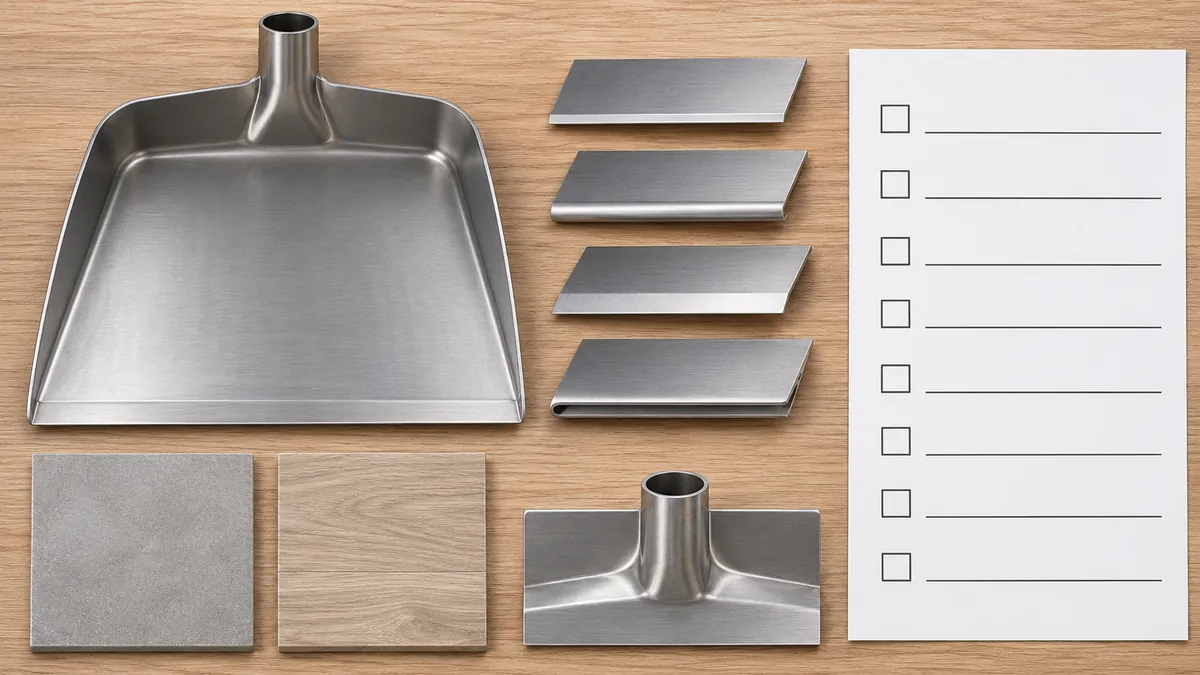
Buyer RFQ checklist
Before ordering, define the pan model and revision, lip part and source, attachment scope, brush inclusion, reference floor, debris condition, pack protection and service-part needs. Request a controlled drawing or supplier confirmation for any dimension or replacement mapping.
Before sample approval, compare the actual metal edge and lip across the width on the declared surface. Record the debris and observed result. Keep the evaluation bounded to that sample. Before reordering, compare the BOM, lip code, finish, pack and replacement documentation with the approved record.
Keep the exact metal dustpan rubber lip description consistent across the RFQ, approved sample, carton label and reorder record.
Häufig gestellte Fragen
Does a rubber lip make a dustpan work on every floor?
No. This guide does not establish universal floor compatibility. Review the actual pan and lip against the defined surface and use condition.
Can I order any strip labeled rubber as a replacement?
No. Replacement fit should be confirmed against the exact dustpan model and supplier part number.
Does a sample sweep prove that no dust will remain?
No. It records only what happened under the stated surface, debris and motion conditions. It does not support an “all dust” claim by itself.
Are all lips replaceable?
No. Confirm the selected manufacturer’s documentation and service-part list. Visual appearance alone does not prove the part is designed for replacement.
Can tape or glue repair a production lip?
This guide does not recommend improvised repair methods. Ask the product supplier for the approved replacement part and method.
Should a buyer specify rubber hardness or angle?
Only if the responsible product designer and supplier provide a requirement for the exact product. No universal value is established here.
What should the pack label say?
Identify the exact dustpan model and any matching replacement lip code. Do not imply cross-brand compatibility without supplier evidence.
Koitor scope boundary
This article is a buyer framework for an adjacent metal-and-purchased-component product. It does not claim Koitor makes dustpans, rubber lips or cleaning brushes, and it does not report a Koitor test result. Koitor Hardware is a family-owned custom metal hardware factory focused on bathroom and home-storage hardware. Buyers can share a lawful drawing and component scope for initial feasibility through the contact page or review the OEM home-storage hardware scope.
Sources
- Bürstenmanufaktur, metal dustpan with rubber lip — product architecture example; it does not establish a universal lip profile or pickup test.
- McLane Edgers, DP-5 replacement rubber lip — model-linked replacement part example; no cross-brand dimensions or fit are inferred.
- Reddit, question about replacing a damaged dustpan edge — an individual repairability question, not wear-life evidence or market prevalence.
Discuss a Custom Metal Hardware Project
Share your drawing, reference sample, finish target, component scope and order quantity. Koitor can review whether an adjacent metal concept fits its confirmed production scope before quotation.
OEM / EIGENE MARKE
Verwandeln Sie diesen Beschaffungsleitfaden in ein Produktdossier
Teilen Sie uns Ihr Zielprodukt, die Größe, die Oberflächenausführung, die Bestellmenge und Ihre Verpackungsanforderungen mit. Ihr Team erhält vor der Angebotserstellung eine praxisorientierte Prüfung der Herstellbarkeit.


 English
 Español
 Português
 Français
 Deutsch
 العربية