
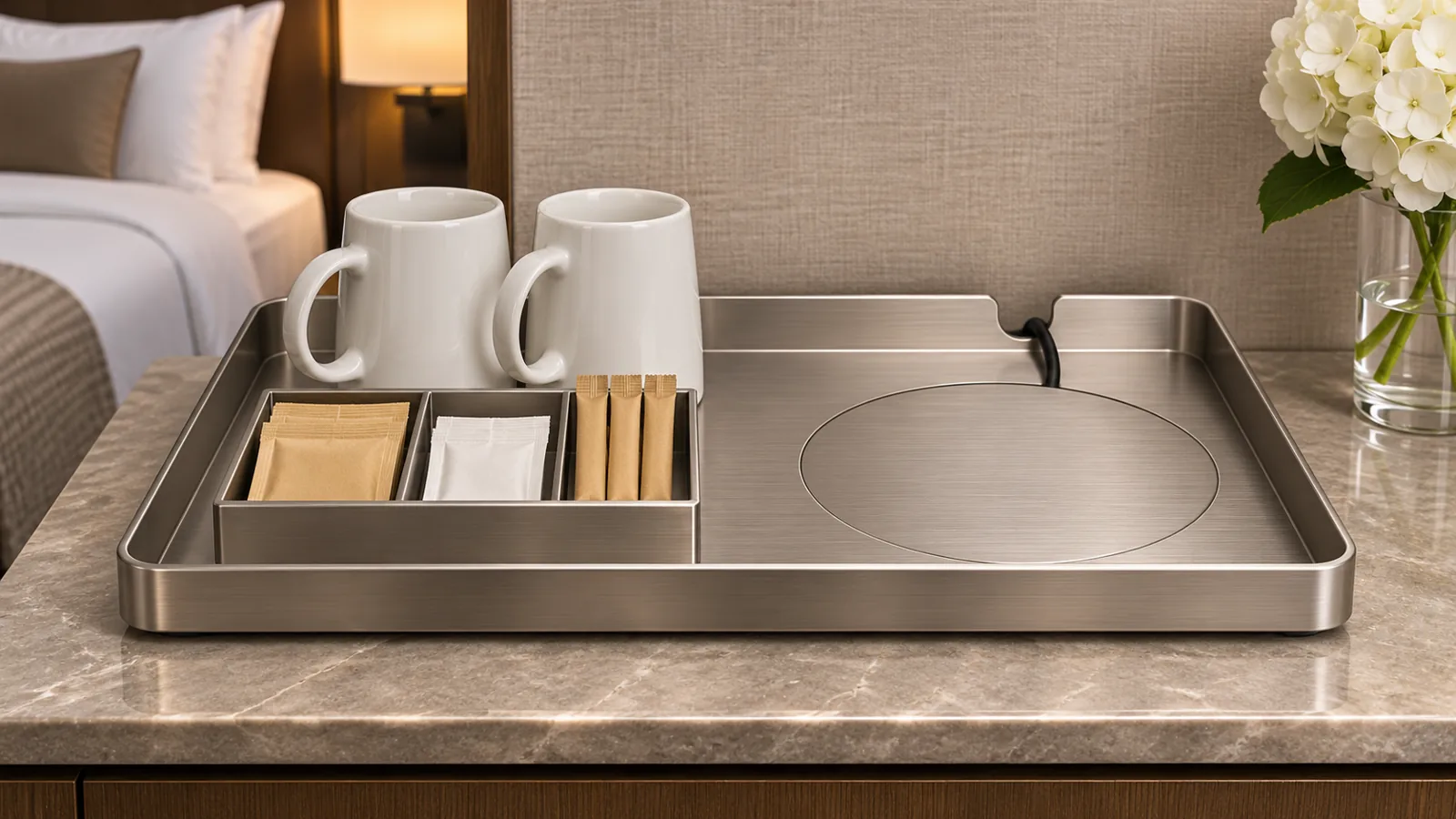
Buyer Decision and Project Scope The buyer should document metal hotel welcome tray as a named requirement.
Buyer Decision and Project Scope
Direct answer: approve the tray with the named kettle base and cord route
A metal hotel welcome tray should be approved against the exact kettle or coffee appliance selected for the room program. The buyer needs to record the base footprint, the direction the power cord exits, the path to the room outlet as a project input, and the location and finish of every tray cutout. A tray image or overall outer dimension cannot show whether a particular appliance base seats as intended or whether its cord can follow the planned route. This guide covers the tray and appliance’s passive mechanical layout; it does not approve electrical safety, heat resistance, spill protection, antitheft performance, or a Koitor hospitality-tray product.
Hotel welcome trays demonstrate different interface designs. Bentley’s metal Sophia tray lists two cable cutouts for a kettle or coffee machine, while its Bibian tray uses a model-specific base indentation and allows cord routing from the side or back. Those examples show that tray architecture varies; they do not establish a universal template or prove that any tray fits a buyer’s appliance. See the product details for Bentley’s Sophia metal tray und Bibian’s side-or-back cable route.
What purchasing decision should the hotel buyer make first?
The buyer’s first decision is which appliance and room arrangement the tray must accommodate. Record the appliance manufacturer, model, regional electrical version where applicable, base model or part number, and the selected room location. A “kettle tray” description is not a sufficient interface specification when base sizes and cord exits differ. If the program allows more than one appliance, list each configuration separately and say whether one tray revision must serve them all.
Next decide whether the tray is only a surface and cable-routing aid, or whether the program expects it to position the appliance using a recess, rim, locator, divider, or other feature. Those are different product functions. A flat tray with a cutout may allow a cord to pass through without locating the appliance. A formed indentation may constrain the base position. A retaining feature or security cable is a separate design and responsibility question, and must not be inferred from a cord opening.
Clarify the product boundary among hotel owner, appliance supplier, tray supplier, installer, and housekeeping or maintenance staff. Who provides the kettle? Who confirms its base and cord arrangement? Who approves the tray’s surface and cleaning method? Who owns any cable, power component, or fixing? The tray manufacturer should not silently assume responsibility for an appliance, room outlet, or electrical installation. The buyer or hotel project team must assign those questions to qualified owners.
Finally determine whether the tray is a single SKU, a room-type variant, or one element in a wider amenity set. A tray that shares a packaging or finish family with other items may still need an appliance-specific insert, label, or size code. The buyer should settle the assortment and target room configuration before a sample is frozen.
Which appliance and room inputs belong in the reference pack?
A useful reference pack begins with the actual appliance, not a generic silhouette. Capture its model code, base drawing or measured base outline, cable exit direction, cable strain-relief location, cord length information supplied by the appliance owner, and any approved arrangement guidance. If the supplier’s technical sheet shows different base or cord versions by market, record the version selected for the program. Do not assume regional models are mechanically identical.
For the room, record the intended surface where the tray will sit, the required location relative to the outlet, the available countertop or shelf area, and any adjacent wall, backsplash, furniture edge, or amenity components that influence access. These are buyer-provided layout inputs, not electrical installation instructions. Do not use a tray drawing to determine safe clearances, outlet requirements, heat limits, or wet-area suitability. The project’s electrical professional and appliance maker own those decisions.
The reference pack can include a top view and side view of the appliance base and tray, a cord-route sketch, a photograph of the intended counter location, and a list of unknowns. Mark the appliance orientation: front, back, left, and right should be unambiguous. A cable opening “at the rear” is not sufficiently clear if the base can rotate or if the outlet is on a different side of the room.
If the buyer cannot yet confirm the final appliance, document the temporary reference and the decision date by which it must be replaced. A sample made to an assumed base may help evaluate tray manufacturing, but it is not a final paired fit approval. State the limits in the sample record and do not publish a compatibility claim until the actual appliance configuration has been confirmed.
The same principle applies when a project team supplies a 3D model. A digital model can assist layout review, but the buyer should confirm that it represents the production appliance and cord interface. A rendered image may omit strain relief, plug shape, or cable exit orientation. Ask for a physical appliance or controlled outline when those details affect the opening.
How should a buyer define the kettle-base footprint?
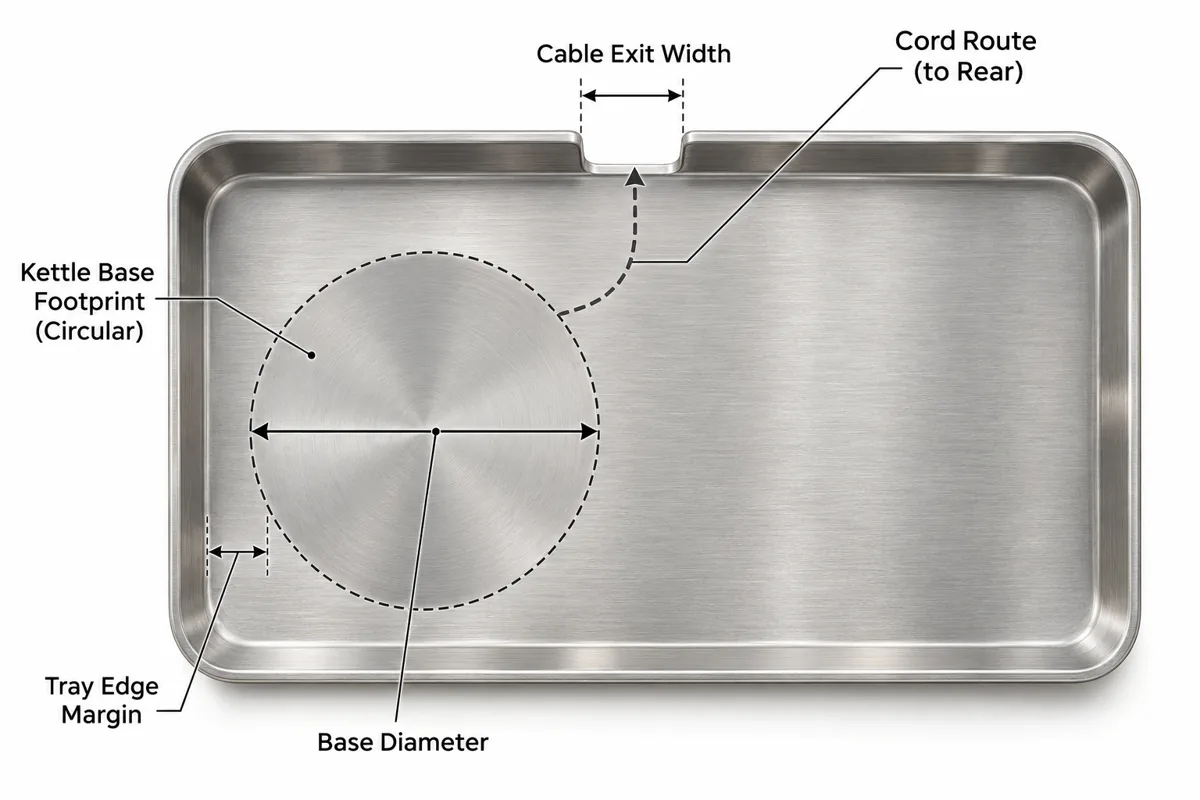
The footprint is the actual area that contacts or rests on the tray, as defined by the appliance maker or verified on the selected appliance. It may not be a perfect circle, and it may include feet, a center boss, a recessed region, a cable connection, or other geometry. Do not draw a generic circle because the appliance is called a kettle. Use the selected base reference.
The buyer should decide whether the tray merely supports the base, or whether it locates it. If location matters, specify the feature that constrains movement and the acceptance evidence required. If the tray is intended to leave the appliance free to be lifted and replaced, make sure any rim or indentation does not obstruct that action. A tighter recess is not automatically better; it can make cleaning, appliance changes, or cord routing harder.
Define a clearance envelope around the base using buyer-approved inputs. Include the base’s maximum footprint, any feet that extend beyond the main body, and the movement needed to lift or rotate the appliance as intended. If multiple appliance models are in scope, compare each outline against the tray surface and cutout positions. A single template can overlay them, with differences clearly labeled.
Avoid asserting a fit tolerance before the responsible engineer and supplier agree on the measurement method, manufacturing process, and intended function. The buyer can designate critical dimensions and request them on the sample drawing. The sample itself can be checked against the approved base outline. Record actual values and the disposition; do not turn a demonstration model into a universal product specification.
A useful tray-appliance matrix can include appliance model, base outline reference, planned orientation, support area, feature that locates the base if any, cutout position, cord path, room outlet side, cleaning access, sample status, and approved room types. It helps a buyer see whether a change in kettle or counter layout affects only one variant or the whole assortment.
| Buyer input | Record before approval |
|---|---|
| Named product or component | Exact model, code, and revision |
| Interface or project condition | Reference sample, drawing, or site input |
| Evidence and owner | Source, reviewer, and unresolved questions |
| Release status | Approved scope and excluded claims |
Product Fit and Specification
How should the buyer position cable cutouts?
Start with the cord as it exits the actual appliance base. Identify the exit side or direction, the strain-relief shape, the cable’s route across or below the tray, and the point where the plug must reach the project-defined outlet. The buyer’s tray drawing should show this route in plan and side views. Mark the opening’s location, shape, edge finish, and any intended contact with the cable jacket. A photo of a hole is not enough to determine the route.
The cable should not be forced around a sharp edge or trapped under the appliance base. The tray designer and responsible appliance or electrical team need to review the actual arrangement. The tray opening cannot, by itself, establish safe electrical use or code compliance. The article does not advise changing plugs, extending cables, hiding connections, or moving outlets.
If a tray uses two cutouts, specify what each opening is for and which one is used in each configuration. Bentley’s Sophia product page, for example, describes a metal hotel tray with two cutouts for a kettle or coffee machine. It is a model-specific product detail, not a general requirement. A different tray can use one opening, side routing, an integrated base, or another arrangement, provided the project owner and qualified parties approve the design.
Review the opening edge. A punched, laser-cut, drilled, or formed opening can have different geometry and finishing needs. The buyer should specify whether the cable passes through, sits beside, or is merely routed around the tray. If the cord does not touch the cutout in the approved setup, document that observation rather than claiming the opening protects the cable. If an edge contacts the cord, request a review of edge radius, protective treatment, and assembly condition from the responsible product engineer.
Do not add an “anti-theft” or “cable lock” claim because the tray includes a cutout. A cable path is not a security feature. If the hotel requires an anchoring or security system, identify it as a distinct component and assign its design, installation, and validation to the appropriate owner. Do not copy a competitor’s locking feature or imply that Koitor has tested it.
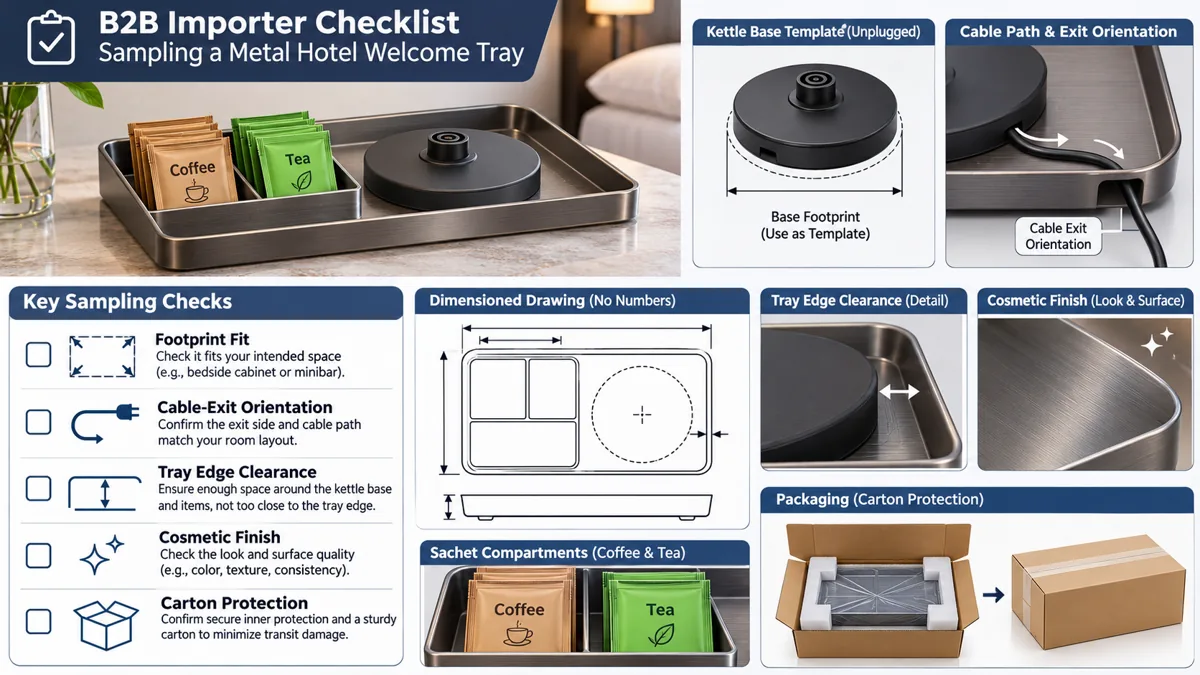
Buyer checks for metal hotel welcome tray
What should the production-intent sample demonstrate?
Review the tray with the named appliance base, not only with a drawing or a visually similar kettle. The sample should be identified by tray drawing revision, finish, material, and any non-metal components. The appliance should be identified by model and version. If a substitute appliance is used, record the difference and which conclusions remain provisional.
The sample review can proceed in a controlled sequence:
- Confirm the tray drawing, appliance model, room layout inputs, and proposed cord route.
- Place the tray in the orientation selected for the room and identify front/back.
- Set the appliance base in the intended position without forcing it into a recess or against an unapproved stop.
- Check the base contact and any locating feature against the agreed reference.
- Route the cord through or around the tray exactly as the buyer plans to present it.
- Observe the cord path and cutout edge without making any electrical safety judgment.
- Confirm that the appliance can be placed, removed, and repositioned as intended.
- Review adjacent amenity items, surface space, and cleaning access using the buyer’s layout.
- Inspect finish, formed edges, welds, cutouts, and packaging condition on the final sample.
- Record the model, revision, observations, unresolved issues, owners, and approval scope.
The sample must not be described as proving heat resistance, spill containment, cord safety, antitheft performance, or regulatory compliance unless separate evidence supports those claims. A tray that looks appropriate on a counter has not necessarily been evaluated with a powered appliance in use. The hotel or product owner should use a qualified electrical professional and follow the appliance maker’s instructions for any powered-device questions.
Separate cosmetic observations from functional ones. A finish swatch can be compared for color and appearance. A tray drawing can define the opening geometry. A physical sample can demonstrate whether the named base rests in the intended area and whether the proposed cord route is physically possible. None of those checks alone proves performance under heat, liquid, or electrical conditions.
If the paired sample does not fit, identify the mismatch: base outline, cutout position, cord direction, tray edge, counter boundary, or orientation. Ask the design owner whether the tray, appliance choice, or room layout is allowed to change. Do not simply enlarge the opening or move a cutout without considering finish, edge quality, visual presentation, packaging, and manufacturability.
How should metal construction and finish be specified?
For a metal tray, the buyer should define the substrate or material family, visible finish, color reference, thickness or structural inputs where technically appropriate, edge condition, and any areas that contact the appliance. The exact specification depends on the design and project. A brushed or powder-coated appearance does not establish heat, moisture, chemical, or scratch performance.
Bentley’s Sophia listing demonstrates one market example: a metal tray with stated cable cutouts. That source does not establish its manufacturing method, test results, or suitability for another buyer’s appliance. It is useful as evidence that buyers can encounter a tray architecture with cutouts, not as a specification to copy or a benchmark for Koitor capability.
If the tray has a rim or recess, it may be formed, assembled, welded, or made through other processes. Ask the supplier to explain any feature that affects the base, cord path, cleaning, or visible surfaces. A seam or joint near a cutout may affect appearance or edge quality. A coating near a cut edge may need specific process control. The buyer should review the actual sample and state which surfaces are cosmetic, functional, hidden, or likely to contact the appliance.
Cleaning claims require a separate basis. A buyer can specify cleaning agents and appearance expectations, but should not state “easy to clean,” “waterproof,” “heatproof,” or “scratchproof” as a performance claim without evidence. If the tray is intended to be wiped, describe the expected care instructions and get confirmation from the product owner and finish supplier. If liquid containment is needed, define that function and the responsible verification; an outer rim alone does not prove the tray will contain a spill.
Koitor’s approved company facts support metal forming, punching, bending, surface finishing, assembly, packaging preparation, and sample coordination in its confirmed product scope. They do not confirm current production of hotel welcome trays, kettle bases, electrical devices, or heat and water testing. For an adjacent tray concept, any discussion should remain a feasibility conversation, with appliance and claim approvals assigned separately.
How should the buyer control component ownership and revisions?
The tray and the appliance may come from separate suppliers. Record the tray supplier, appliance supplier, owner of the base outline, owner of the room outlet information, and person who approves the paired sample. If a cable, fastener, insert, rubber foot, or other part is included, identify its source and responsibility. This prevents the metal tray supplier from being treated as the authority on a kettle’s electrical design or suitability.
A change to the appliance can alter the tray fit even if the tray itself has not changed. A new kettle model may use a different base footprint or cord exit. A room refresh can move the outlet or reduce counter space. A tray change can move the cutout or modify a raised edge. Establish a change review before either side is substituted. The reviewer should decide whether a new drawing comparison, paired sample, or project approval is needed.
A change record should note the old and new revision, what physically changed, which interface may be affected, who reviewed it, and what evidence supports continued use. If the appliance change is outside the tray supplier’s control, the buyer should provide the new model information before approving the tray. If the tray change is minor and unrelated to the interface, document why the previous paired approval remains applicable rather than repeating every check automatically.
The purchase order should reference the approved tray model, drawing revision, finish, cutout layout, packaging, and sample. It should also state the named appliance or the list of appliance models used for approval. If the hotel has multiple room types, call out any variation. A generic “hotel kettle tray” line does not preserve the approved arrangement.
The product data and carton should identify the correct variant. If one tray supports multiple named appliances, maintain that compatibility list through purchasing and product changes. If the tray is model-specific, avoid a broad product image or title that implies universal fit. Use internal records and labels that let distributors or hotel teams locate the approved spare or replacement SKU.
Sample Review and Change Control
What should an importer put in the RFQ and buyer checklist?
RFQ information
- Named appliance manufacturer and model, including market version if relevant.
- Base outline, support points, cord exit direction, and buyer-provided reference.
- Tray plan and side views, room orientation, countertop envelope, and outlet location as a project input.
- Whether the tray is flat, recessed, divided, or includes another locating feature.
- Cutout count, positions, shapes, edge treatment, and intended cable path.
- Material, finish, color sample, visible faces, and packaging requirements.
- Responsibility for tray, kettle, cord, plug, inserts, fasteners, or security components.
- Required sample configuration and who will approve it.
- Product claims the buyer intends to make, with owner and evidence needed.
- Target order quantity, SKU variants, destination market, and packaging/label needs.
Sample approval checklist
- Is the exact appliance or approved equivalent identified?
- Does the drawing mark front/back and the intended orientation?
- Does the actual base sit in the intended support or recess area?
- Is the cable exit direction represented correctly?
- Is the selected route physically clear and consistent with the appliance owner’s instructions?
- Are cutout edges, formed edges, and visible finish acceptable on this revision?
- Can the appliance be placed and removed as planned?
- Does the tray fit the project’s stated counter and amenity layout?
- Are all separate components and their supplier responsibilities identified?
- Are electrical, heat, liquid, safety, or compliance questions assigned to qualified owners?
- Does the approval record name the exact tray and appliance revisions?
- Do carton, labels, and product listing use the same approved compatibility scope?
The purpose is to prevent an interface assumption from becoming an unreviewed purchase-order promise. If the base model, outlet layout, or cable route is not known, mark the item open and assign an owner. Do not compensate for missing information with an invented universal dimension.
Häufig gestellte Fragen
Do hotel welcome trays need two cable cutouts?
No universal number follows from the product category. A documented model may have two openings, while another product may use a side route or an integrated base. The buyer should define the chosen appliance and room layout first, then approve the specific tray geometry.
Purchasing Questions and Practical Decisions
Is an indentation enough to guarantee kettle compatibility?
No. A recess can help locate a named base if its geometry is designed and checked for that model. It does not establish electrical safety, heat suitability, or fit with other kettles. Bentley’s Bibian example specifically describes its indentation as fitting Bentley kettle models; that does not make it universal.
Can a tray cable opening be called an anti-theft feature?
Not by itself. An opening provides a path; it does not prove that a cable is secured. Any security feature must be separately defined and supported by the supplier and project owner.
Can Koitor confirm a hotel tray is safe for a particular kettle?
Koitor’s approved facts do not establish kettle supply, electrical engineering, or testing of hotel welcome trays. Koitor can discuss confirmed metal-part feasibility where applicable, while appliance, electrical, heat, and use approvals remain with the responsible suppliers and qualified project reviewers.
What should change if the hotel changes kettle model?
Compare the new base outline and cable exit against the approved tray drawing and sample. The project owner should decide whether the previous fit record still applies. Update the compatibility statement, sample, SKU, or room-type record if the interface changes.
Work with Koitor Hardware
For an adjacent metal tray or storage concept, share a controlled drawing, named appliance base reference, proposed cord path, finish, packaging, and quantity requirements. Koitor can discuss metal-part manufacturability within its confirmed scope; appliance fit, electrical use, and product claims require separate approval. See the custom hardware drawing and sample process oder Kontaktieren Sie Koitor.
Review a Metal Tray Interface Before Sampling
Share a controlled tray drawing, named appliance-base reference, cord-route sketch, finish target, and packaging brief. Koitor can discuss metal-part feasibility; appliance and electrical approvals remain with the responsible project parties.
OEM / EIGENE MARKE
Verwandeln Sie diesen Beschaffungsleitfaden in ein Produktdossier
Teilen Sie uns Ihr Zielprodukt, die Größe, die Oberflächenausführung, die Bestellmenge und Ihre Verpackungsanforderungen mit. Ihr Team erhält vor der Angebotserstellung eine praxisorientierte Prüfung der Herstellbarkeit.

 English
 Español
 Português
 Français
 Deutsch
 العربية