
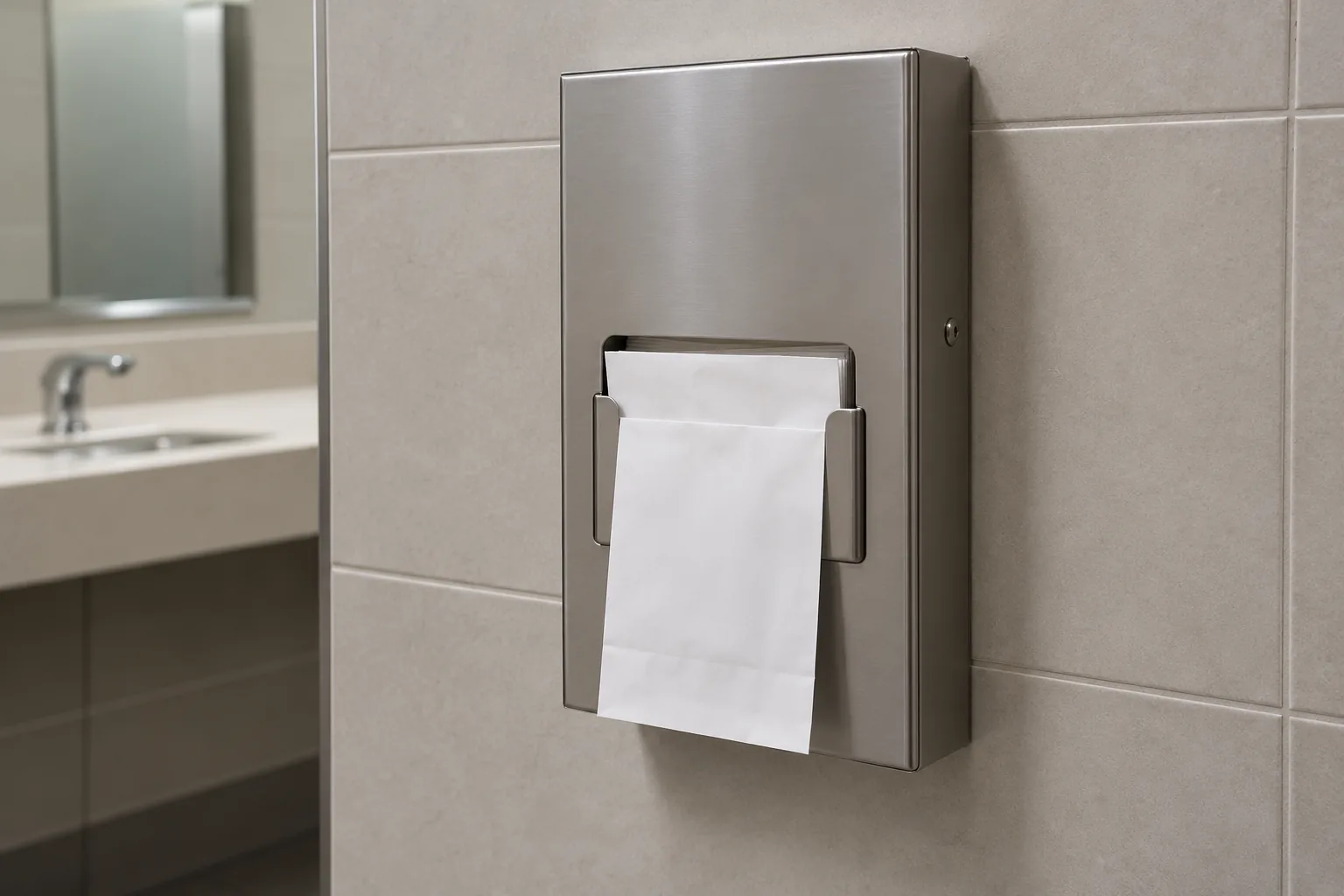
For procurement, the sanitary bag dispenser refill compatibility starts with the exact reference parts and intended arrangement. Sanitary-bag dispenser refill compatibility depends on the carton and dispensing presentation the buyer intends to supply. A metal enclosure can have enough outer volume and still fail the practical fit check if its internal locating surfaces, outlet opening or wall-mounted refill path conflict with the actual carton. Buyers should approve the refill and dispenser as a paired configuration rather than rely on a generic category name.
This guide covers a wall-mounted dispenser for unused sanitary bags supplied in a refill carton. It is not about collecting used sanitary waste, dispensing toilet seat covers, or choosing a medical or hygiene product. It does not establish a health outcome, antimicrobial effect, accessibility compliance, capacity, pulling force or universal refill fit. Those matters require separate product-specific evidence and applicable review.
Why should buyers identify the refill carton first?
A refill carton is not merely a package that happens to fit inside a housing. Its outside dimensions, opening location, orientation and bag presentation determine whether the dispenser can hold it and whether a user can withdraw a bag from the installed position. Some suppliers sell a holder for a specified carton family; that product pairing is not a general interchangeability standard.
Mediclinics’ technical sheet for model AI0920C describes a wall-mounted stainless dispenser and a carton-box refill. The sheet contains conflicting thickness wording in different sections and carries legacy revision context. It is useful evidence that refill-box geometry and wall installation belong in the procurement brief, but it is not a safe source for transferring a gauge or dimension into a new product specification. Buyers should request the current controlled drawing and written confirmation for any model they plan to buy. A current catalog lists related sanitary-bag dispenser models, but their names do not prove identical refill geometry.
Record the refill supplier, SKU, revision, closed-carton dimensions, outlet location and whether the dispensing opening is factory-created or opened by the installer. If more than one refill brand may be used, obtain each carton and qualify it separately. Do not assume that two cartons fit because they are both described as sanitary-bag refills.
How should the carton-to-housing interface be checked?
Request the housing drawing with the internal usable envelope and identify the surfaces that locate the carton. The outer dimensions of the dispenser do not show the interior clearance after bends, seams, mounting plates or retaining features are included. Compare the refill carton in its intended orientation and check whether it can be placed without crushing or modifying its packaging unless that is explicitly part of the approved design.
Then align the carton outlet with the enclosure opening. The user should be able to reach the bag presentation in the actual mounted orientation. Check whether an opening, lip or door overlaps the carton outlet. Inspect the carton’s remaining volume at refill stages if the intended user needs to access it while partially depleted. Avoid claiming “one-at-a-time dispensing” unless the sample and the bag presentation support that specific statement.
| Buyer field | Evidence to collect | Acceptance note |
|---|---|---|
| Refill identity | Supplier, SKU, revision and bag type | Named approved carton |
| Carton envelope | Closed dimensions and orientation | Drawing or measured sample |
| Outlet presentation | Location, opening shape and bag direction | Alignment with housing access |
| Housing interior | Usable dimensions and contact surfaces | Controlled drawing revision |
| Retention | Door, lip, tab or other locating feature | Actual carton seating |
| Withdrawal | Opening access and bag removal observation | Agreed sample condition |
| Replenishment | Carton insertion and removal path | Installed access observation |
| Wall interface | Fasteners and substrate responsibility | Separate installation specification |
| Included items | Refill, enclosure, key or mounting parts | BOM and carton list |
The fields are a purchasing worksheet, not a prescriptive dimension standard. Any numeric acceptance value should come from the controlled design, current manufacturer data or a mutually approved sample.
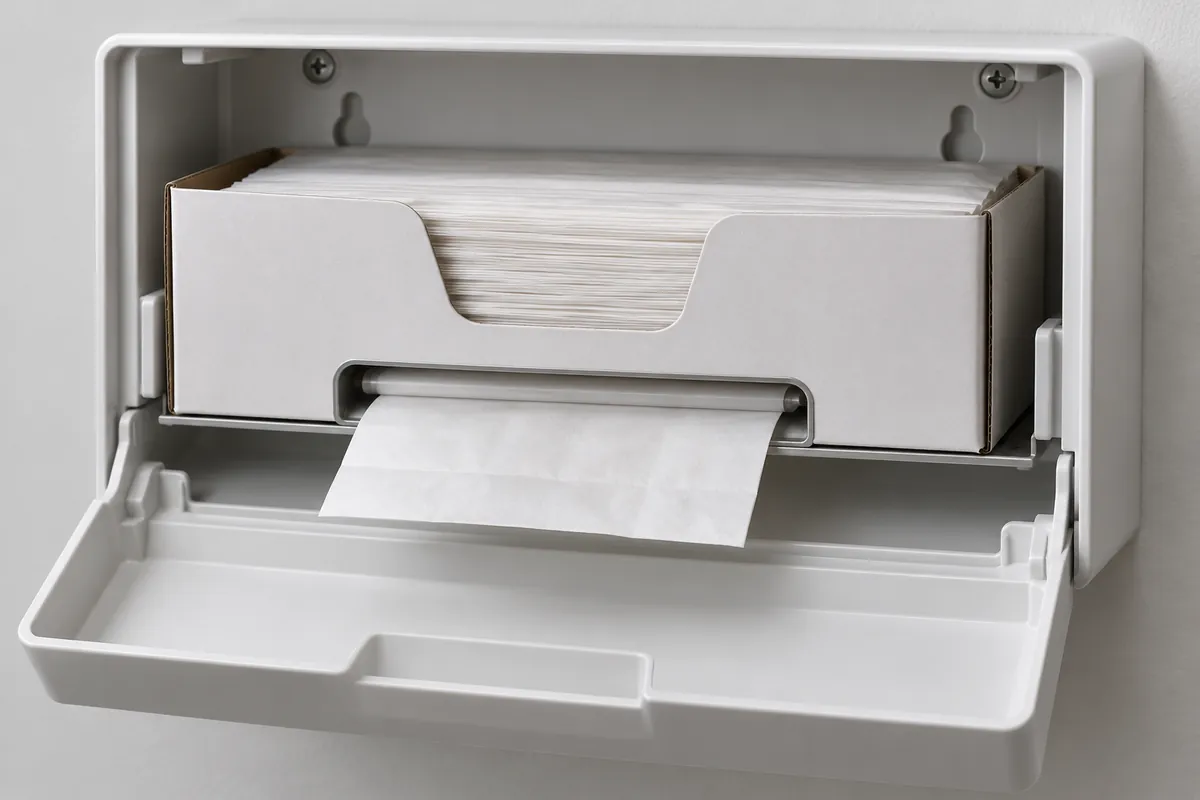
What should be checked after wall mounting?
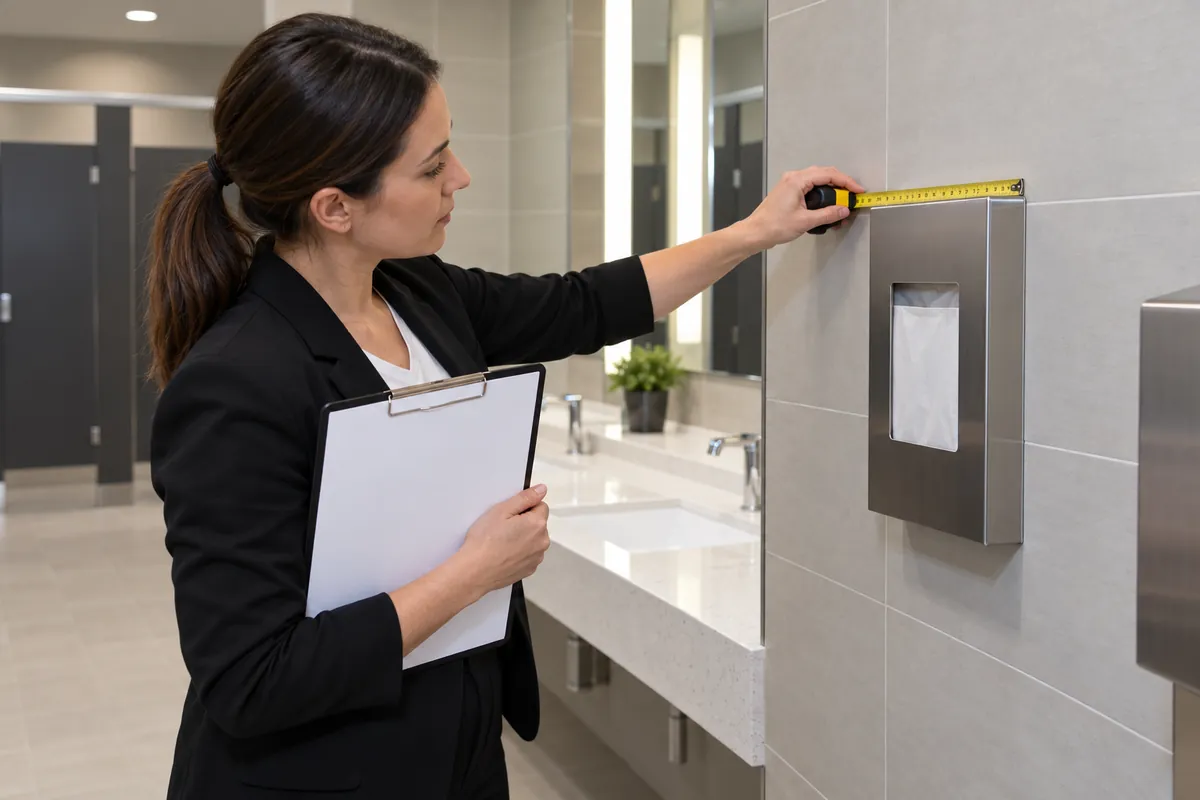
A tabletop fit does not establish that a carton can be replenished after the housing is installed. Confirm the planned orientation, opening direction and service clearance. Check whether a door or cover needs to swing or lift away from adjacent equipment. The facility owner should specify the mounting surface and site constraints; the metal-product supplier should document the intended bracket and fastener arrangement. Do not prescribe installation into a particular substrate without product- and site-specific engineering instructions.
Mounting location can change how the refill opening is approached. Review the sample at a representative height and orientation when possible. Identify who installs the product, who supplies anchors and whether the carton is changed from the front, underside or another direction. The user should be able to remove the old carton, install the replacement and identify the dispensing side without disassembling the product unless that is the stated method.
This observation is not an accessibility determination. Applicable reach, mounting-height and facility requirements depend on jurisdiction and project type, and the buyer must verify them with the responsible design professional. A supplier product sheet’s general marketing language is not proof that a different model meets a specific local obligation.
How should withdrawal and replenishment be evaluated?
Use the exact refill carton and a production-intent dispenser sample. Record the initial state and the test sequence. Check bag withdrawal without tearing or distorting the carton beyond its intended opening, then try the agreed replenishment action. If the carton changes shape as bags are removed, note whether that changes seating or access. This is a qualitative fit observation, not a measured pull-force test or guaranteed dispensing behavior.
The reviewer should observe:
- Whether the carton enters the housing in the intended orientation.
- Whether it rests on the specified supports or locating points.
- Whether the carton outlet aligns with the metal access opening.
- Whether bags can be reached in the intended user position.
- Whether the cover closes and remains in its specified configuration.
- Whether a replacement carton can be removed and inserted while mounted.
- Whether the refilling action disturbs or damages the housing finish.
- Whether other parts must be removed for normal replenishment.
Do not convert a single successful withdrawal into a lifetime or universal-refill guarantee. If a dispensing-force requirement matters to the buyer, define the measurement method, sample conditioning, carton fill state and acceptance criteria with a qualified supplier. The research pack does not provide such data.
How does this differ from other washroom dispensers?
An empty sanitary-bag dispenser holds a refill of unused bags for withdrawal. A sanitary waste receptacle collects used products and has a different liner, service and cleaning function. K1317 owns the waste receptacle and used-liner questions. A toilet-seat-cover dispenser serves a separate consumable and refill configuration; K1312 owns that topic. Roll dispensers for trash liners or tissue have spool or roll mechanics, not the carton arrangement discussed here.
Keeping these functions distinct helps buyers avoid a keyword-driven but confusing product family. The SKU should clearly state whether it is the empty-bag dispenser, the waste container, a seat-cover unit or an unrelated accessory. Do not borrow cleaning, odor-control or hygiene statements from another category.
What should the RFQ and sample record include?
Ask the refill supplier for a current carton drawing or sample. Ask the housing supplier for a controlled interior and mounting drawing, material/finish specification, supplied hardware and assembly or servicing method. If a lock or key is included, identify its exact configuration; do not assume it is included because another model offers one.
A complete RFQ can state:
- Exact refill supplier, carton model and revision.
- Filled, partially used and replacement-carton states in scope.
- Carton orientation and outlet presentation.
- Housing internal envelope, access opening and retention features.
- Wall mounting method and responsible fastener supplier.
- Installed refill and withdrawal observations required at sample review.
- Included or excluded refill cartons, keys, hardware and accessories.
- Material, finish and appearance requirements from approved documents.
- Packaging, labels and current drawing revision.
- Any local project or regulatory requirements for independent confirmation.
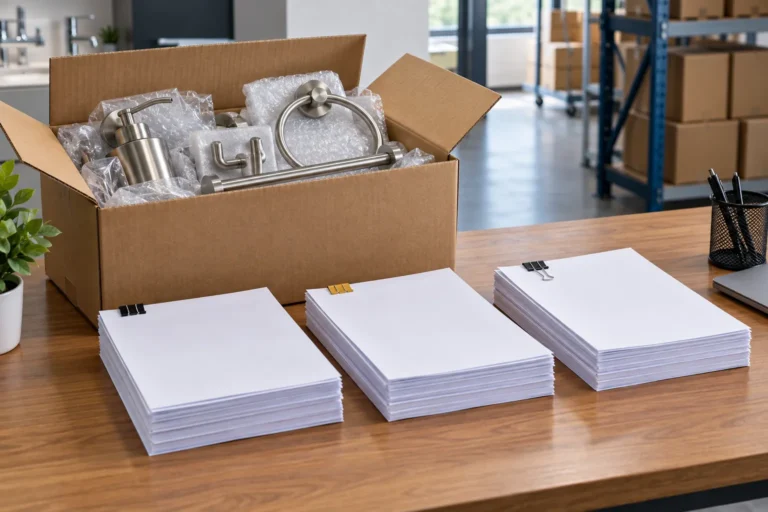
For broader context about bathroom and metal storage components, buyers can review Koitor’s custom bathroom accessories manufacturing und OEM-Hardware für die Heim-Datenspeicherung pages. Those pages do not confirm a current sanitary-bag dispenser SKU, dispenser certification or refill supply. Buyers may share drawings and actual refill samples through the contact page for a bounded metal-component feasibility discussion.
How can the review account for the carton as it empties?
If the buyer expects users to keep withdrawing bags until a carton is empty, review more than the full-box starting condition. A sample check can record how the remaining carton sits after several withdrawals performed under an agreed, repeatable setup. The team should note whether the carton shifts, collapses or blocks access in that sample. This observation does not establish reliable dispensing across every carton or a defined quantity of use; it only identifies behavior that the buyer and supplier can assess further.
Keep the state of the refill visible in the approval record: unopened carton, partly used carton or replacement operation. A different fold or dispensing perforation may affect the opening. If the design depends on tearing or opening the refill package before insertion, the instructions and carton must make that sequence clear. Do not assume a user knows which side faces the dispenser aperture.
How should the buyer word the product listing?
State the dispenser SKU, mounting configuration and refill format that were reviewed. If a named supplier carton was the reference, identify it in the technical documentation and limit any public compatibility statement to the confirmed model. If the buyer has not checked alternate refill brands, say that fit with other cartons has not been confirmed. Avoid broad phrases such as “fits all refills” or “universal sanitary bags” unless a documented review supports them.
Images should match the product sold. A photo may show a refill carton as an example, but the caption and package list should clarify if it is supplied separately. Do not imply that mounting hardware, a key or a refill is included unless the BOM says so. If a dispenser is offered in different metals or finishes, separate SKU identifiers and confirm that product claims match the actual revision.
Product descriptions should also avoid unsupported health or cleanliness language. The presence of an enclosure does not by itself prove that bags remain hygienic, protected from contamination or suitable for every facility. Use only substantiated claims approved for the market and model. Any regulatory or accessibility statement requires current, jurisdiction-specific review by the responsible party.
What should be controlled on repeat orders?
A carton source change can affect outside dimensions, cardboard stiffness, outlet position and the way bags are folded. A housing change can alter the opening, internal locating points, cover movement, wall plate or clearance. Record both sides of the pairing and check for substitutions before repeat production. If the original carton is discontinued, review the new refill through the complete sample sequence instead of assuming a similar label guarantees fit.
Maintain an approval file with product and carton identifiers, drawings, photographs, sample observations, mounting component responsibility, finish, packed contents, revision date and any known limitations. Marketing text should match the exact tested configuration. If the buyer has not confirmed multiple refill suppliers, do not list broad compatibility. If installation requirements remain unknown, flag them for the project owner rather than extrapolate from the enclosure sample.
When is the dispenser ready for the assortment?
The selection is ready when the buyer can name the intended refill carton, show how it locates and aligns within the housing, confirm withdrawal access and replenishment after mounting, and see the complete SKU and hardware scope. The physical fit gate and other requirements—material, finish, installation, applicable regulations and quality review—remain separate.
The practical takeaway is to approve the consumable and metal enclosure together. A clear drawing, a real carton and a mounted sample reveal interface problems that product naming and exterior dimensions cannot. Keep the evidence specific to the named carton and model, and avoid claims the sample did not verify.
Source basis: Mediclinics AI0920C technical sheet and its 2026 catalog. The sheet contains conflicting thickness wording and legacy revision context; no numeric material specification is transferred. Confirm current controlled data for any purchase.
Keep the sanitary bag dispenser refill compatibility tied to the named sample, drawing revision and included components.
Keep the sanitary bag dispenser refill compatibility tied to the named sample, drawing revision and included components.
Developing a Metal Bathroom Accessory?
Share the refill carton, housing drawing, opening and mounting requirements, finish reference and packaging scope for a bounded feasibility discussion.
OEM / EIGENE MARKE
Verwandeln Sie diesen Beschaffungsleitfaden in ein Produktdossier
Teilen Sie uns Ihr Zielprodukt, die Größe, die Oberflächenausführung, die Bestellmenge und Ihre Verpackungsanforderungen mit. Ihr Team erhält vor der Angebotserstellung eine praxisorientierte Prüfung der Herstellbarkeit.


 English
 Español
 Português
 Français
 Deutsch
 العربية