
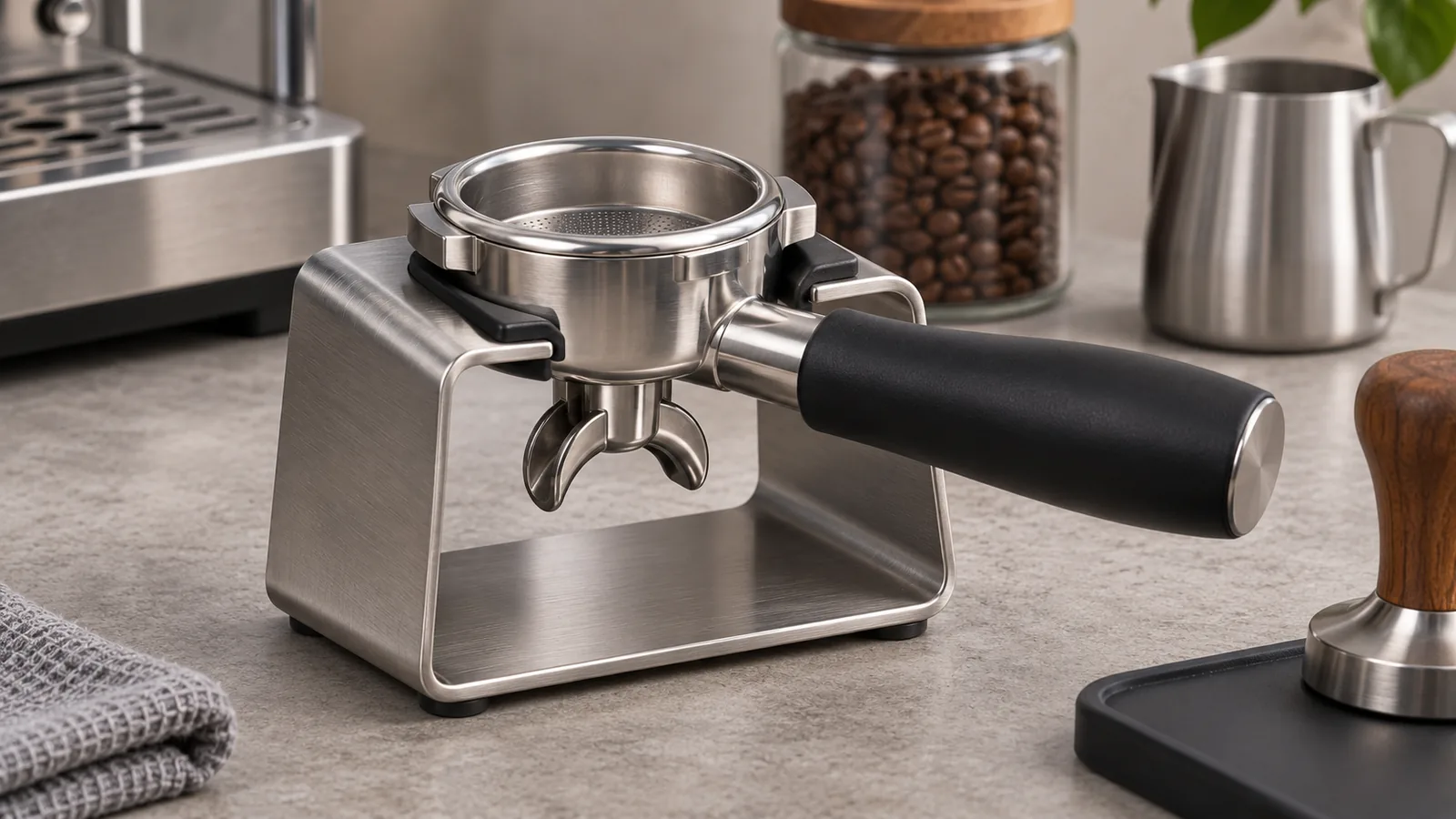
Portafilter tamping stand compatibility cannot be established from a nominal basket diameter alone. Buyers should check the actual portafilter head and lugs, handle shape and angle, spout orientation, intended support points, and the counter or edge arrangement against the exact stand revision. A portafilter may share a nominal basket size with another model yet contact the stand differently or require a different position. The approval should name the tested stand and portafilter models and record the support configuration that was actually reviewed.
This is a product-development and assortment question for coffee-accessory importers and distributors. Portafilter tamping stand compatibility should be documented against the exact tools a listing names. A passive metal stand may support a portafilter while a user works with a separate tamper, but the stand does not become a precision tamper, espresso machine, or guarantee of extraction quality. The buyer should define the interface and use position without inventing universal dimensions, acceptable force limits, or performance claims. The manufacturer’s instructions and actual fit observations should guide any compatibility language.
What does portafilter tamping stand compatibility require?
Compatibility means that a named portafilter sits in the intended support position on a named stand, with the relevant parts clear of unintended contact under the buyer’s defined sample review. It does not mean that every product with the same basket diameter will fit. The outside envelope can include the basket rim, locking lugs, ears, spouts, a bottomless opening, a handle transition, and a handle that projects at a particular angle. Those features determine where the stand touches the tool and where it needs clearance.
Start with the product data the portafilter manufacturer provides. Record the maker, exact model, revision if available, basket or nominal size, spout format, and any model notes relevant to the holder. A nominal size can be an initial filter, but it is not a substitute for the overall head and handle geometry. If an importer sells several coffee machine families, a sample set should represent the models the product page or packaging will actually name.
Then identify the stand architecture. Does the portafilter head rest on a horizontal ledge, enter a cutout, contact a pad, or sit against a formed edge? Does the handle rest on a second support, or is it held by the user? Is the stand meant for a flat counter, positioned over an edge, or used in another arrangement specified by its maker? These details change the contact pattern. A stand may be compatible with a head profile but not with the handle position, spout direction, or counter edge described by the buyer.
Maker literature demonstrates why product-specific exclusions matter. Normcore’s wood espresso tamping station lists compatibility qualifications for certain portafilter arrangements, including an exclusion for upward-facing spouts and limits on a funnel slot; its compact station and other model configurations are not interchangeable. This is evidence about that maker’s products, not a generic rule for metal stands. Normcore’s station information should be checked for its current model details and not used to copy its geometry.
A metal example also shows that edge orientation is a design choice. JoeFrex describes an upward-bent version and a separate downward-bent version of its professional tamping station, with different edge positioning. Its marketed compatibility statement is not independently verified proof that every portafilter fits. Compare the actual upward-edge model und downward-edge model as supplier-specific examples. They do not establish a universal preferred shape or a Koitor product capability.
Use an exact pairing statement in internal records: “This portafilter model and revision was checked on this stand revision, in this support position, on this work surface.” That is more useful than a broad label such as “58 mm compatible.” A maker can use its own criteria, but an importer should keep product claims within the models and conditions actually covered.
Which portafilter geometry should buyers compare?
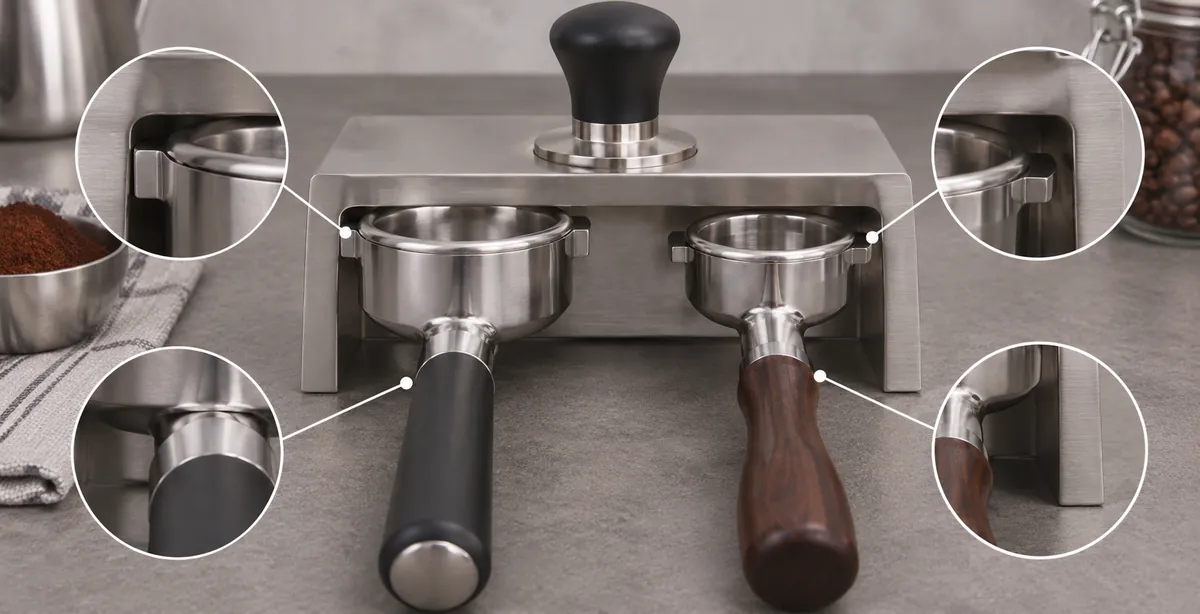
Compare the complete contact envelope rather than a single diameter. The basket rim may be close to the intended stand opening, while lugs or ears extend beyond that circle. A spouted model may have one or two downward projections that need clearance below the support. A bottomless model may expose a different underside shape. A handle may meet the basket head at a different angle or have a thicker collar that contacts the stand before the intended seating surface does.
Build a simple model matrix using the tools the buyer plans to name. For each one, record maker, model, nominal basket size where provided, bottomless or spouted format, lug profile, handle direction, handle transition, and any collar or funnel that remains attached during the intended use. If a portafilter will be used with a dosing funnel, include that setup in the sample review. Do not assume the accessory will be removed unless the instructions or product copy say so.
The support point matters. A stand should be reviewed where it actually contacts the head or handle. If a design rests under the rim, the buyer should observe whether the rim bears on the intended surfaces and whether the handle occupies its expected position. If it uses a V, slot, or pad, identify the contact area and ask whether the buyer’s specific models seat as intended. Avoid translating a visual match into an engineering claim about stability, strength, ergonomic comfort, or safe force capacity.
A compatibility matrix can make the review visible:
| Portafilter reference | Head and lug profile | Spout or bottomless format | Handle position | Stand contact and clearance | Review outcome |
|---|---|---|---|---|---|
| Exact maker and model A | Record from actual product or drawing | Identify actual configuration | Record angle and collar | Note seating and any unintended contact | Supported, unsupported or pending |
| Exact maker and model B | Record actual variation | Identify spout orientation | Note handle length/shape | Compare with intended stand support | Supported, unsupported or pending |
| Model with funnel attached | Identify funnel model | Note retained accessories | Check assembled envelope | Observe whether funnel contacts stand | Supported, unsupported or pending |
| Unnamed or unknown model | Incomplete | Unknown | Unknown | Do not infer | Unreviewed |
A user discussion can reveal a fit question without proving its frequency or cause. One Reddit discussion describes a user’s slim portafilter not sitting flush in a tamping station without continuous handling. This is anecdotal evidence of a model-specific support concern, not a technical finding, prevalence statistic, or Koitor customer complaint. The article’s recommendation is to identify actual models and contact points, not to generalize from one report. The discussion can be treated as a question prompt only; unverified comments are not design specifications.
Do not borrow dimensions from a competitor listing unless the buyer is explicitly reviewing that exact competitor model and understands the source. The research pack intentionally does not use numerical stand or portafilter dimensions as a universal rule. Measurements should come from the actual buyer reference, maker drawing, or supplier-approved sample and should be associated with the exact part revision. If the maker does not publish an overall envelope, request a drawing or physical sample rather than estimating it from a photograph.
How should buyers define the intended support and counter setup?
Specify the work position before assessing fit. A flat-counter stand and an edge-positioned station can use different formed edges and contact areas. JoeFrex presents distinct upward- and downward-edge versions; that demonstrates model-specific formats, not a universal best orientation. The buyer should say whether the stand sits fully on a flat worktop, over a counter edge, or in another position supported by the maker. Do not assume a design for one setup will behave the same in another.
Clarify where the portafilter is intended to rest before the user acts on it. The support may be under the head, around part of the rim, against an edge, or on a pad. The handle may rest on the counter, contact a second feature, or be held by the user. Record the intended contact and inspect whether the actual reference tool reaches it without being forced into an unrelated edge. A stand that merely accepts the head opening may leave the handle unsupported or cause the spout to touch the work surface.
Separate geometry review from applied-use claims. This guide does not state a universal tamping force or test cycle. A qualified product engineer or the actual manufacturer should define any load, deflection, deformation, or safety evaluation appropriate to the intended product. A buyer may observe whether a named reference tool sits in the planned position during a bounded sample check, but that observation does not establish a rating for every user, portafilter, or work surface.
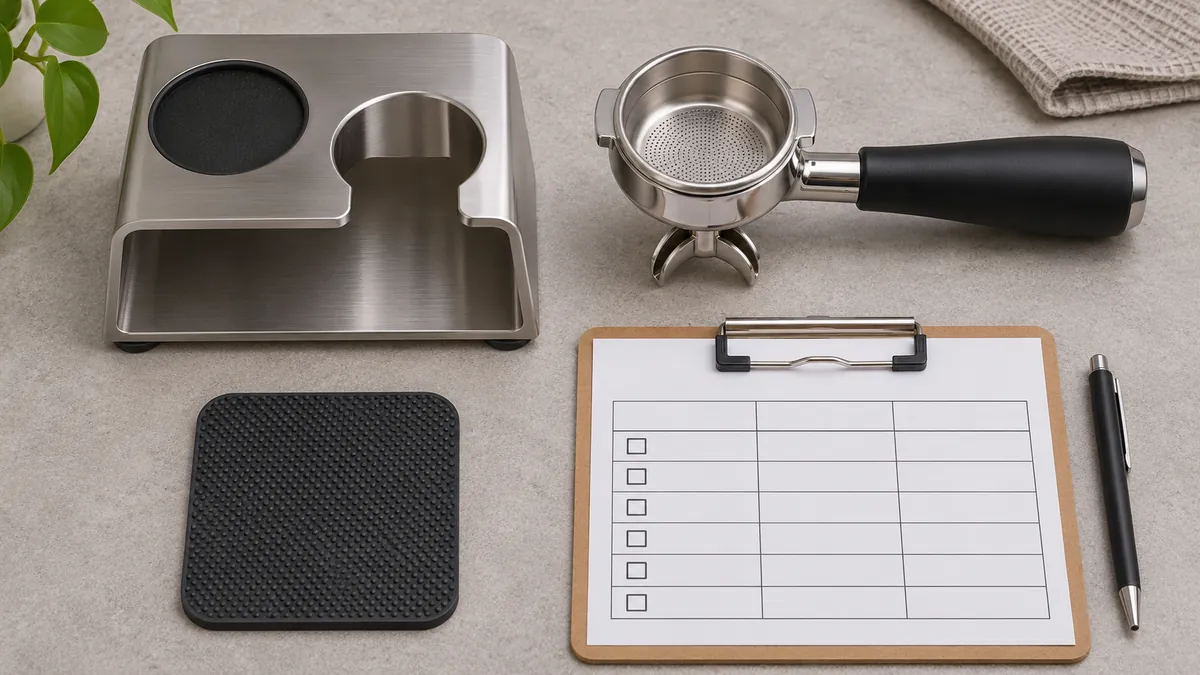
Pads or feet add another interface. Identify whether a silicone or other contact component is included, who supplies it, and which revision is represented. A pad can change the contact height or friction at the worktop, but its exact effect depends on material, hardness, shape, surface, and assembly. Do not make food-contact, heat-resistance, dishwasher, slip-resistance, or hygiene claims unless supported by relevant evidence for the specific component and conditions.
The sample review can use a setup diagram with the portafilter model, stand revision, worktop edge, support points, and any attached funnel. A simple diagram is useful when it captures what is actually being evaluated. It should not be presented as a manufacturing drawing or dimensional guarantee. If the buyer needs production dimensions, request the controlled drawing and identify critical-to-fit features with the supplier.
Consider the whole work sequence. The portafilter may be placed into the stand, used with a separate tamper, removed, and cleaned. The buyer should identify whether it must remain seated during that sequence or whether a user holds it. Do not describe a design as “hands-free” unless the actual product and supported combinations have been evaluated and that claim is substantiated. If continuous handling is needed in a sample observation, document it as such and decide whether that behavior meets the intended product brief.
How should buyers approve actual sample pairings?
Select representative references based on the intended assortment, not on a single convenient portafilter. If product copy names specific models or model families, obtain those exact parts or supplier drawings. If a distributor expects to serve several formats, choose samples that cover the relevant head, lug, handle, and spout differences. The buyer should state what is included and what is outside the approved range.
At sample review, confirm the identity of the stand and portafilter first. Record any pad, insert, funnel, accessory, or work surface included in the setup. Place the parts according to the manufacturer’s instructions and observe the intended support points. Do not force the portafilter into an opening or alter the stand to create a fit. If a maker provides an exclusion or installation note, include it in the review. Ask for technical clarification if the instructions and physical sample appear inconsistent.
Record observable facts rather than broad diagnoses. Examples include:
- The named portafilter head entered the intended opening without forced insertion.
- A specific lug contacted the stand edge before the intended seating surface.
- A spout touched the worktop in the documented orientation.
- The handle rested on the second support or remained unsupported.
- The funnel was included or removed during the review.
- A particular stand was positioned on a flat surface or counter edge.
- The buyer or reviewer had to hold the portafilter continuously in the observed setup.
These notes do not by themselves establish strength, load capacity, safe operation, or brewing quality. If a condition fails the buyer’s requirement, capture the exact model and contact point, then ask the supplier or qualified engineer to review the interface. Do not prescribe a thicker material, larger opening, or new support angle as an automatic fix. A change may solve one contact issue while creating another or altering appearance and packaging.
Use a bounded approval phrase such as “approved for visual fit with portafilter model A, revision B, without funnel, on a flat counter; force rating not evaluated.” The wording should match the actual review. If the sample was used only to inspect appearance, do not imply functional acceptance. If only one model was reviewed, do not claim universal compatibility. If a model is on the list but unavailable for review, mark it pending rather than leaving it implicitly included.
A small review plan can include:
- The stand model, revision, finish, and included pad.
- The portafilter maker, model, revision, head/lug format, handle, and spouts.
- Any funnel or accessory attached during the intended use.
- The worktop arrangement and intended support contact.
- What the reviewer will observe and record.
- Which claims are being evaluated and which are out of scope.
- How photos, measurements, and exceptions will be attached to the sign-off.
The plan should be proportionate. A simple passive product may need a straightforward model-fit check, while a safety or performance claim may require a more formal engineering review. This article does not create the test method or set pass criteria. The buyer and responsible manufacturer should agree on what evidence is needed before making a claim or releasing an SKU.
What compatibility claims should importers avoid?
Avoid claiming “fits all 58 mm portafilters” based only on basket diameter. The phrase can cover different head exteriors, lugs, handles, spouts, and accessory combinations. If the buyer has reviewed a defined set of models, name that set and state relevant exclusions. A compatibility chart should distinguish supported, unsupported, and unreviewed pairings rather than implying that every possible variation was tested.
Do not use “universal” because a maker uses the word on its own product. A supplier’s marketing statement may be useful to understand its offer, but the buyer should not reproduce it as an independently verified guarantee. If the listing includes an exclusion, the buyer should preserve it. For example, a particular stand may not suit an upward-facing spout or a specific laid-flat configuration. Such an exclusion belongs to that model and must not be generalized to all stands.
Avoid strength and safety claims based on material thickness, weight, or a single demonstration. Heavier metal does not by itself establish better support. A sample that appears not to move under one brief interaction does not establish a safe load rating, resistance to repeated force, or fit for all surfaces. If a product claim requires a quantified rating, assign the test and acceptance criteria to qualified parties and keep the claim bounded to the evidence.
Do not claim that the stand improves extraction, shot consistency, ergonomics, cleanliness, or workflow speed without appropriate evidence. Those outcomes depend on the user, coffee equipment, portafilter, technique, and other conditions. This topic is a mechanical interface and sourcing guide. It does not endorse any brand or make a claim about coffee quality.
For private-label copy, create a claims table:
| Draft claim | Buyer check before use |
|---|---|
| “Fits standard portafilters” | Define the actual standard and named models, or remove vague wording |
| “Universal compatibility” | Identify complete evidence across the stated range and model exclusions |
| “Hands-free support” | Confirm the intended use and all named combinations; do not infer from appearance |
| “Heavy-duty” | Define the requirement and supporting evidence instead of using weight alone |
| “Food-safe silicone” | Obtain evidence for the actual compound and applicable use; do not infer from a generic pad |
| “Professional-grade” | Replace with specific product facts or evidence if no defined standard exists |
The buyer should approve product images and text against the same reference configuration. A photograph may show a bottomless model while the compatibility copy mentions spouted models; that mismatch should be resolved. If the included item differs from the shown accessory, state what is included. Product data should not imply that a tamper, portafilter, espresso machine, or pad comes with the stand unless that is the actual package.
How should buyers manage revisions and assortment expansion?
Keep a revision-controlled matrix so that the approved scope remains clear. For each pairing, record the stand revision, portafilter model, configuration, accessories, intended position, observations, claim decision, evidence, reviewer, and date. If a supplier changes the bend, opening, support pad, finish, or assembly, determine which pairings and claims need another review. If the portafilter maker changes the head or handle, review the affected fit rather than assuming a model name always maps to an unchanged envelope.
A new SKU can expand the assortment without rewriting the whole approval record. Add a row for each new portafilter configuration and mark it pending until checked. If several models share verified geometry, the buyer may group them only if the evidence and recipient’s policy support that grouping. Do not group models just because their nominal basket size matches.
When comparing alternative stand formats, keep flat-counter and edge-positioned versions distinct. The work surface can change how the stand sits and where force is applied. A downward edge and upward edge may represent different placement assumptions; neither should be called better universally. The importer should select the version that matches the customer’s work surface and instructions, then review the actual reference models in that arrangement.
Purchased pads and contact components need their own change record. Confirm who supplies them and whether their shape or thickness changed. Do not assume a replacement pad is equivalent because it has the same color or outside appearance. If a material or supplier change could affect contact, fit, cleaning, or claims, request the information needed for a targeted review. This is a sourcing question; the article does not assert that Koitor molds silicone or supplies coffee accessories.
Before approving a compatibility expansion, ask:
- Does the new portafilter share the relevant head and lug envelope?
- Are the handle, collar, spouts, and funnel arrangement the same?
- Does the stand touch the same support surfaces?
- Is the worktop arrangement unchanged?
- Are the claim and included items still accurate?
- Does the available evidence cover this model or merely a similar one?
If the answer is uncertain, mark it as unreviewed. Clear limits can be more useful to a distributor than a broader but unsupported claim. A buyer who knows which model fits and which remains untested can make a better assortment decision, respond honestly to a retailer question, and identify the right sample needed for the next approval.
Häufig gestellte Fragen
Does a 58 mm basket mean every portafilter fits the same stand?
No. Basket size does not describe the full outer head, lug, handle, spout, or accessory geometry. Check the actual model and support contact.
Can a bottomless and spouted portafilter share one stand?
Possibly, but the buyer should review both exact configurations. Spouts and underside geometry can change clearances and contact points.
Does a metal stand need a specific support test?
The suitable method and acceptance criteria depend on the product claim and use. A qualified supplier or engineer should define them; this guide does not prescribe universal forces or cycles.
Is a maker’s “universal fit” statement enough for private-label packaging?
Not by itself. Review the exact models and exclusions covered by the maker’s statement before reproducing it.
Does the presence of a silicone pad prove food-contact or heat suitability?
No. A generic pad’s appearance or presence does not establish a compound, regulatory status, or temperature rating. Request evidence for the actual component and intended claim.
Sources and scope
- Normcore espresso tamping station — maker-specific fit notes and exclusions.
- JoeFrex upward-edge station und downward-edge station — distinct supplier-specific worktop formats.
- Metallurgica Motta bar accessory category — assortment context only.
- One user fit discussion — anecdotal question, not technical proof or prevalence evidence.
- Koitor production of portafilter tamping stands, silicone molding, coffee testing, food-contact certification, or espresso performance is not claimed.
Discuss a Custom Metal Storage Hardware Concept
Send a drawing or sample, the intended application, finish reference and quantity split. Koitor can first confirm whether the product and process fit its current bathroom and home storage hardware scope.
OEM / EIGENE MARKE
Verwandeln Sie diesen Beschaffungsleitfaden in ein Produktdossier
Teilen Sie uns Ihr Zielprodukt, die Größe, die Oberflächenausführung, die Bestellmenge und Ihre Verpackungsanforderungen mit. Ihr Team erhält vor der Angebotserstellung eine praxisorientierte Prüfung der Herstellbarkeit.


 English
 Español
 Português
 Français
 Deutsch
 العربية