
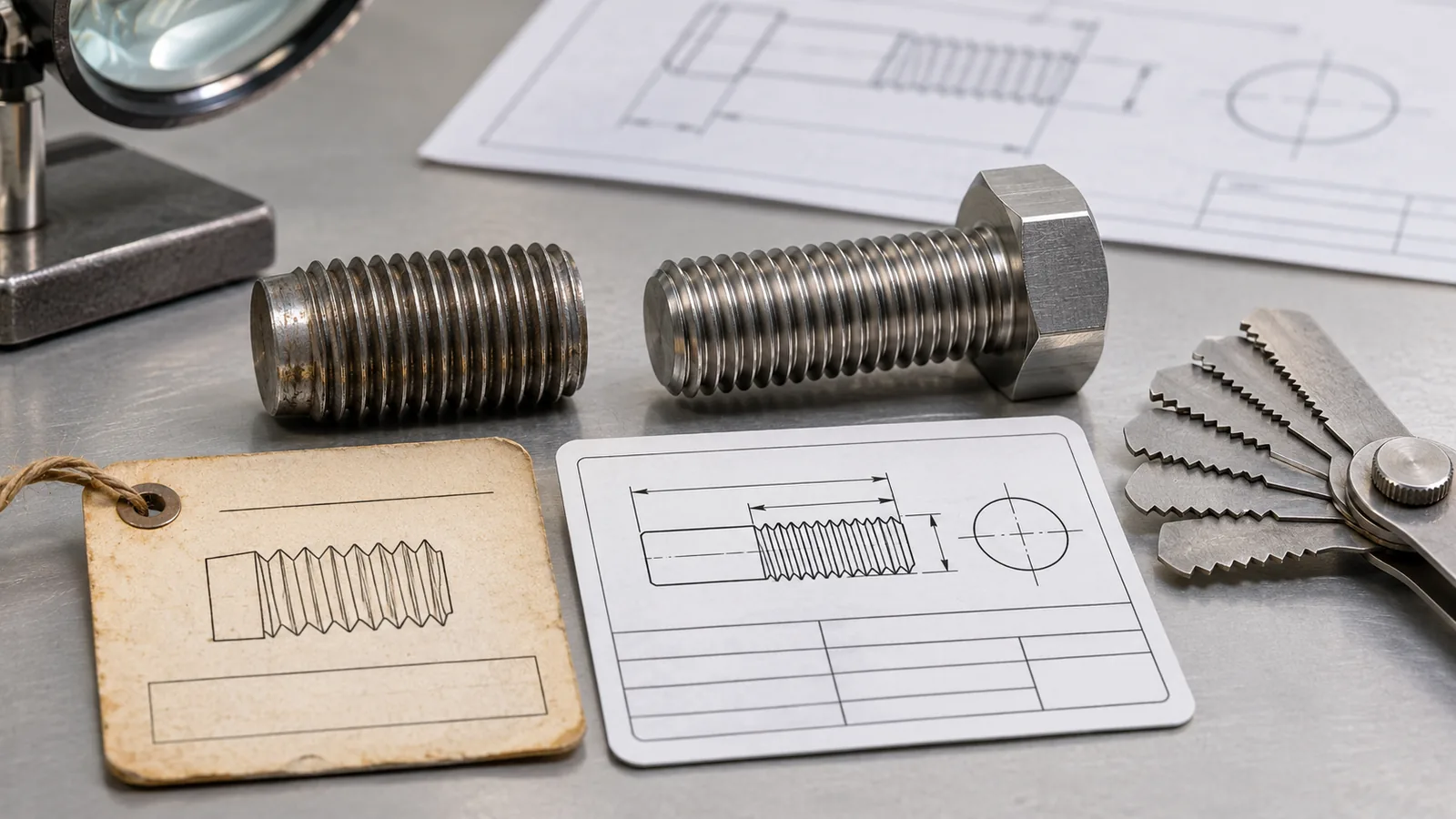
For buyers researching NS threads, the legacy American National inch-thread context uses NS to mean National Special. It identifies a special thread designation context; by itself it does not specify one fixed diameter, pitch, fit class, material or approved replacement. A buyer should read NS with the governing thread system and edition, the diameter and pitch, the internal or external thread and fit requirements, and the actual mating part and drawing revision. Do not treat NS and UNS as interchangeable purchase instructions just because the abbreviations look similar.
The terminology can appear in historical records, tooling references or older component documentation. Historical American National Special designations and modern Unified inch-thread terminology belong to different naming contexts. A superseding or current standard does not automatically decide which legacy project requirement has been approved. If a buyer is proposing an NS-to-UNS or NS-to-UN conversion, the drawing authority and qualified supplier must review the complete part and mating assembly.
What Does NS Mean in a Thread Designation?
NS is an abbreviation for National Special in a legacy American National inch thread context. Historical standards material describes special diameter, pitch or engagement combinations while retaining a defined thread form. Toolmaker nomenclature also lists National Special separately from common coarse and fine inch series. The designation is therefore not a modern standalone recipe for a replacement screw.
A useful reading separates four layers:
| Layer | Example field | What it identifies | What it does not approve |
|---|---|---|---|
| Thread system and edition | Legacy American National or a specified Unified document | The nomenclature context to interpret | A current substitute by itself |
| Size combination | Diameter and pitch/TPI | The stated nominal size and spacing within the system | Correct hand, fit or mating part alone |
| Thread role and fit | Internal/external and specified fit requirements | Which component carries which thread and how the project defines engagement | Material or product suitability |
| Part and revision | Component number, drawing revision and mate | The approved project item and its counterpart | A deviation or alternate without review |
The abbreviation NS does not supply every field in this table. A short string may preserve the special-series clue but still need the original drawing or specification to identify what the purchasing team should order. A buyer should not invent the omitted values from a similar fastener or a present-day catalog result.
A historical National Bureau of Standards document uses American National Special terminology in its period context. That is useful evidence for interpreting the older term. It is not a current dimensional requirement, and this guide does not reproduce its numerical tables or derive a conversion. Current Unified thread standards are published separately. ASME’s public description of B1.1 identifies the Unified inch screw thread subject and scope, but the full paid standard text was not consulted for this article. No current table or automatic equivalence is claimed.
Why Are NS and UNS Not the Same Purchase Instruction?
UNS is used for a Unified inch thread series designated as special. NS belongs to the legacy National Special naming context. The names are similar, but a buyer cannot conclude that one is a direct replacement for the other from the letters alone.
The “U” is a clue to the Unified naming family; it is not a numerical compatibility calculation. Thread designations carry information about a thread system and specified size combination. Even if two terms appear to occupy a comparable “special” category, that does not prove the actual parts share diameter, pitch, fit, engagement, thread form or mating requirements.

A symbolic field strip can help a buyer ask the right questions without inventing a conversion:
| Callout layer | Legacy example field | Unified example field |
|---|---|---|
| Diameter | Confirm from controlling document | Confirm from controlling document |
| Threads per inch | Confirm from controlling document | Confirm from controlling document |
| Series context | NS / National Special, where documented | UNS / Unified special series, where specified |
| Fit or class | Verify legacy requirement and edition | Verify the Unified requirement and edition |
| Mating part and revision | Identify actual project counterpart | Identify actual project counterpart |
The labels are schematic only. This article intentionally does not supply a real numeric thread callout, a conversion table, gauge limits or cutting instructions. A missing “U” should prompt a question about the source document and naming era; it should not be used alone to decide that the part is obsolete, incompatible or interchangeable.
What Should a Buyer Verify Before Replacing an NS Part?
First find the controlling source: an approved drawing, engineering specification, bill of materials or supplier document. Confirm whether it is a historical record or the current controlling revision. If the thread is only identified by a shorthand, request the complete supporting definition and the intended mating component.
Before ordering NS threads or replacements, record:
- The original part number and its drawing revision.
- The source and edition of the thread designation.
- The exact wording of the callout, preserved without silent normalization.
- Diameter and pitch/TPI as stated by the controlling document.
- Internal or external thread role.
- Fit or class requirements if the project specifies them.
- The matching part number and revision.
- The proposed replacement’s source and complete supplier designation.
- Any approval required from the drawing owner or design authority.
A supplier catalog can help locate an offered product, but its description is not automatically the project’s approval. If the supplier proposes a Unified designation in place of a legacy NS reference, ask the drawing authority to review the proposal using the applicable documents and mating components. Do not assume that the latest terminology itself authorizes a substitution.
A thread pitch gauge has a narrower role: it can help compare spacing when used in the right context. It does not establish the full thread system, fit, diameter, mating part, or whether the proposed alternate is approved. Koitor’s thread pitch gauge guide explains those tool limits. The separate UNC versus UNF article addresses coarse and fine Unified series; use it for that different comparison, not to infer NS equivalence. The thread types and profiles guide covers broader terminology.
How Should a Legacy Callout Be Handled in a Hardware Project?
A threaded component in a bathroom or home-storage product may be part of an assembly connecting brackets, supports or other metal parts. That context does not establish that Koitor makes a National Special thread, stocks a specific fastener, or provides a special tapping capability. The buyer’s immediate task is to preserve the approved definition while the responsible component supplier and drawing owner resolve any incomplete or legacy notation.
Keep the original callout in the record, then add a separate clarification field for the proposed interpretation. Do not overwrite the original text with a guessed modern label. A traceable table can distinguish original data from an engineering proposal:
| Record field | Entry approach |
|---|---|
| Source callout | Copy exactly from the drawing or source document |
| Source date/edition | Record if known; otherwise mark unknown |
| Supplier interpretation | Record separately and identify the supplier |
| Proposed alternate | Provide its full designation and source |
| Mating part checked | Identify the actual counterpart and revision |
| Approval status | Pending until the authorized design owner decides |
| Final released requirement | Update only after approval and revision control |
This avoids a common documentation failure: a buyer receives a replacement suggestion, someone edits the product database, and later teams can no longer tell what came from the drawing versus what was proposed. Keep provenance and approval status visible. If the historical edition is not available, record that limitation and do not claim the complete dimensional definition was recovered.
A sourcing request should also separate thread definition from material, finish and product-level requirements. A designation does not specify a coating, corrosion performance, load capacity or suitability for a particular product. Those facts belong to other documented requirements. Do not assume a thread abbreviation implies a particular steel, material, manufacturing route or performance result.
What Does the Standard or Toolmaker Evidence Establish?
Regal Cutting Tools’ specialty-tool discussion explicitly associates NS with National Special pitch terminology in a supplier context. Newman Tools lists NS separately from common inch-thread series in its nomenclature. The historical National Bureau of Standards source describes the older American National Special system and its special combinations. Together these sources support interpreting NS as National Special in the legacy context; they do not provide a complete current replacement decision.
Gage Crib’s nomenclature discussion distinguishes N/UN and NS/UNS usage and cautions that customer approval is needed. That is consistent with the article’s practical rule: a buyer should not assume a legacy-to-Unified substitution is approved. ASME’s public B1.1 page provides the current publication scope, but does not expose the full standard tables used for dimensional verification. Paid-standard data and exact conversion values are outside this article.
The evidence does not establish that every NS part is incompatible with every UNS part, nor that all pairs are interchangeable. It also does not provide a numerical translation, allowable tolerance, gauge method, machining recipe or permission to deviate from a drawing. If the actual purchase decision requires those answers, the buyer needs the governing standard and engineering approval for the exact assembly.
This boundary is important when the acronym appears in an old equipment manual, maintenance record or legacy BOM. The context can explain why the term exists, but it does not resolve what a current buyer should order. Record the full source, preserve the exact callout and ask the person responsible for the design to approve the interpretation.
How Should the Buyer Document the Proposed Interpretation?
A legacy abbreviation should remain visible in its original context while a supplier or engineer evaluates what it means for a current order. The purchase record can separate the raw source from the interpretation, proposed alternate and final approved requirement. That separation is important if an older part is being re-sourced: a buyer can preserve provenance without presenting an unverified reading as a released specification.
For example, a buyer can record “source callout: NS, copied from drawing revision X” and in a separate field request the supplier to identify the complete thread definition and its source. If the supplier suggests a Unified part, include its complete designation and the source document. The drawing owner can then decide whether that alternate satisfies the actual assembly requirement. Until the owner approves it, the proposed designation should remain a proposal, not replace the original requirement in the BOM.
This workflow also helps when documents conflict. A catalog may use a modern series label while a purchase file retains a historical designation. A product sample may physically resemble an available replacement but not expose the drawing’s fit class or intended mate. The discrepancy should be documented and resolved by the responsible technical owner, not hidden by changing one abbreviation in a spreadsheet.
| Schritt | Buyer action | Record to retain |
|---|---|---|
| 1. Preserve | Copy the original callout without correction | Source file, revision and exact text |
| 2. Clarify | Ask what system and edition the callout uses | Supplier answer and cited source |
| 3. Compare | Obtain the complete proposed alternate and mating details | Original versus proposed fields, separately labeled |
| 4. Review | Route the change to the authorized design owner | Decision and any conditions |
| 5. Release | Update the controlled requirement only after approval | New revision and date of approval |
This sequence does not make an otherwise incomplete callout complete by administrative means. If the governing drawing, edition or mating part cannot be established, record that gap and keep the replacement decision pending. A clear “not verified” status protects procurement from assuming that similar naming equals approved technical compatibility.
What Is the Limited Role of the Historical and Current Sources?
The historical National Bureau of Standards document explains National Special terminology in its own period. It supports the definition and the distinction between ordinary coarse/fine series and special combinations at that time. It is not a source for a modern dimensional conversion or a current purchase decision. This article does not reproduce the old tables or extrapolate their numbers.
Regal Cutting Tools and Newman Tools provide toolmaker terminology in which NS is named separately from other inch series. Those catalog references help a reader recognize the abbreviation; their presence does not mean that every manufacturer uses an identical ordering shorthand or that a tool listing completes a part definition. Gage Crib describes differences between legacy and Unified nomenclature and notes customer approval. Its caution is a reason to preserve the project’s authority, not a substitute for the standard or drawing.
ASME’s public B1.1 page identifies the Unified inch thread subject and the standard’s published scope. It does not expose the full paid requirements for this article, so no dimensional rule is attributed to the full standard. If a replacement depends on exact limits or gauge requirements, consult the governing full document through the responsible engineer or standards holder. The buyer should not infer unavailable material from a short public summary.
What Mistakes Should Buyers Avoid?
Do not treat NS as a complete part specification. The abbreviation alone does not give a buyer every size, fit and mating detail needed for procurement.
Do not substitute UNS automatically because it contains the word “special.” Related wording does not demonstrate identical geometry or an approved replacement.
Do not infer exact dimensions from an abbreviation or from a modern catalog listing. The complete controlling document and the actual proposed part must be checked.
Do not use a pitch gauge as a compatibility certificate. Spacing is only one aspect of thread identification.
Do not treat a current publication as automatic permission to change a legacy drawing. The responsible design authority must resolve the applicable requirement and revision.
Do not describe the historical standard as the current dimensional rule. This article uses the old document as historical terminology evidence only. The full current standard tables were not consulted.
Do not silently “correct” the notation in a purchase order. Preserve the original callout and write a separate clarification request until the approved requirement is released.
Why Does a Similar Catalog Entry Not Settle the Question?
A catalog entry can help locate a candidate but may omit the legacy document, mating part or revision that controls the project. Even when a listing shows a diameter and pitch, the buyer still needs the appropriate system and fit context. The same caution applies to a sample: physical resemblance can guide identification, but it does not establish the complete design requirement.
If the part is unavailable or the drawing is incomplete, do not fill the gap with a guessed modern code. Record which field is missing, preserve the source information that is available, and ask the drawing owner to establish the requirement. That keeps the purchasing trail honest and avoids turning a plausible interpretation into a de facto engineering approval.
Buyer Checklist Before Ordering a Replacement
- Copy the source callout exactly and identify the drawing revision.
- Confirm whether NS is used in a legacy American National context.
- Identify the governing document or edition when available.
- Confirm diameter, pitch/TPI, internal or external role, and fit requirements from an approved source.
- Identify the actual mating component and its revision.
- Ask the supplier for the full designation of any proposed replacement.
- Keep NS and UNS as distinct labels until an authorized comparison is completed.
- Use a pitch gauge only as one limited spacing check.
- Record any unavailable historical specification instead of reconstructing it by guesswork.
- Obtain design-owner approval for a proposed conversion or deviation.
- Keep material, finish and product-level performance requirements separate from the thread label.

What Do NS Threads References Establish?
The historical U.S. Bureau of Standards publication hosted by NIST uses the American National Special designation in a period-specific thread system. Current public supplier references also keep NS terminology visible: Regal Cutting Tools describes National Special tools, while Newman Tools lists NS separately from common NC and NF series. These references help explain the label; they do not provide a blanket replacement table. Gage Crib’s comparison likewise warns that nomenclature and fit details must be read with the actual application. The public ASME B1.1 scope page describes a Unified-thread standard; the full paid standard text was not reviewed here.
For a legacy component, preserve the original callout and revision, then ask the drawing owner to identify the intended system, diameter, pitch, class or fit requirement, internal or external form and mating part. Compare those fields with the proposed supplier drawing and record approval before ordering a substitute. A matching nominal diameter or a similar abbreviated label does not establish compatibility. This is a controlled identification workflow, not permission to convert NS threads into UNS or to manufacture from a historical table without current design approval.
For adjacent thread-making and fastener-identification topics, see Koitor’s thread chaser versus tap guide, und form tapping versus cutting taps guide, und nut types guide.
Häufig gestellte Fragen
What does NS mean on a screw or thread callout?
In a legacy American National inch-thread context, NS means National Special. The letters alone do not specify a complete replacement part.
Is an NS thread the same as a UNS thread?
Do not assume so. NS and UNS belong to different designation contexts. Similar names do not prove that a specific pair has matching dimensions or approval.
Does NS identify one fixed thread size?
No. The designation context is not one fixed diameter, pitch or fit class. Read the full source callout and governing document.
Can I replace an NS part with a current Unified part?
Only after the complete proposal is reviewed and approved by the drawing authority for the actual part and mate. This article does not provide a conversion table.
Can a pitch gauge identify an NS thread?
A pitch gauge can help compare spacing, but it does not establish the full system, size, fit or replacement approval.
Does an NS designation specify material?
No. The thread designation should not be used to infer the fastener material, finish or product performance.
What if the old drawing does not identify an edition?
Record that the edition is unknown and preserve the exact source wording. Request clarification rather than guessing the omitted specification.
Is the historical National Bureau of Standards document a current design standard?
It is historical evidence for the terminology and system of its period. This article does not treat it as a current dimensional requirement.
Record clarification requests with the controlled drawing revision.
Do not substitute from abbreviation alone; the approved drawing and mating part control.
Keep each revision traceable.
Arbeiten Sie mit Koitor Hardware zusammen
Reviewing a Legacy Component for a Hardware Project?
Share the controlling drawing, revision, proposed replacement and mating-part information. Koitor can discuss the confirmed bathroom and home-storage hardware scope and the project details needed for a component review.
OEM / EIGENE MARKE
Verwandeln Sie diesen Beschaffungsleitfaden in ein Produktdossier
Teilen Sie uns Ihr Zielprodukt, die Größe, die Oberflächenausführung, die Bestellmenge und Ihre Verpackungsanforderungen mit. Ihr Team erhält vor der Angebotserstellung eine praxisorientierte Prüfung der Herstellbarkeit.


 English
 Español
 Português
 Français
 Deutsch
 العربية