

An over-tank bathroom organizer should be checked against the actual toilet tank and lid before a buyer makes a compatibility claim. The importer needs to inspect the exposed rim section, the lid’s underside and return shape, the hanger dimensions and contact points, and the way the lid seats with the organizer in place. The review should also check whether the product interferes with nearby walls, flush controls, seat operation or required service access. No single hook design fits every tank by assumption.
What Tank and Lid Details Should Be Measured?
Start with the toilet model or a physical fixture sample. The tank’s outside width does not describe the rim section where a hook rests. Measure the exposed rim width and shape, wall thickness, lid overlap, underside return and any contour that changes how the lid sits. Record whether the tank has curves, bevels or a thick decorative lid.
The organizer’s hanger should be measured at the interface: inner hook width and depth, material or padding thickness, bend radius, contact length and lateral projection. Do not estimate these values from an image. A product can appear to hang over a tank yet rely on a narrow contact that conflicts with a particular lid edge.
| Fixture or organizer field | Record | Fit question |
|---|---|---|
| Toilet brand/model | Exact model if known | Is the fit claim tied to a reference fixture? |
| Exposed tank rim | Width, contour and wall thickness | Can the hook seat without forcing? |
| Lid underside | Return, bevel, overlap and support | Does the lid remain fully seated? |
| Hook interior | Width, depth and bend shape | Does it clear the rim and lid together? |
| Contact protection | Pad/liner material and position | Does it remain attached and aligned? |
| Organizer projection | Side and front envelope | Does it interfere with adjacent items? |
| Flush control | Handle, button or sensor position | Can it operate normally? |
| Service route | Lid lift and tank access | Can maintenance remove the lid? |
| Sample identity | Fixture, product and revision | Can approval be repeated? |
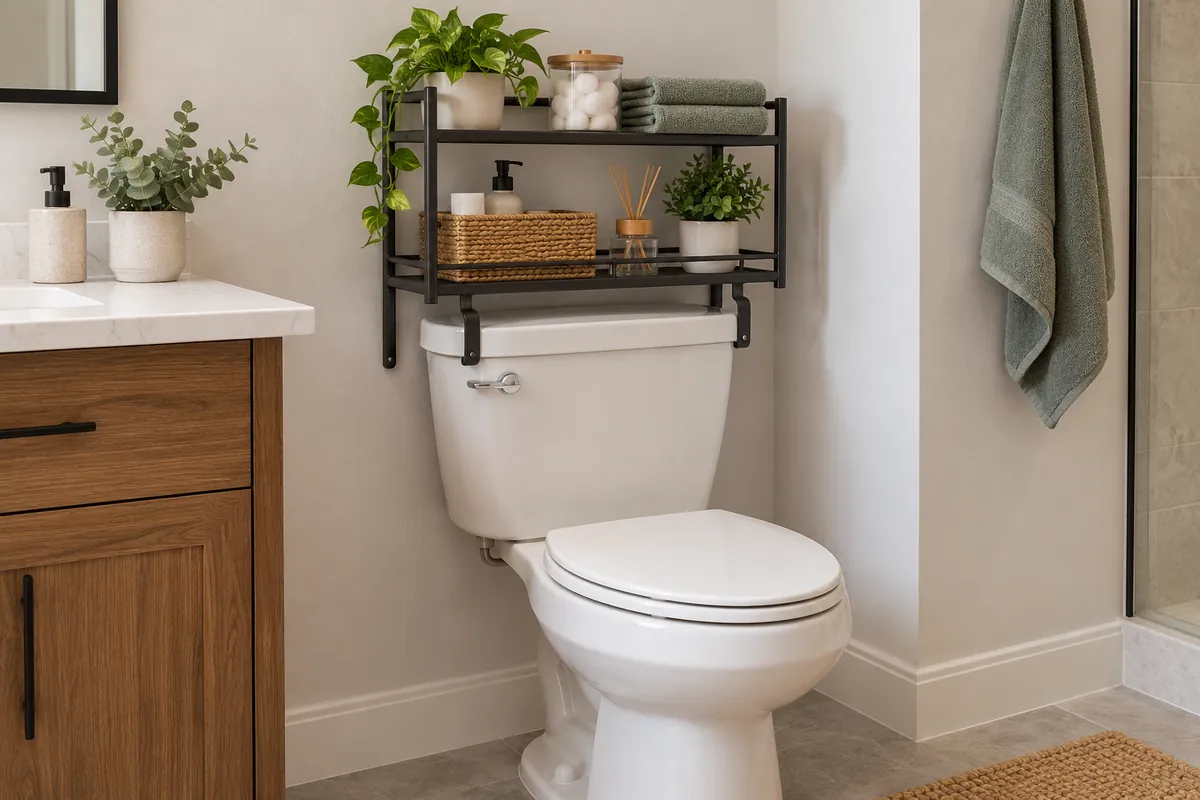
YBM Home’s product description, for example, says its wire organizer slides under the tank top and uses hooks at the tank edge. Garbath lists an over-tank metal tissue-holder product for supplier inquiry. These are examples of real product architecture, not universal compatibility evidence. A catalog photograph cannot establish fit to a different toilet.
How Should Hook Contact and Lid Seating Be Reviewed?
Install the organizer on the actual reference fixture without forcing the hook. Observe whether it rests evenly, moves laterally, presses on a narrow point or blocks the lid from its normal seated position. Remove and replace the lid according to the fixture’s normal service motion. If the hook stays sandwiched between tank and lid, confirm that the lid is not held up or rocked by the product.

If a protective pad or liner is part of the design, check its placement, thickness and attachment. Confirm whether it is supplied on every unit and whether it can shift during installation. A pad is a contact feature, not proof that ceramic cannot be scratched, chipped or stressed. Do not make such a promise without evidence for the exact design and use.
Test the fixture with the organizer in its intended position. Check whether the flush handle or button moves through its normal range and whether the lid can be lifted for maintenance. If the tank manufacturer provides operating or service instructions, those take priority. Do not alter tank parts or force a product into a space that the fixture does not provide.
What Nearby Clearances Matter?
The organizer can fit over the rim and still conflict with the room. Check lateral projection toward the wall, toilet seat, side partition, roll holder, cabinet or user pathway. Consider whether stored items protrude into the seat area or block access to a flush control. Use a room mock-up to review the full product envelope, not just the hanger.
A hanging rack may place weight or movement against the tank interface. This article does not set a universal load value or allowable ceramic-contact pressure. Buyers should not infer a rating from frame material or a static image. If a project requires a load or movement criterion, the responsible product engineer and qualified reviewer should define the method for the actual design and fixture.
Check whether the tank lid must be lifted regularly for cleaning or service. A design that requires removal of stored items each time may still be acceptable, but that trade-off should be explicit. Facilities staff should review access as part of sample approval rather than discovering the issue after installation.
How Should Product Fit Claims Be Controlled?
Write a compatibility statement that names the verified fixture models or states a measurable fit range. Avoid “fits all toilets” unless there is comprehensive evidence supporting that breadth. Even visually similar tanks may differ at the exposed rim, lid return and control placement.
Keep the compatibility record with the product drawing and sample. Identify which tank models were reviewed, whether the lid remained fully seated, which parts were installed and any limitations. If the organizer design changes, recheck the claim. A different hook bend, pad thickness, finish buildup or side projection can affect the fit.
When selling a storage accessory, state which items are included and how they should be placed. Avoid implying that the organizer is a permanent fixture or that it is suitable for every user or room. If product imagery shows a specific toilet, ensure that the image does not imply broader compatibility than the approved model list.
What Should Buyers Include in the RFQ?
Provide a toilet model list or physical tank samples, dimensioned drawings, intended storage items, required finish, projected quantity and installation environment. Ask the supplier to dimension the hanger interface and identify which fixture characteristics were considered. State whether the product must preserve full lid seating and normal access to controls.
The sample plan should include:
- install/remove steps on the reference toilet;
- lid seating before and after fitting;
- flush control operation;
- contact locations and pad retention;
- lateral and front projection;
- access for lid removal and service;
- fit against the largest and smallest target fixtures; and
- packed condition and any instructions.
Use a physical sample because fixture geometry and surface contact can be difficult to assess from drawings alone. Record results without converting observations into unsupported safety, scratch-resistance or universal-fit claims. Where the buyer provides a fixture drawing, treat it as a reference for that project, not as a universal bathroom standard.
Buyer Approval Checklist
- Record the toilet tank brand/model or assign an identified reference sample.
- Measure the rim, tank wall and lid underside together.
- Dimension the hanger’s inner width, depth and contact geometry.
- Test that the lid fully seats with the organizer installed.
- Check the flush control and routine tank service path.
- Inspect whether protective pads are supplied and remain in position.
- Check wall, seat, side and user-path clearance.
- Test the intended item load without inventing a universal rating.
- Identify compatible models and limitations in the product record.
- Keep included accessories and instructions consistent with the listing.
- Reassess if the toilet model, hook, pad or organizer changes.
- Route any building or installation requirements to the responsible professional.
How Should a Multi-Toilet Compatibility Program Be Managed?
An importer that serves several property types should create a fixture matrix rather than treating one successful sample as category-wide proof. List toilet models, tank shapes, lid configurations, exposed rim dimensions and control positions. Assign each fixture a status such as checked, pending measurement or excluded. The status is an internal scope record, not a consumer rating. It prevents a salesperson from extending a fit statement to an unreviewed toilet because the two tanks look similar.
When a property uses multiple bathroom styles, take reference measurements from each relevant style or set a conservative target envelope for engineering review. Use physical samples for configurations near the boundary. A drawing may show the outer shape but omit a lid underside or local contour that determines whether a hook can seat. If the fixture manufacturer changes a lid or tank revision, confirm that the reviewed interface remains applicable.
Documentation should include the exact organizer revision and supplied pad or liner. A change in hook depth or protective material can alter both lid seating and contact. Keep a retained sample when possible and identify who reviews substitutions. This is particularly useful where the product is reordered months later and the original buyer is no longer handling the project.
The product page should express fit limits in language a buyer can use. State that fit was checked against named models or defined dimensions, explain any required installation orientation and avoid a blanket “universal” statement. If compatibility data is not available, describe the product dimensions and invite a measurement check rather than inventing coverage.
Keep the Fixture and Product Instructions Together
The buyer should keep the toilet reference, organizer instructions and approved compatibility record accessible to the receiving and maintenance teams. If an installer needs to remove the tank lid, the instructions should clarify the organizer’s removal path and whether any detachable parts are involved. Do not leave staff to guess how a hook is seated or how the fixture should be serviced. Follow the toilet manufacturer’s operating and maintenance directions.
For a project with staged delivery, record which toilet models were sampled and which rooms remain pending. When an organizer is installed, check that the product matches the approved revision and that the tank lid and controls behave as they did during the mock-up. If the fixture or organizer changes before installation, the project team can identify whether another fit review is needed. This is a practical configuration-control step, not a safety certification.
Communication should avoid using a single compatibility icon to represent every tank. A model list or measured condition is more precise. If the buyer cannot verify a toilet, keep its status open and request a sample or measurements. It is better to state a bounded fit range than to imply universal compatibility on an e-commerce page or carton.
For each approved fixture, save the actual sample setup or an annotated photograph showing where the hook rests and how the lid closes. Keep the image clearly labeled as an internal model-specific reference, not a universal installation diagram. If the tank model cannot be identified, record the dimensions and mark the compatibility conclusion as limited to that measured sample. This gives customer support a concrete basis when a buyer asks whether a different tank is likely to fit.
When the organizer holds a specific item such as a tissue pack or small roll, check both the stored item and its refill path. The toilet fixture may accept the hook while the intended item projects into the flush control or side clearance. Use the intended retail package or refill in the mock-up and document which items were checked. This keeps the compatibility decision tied to the whole arrangement instead of the hook alone.
Record the approved over-tank bathroom organizer scope with the sample identity and current drawing revision so later product changes trigger the right review.
Häufig gestellte Fragen
Will an over-tank organizer fit every toilet?
No. Tank rims, lid returns, thickness and control locations vary. Define the reference models and verify them with a physical sample.
Can the organizer be installed if the tank lid no longer sits flat?
Do not treat that as acceptable by default. Check fixture instructions and have the responsible project team assess the fit. The product should not interfere with required operation or service.
Do protective pads guarantee no ceramic damage?
No. A pad is a design element, not proof of a universal outcome. Any claim needs suitable evidence for the exact interface.
Does a hook fit check establish the organizer’s load rating?
No. Fit and load are separate. Any load criterion requires a defined design-specific method and evidence.
Can the product page use a generic toilet photo?
It may illustrate the concept, but the compatibility statement should still be limited to verified fixtures. Avoid implying that every tank has the same interface.
Koitor Scope and Buyer Next Step
Koitor’s confirmed capabilities support custom metal hardware discussions, sample development, forming, finishing, assembly and packaging. Current manufacture of an over-tank organizer, universal tank fit, ceramic protection or a load rating is not confirmed. Buyers may review the bathroom hardware manufacturing page und home-storage OEM context, then share toilet models, a hook drawing, protective-part specification and intended use through the Kontaktseite. Fit and all claims must be validated for the exact product-fixture combination.
When comparing supplier proposals for over-tank bathroom organizer, use the same reference samples and acceptance notes to keep the purchasing decision traceable.
Developing an Over-Tank Organizer?
Share the reference toilet model, rim and lid measurements, hanger drawing, contact protection and target assortment for a fit discussion.
OEM / EIGENE MARKE
Verwandeln Sie diesen Beschaffungsleitfaden in ein Produktdossier
Teilen Sie uns Ihr Zielprodukt, die Größe, die Oberflächenausführung, die Bestellmenge und Ihre Verpackungsanforderungen mit. Ihr Team erhält vor der Angebotserstellung eine praxisorientierte Prüfung der Herstellbarkeit.


 English
 Español
 Português
 Français
 Deutsch
 العربية