
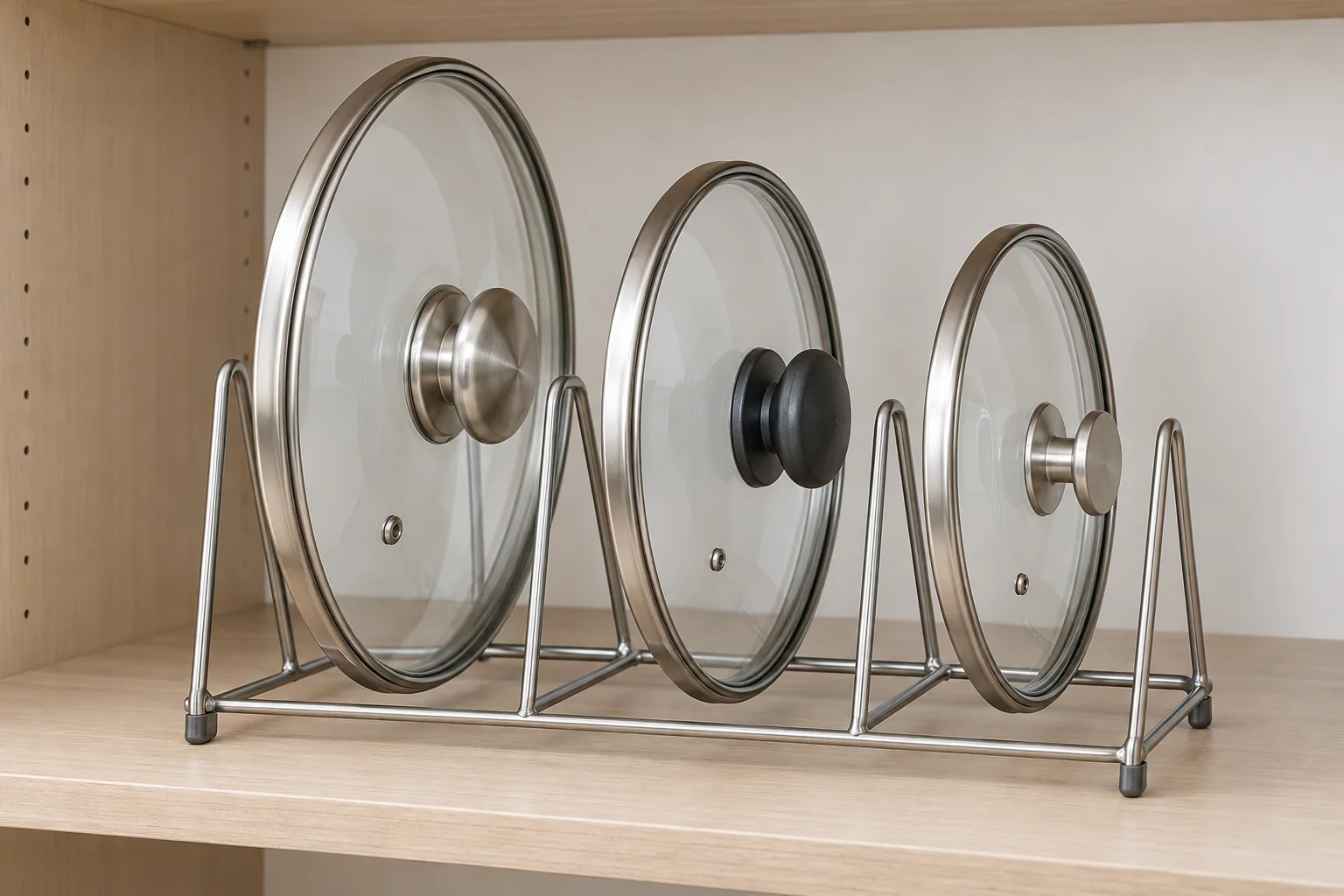
Pot lid organizer knob clearance depends on more than lid diameter: buyers must account for the lid rim, knob projection, slot pitch, support points and the cabinet or drawer envelope. A rack’s stated capacity describes a configuration, not necessarily every lid in a mixed assortment. Before approving a private-label product, map representative lids to the intended slots and test insertion, removal, neighboring contact and storage height in the assembled sample. Keep any fit claim limited to the lids and configuration actually reviewed.
This guide turns a common kitchen-storage fit question into a buyer specification. It does not rank consumer products or claim that Koitor currently manufactures a particular pot-lid rack. The useful deliverable is a lid-to-slot fit matrix that can accompany an RFQ, drawing review and sample sign-off.
Why can stated rack capacity differ from usable fit?
A rack advertised for a certain number of lids may only reach that capacity with a particular combination of lid shapes. A wide knob may project into the space needed by a neighboring lid. A deep rim, folded edge or loop handle can change how far the lid sits inside its slot. The cabinet shelf or drawer may also be too short for a lid held at the rack’s intended angle.
The difference is between nominal slot count and usable assortment capacity. A design with three positions has three physical positions; that does not prove that three arbitrary lids can occupy them together. Buyers should approve the capacity statement using a defined set of lids, not by counting empty dividers or measuring only the rack’s outside width.
The Joseph Joseph Space 3-piece Pan Lid Storage Stand is a model-specific example. Its manufacturer describes it as designed for the brand’s Space cookware lids and as holding up to three glass lids. The same page includes customer feedback reporting that some knob shapes or drawer-height conditions limited a particular user to fewer lids. Those reviews are anecdotal observations, not a defect rate or a general conclusion about all racks. They show why a buyer should distinguish named compatibility from an unrestricted “fits most lids” claim.
For a sourcing team, pot lid organizer knob clearance is therefore a combined lid-and-storage-system decision. It includes the rack, the actual lids, the intended cabinet or drawer and the stated use configuration. A photograph of a rack holding three sample lids is useful evidence only if the lids represent the buyer’s intended assortment.
Which lid measurements define the clearance envelope?
Start by identifying the lid assortment. Record the largest and smallest intended lid, but also note unusual shapes that may control fit: tall knobs, broad knobs, side loops, arched handles, deep rims, steam vents or non-circular outlines. Two lids with the same nominal diameter may occupy different space when stored upright because their projections and support contacts differ.
For each representative lid, record the dimensions that influence the rack interface:
- Overall diameter or maximum outline in the intended storage orientation.
- Rim depth and thickness at the point that enters or rests against a divider.
- Knob or handle height measured from the outer lid surface.
- Knob or handle width and direction of projection.
- Any side loop or feature that extends beyond the lid perimeter.
- The distance from the rim to the center of mass, where that is relevant to stability in the selected support arrangement.
- The intended lid orientation, including which face points toward adjacent slots.
Use repeatable datums. For example, specify whether knob projection is measured from the glass surface or from the outermost rim plane. A supplier should not have to infer whether a dimension is the lid’s nominal size, maximum outer diameter or usable opening. If a lid is oval or has a handle offset from center, add a simple drawing or a top-and-side photograph with the measurement references marked.
These dimensions describe the sample set; they do not create a universal lid standard. The buyer may group lids into families by shared geometry, but should keep unique lids as separate cases until the sample confirms that the same slot configuration accommodates them.
How do slot pitch, dividers and support affect placement?
The slot pitch is the distance between adjacent lid positions. If the pitch is too narrow for the combined lid and knob envelope, neighboring lids may touch, cross or become difficult to remove independently. If it is made unnecessarily wide, the rack may occupy more cabinet width than the assortment allows. There is no single pitch that is right for all lid diameters and knob forms.
| Fit input | What the buyer should record | Sample question |
|---|---|---|
| Lid outline | Maximum diameter or non-round envelope in the stored orientation | Does the rim enter the intended slot without forcing? |
| Knob projection | Height and width from the defined lid-surface datum | Does the knob contact a divider or neighboring lid? |
| Slot pitch | Distance between adjacent lid center positions | Can the required mixed set be inserted and removed independently? |
| Cabinet envelope | Usable width, depth and height at the tightest point | Does the loaded rack fit with the door or drawer fully closed? |
Divider height and shape influence how a lid is guided and supported. A low divider may leave a large lid free to tilt; a high divider may interfere with a projecting knob, rim or side loop. A formed plate, wire rail or adjustable separator will behave differently depending on the lid’s contact points and the rack’s base. The buyer should approve the actual construction rather than assume that “adjustable” automatically resolves every compatibility issue.
Review the interaction at three levels:
- Entry: Can each intended lid be placed into its assigned position without forcing, twisting or contacting a neighboring divider?
- Stored state: Does the lid remain in the intended orientation while the rack is moved or accessed normally?
- Removal: Can a user lift one lid without pulling another lid out, catching a knob or scraping adjacent surfaces?
The review should include the sequence of lids in a mixed assortment. A set of identical lids might fit even when a large lid next to a small lid creates a collision. Test the most space-consuming combination and any pairing that places two large knobs side by side. If the customer can rearrange lids, include the least favorable permitted arrangement or explain which slot assignment the instructions require.
Avoid converting a visual fit check into a structural performance claim. A lid that stays in a sample rack during a tabletop demonstration does not prove transport performance, long-term durability or a tested load rating. State only the observed condition and any test method that was actually agreed.
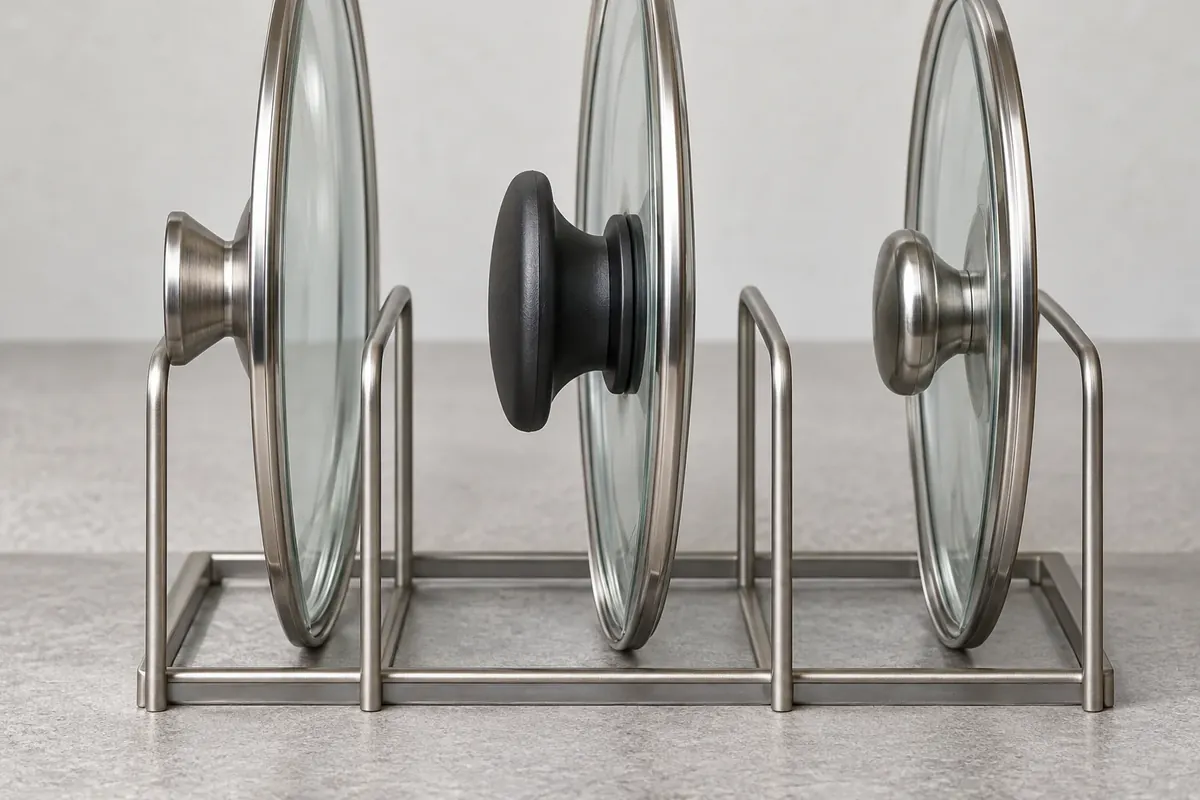
How should cabinet and drawer clearance be checked?
Rack fit is not complete until the rack-and-lid assembly fits the intended storage location. A lid that fits between dividers may sit too high for a closed drawer or collide with a shelf above. A shelf’s usable height can be less than its nominal opening because of runners, cross rails, hinges, door panels or an overhanging cabinet face.
Specify the complete storage envelope. Record the cabinet or drawer’s usable width, depth and height at the narrowest points, plus obstructions along the path where the rack is inserted. Identify whether the buyer expects the product to sit flat on a shelf, slide inside a drawer or attach to an interior panel. For a drawer, include its closed usable height and any obstruction that projects below the drawer front or into the cavity. For a shelf, check the lid’s topmost point and the space needed to lift it out.
A practical review follows this sequence:
- Measure the assembled rack by itself, including feet, handles and any projecting attachment.
- Place the intended lids in their approved slots and record the total height and width of the loaded configuration.
- Check whether the lid knobs, rims or loops extend beyond the rack’s footprint.
- Insert the loaded arrangement into the actual cabinet or a representative fixture.
- Close the drawer or door fully, then open it and remove each lid using the expected motion.
- Note which dimension controls the fit and where clearance is tightest.
A paper drawing can support this check, but it does not always reveal how a knob or angled lid contacts the cabinet during movement. Use a physical sample or a dimensionally faithful fixture for the final approval where practical. If the cabinet is supplied by another company, align on who owns the cabinet dimensions, interface assumptions and final system fit.
What should a sample matrix and approval record include?
Create one row for each representative lid and one column for the rack position or configuration being checked. Include the lid identifier, relevant outline and projection dimensions, assigned slot, cabinet or drawer condition, observed contact, insertion/removal outcome and approval status. A simple matrix keeps a strong lid from being overlooked just because the standard set fits.
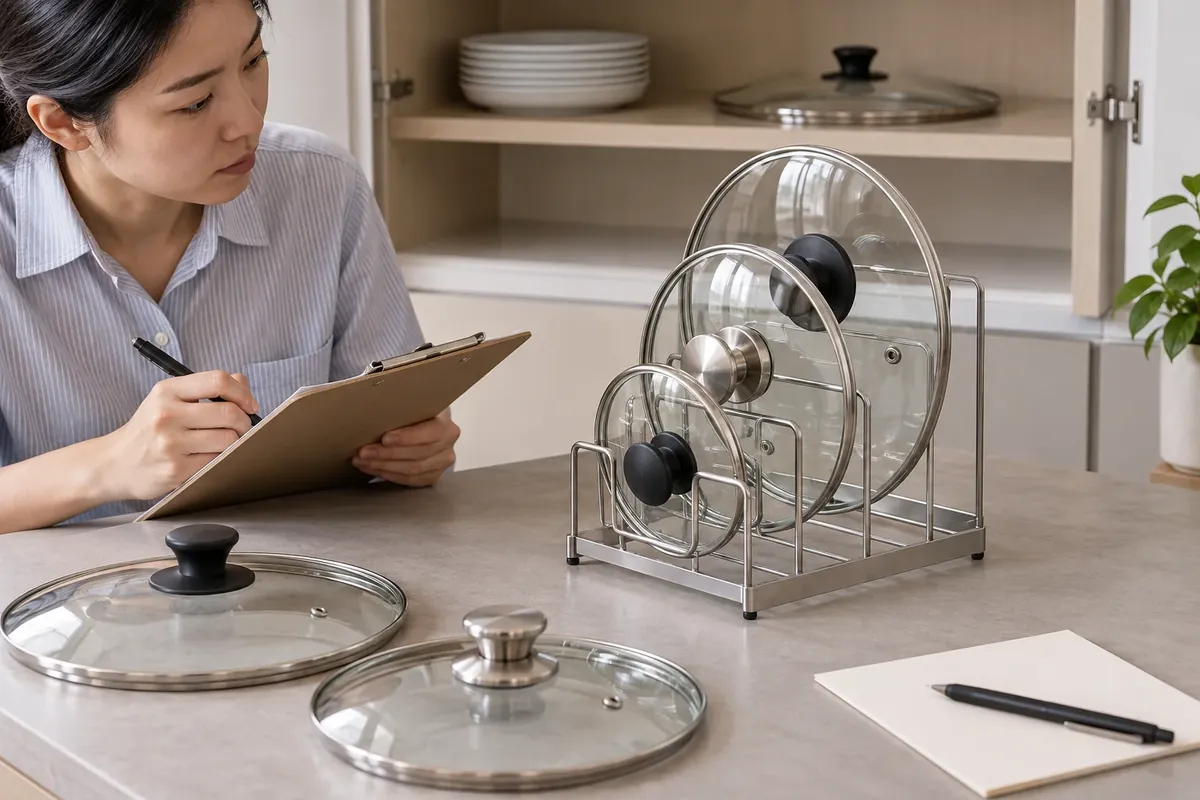
The approval record should identify the specific revisions: rack drawing, divider arrangement, lid references, cabinet opening and any packaging or instruction that limits the intended arrangement. Add photos from the side and top, because side images show knob projection while top views show spacing and lateral clearance. When a configuration does not fit, record which interface failed rather than writing “rack too small.” A pot lid organizer knob clearance matrix makes the approved lid-to-slot assignment repeatable for later samples and production reviews.
For repeat orders, tie the approved sample to the production description and change-control process. A replacement divider, a moved rail, a different finish build, or a new lid assortment can change usable space. If the buyer changes a lid supplier or cookware range, review the affected fit cases before carrying forward the earlier statement. If the rack itself changes, check whether the previous lid matrix still applies.
Sample review should also confirm how the product will be described to the market. “Designed for the listed lid models” is narrower than “fits any pot lid.” A capacity statement should say whether it refers to identical lids, a particular cookware family or the reviewed mixed assortment. Do not use generic wording that goes beyond the sample evidence.
What sourcing mistakes undermine lid-fit claims?
One mistake is treating rack slot count as proof of compatibility. Slot count is a construction feature; fit depends on the dimensions and arrangement of the actual lids. A second mistake is measuring only diameter while ignoring knob projection, rim thickness and handle direction. A third is checking the rack on a countertop but not inside the cabinet or drawer where it will be sold.
Another common process error is approving lids one at a time without checking them together. A small lid may sit correctly in a slot by itself but leave too little room for the neighboring large knob. Likewise, the largest lid may fit, while the intended sequence makes removal awkward. Record the mix and order used during approval.
Buyers should also avoid asking for an undefined “universal” solution. A supplier cannot reliably demonstrate universal fit across all brands, knob shapes and cabinet layouts without an agreed scope. Provide representative samples, drawings or a dimension matrix, and state the target customer assortment. If those inputs are not yet available, treat compatibility as an open development question instead of promising it in product copy.
Finally, do not let the image become the specification. Product photography can illustrate a plausible arrangement, but it cannot substitute for named lid references and an approved physical fit. The buyer matrix and sample notes should remain the source of truth for purchasing and marketing.
How can an OEM metal-rack discussion help?
A kitchen-storage product developer can use an OEM discussion to separate the rack’s metal structure from the cookware and cabinet interfaces. Koitor Hardware is a family-owned custom metal hardware factory specializing in bathroom and home-storage hardware. Approved company facts include metal forming, finishing, assembly and sample development based on drawings or physical samples. Current pot-lid-rack production is not confirmed, so this guide does not present the generic visual concepts as Koitor products or promise a specific rack capability.
When discussing a possible metal rack, send a drawing or physical sample, target assortment, slot count, lid envelope and destination cabinet or drawer dimensions. Identify whether the metal structure is fixed or uses adjustable dividers, and state which parts are supplied by the buyer or another vendor. The supplier can then review the metal geometry and sample plan within its confirmed manufacturing scope, while the buyer retains responsibility for approving cookware compatibility and the complete installation environment.
Metal construction choices can affect product geometry and assembly. A wire divider, formed sheet support or combined construction may occupy different space and create different contact areas. The right choice depends on target lid shapes, finish, cost, appearance and manufacturing requirements. Do not assume that heavier metal or more dividers automatically make a better product; agree what the rack must support and how that will be checked.
A small-batch OEM project can be useful for testing a defined assortment before broader rollout, but MOQ, samples and production timing depend on structure, materials, finish and packaging. A clear fit matrix reduces ambiguity during quotation and gives the sample review a concrete acceptance target. For help with a metal home-storage project, see Koitor’s OEM home-storage hardware information.
Buyer checklist before requesting a quotation
- List the intended lid references or provide physical samples.
- Record maximum diameter or outline, rim thickness, knob height/width and side-handle projection.
- Show the intended lid orientation and slot assignment.
- Identify the target rack position count and whether dividers are fixed or adjustable.
- Provide the cabinet or drawer’s usable width, depth and height at the tightest point.
- Show obstructions such as drawer runners, hinges, door panels or shelf lips.
- State which mixed-lid combinations must be checked together.
- Define what counts as acceptable insertion, stored stability and single-lid removal.
- Request an assembled sample using the agreed lids and storage location or representative fixture.
- Record the approved drawing, lid references, rack revision and compatibility wording.
- Identify the metal material, surface finish, packaging and expected order quantity.
- Separate confirmed facts from unresolved cabinet, cookware or third-party component assumptions.
A quotation request can include a simple lid-to-slot table and photos annotated by the buyer. That makes the conversation more efficient than sending only a product name or a target slot count. If a complete system depends on another supplier’s cabinet or cookware, state that the fit outcome remains subject to those interface dimensions.
Häufig gestellte Fragen
Does a rack advertised for three lids fit any three lids?
No. Advertised capacity applies to the intended product configuration. Knob projection, rim shape, lid diameter and arrangement can reduce how many of a particular mixed set fit together.
Is lid diameter enough to specify a pot-lid rack?
No. Buyers should also record the rim, knob or handle envelope, storage angle and surrounding cabinet or drawer clearance. Test representative lids together in the assembled sample.
Should an OEM buyer request adjustable dividers?
Only if adjustability solves a defined assortment need. Verify the adjustment range, repeatability and whether the chosen positions stay approved during normal handling. The word “adjustable” alone does not prove fit.
Can a supplier guarantee compatibility before receiving lid samples?
A supplier can review drawings and dimensions, but a guarantee should not be implied. Final wording should follow an agreed sample review or other documented validation using the intended lids and storage space.
Does Koitor currently manufacture the pot-lid rack shown in the article images?
No such current product capability is confirmed in the approved company facts. The images are generic concepts for buyer education; Koitor’s confirmed scope is metal bathroom and home-storage hardware manufacturing, with capability details subject to project review.
Discuss a Custom Metal Home-Storage Project
Share your drawing or physical sample, intended lid assortment, cabinet envelope, finish and packaging requirements. Koitor can discuss the confirmed metal-hardware scope and sample-development questions before quotation.
OEM / EIGENE MARKE
Verwandeln Sie diesen Beschaffungsleitfaden in ein Produktdossier
Teilen Sie uns Ihr Zielprodukt, die Größe, die Oberflächenausführung, die Bestellmenge und Ihre Verpackungsanforderungen mit. Ihr Team erhält vor der Angebotserstellung eine praxisorientierte Prüfung der Herstellbarkeit.
 English
 Español
 Português
 Français
 Deutsch
 العربية