

Robe hook installation, as a published kit file, starts with architecture and with the parts actually packed, not with a hanging-height number. Name whether the hook is single or double, whether the plate is a concealed cap or an exposed-screw design, what the carton includes, and how the installer is told to mark the wall, before any easy-install line is printed.
Hook height belongs on the companion robe-hook height file. This kit file should not print hook-height inches, and that height file should not reprint the packed list.
This guide is for importers, distributors, and private-label teams approving the first-install box and the install sentences for a bathroom robe hook. Koitor Hardware is a family-owned China OEM that makes custom metal bathroom and home storage hardware.
Send the hook drawing, the packed-kit list, the intended substrates, and any easy-install sentence the carton must carry. We can review the kit and the wording. We will not issue an install-time, a torque value, an anchor rating, or a load rating.
What does robe hook installation actually freeze?
It freezes the first-install kit and the claims that kit can support: architecture, packed parts, template or mark method, and substrate notes. It does not freeze a published hook height, a projection, a wet-load claim, or a spacing file.
Searchers who look up robe hook installation often want a how-to sequence. That demand is real. For an importer, the usable decision is whether the carton and the sheet describe a kit that can be followed without inventing parts or a method. This page is not a consumer drywall tutorial, and it is not a product listing.
Towel-bar installation is a neighboring discipline on a different primary SKU. The live towel-bar installation article can remind you that kit language should follow packed parts. It should not be cloned onto a hook. A hook has a different architecture, a different template problem, and often a different packed-tool question. The same is true of the live towel-ring hang-and-fixings guide: useful as a reminder that wall type and returns are serious, not as a script to copy.
Brand-specific install terms, including terms tied to a named competitor SKU, are not this page’s target. Write the architecture in plain language. Do not build the file around another company’s model name.
A Hersteller von maßgefertigten Badbeschlägen can match a hook form or a finish to a collection. Matching the metalwork is not the same as inventing a default kit, a default template, or a default substrate rating. If you are developing a hook program, bring the intended packed list with the drawing.
Why must architecture be named before any easy-install line?
The installer has to know what kind of hook is in the box before the carton can say the hook is easy to install. A single hook and a double hook do not pack the same way if the plate, the cap, or the fastener count changes. A concealed-cap design and an exposed-screw design do not use the same visual steps, even when the hook arms look similar.
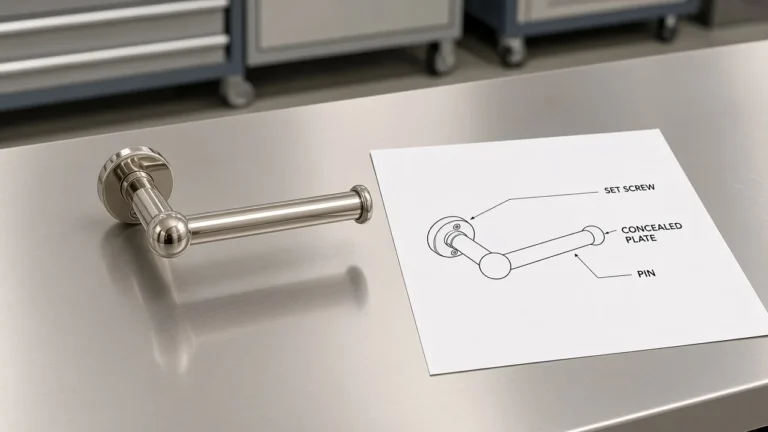
Name the architecture first: single or double; concealed cap or exposed screw; wall-mounted or door-mounted as a kit program. “Kit program” here means which parts and which mark method the box is built for. It is not a back door for printing a height figure. Height still belongs on the companion height file.
A concealed cap can hide the fasteners after the plate is on the wall. That design often depends on a cap, a rose, or a set screw that holds the hook body to the plate. If those parts are not named, an easy-install line will be read as if the hook were a simple exposed-screw plate. The return then starts with a buyer who cannot find the hidden fastener.
An exposed-screw design is simpler to describe, and it still needs a named plate and a named fastener count. “Visible screws” is not a complete architecture line if the sheet never says how many, or whether decorative caps are supposed to cover them later.
Door-mounted kits need the door program named at the kit level. A door hook may need a different fastener, a different backplate, or a different warning about door thickness. Those are kit notes. They are not hook-height inches, and they are not a reason to merge this file with the height file.

What belongs in the packed list, including a tool or an explicit exclusion?
The packed list should include every part the easy-install sentence assumes. If the architecture uses a set screw, the list should include the matching tool or an explicit exclusion that the tool is not packed.
A missing hex key is one of the most common reasons a “simple” hook becomes a service call. This file should not invent a hex size as a Koitor standard. It should only require that the size, if one is used, be named from the project or brand file, and that the kit either packs the tool or says it does not.
Write exclusions in plain language. “Tool not included” is a complete sentence when the architecture needs a tool. Leaving the line blank is how buyers assume the tool is in the bag. The same rule applies to anchors, decorative caps, and door-mount hardware. If the carton photograph shows a cap, the cap should be in the list or the photograph should change.
Do not invent a minute-count, a torque value, or a factory install test and present it as Koitor data. “Installs in minutes” is a marketing line, not a kit field. If a brand wants a time claim, it needs its own evidence file. This article will not supply one.
Spare-part codes and replacement-part planning belong on their own neighboring files when they exist. The first-install kit can point to a replacement plan. It should not become a spare-part catalog, and it should not treat a later replacement hook as the answer to a missing packed tool.
Count the hooks, the plates, the caps, and the fasteners as a set. A double hook with one plate is a different pack than two single hooks. A pair packed for a hotel-style pair of hooks is a different pack than one hook. The list should make the count obvious without turning the page into a hospitality punch list.
How should the template or mark method and substrate notes be written?
Say how the installer is supposed to mark the wall or the door. The usual choices are a packed paper template, a mark jig, a backplate used as a mark guide, or no template with a stated method on the sheet. Any of those can be written clearly. What cannot be written clearly is silence. Silence is read as “guess the holes.”
If a paper template is packed, the sheet should say that it is packed, and it should say what the template locates. If the template can be used upside down, say how to orient it.
If no template is packed, say that no template is packed, and say whether the backplate may be used as a mark guide. Do not invent a hole-to-hole millimetre figure in this article and present it as a factory standard. A project drawing can supply a spacing when one is required. This file only requires the method to be named.
Substrate notes should name which substrates may be mentioned and whether a fastener for that substrate is packed or excluded. A carton that shows a hook on tile, drywall, or wood, without a note, will be read as a promise that the packed kit holds on that substrate.
If the kit is only a machine-screw set, the sheet should not imply a tile anchor is included. If a brand wants a named substrate, the note should follow the packed list, not replace it.
Do not convert those notes into an anchor rating, a “holds on any wall” line, or a universal embedment depth. Koitor can help you review whether the wording matches the bag. Koitor will not issue a substrate rating in this article.
Door substrates need the same honesty. A door-mount kit that is silent about door thickness will be installed on doors it was never packed for. Name the limit as a kit note if the project supplies one. Do not invent a thickness here, and do not hide the issue inside an easy-install sentence.
| Kit or claim field | What must be named | When this field is complete | What this field is not |
|---|---|---|---|
| Architecture | Single or double hook; concealed cap or exposed screw; wall or door mount as a kit program, not as a height figure | When a reader can tell which parts should be in the box before opening it | A projection, load, or spacing callout, or a hook-height sentence |
| Packed list | Every part that the easy-install sentence assumes, including a set-screw tool or an explicit exclusion | When a missing tool cannot be mistaken for a packed tool | A minute-count, a torque value, or a factory install test |
| Template or mark method | Whether a paper template, a mark jig, a backplate used as a mark guide, or no template is packed, and what the sheet tells the installer to do | When hole locations are not left to a freehand guess the carton never mentioned | A published hole-to-hole dimension invented for this article, or a height datum |
| Substrate notes | Which substrates may be mentioned, and whether a fastener for that substrate is packed or excluded | When a carton cannot be read as promising a hold on a substrate the kit does not address | An anchor rating, a tile-warranty, or a universal millimetre embedment |
| Easy-install marketing line | The architecture and the packed list the line depends on | Only after the four fields above are named, or the line is removed | A standalone promise that the hook ‘installs easily’ on any wall |
Read the table as a filing rule, not as a factory bill of materials. The first four rows are the kit fields this article is willing to discuss. The last row is the marketing line that should wait until those fields are named.
Which neighboring files should stay off this kit sheet?
Hook height, including any unofficial consumer inches, stays on the companion robe-hook height file. This kit file may say that a height callout exists elsewhere. It should not print the inches. Projection, wet-load claims, double-hook spacing, and towel-retention geometry stay on their existing hook pages. Mention them only to keep those decisions off this sheet.
Set-screw drive size, when it is a program-wide kit question, may already have a neighboring hex-key article for bathroom accessories. Use that file for drive-size discipline. Do not reprint a hex size here as a Koitor default, and do not turn this hook file into a tool catalog.
Towel-bar installation, and the live towel-ring hang-and-fixings guide, stay on those pages. A Hersteller von maßgefertigten Handtuchhaltern für das Badezimmer can be a send-off when the collection also includes towel racks. It is not a hook-install shortcut, and it is not a reason to copy a bar-install sequence onto a hook.
If the hook is part of a broader custom bath program, the Hersteller von maßgefertigten Badbeschlägen page can be used as a commercial send-off. It does not replace the packed list, and it does not authorize an easy-install claim that the box cannot support.
What should be checked before an easy-install line is printed?
Use the checklist below as a carton and install-sheet review, not as a how-to video script. Koitor’s practical manufacturing insight here is that a small-batch OEM can pack a hook, a plate, a cap, and a bag of fasteners to match a drawing, but it should not be asked to print “easy installation” until the architecture and the packed list have been named.
During sample and packing review, the useful questions are simple. Does the bag match the photograph? Does the sheet name a template or say that none is packed? Does a set-screw design pack a tool or exclude it in writing? Does any substrate shown on the carton have a matching note? That is kit hygiene. It is not an install test, and it is not a height check.
When the packed list changes, revise the carton line in the same change. A later decision to omit the template, or to stop packing a tool, can leave an old easy-install sentence stranded on the box. Record that as a kit revision, not as a silent packing tweak.
Lifestyle photographs should not show tools or anchors the box does not include. If a photo stylist adds a drill, a level, or a tile bit, the carton will be read as if those items were packed or required in a way the sheet never stated. Either the photo stays illustrative and the sheet is complete, or the photo is corrected.
If two markets share a hook but not a kit, do not force one carton into both programs. It is cleaner to keep one hook body and two named kits than to print a blended “easy install” line that is true for neither bag.
Left-hand and right-hand hooks, or hooks packed as a pair, should be obvious from the list and from the label. A pair packed as “two hooks” is not the same kit as one hook and one unused plate. If a cap or a tool is shared across a pair, say how many are packed. Buyers will otherwise open one box and assume the second hook is missing a part.
Translations on a bilingual carton should follow the same named fields. A tool exclusion that appears only in one language is not an exclusion in the other market. Review both languages against the same packed list before the easy-install line is translated.
Incoming sample checks can use a simple bag-to-sheet comparison: open the box, lay out the parts, and tick the named list. That check is not a torque test and not an install-time study. It only asks whether the carton can be believed.
If a later order adds a door-mount variant, treat it as a kit change, not as a sticker change on the same wall-mount bag. The plate, the fastener, and the mark method may all change. A wall-mount easy-install sentence left on a door-mount carton will be believed, and it will be wrong.
The same discipline applies when a concealed-cap hook later becomes an exposed-screw hook in the same finish. The arm can look familiar. The packed list is a new list. Reprint the kit fields before the carton reuses the old line.

- Name the architecture: single or double hook; concealed cap or exposed screw; wall or door as a kit program, not as a height figure.
- Name every part the install sentence assumes, including caps, plates, and fasteners, and keep the count obvious.
- If the architecture uses a set screw, pack the tool or state in writing that the tool is not included; do not invent a hex size as a factory standard.
- Name the template or mark method, or state that no template is packed and what the installer should use instead.
- Name which substrates may be mentioned, and whether a fastener for that substrate is packed or excluded.
- Do not print hook-height inches on this kit file; send height to the companion robe-hook height file.
- Do not invent a minute-count, a torque value, an anchor rating, or a factory install test.
- Do not clone a towel-bar installation sequence or a towel-ring hang guide onto the hook.
- Do not target a named competitor SKU install term; describe the architecture in plain language.
- Revise the carton line whenever the packed list or the template decision changes.
Häufig gestellte Fragen
Can the carton say the hook is easy to install?
Only after the architecture, the packed list, the template or mark method, and the substrate notes are named, and only if the sentence does not go beyond that kit. An easy-install line is not a substitute for a missing tool or a missing template. This article does not supply a minute-count.
Should robe hook installation artwork include the hook height?
No. Print hook height on the companion height file, after the datum and the wall-or-door program are named. This kit file may point to that file. It should not print the inches.
What if the hook uses a hidden set screw?
Name that architecture, and then pack the tool or exclude it in writing. Do not leave buyers to discover a hidden fastener after the carton promised an easy install. Do not treat a hex size invented in this article as a Koitor standard.
Do we need a paper template in every kit?
Not necessarily. You do need a named mark method. If a template is packed, say so. If it is not packed, say that it is not packed, and say whether the backplate may be used as a guide. Silence is not a method.
Can the same kit notes be copied from a towel-bar install sheet?
No. A bar and a hook do not share a plate, a cap, or a template just because they share a finish. Use the bar-install article only as a reminder that kit language should follow packed parts, not as a script.
Can Koitor specify the anchors we should pack?
Koitor can review whether the wording matches the bag and whether a substrate shown on the carton has a note. Koitor will not issue an anchor rating, a torque value, or a universal substrate determination in this article. If a project file names a fastener, bring that file with the drawing.
Arbeiten Sie mit Koitor Hardware zusammen
Need a robe-hook install kit reviewed?
Send Koitor the hook drawing, the packed-kit list, the intended substrates, and any easy-install sentence the carton must carry. Our team can review the kit and the wording, without issuing an install-time, a torque value, or a load rating. MOQ can start from about 100 pcs depending on the product; samples usually take 5-7 working days after details are confirmed; bulk production usually takes 4-6 weeks depending on the project.
OEM / EIGENE MARKE
Verwandeln Sie diesen Beschaffungsleitfaden in ein Produktdossier
Teilen Sie uns Ihr Zielprodukt, die Größe, die Oberflächenausführung, die Bestellmenge und Ihre Verpackungsanforderungen mit. Ihr Team erhält vor der Angebotserstellung eine praxisorientierte Prüfung der Herstellbarkeit.


 English
 Español
 Português
 Français
 Deutsch
 العربية