

Section 232 steel hardware importer supplier documentation should give a customs broker traceable product facts—not a factory’s guess about tariff classification or duty. For each relevant SKU and revision, an importer should be able to connect the product description and material breakdown to unit weight, supporting steel-origin records, the commercial documents, and the production lot where available. The importer and broker then decide which HTSUS and Chapter 99 provisions apply to the actual item and entry date. A well-organized handoff makes that review faster without turning a supplier declaration into a legal conclusion.
What supplier records should a steel hardware importer request?
Ask the factory for a SKU-level fact sheet that describes the product exactly as sold and packed. A product name such as “wire rack” is too broad to settle tariff treatment. A broker may need to understand the construction, components, material types, dimensions, weight, and the way the item is presented for entry. The factory supplies product facts and supporting records; the importer and customs broker determine classification and entry reporting.
A reusable Section 232 steel hardware importer supplier documentation sheet makes each answer traceable to its source. A practical first request should identify:
- Buyer SKU, factory item code, product name, drawing number, and revision.
- A dated bill of materials or component list identifying steel, stainless steel, aluminum, plastic, rubber, and other relevant materials separately.
- Net weight per sellable unit and the basis of that figure, including whether screws, pads, packaging, or accessories are included.
- Applicable metal weight by product where the broker requests it, with the calculation method and assumptions kept visible.
- Available mill, service-center, or upstream supplier records that support the reported country where the steel was melted and poured.
- Factory production site, supplier identity, lot or work-order reference, and the dates the information applies to.
- The invoice and packing-list description and units, so the facts can be reconciled with the entry documents.
Do not request a generic certificate if the buyer needs traceable item-level facts. Ask what each record covers: product, component, lot, material source, date, and revision. If a record only covers a raw-material batch or a supplier family, label that scope instead of presenting it as proof for every finished item.
A supplier may not hold every upstream mill record, particularly when materials pass through a service center or another processor. Record the gap honestly. The buyer can ask for the next available supporting document, request a written explanation of the source and scope, and let the customs broker decide whether it is adequate for the entry question.
How can buyers connect the data to the correct SKU and production lot?
A useful data handoff is a chain of matching identifiers, not a folder of unrelated PDFs. The SKU on the buyer’s order should connect to the approved product revision, the component list, the production lot, and the shipment documents. When the shape, wire diameter, frame, material source, or component set changes, the existing material and weight record may no longer describe the shipped product.
Use one row per SKU and revision in a controlled workbook or product-data sheet. Include a document owner, source file name, effective date, and status such as “supplier stated,” “document supported,” “broker review pending,” or “confirmed for this entry.” Those labels distinguish evidence from an inference. Do not quietly convert an estimate into a verified value when a missing measurement is filled in later.
A practical version-control routine looks like this:
- Freeze the approved drawing or sample reference that defines the product.
- Ask the factory to map each component to that revision and identify material changes.
- Record how each weight was obtained: scale measurement, engineering calculation, or supplier estimate.
- Tie material-source evidence to the component and lot it covers; identify mixed sources rather than forcing one country into the record.
- Match the SKU, quantity, unit of measure, and item description to the commercial invoice and packing list.
- Send the package to the customs broker with specific questions and retain the response with the entry file.
This approach is especially useful when a buyer has similar racks in several sizes or finishes. A small frame redesign can change the quantity of steel per unit. A bundle may add screws, hooks, or a non-metal component. A finish change might not alter the underlying steel weight, but the buyer should confirm whether the part or supplier changed at the same time. The data sheet should show the actual scope rather than assuming that one SKU’s record covers a whole family.
What should a metal composition and weight record show?
For Section 232 steel hardware importer supplier documentation, make each weight record useful by stating its denominator, included components, and method. “Metal content: 1.2 kg” leaves open whether the figure is per unit or per carton, whether it refers only to steel, and whether it includes accessories. For a threshold or reporting question, the customs broker should identify the relevant HTSUS provision and the quantity fields that must be reported.
| Data field | What the supplier should provide | Buyer or broker follow-up |
|---|---|---|
| Item identity | Buyer SKU, factory code, description, drawing/sample revision | Confirm that the record matches the shipped configuration |
| Product weight | Net weight per sellable unit and a note on included components | Confirm the measurement basis and reconcile it to packing data |
| Material breakdown | Component-level material and, where known, grade or source document | Separate verified facts from estimates and unresolved material identity |
| Applicable-metal weight | Weight by relevant metal, calculation method, and unit | Broker determines whether and how a specific entry provision uses it |
| Origin evidence | Available mill or processor documents for steel melt-and-pour country | Confirm what the evidence actually covers; do not infer finished-product origin |
| Lot and dates | Production lot/work order, document date, and source period | Tie records to shipment and retain the revision history |
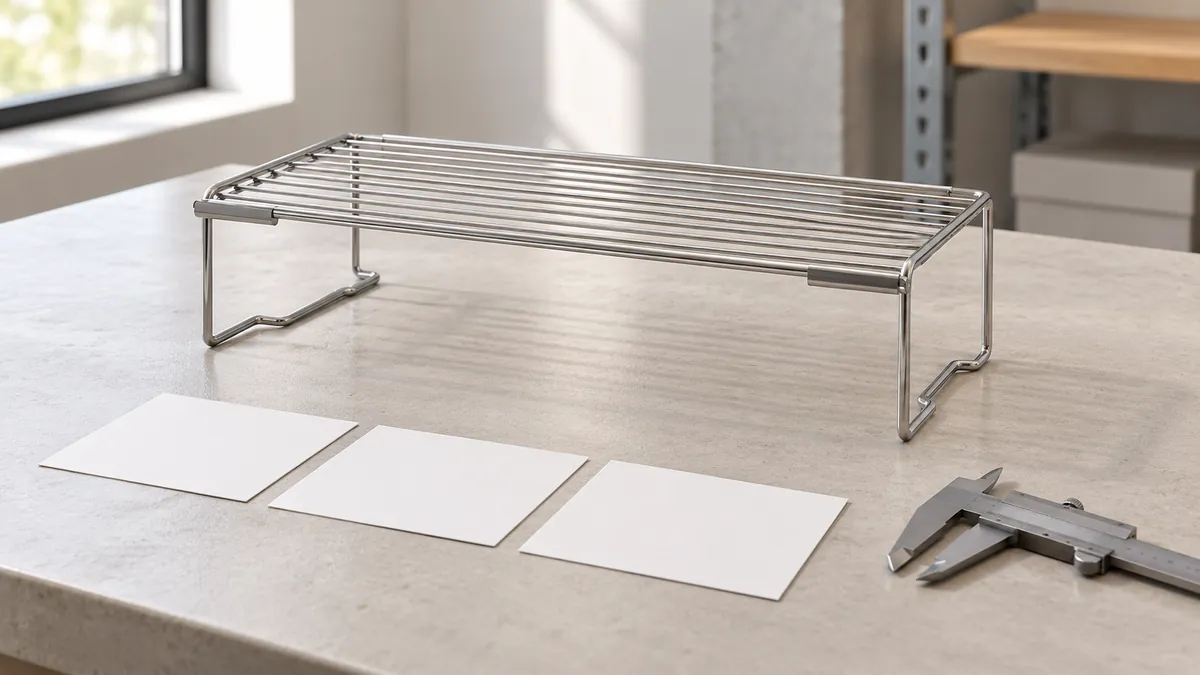
For a welded wire storage rack, the record might separate the wire deck, perimeter frame, support legs, screws, and any non-metal feet or pads. This is a data structure example, not a statement that every rack has the same bill of materials or falls under a particular tariff provision. The factory should not assign a customs code merely because a component is steel. Product form, function, construction, and the current tariff schedule matter, and a broker may need more detailed drawings or photographs.
The method should be reproducible. If a team derives weight from dimensions and nominal wire diameter, mark the result as calculated and retain the inputs. If the supplier weighs a sample, record the sample identity, scale basis, and whether the packaging was removed. If mixed materials cannot be separated reliably, say so and ask the broker what additional evidence is useful. Unsupported precision can create more risk than an explicitly documented estimate.
How should steel melt-and-pour information be handled?
Melt-and-pour is a steel-origin data point that may be relevant to current Section 232 entry reporting for covered steel products and derivatives. It is not a substitute for country-of-origin analysis, tariff classification, or a broker’s review of the applicable Chapter 99 note. Ask for the country information and its supporting scope, then preserve the source document or supplier explanation with the SKU and material revision.
When several steel sources are possible, do not compress them into a single assumed answer. Ask whether the supplier can identify a mill, service center, purchase batch, or other record that links the source material to the production lot. If an upstream record only identifies one source period but the factory used mixed inventory, label the uncertainty. The importer and broker can decide whether the available evidence is sufficient for a specific entry or whether a different sourcing or recordkeeping action is needed.
In its April 2026 guidance, U.S. Customs and Border Protection says filers should continue to report countries of melt and pour for subject steel and steel-derivative products. The June 2026 CBP update added certain classifications and provides entry instructions. These notices do not make every metal bathroom accessory or home-storage rack subject to the same treatment. CBP’s guidance refers to particular HTSUS provisions; coverage depends on the actual product, current classification, entry date, origin facts, and applicable notes. Check the current CBP CSMS guidance on Section 232 and have the customs broker assess the item.
What does current Section 232 guidance mean for a broker handoff?
The most important operational point is to avoid building the handoff around an assumed “steel value” formula. CBP’s April 2026 guidance states that certain covered articles and derivatives are assessed on full customs value, subject to the provisions and exceptions it describes. It also describes a less-than-15-percent-by-weight provision for eligible classifications outside HTSUS Chapters 72, 73, 74, and 76, and specifies aggregate applicable-metal weight as a second quantity when that provision is reported. Whether a particular item qualifies is not a supplier’s decision.
A customs broker should check at least:
- Whether the product’s classification is among the provisions currently covered by Section 232.
- Which metal or metals are applicable under the provision for that classification.
- Whether the product is within a stated exception and what facts support that assessment.
- Which Chapter 99 code and quantities are required for the entry date.
- Whether the reported steel melt-and-pour information and supporting records match the shipment.
- Whether a recent tariff or HTS revision changed the analysis.
For example, CBP’s June 2026 notice identifies certain steel-shelving statistical classifications effective June 8, 2026, including specific 9403.20 and 9403.99 provisions. That is a prompt for a broker to review a product whose construction may fall within the listed scope; it is not a blanket code assignment for bathroom racks, wire baskets, or organizers. Do not copy a code from an example page into an invoice or product database without a classification review.
At the time of this guide’s review, the USITC had published 2026 HTS Revision 21 on October 9, 2026. The schedule and relevant Chapter 99 notes should be checked again at the time of entry. Official guidance can change, and an article cannot replace the importer’s broker or qualified trade counsel. For background on the full-value and metal-weight provisions, see CBP CSMS 68253075.
How can buyers prevent handoff errors and involve a hardware factory?
The first common process error is collecting records without a stable product identifier. A mill document named “steel” or a weight sheet marked “rack” may not reveal which component, revision, or shipment it covers. Give each file a document owner and scope, and include the buyer SKU, factory item code, drawing revision, lot, and date whenever those facts are available.
Another mistake is asking the factory to decide the tariff code or duty. A supplier can describe materials, dimensions, fabrication, and a product’s intended use. Classification and entry reporting belong to the importer and its broker. The supplier’s commercial description may be useful evidence, but it is not binding tariff advice.
Other preventable problems include:
- Treating the country where a finished item ships from as the steel’s melt-and-pour country.
- Using a sample weight for every size or configuration without checking what changed.
- Reporting total product weight where the broker needs aggregate weight for specific applicable metals.
- Combining steel, aluminum, fasteners, plastic feet, packaging, and accessories into one unexplained number.
- Relying on a supplier declaration without asking what source records support it.
- Assuming a “low metal content” exception applies before the broker confirms the correct classification and current note.
- Failing to refresh the record after a drawing, supplier, material source, or component change.
- Stating a fixed tariff rate or expected duty in a buyer-facing product page that may outlive the rule.

The cure is not to create a larger document pile. It is to make the data traceable, state what remains unknown, and send the broker a short list of decisions to resolve. If the broker asks for a specific fact that the factory has not documented, request that fact explicitly and record when it becomes available.
What can a factory support without acting as the broker?
A manufacturer can make the factual side easier by keeping the drawing, bill of materials, sample approval, and production revision connected. During an RFQ or sample review, a buyer can request a component list, identify which metal parts require separate weight information, and agree how a revision or supplier change will be communicated. The factory should describe what it can document and flag missing upstream records rather than claiming to certify customs treatment.
Koitor Hardware is a family-owned custom metal hardware factory focused on bathroom and home-storage products. For a suitable project, direct factory communication can help a buyer clarify the product structure, compare a drawing with a sample, and discuss which product facts are available for an item-level handoff. This does not establish a tariff classification, guarantee material-origin evidence, or replace a customs broker. Buyers can review the OEM home-storage hardware manufacturing overview and define the data request before the product is approved for production.
Before requesting a quotation or sample, prepare these inputs:
- Buyer SKU, target market, product description, intended use, and packaging format.
- Drawing or physical sample with dimensions and a revision number.
- Component list showing which parts are metal and which are not.
- The broker’s requested weight fields and unit basis, if already known.
- Material-source or melt-and-pour records required for the specific review, without assuming every record is available.
- Sample and order quantities, finish, packaging, and any private-label requirements.
- The target date by which the information is needed for broker review.
- A named person responsible for confirming changes between approved sample and production lot.
A focused request avoids asking the factory for legal conclusions and helps both sides prepare accurate product facts. If the broker has a specific question about current HTSUS scope or Chapter 99 reporting, send that question to the broker with the product evidence attached. For legal or classification advice, use a qualified U.S. customs professional.
Häufig gestellte Fragen
Does every steel bathroom or home-storage product owe Section 232 duties?
No blanket answer is safe. CBP guidance applies to goods within particular HTSUS provisions and conditions. The importer and customs broker should review the actual construction, classification, entry date, origin facts, applicable Chapter 99 note, and any exception that may apply.
Should a factory assign the HTSUS code for a wire rack?
A factory can provide a precise product description, drawings, dimensions, materials, and construction details. The importer and broker should determine the classification and entry declaration. A supplier’s suggested code can be recorded as a question for review, not treated as a final determination.
What does melt-and-pour information prove?
It records a steel-origin fact for the material and evidence scope identified by the supplier or upstream document. It does not by itself establish the finished good’s country of origin, tariff classification, or eligibility for a particular treatment. Check what product, batch, supplier, and date the evidence actually covers.
Is a supplier spreadsheet enough evidence?
It may organize the facts, but sufficiency depends on the specific entry issue and the broker’s requirements. Keep the inputs, methods, source documents, revision and uncertainty visible. Ask the broker what evidence is needed for the exact product and entry.
Arbeiten Sie mit Koitor Hardware zusammen
Preparing Product Facts for a U.S. Import Review?
Share the product drawing, sample, revision, component list and the factual questions your customs broker needs answered. Koitor can discuss product structure and available manufacturing records; classification and entry decisions remain with your importer and broker.
OEM / EIGENE MARKE
Verwandeln Sie diesen Beschaffungsleitfaden in ein Produktdossier
Teilen Sie uns Ihr Zielprodukt, die Größe, die Oberflächenausführung, die Bestellmenge und Ihre Verpackungsanforderungen mit. Ihr Team erhält vor der Angebotserstellung eine praxisorientierte Prüfung der Herstellbarkeit.


 English
 Español
 Português
 Français
 Deutsch
 العربية