
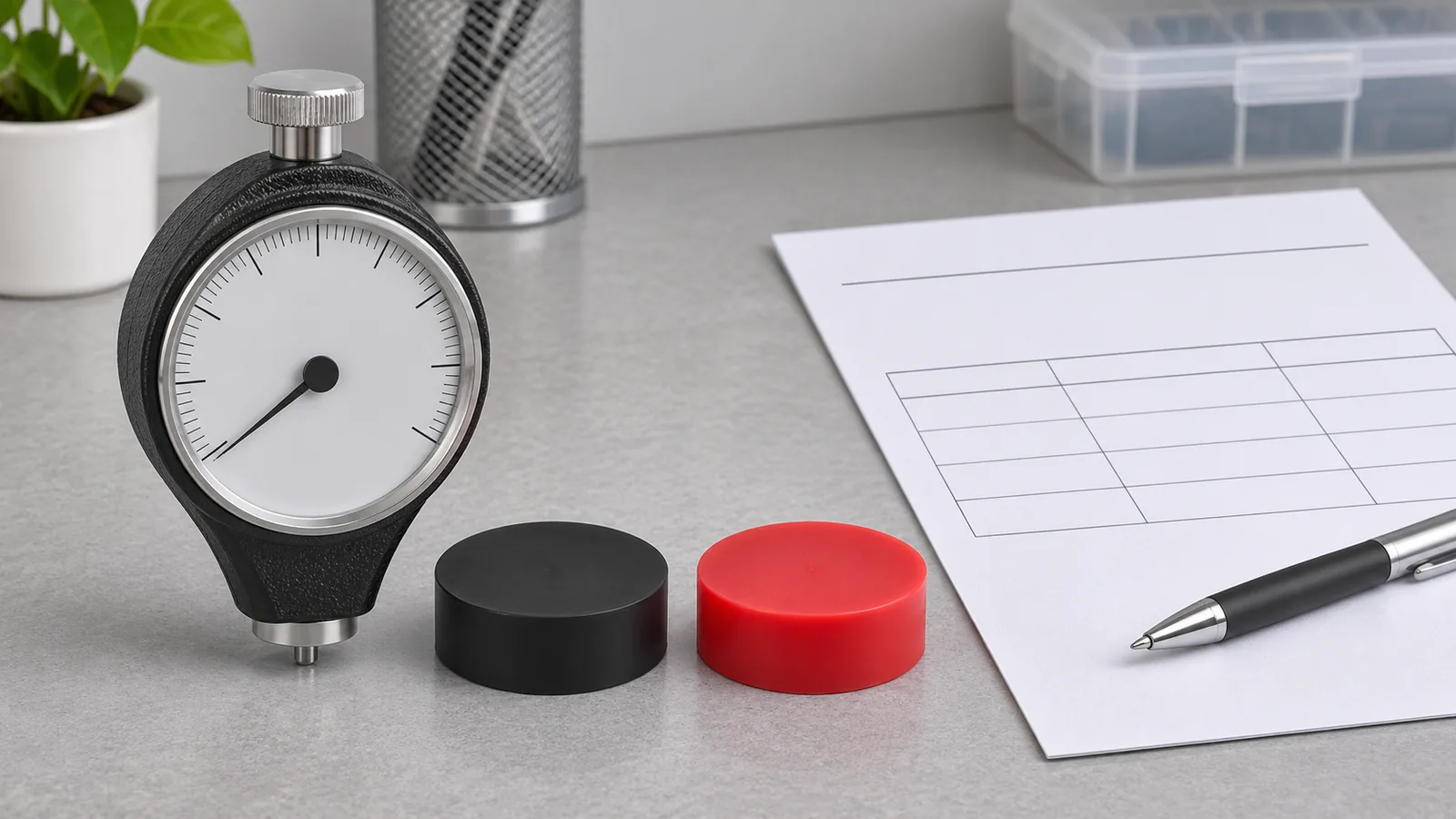
Shore A vs Shore D compares two different indentation-hardness scales, not two interchangeable ways to write the same number. A reading is incomplete unless the scale is stated with it: the same numerical value on Shore A and Shore D does not represent the same hardness. The scales use different indenter and loading systems and are used across overlapping ranges of elastomers and plastics. For a buyer reviewing rubber pads, feet, bumpers or caster treads on a metal storage product, the first task is to preserve the scale, specimen and method in the supplier record, then decide whether the reading answers the product question.
This distinction is useful when a quotation, sample report or component data sheet says only “hardness 70.” Without a scale and test context, the number cannot be interpreted reliably. A harder-range material is commonly described with Shore D, while more flexible rubbers are commonly described with Shore A, but the scale does not identify a polymer family and hardness does not prove how a foot will grip, mark a floor, resist tearing or compress over time. The buyer should avoid a bare-number comparison or an unsupported conversion chart and instead request the relevant information for the actual component.
What does Shore A vs Shore D tell a buyer?
Shore A and Shore D are durometer scales that express resistance to indentation under a defined measurement system. They differ in the indenter geometry and loading system used, so the scale is part of the result, not optional decoration. A supplier’s “Shore A” reading and a separate “Shore D” reading must not be treated as directly equivalent simply because the numeric values look similar. That scale-specific distinction is the core of the Shore A vs Shore D comparison. The reading reports an aspect of indentation response under its method; it does not by itself tell a buyer the material’s identity or full service performance.
Material makers describe the distinction in their technical guidance. Smooth-On’s Shore hardness scale overview explains that different Shore scales serve different hardness ranges and use their own durometer configurations. Apple Rubber’s discussion of Shore A versus Shore D likewise distinguishes the scales and their indenters. Those sources support the general comparison; they do not establish an exact conversion for every compound, specimen or test condition.
| Supplier statement | What it can mean | What remains unknown |
|---|---|---|
| “Shore A 70” | A value reported on the Shore A scale | Compound, specimen, method, conditioning and application performance |
| “Shore D 70” | A value reported on the Shore D scale | It is not interchangeable with Shore A 70; the same contextual details remain open |
| “70 hardness” | A number with an omitted scale | The scale itself and therefore the intended measurement meaning |
| “Equivalent to 70 on the other scale” | A claimed conversion or approximation | The conversion basis, source, method and whether the approximation fits the actual material |
For purchasing, the practical rule is simple: preserve the scale beside every value as the record moves from a drawing to a quotation, sample approval, inspection document and reorder. If one supplier sends a value without the scale, ask for the original record or a corrected statement. If two suppliers report values on different scales, ask each to identify its scale and measurement context before comparing them. Do not normalize them into a single number unless a qualified technical source has established a suitable method for the exact comparison.
The question also depends on the component. A rubber bumper on a wall-mounted rack may have a different job from a non-marking foot under a freestanding basket or a tread on a mobile rack. The hardness number may be one design input, but it does not specify shape, thickness, contact area, formulation, attachment method or the surface the component touches. The buyer’s decision should begin with the function of the part rather than with a number from a spreadsheet.
Why can the same number on A and D mislead a comparison?
The number can mislead because it is tied to a scale-specific response. Shore A and Shore D use different indenters and loading systems; they are not simply a soft and hard display mode for one universal scale. Although their useful ranges can overlap, that overlap does not create a universal one-to-one conversion. A visual conversion chart may provide rough orientation in a narrow context, but it should not become a contractual acceptance threshold or a replacement for the supplier’s actual test record.
Imagine that one pad supplier reports Shore A 75 and another reports Shore D 75. The shared “75” does not mean the pads have matching hardness. The correct next question is not “Which one is softer by converting 75?” It is “What material and scale did each supplier test, what specimen was used, and what functional requirement is this number meant to inform?” The answer may be that the suppliers used different compounds, different reporting conventions or different test set-ups. Until those are known, the numbers are not a like-for-like comparison.
Even two values reported on the same scale may not be directly comparable if the specimens or methods differ. Relevant context can include specimen thickness, support, conditioning, time after indentation, instrument, test location and the applicable procedure. This article intentionally does not give universal geometry, force, timing or specimen limits because those details depend on the method and standard selected by the responsible technical party. Buyers should not use an article-level summary to specify laboratory conditions.
The same caution applies to statements such as “the harder pad protects the floor better” or “a softer foot grips more.” Hardness alone does not establish friction, surface marking, compression set, tear strength, impact response, temperature behavior or chemical compatibility. Those properties depend on formulation, geometry, surface, load, temperature, aging, cleaning agents and how the part is installed. The real product question should determine which evidence matters.
For metal storage hardware, a pad or foot is usually an interface between a product and its supporting surface. If the buyer cares about preventing scratches, a hardness reading is not a substitute for a contact-surface or material assessment. If the buyer cares about stability, a hardness number does not establish that a rack will resist tipping or stay in position. If the buyer cares about noise, vibration or compression, the component must be assessed in the relevant assembly and use conditions. These are separate requirements and should not be collapsed into one durometer value.
What context should accompany a hardness result?
A useful report should preserve enough context to understand what was measured and what the result is intended to support. At minimum, record the scale beside the value. Then connect the result to the material or supplied component, the test method or procedure used, the specimen description and any conditions the responsible tester considers material. The buyer does not need to invent a laboratory method; the buyer does need to avoid separating the result from its meaning.
Use a report review table such as this:
| Field | Why the buyer should retain it | Follow-up if it is missing |
|---|---|---|
| Scale | A and D readings are not interchangeable | Ask whether the result is Shore A, Shore D or another scale |
| Value and units/context | Identifies the reported result without stripping its scale | Request the original result, not a retyped number alone |
| Material or part identity | Connects the result to the supplied component | Match the sample or compound designation to the order record |
| Specimen description | Geometry and support may affect the measurement | Ask the responsible tester how the specimen was prepared |
| Method or procedure | Explains how the result was produced | Request the method reference and version when applicable |
| Test conditions | Conditioning and timing may matter | Have the test owner state relevant conditions and limitations |
| Responsible party | Shows who performed or supplied the information | Identify the supplier, lab or technical owner and report date |
| Acceptance use | Clarifies whether this is information or a pass/fail criterion | State the buyer requirement and agreed decision rule separately |
This table is a communication structure, not a claim that every report must contain an identical set of fields. The appropriate method depends on the component, material, standard and intended decision. A buyer may use a supplier’s data sheet for early comparison and a project-approved inspection record for release, but should not mistake one for the other. A technical report can contain a measured result without establishing that the part meets the buyer’s specific function.
When there is a mismatch, preserve both records and document the question. For example: “The drawing calls for Shore A, while the submitted report lists Shore D. Please confirm the tested material and scale, and advise whether the submitted sample matches the specified component.” This is clearer than changing the drawing to match the supplier document without technical review. It also avoids inventing a conversion factor or silently substituting a new compound.
If a component is supplied by a specialist, the buyer should identify which organization is responsible for material selection and testing. A custom metal hardware manufacturer may coordinate the component specification as part of the assembly, but that does not mean it formulates the elastomer or operates a hardness-testing laboratory. Koitor Hardware’s approved work includes drawing- and sample-based custom metal hardware development; a specific pad material, supplier, test method or result must be confirmed for the actual project.
How should buyers connect hardness to a hardware function?
Start by describing the function in observable, buyer-relevant terms. Does the pad protect a surface from direct metal contact? Does it provide a buffer at a contact point? Does a foot need to seat on a floor? Is the component a wheel tread, spacer, bumper or grip? Each function points to different design variables. A durometer reading can inform one part of the conversation but should not be allowed to stand in for all of them.
For a protective foot, the buyer may need to review the footprint, thickness, attachment method, surface contact, expected load path, cleaning environment and the appearance standard for the supporting surface. A hardness result may help distinguish candidate compounds, but a sample assembly can still be needed to check contact, fit and visible marking under a project-defined method. For a bumper, the impact direction, shape and compression space can matter. For a caster tread, wheel construction, mounting, load distribution and floor conditions are separate concerns. None is proven solely by a Shore A or Shore D value.
The buyer should also distinguish material properties from finished-part behavior. A test coupon from a material supplier may not be identical to the molded pad, installed foot or wheel assembly delivered with the metal rack. The report may be representative, but the relationship should be stated by the supplier. If the component is bonded or mechanically retained, the attachment can introduce another failure mode that a hardness test does not measure. If the part is exposed to cleaning chemicals or temperature changes, those conditions may require a separate compatibility review.
To keep the conversation efficient, send the supplier the drawing or sample, identify where the component is used, state the function that matters, and ask which evidence supports that function. If you are developing a custom bathroom or home-storage product, the overview of Koitor’s OEM home storage hardware scope explains the metal product relationship. For a closer discussion of how hardness readings should be documented for rubber components on hardware, see the existing Shore hardness guide for rubber hardware pads; this article focuses specifically on keeping Shore A and Shore D scale identity attached to the reading.
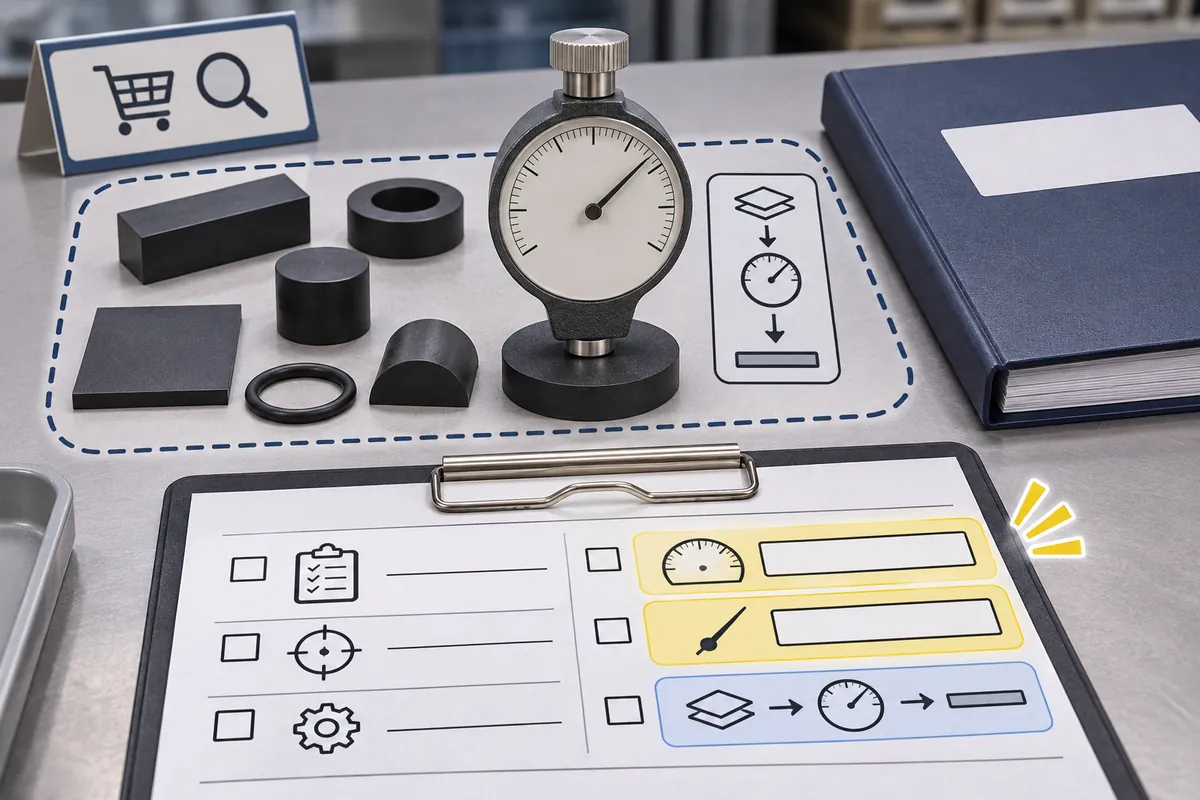
The drawing, sample and report should agree on what component is being considered. If a buyer has not selected a target hardness, do not turn a supplier’s typical range into a specification without confirming the function and material. If a project does include a hardness requirement, state the scale and the agreed method instead of writing an unqualified number. If the requirement is not yet settled, mark it as open and ask the technical owner what evidence is practical. That makes the product-development decision visible and prevents a tentative data point from becoming a hidden acceptance criterion.
This approach is especially useful when separate suppliers describe their material using different scales. A buyer should not rank one offer as “softer” or “harder” based only on two unrelated numbers. First check whether both suppliers are describing the same type of component and the same function. Then ask each one to identify the tested material, scale, specimen and method. If one party supplies only a chart, request the source and the intended comparison range. Keep any approximate conversion outside the formal acceptance field unless the responsible technical owner has approved its use for that material and method.
The Shore A vs Shore D distinction also affects document control. If a drawing or purchase specification contains a numeric target, the scale must travel with every copy, spreadsheet cell, inspection form and supplier email. When a number is copied into a new document, the unit and scale can be lost even when the original report was complete. A controlled data field should therefore keep value and scale together, for example as one label or as two linked fields that cannot be separated during export. The exact record format is up to the buyer’s system; the purpose is to avoid a floating number that cannot be interpreted later.
When the first sample is reviewed, record whether the hardness value belongs to a material coupon, a finished component or a representative batch. If a component source or compound changes, confirm whether the previous report still describes the delivered part. A scale-correct reading from an old supplier sample does not automatically apply to a new material. The buyer can ask the supplier to identify the report revision and the part or compound lot, then determine whether the evidence is current for the order.
What is the safe way to compare supplier reports?
Compare reports in a sequence that first checks identity and method, then checks whether the result is relevant to the product decision. A tidy comparison table can expose missing information without trying to make incompatible values look comparable.
- Match the component. Verify that both reports relate to the same or clearly comparable pad, foot, bumper or tread.
- Confirm the scale. Retain Shore A, Shore D or the other reported scale next to every value.
- Review the method context. Record the test method, specimen description and relevant conditions supplied by the responsible party.
- Separate measurement from requirement. A measured number is evidence; a buyer acceptance limit is a separate decision.
- Connect the result to function. Ask whether the reported property answers the actual concern, such as contact, fit or wear, or whether additional evidence is needed.
- Keep the record controlled. Tie the result to the sample, component source, revision and purchase order or project file.
The comparison should not add a conversion column that implies exact equivalence without a validated basis. If a supplier provides a chart, record its source and intended use and ask the technical party whether it is suitable for the exact material and method. A chart may be an orientation aid; it does not automatically authorize substitution, release a product or define contractual acceptance.
Use this image as a visual reminder to record the scale and context. It is not a test result, calibration certificate or product claim. The actual approval should be written in the buyer’s specification or quality record, not inferred from an image or an article illustration.

What should buyers ask before approving a rubber component?
Use direct questions that reveal whether a reading has been stripped of context and whether it relates to the actual supplied part. The purpose is not to demand a particular scale in every case, but to make sure the chosen scale and method suit the material and the decision. A procurement team can use these prompts during quotation, sampling and production review:
- Which exact component or compound does the hardness report describe?
- Is the value Shore A, Shore D or another scale, and is the scale shown on the original report?
- Which method or procedure was used, and who performed the measurement?
- What specimen was measured, and how does it relate to the part supplied with the rack or basket?
- Are the two candidate reports based on comparable specimen preparation and conditions?
- Is the value informational, a design target or a buyer’s formal acceptance criterion?
- What functional requirement is the hardness intended to support?
- Does the buyer also need to assess surface contact, fit, attachment, marking, compression or chemical exposure?
- If the compound or component changes, what sample or record will be resubmitted for approval?
The order file can then separate three levels of evidence. The first is material identification and supplier documentation. The second is the reported hardness reading and its method context. The third is evidence about the installed component’s performance for the actual use. A buyer may need all three, or a particular project may need only some of them. The essential point is not to claim that one level proves another.
For a custom metal rack or bathroom accessory, a clear component schedule can list the pad, foot, bumper or caster tread as a bought-in component and identify its interface with the metal part. If a product uses a specific component, the buyer can request that the sample and production item remain consistent with the approved revision. If substitutions are possible, define how they will be communicated. This approach is more useful than putting a Shore number into a drawing without a scale, material context or functional explanation.
Häufig gestellte Fragen
Is Shore A 70 the same hardness as Shore D 70?
No. The numerical value is tied to its scale. Shore A and Shore D use different indentation systems, so the same displayed number does not mean the same hardness. Always state the scale with the reading.
Can I convert Shore A to Shore D with a chart?
Some charts offer approximate orientation, but a chart is not a universal conversion or acceptance rule. Confirm the source, scope and method with the responsible technical party before using any conversion for a material or purchase decision.
Does Shore hardness identify the polymer?
No. A Shore reading alone does not identify whether a material is a particular rubber or plastic formulation. Request the material designation or supplier documentation separately.
Does a higher Shore number mean a better rubber foot?
Not by itself. The appropriate hardness depends on the intended function and is only one aspect of the component. Contact, marking, grip, compression, attachment and environment may need separate consideration.
Does a Shore value prove that a foot will not mark a floor?
No. A hardness result does not establish non-marking behavior. The contact material, shape, surface, load, movement and test conditions matter. Define the relevant surface concern and agree on suitable evidence.
Does this article specify a mandatory test method?
No. It explains why scale and context should travel with a reading. The responsible technical party should identify the applicable method and conditions for the actual specimen and decision.
Arbeiten Sie mit Koitor Hardware zusammen
Review a Rubber Component for a Custom Hardware Project
Share the product drawing or sample, the component function and the report or specification you are reviewing. Koitor can discuss the confirmed metal hardware scope and clarify which component details need project-specific supplier confirmation.
OEM / EIGENE MARKE
Verwandeln Sie diesen Beschaffungsleitfaden in ein Produktdossier
Teilen Sie uns Ihr Zielprodukt, die Größe, die Oberflächenausführung, die Bestellmenge und Ihre Verpackungsanforderungen mit. Ihr Team erhält vor der Angebotserstellung eine praxisorientierte Prüfung der Herstellbarkeit.


 English
 Español
 Português
 Français
 Deutsch
 العربية