
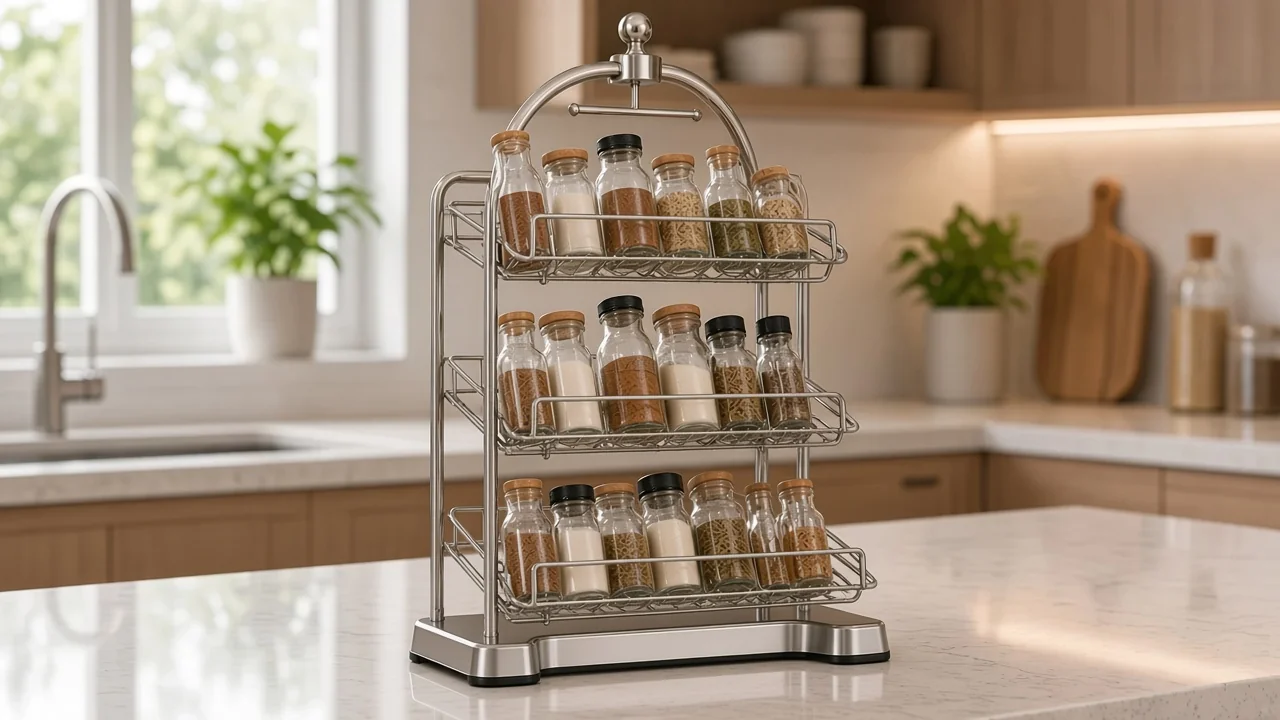
A spice rack jar retention rail is the front lip or wire fence that stops jars from sliding off a shelf, especially when the shelf is tilted toward the user. Shelf clearance answers whether a jar can sit and be lifted out. Rail height answers whether that jar stays put, whether the label stays readable, and whether fingers can still get in.
Importers should freeze rail height against the intended jar set and the actual shelf tilt before a listing says jars are secure and easy to identify. A rail copied from a flat shelf often fails on a steeper tilt. A rail that is too high hides labels and traps dust.
This guide is not a rename of jar-envelope or shelf-pitch design. That work already lives on the jar-clearance page. The increment here is the three-way trade-off of retention, label visibility, and finger access on tilted shelves.
Why shelf clearance and rail height are different decisions
Clearance work starts with the jar envelope and the usable opening of the shelf. It asks whether the body, cap, and retrieval path fit. Kitchen Spice Rack Jar Clearance Design for OEM Buyers owns that file: assortment records, finished clear width and depth, shelf pitch, and installation boundaries. It mentions rails as one obstruction in the retrieval path. It does not freeze rail height against shelf tilt, label readability, and finger access as the main decision.
Retention-rail height is a different CTQ. On a tilted shelf, gravity and a bump both try to walk the jar forward. A low rail may leave a short jar free to tip. A high rail may hold the jar and then hide the front label or block a user’s fingers. The buyer has to approve one height, or a height band, that serves all three jobs for the approved jars.
Do not treat a successful clearance trial as proof of retention. A jar can sit neatly on a flat mock-up and still slide when the production shelf is tilted. Do not treat a tall fence as automatically better. If the user cannot read the label or extract the jar, the rack has failed a commercial task even if nothing falls.
How should buyers set spice rack jar retention rail height on a tilted shelf?
Start with the shelf tilt that will actually ship, measured on the finished rack, not from a rendering. The same rail height behaves differently on a shallow display tilt and on a steep stadium-style shelf. Record the tilt as a project measurement. Do not copy a degree figure from an unrelated vendor page as a Koitor standard.
Then set the rail height from the shelf deck, or from another named datum, to a point on the jar body that can stop a forward slide without covering the label block the retailer cares about. If labels sit low on the jar, the rail may have to sit even lower, or the buyer may need lid labels as a backup rather than pretending the front label is still fully visible.
Trial the shortest and the most slippery jars in the assortment, not only a tall styled bottle. A short glass jar can duck under a rail that looks high enough against a tall grinder. A smooth cylindrical jar can walk more readily than a square jar with a shoulder.
Measure the finished rail after coating. Powder coat and thick plating can raise a wire rail or thicken it enough to change both retention and the look of the label line. Approve the shipping finish.

How can labels stay readable without losing retention?
Label visibility is a commercial requirement, not a decoration. Users identify spices from the front of the jar on a tilted shelf. If the rail covers the name, they pull jars at random or they ask for lid labels that were never in the brief.
Agree which part of the label must remain visible: the spice name, a brand block, a barcode, or a color band. Then check that line of sight from a normal standing or seated kitchen position, not only from a camera placed high above the rack.
If the only way to keep jars on a steep tilt is to cover the front label, the honest options are a shallower tilt, a mid-height rail plus a second low catch, lid or neck labels, or a narrower claim that the rack is meant to be used with lid markings. Do not silently assume the user will remember every jar position.
Third-party kitchen guides often mention a raised front lip as the thing that keeps jars on a steep tier, and they also warn that a high guard rail can hide labels. Use those comments as problem signals. They are not numeric standards to copy into a Koitor drawing.
How should finger access and replacement be trialed?
A rail that holds a jar must still leave space for fingers to grip the body or the cap, lift the jar, and put it back without knocking its neighbors. Trial the rack with the intended row density, not with one lonely jar in the center of an empty shelf.
Watch the removal path. On a tilted shelf the jar may need to be lifted slightly and drawn up over the rail. If the shelf above is close, that path can collide with the next rail or the next cap. This is where clearance work and rail-height work meet, but they still need separate notes: one note for the opening, one note for the fence height.
Replacement matters as much as removal. Users often put a jar back with one hand. A tall rail can force an awkward tilt that spills contents or scrapes a label. Record that observation on the sample, then decide whether the rail, the tilt, or the jar set should change.
| Decision | What to trial | Typical failure if ignored |
|---|---|---|
| Shelf tilt | Finished angle on the shipping rack | A flat-shelf rail is too low once the shelf is tilted |
| Rail height | Height to the controlling point on short and tall jars | Short jars walk; tall rails hide names |
| Label line | Standing view of the agreed label zone | Users cannot identify spices without pulling every jar |
| Finger path | Removal and replacement in a full row | Labels scuff; jars spill; neighboring caps clash |
| Finish film | Coated rail on the golden sample | Coating thickens the fence or roughens the contact |
What should the RFQ and the factory control on a freestanding tilted rack?
This article’s images and sample notes use a freestanding or countertop metal spice rack. Do not mix evidence with over-door racks, cabinet-filler pull-outs, or wall-screw units. Those mounts change the tilt, the bump loads, and the user’s hand path. Over-door and filler programs are neighboring product families and should keep their own files.
Tip-over stability of a freestanding rack is also a neighbor, not a substitute. A well-chosen rail can keep jars on a shelf and the whole rack can still rock if the base is light. Keep base stability in its own review.
The RFQ should name the jar set, the shelf tilt, the rail-height datum, the label-visibility rule, and the finger-access trial. Attach photos or samples of the controlling jars, including short jars and any slick glass cylinders.
Koitor Hardware is a family-owned custom metal hardware factory and a China OEM manufacturer of kitchen and home storage racks. The factory can review wire forming, welding, rail position, finishing, and packaging from a drawing or a physical sample. Useful OEM context is also on custom kitchen storage rack manufacturing und Fertigung von maßgefertigten Metallregalen. Those pages do not freeze rail height.
MOQ can start from about 100 pcs depending on the product. Samples usually take 5–7 working days after details are confirmed. Bulk production usually takes 4–6 weeks depending on product, quantity, finish, and packaging. Treat those as planning ranges.
If the first sample hides labels or drops short jars, compare lowering the rail, reducing tilt, splitting the assortment by jar height, or adding lid-label guidance. Each path has a listing and tooling cost. Ask for the trade-off on the actual rack.
Write the listing with the same limits as the trial. “Holds standard spice jars” is not a rail-height claim. A better sentence names the approved jar class and says the front rail is intended to retain those jars on the stated tilt without covering the agreed label zone, or it stays silent and points to the spec sheet.
Do not invent a universal rail height in millimeters. Two programs with the same overall rack size can need different fences because their jars and tilts differ.
Assembly and weld quality at the rail ends deserve a look on the finished sample. A rail that is welded high on one end will look crooked and will hide labels on one side of the row. A sharp cut end can catch a finger or a label. Those are acceptance observations, not an excuse to use internal factory defect jargon in the listing.
Cleaning and dust should be considered on a high rail or a double-wire fence. A tall fence can hold crumbs and spice dust against the jar. If the buyer wants a wipe-clean design, a simpler single rail at the approved height may be better than a decorative double fence that traps residue.
Packaging can bend a slender front rail inward or outward. An inward bend tightens finger access and may scrape labels. An outward bend can let short jars walk. Include a pack review of rail position after handling, without presenting that review as a certified test report unless such a report is separately provided.
If several shelf tiers share one rack, do not assume one rail height serves every tier. The top shelf may have a different tilt or a different jar set than the bottom shelf. Trial each tier or state that only named tiers are approved for named jars.
Lid labels can be a useful backup, but they should be an explicit merchandising decision. They do not repair a rail that hides every front label in a brand program that is built around front artwork.
Change control should reopen the file when tilt, rail height, wire diameter, finish film, or the jar set changes. A decorative end cap added to the rail can also hide a corner label or catch a finger and should be reviewed.
A first-lot check can repeat the jar-row trial on a production rack and compare rail height and tilt with the golden sample. If jars now hide their names or short jars walk, hold the listing sentence until the rack or the claim is corrected.
Keep bottle-diameter fit, when it is a separate program question, in its own note. Diameter tells you whether a jar occupies the shelf width. It does not tell you how high the fence should be.
Mixed jar shapes on one tilted shelf should be trialed as a row, not as isolated heroes. A square jar can catch a rail earlier than a cylinder. A tapered jar may sit stably until it is pulled, then slip under the fence. If the assortment mixes those shapes, the controlling jar is the one that first walks, hides its name, or blocks fingers, and that may not be the tallest jar.
Oil bottles and tall grinders often need a different tier than short spice jars. Putting them on the same tilted shelf can force a rail that is too high for the small jars or too low for a heavy bottle. The clean commercial answer is often a designated tier, not one compromise height that serves no row well.
A welding or forming jig that locates the rail from a named datum helps production hold the approved height. Ask how the factory will locate the rail from the shelf deck or side frame, and how a finished piece will be checked. That process question is separate from any later lot-sampling agreement.
Countertop bumps are part of the retention story for a freestanding rack. A user may slide the rack to wipe the counter. The rail should be judged in that light, but the sliding mass of the whole rack remains a stability question. Do not let a base-weight discussion replace a rail-height trial, and do not let a rail trial replace a stability review.
If the rack is sold with jars, treat the supplied set as the primary trial and still record whether refill packs or aftermarket jars are excluded. If the rack is sold empty, the compatibility statement has to be bounded by the reference jars the buyer is willing to defend.
Color contrast between the rail and the labels affects readability in photography and in a dim pantry. A chrome rail across a white label can flash in a photo and hide a name even when a tape measure says the rail is below the text. Check a standing photo as well as a measurement.
A double-wire fence can retain jars at a lower top height than a single wire, because the lower wire catches the jar body earlier. It can also hide more of the label and collect more dust. If the buyer wants that form, trial it as its own design, not as a decoration added after the single-rail height was approved.
International assortments may use different jar artwork even when the glass envelope is similar. A label that is high on a US jar may sit lower on an EU private-label refill. When one rack is meant to serve more than one market, trial the lowest label line the program will actually print.
Assembly instructions for knock-down racks should state which way a tilted shelf faces and how the rail is oriented. A shelf installed backward can point the tilt the wrong way or put the rail on the back edge. That is an instruction failure that will be reported as a “jars fall off” complaint.
Koitor can review jigging, welding, rail height, and finish on the actual design, then discuss whether a lower rail, a shallower tilt, or a split-tier assortment is the more practical path. Bring the jar set and a clear label rule so the discussion is not a general request for a “safer rail.”
Spare shelves, if sold separately, should carry the same rail height and tilt as the approved rack, or they should be coded as a new revision. A replacement shelf with a lower fence will quietly undo the retention claim in the field.
Retail planograms sometimes push jars two-deep on a shelf that was trialed one-deep. A second row can lean on the front row and change how hard the front rail has to work, and it can also hide labels. If two-deep storage is in the sales story, include it in the trial or exclude it in the claim.
A first production lot should repeat the short-jar walk test and the standing label check on a finished rack. If the spice rack jar retention rail no longer matches the golden sample, hold the artwork claim until the height or the sentence is corrected.
If a buyer later adds a fourth tier or a wider frame, repeat the tilt and rail trials on the new geometry. A wider shelf can change how jars are bumped in the middle of a long row, and a new tier can ship with a different included angle even when the rail wire looks the same in a catalog sketch.
Buyer checklist before freezing rail height
Use the following checklist to freeze spice rack jar retention rail height on the tilted shelves that will ship.
- Mount locked as freestanding or countertop for this visual set and sample file
- Jar assortment identified, including short and slick jars
- Finished shelf tilt recorded on the golden sample
- Rail-height datum named and measured after finish
- Retention trial performed with a representative row, not a single styled jar
- Agreed label zone still readable from a normal viewing position
- Finger removal and replacement tried in a full row
- Neighbor jar-clearance file kept separate and linked rather than rewritten
- Base tip-over and over-door programs left in their own files
- Weld ends and cut ends of the rail reviewed on the finished sample
- Pack review of rail position after handling
- Listing language limited to the approved jars and tilt

Häufig gestellte Fragen
Can I reuse a rail height from a flat-shelf rack on a tilted shelf?
Not without a new trial. The same fence is often too low once the shelf tilts forward.
Does a jar that fits the shelf already prove the rail is correct?
No. Fit is a clearance question. Retention, label visibility, and finger access are additional checks on the fence height.
Is there a standard rail height for spice jars?
No universal number should be copied as a Koitor rule. Set the height from the buyer’s jars and the finished tilt.
What if the rail hides the front label?
Lower the rail, reduce the tilt, change the jar set, or make lid labels an explicit part of the program. Do not ignore the visibility failure.
Do finish changes require a new rail check?
Yes when film build can thicken the rail or change the contact with the jar. Confirm on the shipping finish.
Should over-door and freestanding racks share one rail-height file?
No. The mounts and bump conditions differ. Keep the evidence with the mount that will ship.
Arbeiten Sie mit Koitor Hardware zusammen
Need a spice-rack rail height reviewed for tilted shelves?
Send Koitor the rack drawing or sample, the intended jar set, the shelf tilt, and the label-visibility rule you want to hold. Our team can review rail position, manufacturability, and small-batch OEM options before quotation.
OEM / EIGENE MARKE
Verwandeln Sie diesen Beschaffungsleitfaden in ein Produktdossier
Teilen Sie uns Ihr Zielprodukt, die Größe, die Oberflächenausführung, die Bestellmenge und Ihre Verpackungsanforderungen mit. Ihr Team erhält vor der Angebotserstellung eine praxisorientierte Prüfung der Herstellbarkeit.
 English
 Español
 Português
 Français
 Deutsch
 العربية