

A supplier warranty agreement is useful only when both sides can identify which product and order it covers, what evidence supports a claim, and how a remedy is approved and closed. For a bathroom or home-storage hardware importer, those details should be aligned before the purchase order—not reconstructed after a customer reports a problem.
This is an issue-spotting checklist, not a warranty template or legal advice. Warranty rights, notice requirements, liability limits and consumer obligations vary with the contract and governing law. A buyer should review proposed terms with qualified counsel for the relevant jurisdictions.
What products and defects should the warranty cover?
Start by tying the agreement to the exact goods. “All products” or “hardware” may be too broad to administer when an order includes several SKUs, finishes, mounting methods or revisions. Record the product name, model/SKU, drawing or specification revision, approved sample, purchase-order line and any agreed changes. If a private-label brand or retailer has its own product code, map it to the supplier’s item identifier.
A supplier warranty agreement should therefore tie its scope to the buyer’s purchase documents and the approved product record, not just a broad category name.
Then define the non-conformity that can trigger a claim by referring to the agreed product requirements. These might include dimensions, finish appearance, weld or assembly condition, included components, packaging configuration or another explicitly approved criterion. State which documents control if the purchase order, drawing, sample approval and later email differ. Identify exclusions only after both parties understand what is being excluded, such as misuse, unauthorized modification or damage after a defined transfer of responsibility; the actual wording requires contract review.
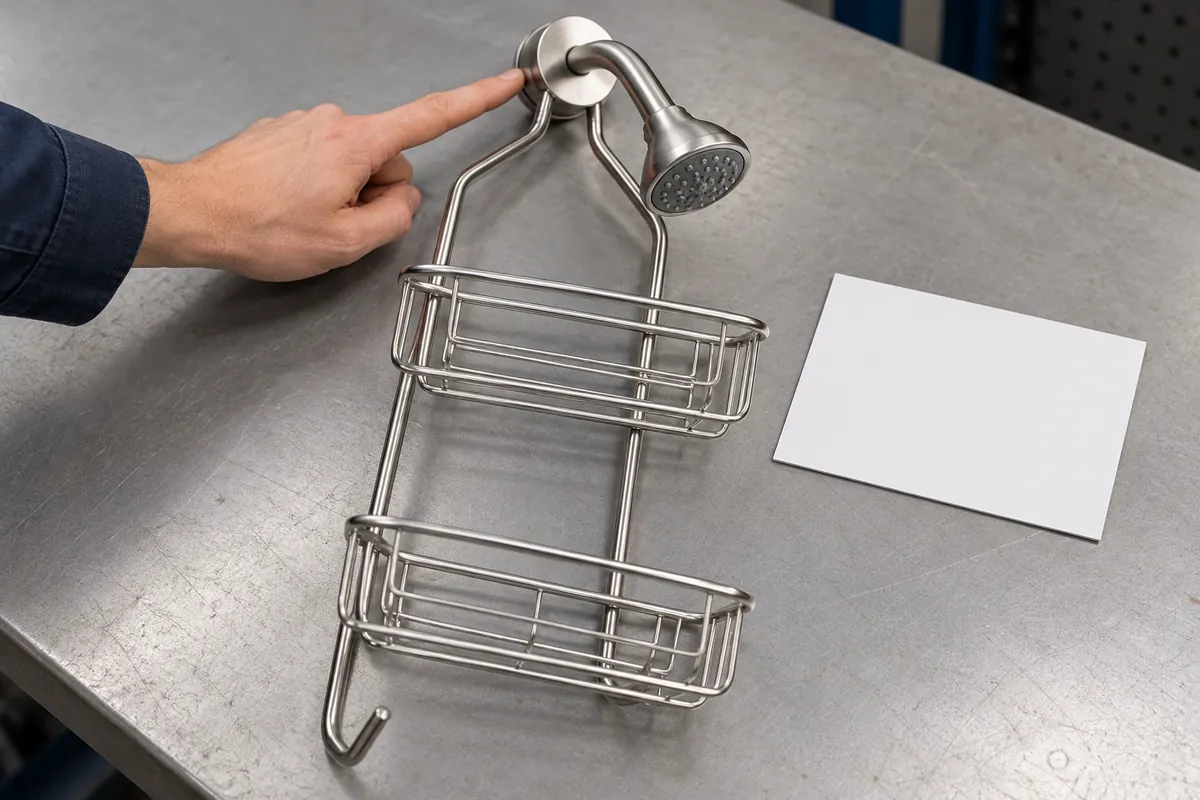
Avoid relying on a generic phrase such as “quality problem.” For a wire shower basket, a claim about a loose joint is different from a finish mark, missing fastener or crushed carton. The buyer and supplier may need different inspection methods, evidence and remedies for each. The wording should describe the product requirement and claim category, not assert a failure mechanism before it is investigated.
How should a claim identify the affected goods and evidence?
A workable claim record lets the supplier understand the alleged non-conformity and locate the relevant order without guessing. Agree what information the buyer will provide when reasonably available:
| Claim field | Useful information | Warum das wichtig ist |
|---|---|---|
| Produktidentität | SKU, model, revision, finish, mounting type and order line | Prevents mixing similar variants |
| Transaction scope | PO, invoice, shipment date, cartons or quantity received | Connects the claim to commercial and shipping records |
| Issue description | What differs from the agreed requirement, where and how many units observed | Makes the claim specific enough to investigate |
| Evidence | Dated photos/video, inspection notes, samples or test records relevant to the issue | Helps compare the report with the agreed criteria |
| Handling context | Storage, installation, cleaning or transit conditions where relevant | Helps separate product, handling and installation causes |
| Requested next step | Inspection, containment discussion, replacement quote or other proposed remedy | Makes clear what response the buyer is seeking |
Not every field will exist for every product or claim. A carton label does not prove unit-level lot traceability unless the supplier’s records connect it to the production scope. Record what is known, what is missing and which party will check. Preserve original photographs and documents with dates; do not edit evidence in a way that changes its meaning.
Set a practical notice channel and contact route in the agreement. If the parties plan to use email, specify the role or address that should receive the notice and what information makes a submission complete enough to open an investigation. Do not present one universal claim deadline as legally sufficient. Contractual deadlines and statutory rights can interact, and a short notice window may be unsuitable for issues that appear only after use.
Which remedies and costs should the parties define?
List possible remedies and the decision path rather than assuming every claim leads to a free replacement. Depending on the agreement, product, evidence and law, the parties may consider repair, replacement parts, replacement goods, rework, credit, refund or reimbursement of an agreed cost. A remedy should identify the affected quantity, approval authority, timing and documentation needed to confirm completion.
Clarify how the remedy is calculated. For example, if parties agree on replacement goods, define whether the scope is the confirmed defective units or a wider quantity after inspection; who confirms the quantity; and how packaging, freight, import charges, local sorting or disposal are treated. If the parties discuss reimbursement, state which costs are eligible, how they are documented and how currency, invoices and payment timing are handled. Do not promise that a supplier or buyer is legally responsible for a cost unless the controlling agreement and law establish it.
It is also useful to separate who pays first from who ultimately bears an agreed cost. A buyer might initially arrange local sorting to protect customer service, while reserving final allocation until inspection. If that can happen, document authorization, cost evidence and the process for resolving disagreement. No one should infer that the party paying an urgent invoice has accepted final liability.

Where a retailer or brand has promised an end customer a particular remedy, compare that promise with the supplier agreement before launch. The buyer may owe duties that are not fully recoverable from the factory. A supplier’s manufacturing warranty does not automatically replace the importer’s separate consumer, retailer or product-safety obligations. If customer-facing commitments are more generous, the difference is a commercial exposure for the buyer to assess, not an assurance the supplier will cover it.
What response and closure steps make a claim manageable?
Define an operational sequence that fits the product and business relationship. One example is: acknowledge receipt; identify missing information; agree whether samples or an inspection are needed; decide any interim containment; investigate against the approved specification; document a proposed remedy; approve and complete it; then record closure or unresolved points. This is a planning sequence, not a statutory procedure.
Set target response times separately for acknowledgement, initial containment discussion, investigation update and remedy completion. Avoid using one deadline for every stage. An acknowledgement confirms the claim was received; it does not mean the supplier has accepted fault. Likewise, an initial technical opinion may change after samples or production records are reviewed. The agreement should say how updated findings are communicated.
Assign owners on both sides. The importer may coordinate the retailer or end-customer communication; the supplier may investigate manufacturing records for its own production; a forwarder, warehouse, installer or insurer may hold evidence relevant to transport or use. The warranty clause should not treat all parties as if they control the same records.
For recurring or systemic issues, define how a warranty claim connects to a separate corrective-action process. The claim determines the affected transaction and remedy; corrective action examines cause, scope and prevention. Keep the two related but distinct so that settlement of one claim does not silently close a wider quality concern. Koitor’s custom bathroom hardware manufacturing page describes the relevant product-sourcing context. For transit-related damage, use a separate cargo damage evidence checklist because carton condition, handoff and carrier records may have different owners and deadlines.
How do customs guidance and international sales rules fit?
Use legal and government sources to identify questions for review, not to copy a one-size-fits-all warranty clause. HM Revenue & Customs’ guidance on warranty, repairs and defective goods explains a specific UK customs-valuation context. It discusses evidence that imported goods were defective at the relevant time and, for a particular duty repayment route, repair and seller reimbursement under warranty. That is not a universal right to repayment, nor a general warranty remedy for all importers. Check the applicable customs rules and obtain advice for the exact transaction.
The UNCITRAL Convention on Contracts for the International Sale of Goods (CISG) includes provisions concerning conformity and examination/notice, among other matters. Whether the CISG applies, whether the parties varied its effect, and what other rules govern a transaction depend on the facts and contract. The UNCITRAL CISG Digest summarizes case-law interpretations; it is not a substitute for jurisdiction-specific advice.
For a general contract-preparation prompt, the Northern Ireland business guidance on overseas supplier contracts recommends putting goods, delivery, insurance, dispute procedures and responsibilities into a written agreement. It is broad business guidance, not legal advice on an individual warranty dispute. The practical takeaway is to identify the governing documents, applicable law and dispute process before relying on a claim clause.
Buyer checklist before approving the first PO
Before production begins, check that the proposed terms address:
- The covered SKUs, approved revisions, specifications, samples and relevant order documents.
- The covered non-conformity categories and any clearly written exclusions.
- How the buyer identifies and reports a claim, including the contact route and evidence requirements.
- How the claim window is defined and how it interacts with inspection, acceptance and applicable law.
- Who acknowledges the report, investigates, makes technical findings and approves a remedy.
- Which remedies may be considered and how quantity, eligibility and completion are documented.
- Which inspection, sorting, rework, replacement, freight, customs, labor or disposal costs may be allocated, and how those costs are evidenced.
- How urgent customer or safety matters are escalated separately from ordinary commercial claims.
- How repeat issues connect to corrective action without treating one claim as proof of a systemic cause.
- How the parties record changes, approvals, settlement and closure, including unresolved disagreement.
- Whether the importer’s retailer or consumer promises exceed the remedies it has actually agreed with its supplier.
- Whether legal counsel has reviewed governing law, jurisdiction, liability limits and any mandatory rights.
If a term is silent, do not assume it means the buyer has a particular remedy or that the supplier has accepted a cost. Raise the gap before order placement, document the agreed interpretation and keep the final signed or accepted version with the order record.
For repeat orders, keep the warranty record connected to the exact purchase order, SKU, production revision and approved finish. If a later order changes wire diameter, mounting hardware, coating color, carton protection or assembly method, the parties should identify whether that change affects the covered product definition or inspection basis. A short change note can prevent an older sample or specification from being treated as the reference for a newer shipment. This is especially useful when a brand uses the same retail name across several product revisions. Keep the change approval, affected lots and any agreed transition date together so a claim can be assessed against the right version rather than a general product family.
A supplier warranty agreement is ready to administer only when its product scope, claim evidence, decision owners and closure record are clear enough for both parties to follow.
Häufig gestellte Fragen
Is a supplier warranty agreement the same as a pre-shipment inspection?
No. Inspection checks a sample or shipment against agreed criteria at a particular stage. Warranty terms address claims under the agreed arrangement after delivery or use. They can reference the same specification but serve different purposes.
Does a warranty guarantee that a buyer can recover every downstream cost?
No. Recovery depends on the contract, evidence, governing law, causation and the agreed cost categories. A buyer should not assume consumer remedies, retailer deductions, local labor or freight are automatically covered by a factory warranty.
Should the warranty period start at shipment or at resale?
There is no universal start point. Parties should define the trigger that fits the sales channel and record it clearly. For goods that may sit in distribution, the difference between shipment, receipt, retail sale and installation can materially change the commercial allocation; have the proposed wording reviewed for the applicable law.
Should a buyer use a model warranty clause from another industry?
Only as an issue-spotting reference. Product risk, inspection, shelf life, sales channel and law differ. An electronics, automotive or industrial clause may not fit bathroom storage hardware. Adapt terms with qualified counsel and the supplier rather than copying language without reviewing scope and cost effects.
Work with Koitor Hardware
Align Product and Claim Records Before Production
Share the hardware type, approved product revision, inspection criteria and order questions. Koitor can discuss factory-side product identification and manufacturing records available for the agreed project; warranty rights and contract remedies should be reviewed by the parties and qualified counsel.
OEM / EIGENE MARKE
Verwandeln Sie diesen Beschaffungsleitfaden in ein Produktdossier
Teilen Sie uns Ihr Zielprodukt, die Größe, die Oberflächenausführung, die Bestellmenge und Ihre Verpackungsanforderungen mit. Ihr Team erhält vor der Angebotserstellung eine praxisorientierte Prüfung der Herstellbarkeit.


 English
 Español
 Português
 Français
 Deutsch
 العربية