

Throughput vs cycle time compares related but different quantities. Throughput is commonly an output rate, such as accepted pieces per hour. Cycle time is time associated with a defined operation or unit interval. A six-minute cycle corresponds to 10 units per hour only under a simplified steady serial assumption; two independent stations with the same six-minute cycle could produce 20 per hour under an ideal parallel assumption. Define the process boundary, units, good-unit count, and operating assumptions before comparing either figure.
What does throughput vs cycle time mean?
Throughput answers “how many units of output over what amount of time?” A supplier might report 120 accepted brackets per shift, 10 completed baskets per hour, or a line output rate over a named period. Cycle time answers “how much time is associated with the defined operation or unit interval?” It may be measured from one start condition to the next repeat, or as the time to complete one unit at a specified process boundary. The definition must say what event starts and stops the clock.
The terms are easy to confuse because output rate and time per unit can be mathematical reciprocals under particular assumptions. If one serial process completes one unit every six minutes without interruptions, it can theoretically complete 10 units in an hour: 60 minutes ÷ 6 minutes per unit. That conversion assumes the same unit, one workstream, continuous operating time, consistent method, and no blocked, starved, defective, or changeover intervals. Real production conditions may not satisfy those assumptions.
“Throughput time” is also used to describe the elapsed time a unit spends moving through a process or system, sometimes including waits. That is a duration, not an output rate. A supplier could report cycle time at one station, throughput rate for a line, and elapsed lead or route time for a complete order. Asking which measure is intended prevents a rate from being compared with a duration.
When buyers review a supplier statement, they should request the unit and boundary in the same sentence as the figure. “Ten per hour” is incomplete if the reader does not know whether it counts finished assemblies, subcomponents, inspected pieces, or only good units after rework. “Six minutes” is incomplete if the operation and included steps are unclear. Numbers are only useful when the counted unit and process are identifiable.
Worximity’s manufacturing explainer distinguishes throughput from cycle time and discusses how the measures relate. The arithmetic examples in this article are simplified illustrations, not production rates for Koitor or any specific factory.
| Measure | Unit to state | Boundary to define | What the figure describes |
|---|---|---|---|
| Throughput | Accepted units per time period | Count point and observation window | Output rate under the stated conditions |
| Cycle time | Time per unit or cycle | Start and stop event for the operation | Elapsed interval within that boundary |
| Throughput time | Elapsed time for a unit through a route | Route start and completion events | Time a unit spends moving through the defined process |
| Takt time | Available production time per demand unit | Demand interval and available-time rule | Planning pace implied by stated demand |
| Lead time | Time between order events | Order acceptance and agreed completion event | Overall elapsed time under the stated order scope |
How does the six-minute example convert into a rate?
The basic reciprocal calculation is:
Rate per hour = 60 minutes per hour ÷ cycle minutes per unit
If a defined serial operation completes one unit every six minutes and runs steadily for one hour, 60 ÷ 6 = 10 units per hour. This is a theoretical conversion under the stated assumptions. It is not automatically a shift output, daily capacity, shipped quantity, or promise to a buyer.
If the operation has planned breaks, changeovers, maintenance, missing material, inspection holds, scrap, rework, or downstream blockage, the number of good units actually produced during the hour can be lower. A supplier statement may also refer to a short observed run rather than a full shift or a sustained period. Ask how and when the rate was observed and whether it represents nominal, demonstrated, planned, or actual output.
The process boundary changes the answer too. One station may form a single metal component; the finished bathroom rack may require wire forming, joining, grinding, finishing, assembly, inspection, and packaging. A six-minute time for one forming step does not mean that a complete inspected and packed product is ready every six minutes. A line’s bottleneck or shared resource can constrain the overall rate even when one operation appears fast.
A unit-of-output check is useful:
- Does “one unit” mean one metal component, one subassembly, or one finished product?
- Are different sizes or revisions mixed in the count?
- Does the rate include only accepted units or all pieces processed?
- Is the time window an hour of running time, a clock hour, or a full shift?
- Were changeovers, breaks, downtime, inspection, or rework included?
- Does the process rely on a shared operator, fixture, machine, or finishing resource?
Answering these questions before doing reciprocal arithmetic avoids a common error: treating the inverse of one operation’s cycle as the realized output rate of an entire manufacturing system. The formula is a useful dimensional check, not a substitute for observing the actual process definition.
Why do process boundaries matter when comparing supplier figures?
A process boundary defines what work and events are included in a measurement. Without one, cycle-time or throughput figures can refer to different points in the route and cannot be compared fairly. One supplier may count from component loading to an unloaded part; another may count from first forming through inspection and packaging. Both may report a valid measurement for their chosen boundary, but the measures answer different questions.
For a custom metal storage rack, a buyer can separate the route into steps such as component preparation, bending, joining, surface finishing, final assembly, inspection, and packing. The route may vary by design and finish. A single cycle value at one station should not be generalized to the whole route. If a supplier gives a line-level number, ask which steps are included, where buffers occur, and whether downstream processes share capacity with other products.
For example, a welding operation may complete a set of joints quickly, while manual handling and inspection are measured separately. If the report starts the clock after setup and stops before inspection, it describes an operation interval, not order lead time or ready-to-ship output. A buyer comparing two suppliers should request the same start event, stop event, unit, and inclusion rules, or explicitly record why the numbers differ.
A useful measurement statement looks like this: “For one defined product revision, from placement in the forming fixture to removal of one completed component, under the observed operator and material conditions, the median operation interval was X minutes over Y observations.” The illustrative format shows the needed boundaries; no time value is supplied here because no Koitor process measurement is available. A real report should also define how unusual events and defective pieces are handled.
Process boundaries are not just a technical detail. They protect the purchasing conversation from turning an incomplete number into an assumed delivery commitment. A station rate, complete-route elapsed time, and order lead time each support different questions. For a related supplier-report question, see OEE versus production capacity. That comparison uses a different report boundary; this article focuses on the dimensional difference between output rate and time interval.
What changes when production is parallel rather than serial?
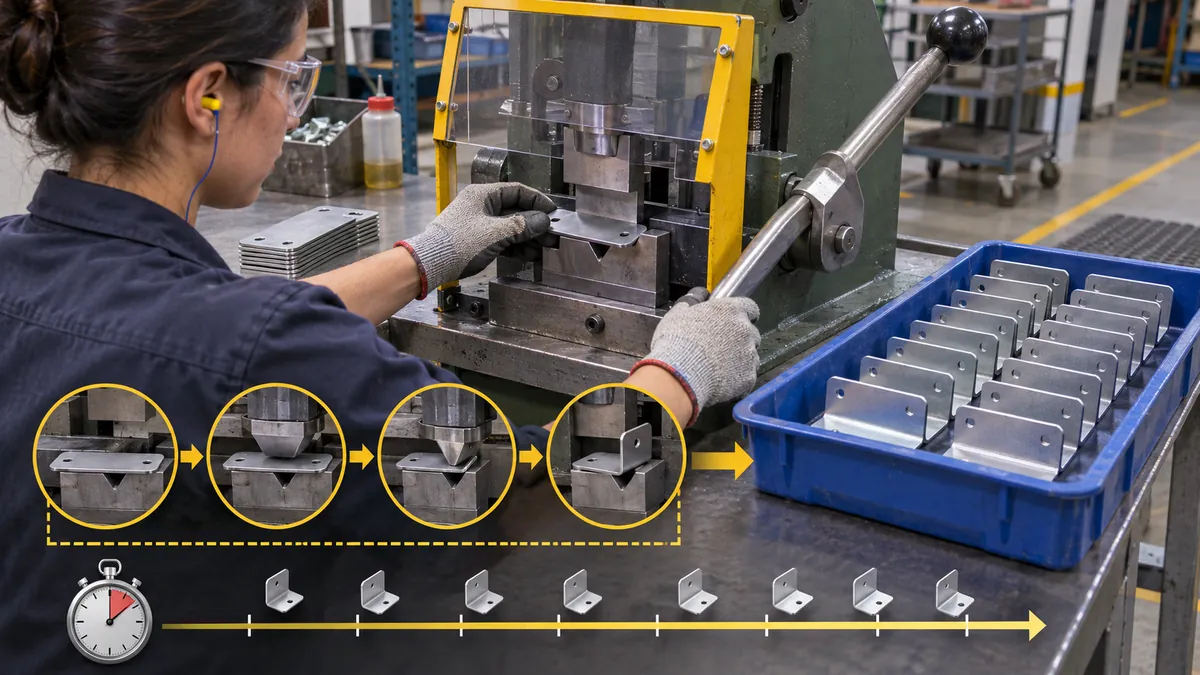
A serial example assumes one unit moves through one repeating operation at a time. If two independent stations each complete one unit every six minutes, and each can run concurrently with no shared constraint, their ideal combined output is 20 units per hour. Each station contributes 10 units per hour under the simplified six-minute calculation. The aggregate rate doubles because there are two independent workstreams, not because either station’s cycle time changed.
That example depends on independence. If both stations share one operator, a fixture, material feed, inspection point, finishing line, or packaging station, the shared resource may limit the combined output. If one station waits for another, or both cannot run simultaneously because of setup or product routing, adding a second station does not guarantee double throughput. The line’s bottleneck, work balance, and availability all matter.
Parallel equipment may also produce different product families or revisions. If a buyer counts all units together, the aggregate output may hide the rate for the specific model being sourced. A mixed count needs product-level detail if the decision concerns one SKU. Likewise, two lines may have different quality outcomes or require different downstream processing. Throughput should clarify whether it means total pieces processed or accepted finished units.
A simple serial-versus-parallel diagram can help show why reciprocal arithmetic has limits. The cycle interval stays attached to each defined operation. The output rate aggregates workstreams only when they truly operate independently under the stated conditions. If the system includes shared resources, downtime, blocked flow, or a constraint elsewhere, the calculation should be supported by actual evidence and not treated as an automatic forecast.
For a purchasing team, the right follow-up is usually not “How many machines do you have?” It is “What exact output unit and boundary does this rate represent, which resources are shared, what time window was observed, and what assumptions apply to our product revision?” Equipment count alone does not establish capacity, operating efficiency, or delivery performance.
How should the good-unit count be treated?
A production rate should distinguish processed units from accepted good units. A machine or operator may complete 100 operations but only 96 units may meet the agreed acceptance criteria on the first pass. If the stated throughput includes all processed pieces, it is different from accepted output. If rework later brings some units into conformity, the report should say whether the rate counts first-pass accepted units, final accepted units, or pieces before inspection.
Yield and rework should not be hidden inside the word “throughput.” A buyer assessing quality needs an agreed inspection plan and evidence. A buyer assessing flow needs a clear output definition. Combining those into one unlabeled metric makes it difficult to see whether an apparent rate increase came from faster processing, a changed count boundary, or fewer items being inspected.
A useful output statement might name the count rule: completed pieces leaving the defined process; pieces accepted at the next inspection step; or finished sets ready for packing. Each could be useful, but they are not equivalent. If the product is assembled from multiple components, the count unit could be an individual part or one complete set. The report should name that unit.
The same principle applies to rework. A unit that returns to an earlier station may be counted once or more than once in raw operation totals. If the report counts every pass, it can exceed the number of unique units. A controlled measurement should say whether it tracks unique product units, operations, or good units. Yield measures are a separate dimension: keep unique good units distinct from operation counts and document any rework treatment.
Do not infer final quality from a headline output rate. A high rate does not demonstrate conformity, and a lower rate does not prove poor performance without knowing the product, acceptance criteria, process conditions, and measurement method. The rate answers a defined flow question; quality records answer the conformity question.
How do cycle time, throughput time, takt time, and lead time differ?
Cycle time is a duration tied to a defined operation or repeating unit interval. Throughput is generally a rate of output over time. Throughput time may describe elapsed time through a route or system and can include waiting, depending on how the term is used. Takt time is a planning interval derived from available production time and customer demand. Lead time is elapsed time between defined events, such as order confirmation and delivery. These terms should not be merged into one “production time” figure.
The units expose the distinction. Cycle time may be measured in seconds or minutes per unit. Throughput may be units per minute, hour, or shift. Takt time is time available divided by demand under a defined planning period. Lead time is a calendar or working-time duration between start and finish events. A report that places two values in a table should name the units and events for each.
A supplier may have a short cycle at a station yet a longer total lead time because work waits in a queue, requires a finish step, or depends on material arrival. Another supplier may have a longer individual operation but a smoother route or different scheduling arrangement. The result cannot be judged from cycle time alone. Lead time also needs its own start and finish events; do not substitute an individual operation’s cycle time for total order lead time.
Takt time and cycle time may be compared for planning, but the comparison depends on defined available time, demand, product mix, and process scope. A buyer should not assume a supplier must meet a buyer’s demand interval simply because one station’s cycle is shorter. Capacity and changeover considerations are discussed in the linked supplier-capacity guide; this article does not assert any Koitor output figure.
A clean glossary at the start of a meeting can prevent multiple teams from using the same word differently. Ask each person to state the unit, boundary, and time basis. That simple practice can reveal whether procurement is asking about order lead time while production is quoting one station’s cycle.
What should a buyer request when a supplier quotes an output rate?
A useful request asks for evidence and a definition, not just a number. Identify the product revision, counted unit, process start and stop points, observation period, operating condition, and whether the count is processed, first-pass good, or finally accepted output. If the figure is intended to support an order plan, also ask what assumptions change when the product mix, finish, packaging, quantity, or shift pattern changes.
A buyer review can ask:
- What product or revision was measured?
- What is one counted unit: component, subassembly, or finished set?
- What is the process start and stop event?
- Is the figure cycle time, throughput rate, throughput time, or lead time?
- What time window and operating conditions were used?
- Are changeovers, breaks, downtime, blocked flow, and inspection included?
- Does the rate count all processed units or accepted units only?
- Are parallel stations independent or do they share resources?
- What evidence supports the claim, and when was it collected?
- What conditions would make the figure different for the buyer’s order?
These questions help compare claims fairly without demanding confidential factory data or inventing a capacity audit. A supplier may share a project-specific method or sample measurement, subject to its policies. The buyer should record what was supplied and what remains an assumption. A theoretical conversion from cycle time should remain labeled as theoretical unless actual output data supports a stronger statement.
The measurement should be proportionate to the decision. For a preliminary quote, a clear scope and cautious range may be enough to plan the next step. For a delivery commitment, the buyer may need a schedule, confirmed quantity, and written milestone assumptions. A station cycle calculation does not replace a production plan, purchase order, or agreed delivery date.
What assumptions should never be hidden in a rate comparison?
The first hidden assumption is uninterrupted time. If the calculation treats a full hour as productive while the observation included breaks or changeovers—or excludes them—the reported rate means something different. State whether the denominator is running time or clock time. For a shift measure, say how planned breaks and nonproduction intervals are treated.
A second hidden assumption is stable product mix. A simple part and a more complex assembly may take different paths. If a facility reports an average across dissimilar products, the buyer should ask whether the figure applies to the purchased model. A rate for a sample run may not carry over to another finish, packaging format, or drawing revision.
A third assumption is quality. If output counts all pieces leaving the station, scrap and rework may affect accepted output. The report should not imply that every processed unit is conforming. A fourth assumption is independence in parallel work. Separate stations are only additive if they can run concurrently and downstream processes do not create a shared constraint.
A final assumption is that the observation predicts future output. One run demonstrates a result under specific conditions. It does not automatically establish a sustained capacity, annual volume, delivery guarantee, or performance across every product. To make a forecast, the responsible business must state the schedule, demand, input availability, constraints, and acceptance basis. The article’s six-minute example is arithmetic only.
These boundaries are especially important when a buyer compares quotes from suppliers using different definitions. One may report a nominal station cycle; another a line’s accepted pieces per hour. Before ranking the figures, normalize the question and request additional evidence where necessary. If the scopes cannot be aligned, report the difference instead of constructing a false head-to-head comparison.
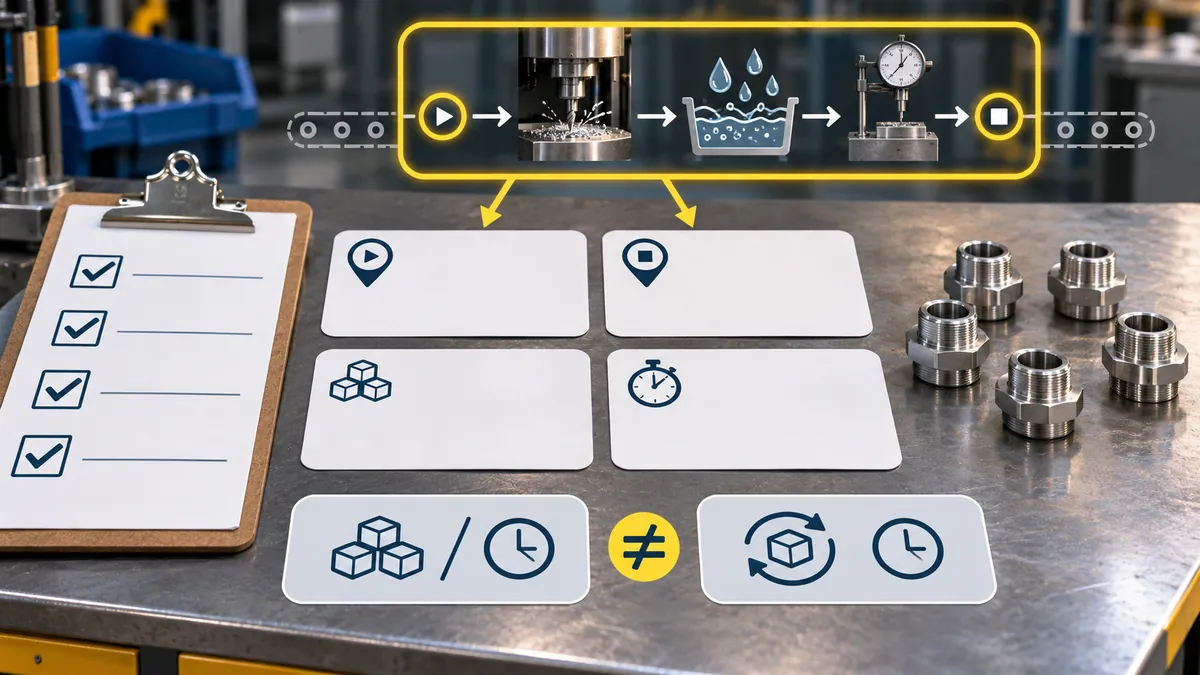
What should you check before comparing cycle time and throughput?
- Is the metric a time duration or an output rate?
- Is one unit defined consistently?
- Are the start and stop events explicit?
- Is the number for one operation, a line, or the full order route?
- Is the time base running time, clock time, shift time, or another interval?
- Does the count include scrap, rework, or only accepted output?
- Are parallel stations independent and free of shared constraints?
- Is the observation tied to the same product revision and mix?
- Are setup, changeover, waiting, and inspection included?
- Is a theoretical reciprocal calculation being kept separate from actual output evidence?
Häufig gestellte Fragen
Does throughput vs cycle time mean the same thing?
No. Throughput is an output rate over a stated period, while cycle time is an elapsed interval for a defined operation or unit.
Is throughput the inverse of cycle time?
It can be under a simplified, steady, single serial operation with consistent units and no interruptions. The reciprocal is not automatically the actual rate of a complete line or factory.
If cycle time is six minutes, is output always ten units per hour?
No. Sixty divided by six gives 10 under ideal continuous serial assumptions. Actual output depends on the process boundary, available time, interruptions, product mix, and whether the count is for accepted units.
What is throughput time?
The phrase is used for elapsed time through a process or system and may include waiting, depending on the definition. It is a duration, whereas throughput is usually a rate. Define the term before comparing values.
Does a high throughput rate prove good quality?
No. A throughput figure must say whether it counts processed or accepted output. Conformity requires its own inspection criteria and evidence.
Can two six-minute stations make 20 units per hour?
Only under simplified assumptions that both stations operate independently and concurrently, each completing one unit every six minutes, with no shared constraint or interruption. It is an illustrative ideal, not a capacity promise.
Is cycle time the same as order lead time?
No. Cycle time describes a defined operation or interval. Lead time spans defined start and finish events and may include waiting, scheduling, and other process steps.
Source note
The basic rate-versus-time distinction is informed by Worximity’s throughput and cycle time explanation. All numerical examples are idealized arithmetic, not Koitor factory measurements or commitments.
Discuss a related hardware project with Koitor
Share the relevant drawing or sample, product revision, finish, order quantity, and packaging scope to clarify the manufacturing discussion. Topic-specific accounting, care, textile, or coating decisions remain with the appropriate buyer and technical owners.
OEM / EIGENE MARKE
Verwandeln Sie diesen Beschaffungsleitfaden in ein Produktdossier
Teilen Sie uns Ihr Zielprodukt, die Größe, die Oberflächenausführung, die Bestellmenge und Ihre Verpackungsanforderungen mit. Ihr Team erhält vor der Angebotserstellung eine praxisorientierte Prüfung der Herstellbarkeit.


 English
 Español
 Português
 Français
 Deutsch
 العربية