
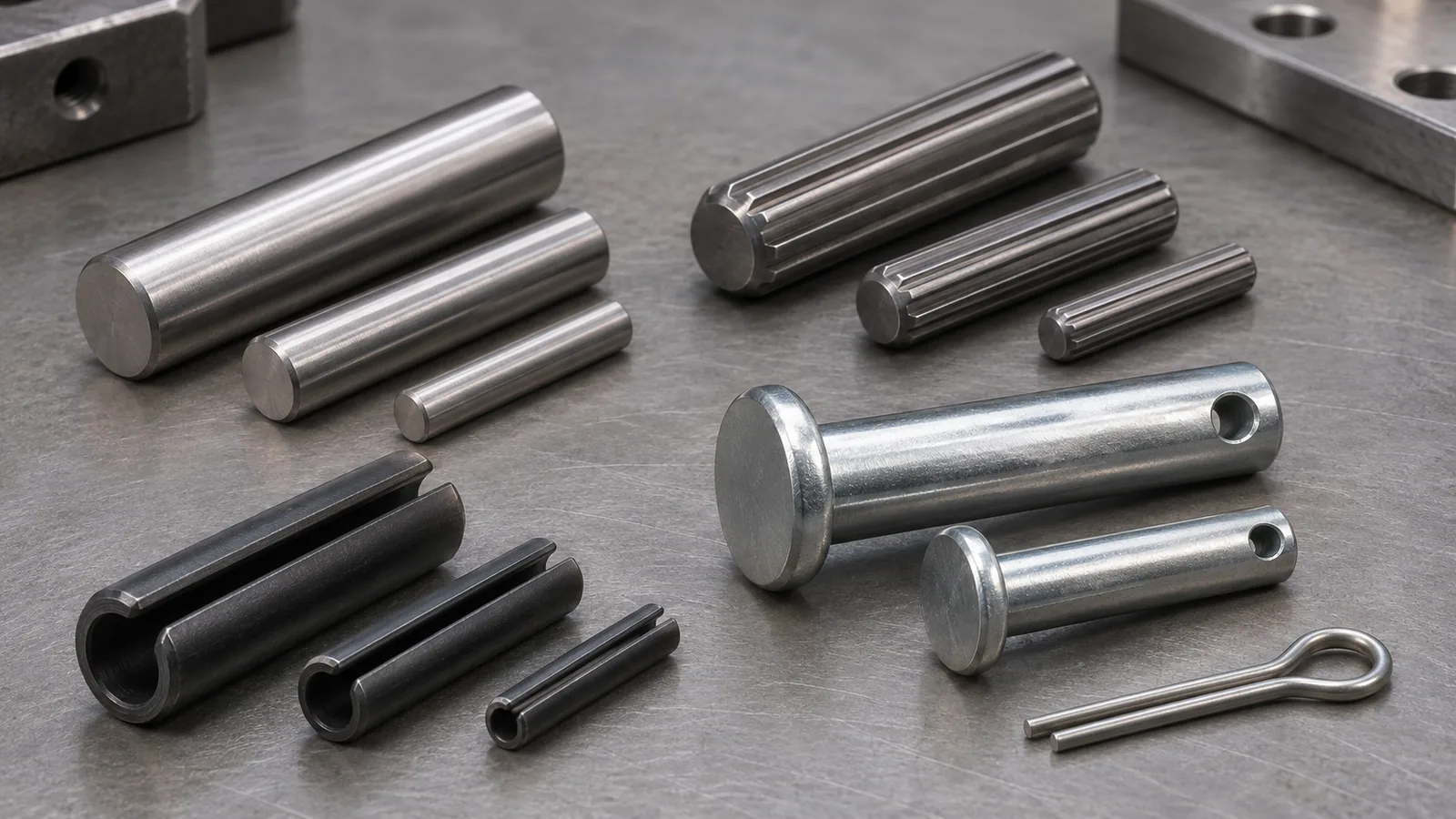
Types of pins can be compared by construction, the job they perform, and how they stay in the host part. A solid dowel may locate two parts; a headed pin can provide a pivot or retained axle; a slotted or coiled spring pin uses a hollow resilient body; and grooved, knurled or barbed designs use surface features for retention in a specific host. These categories overlap: “pin” describes a broad component family, while locating, pivoting, alignment and retention describe functions. Diameter alone cannot establish fit or interchangeability. Use the drawing, mating materials, retainer arrangement and supplier’s part data to define the exact component.
What question does this guide answer?
Mechanical pins connect, locate, align or pivot components in assemblies. A buyer may encounter pin names in a drawing, parts list, supplier quote or sample set and need to identify whether the proposed item is solid or hollow, retained by its shape or a separate feature, or intended to move in the joint. The common word “pin” is not a complete specification.
The search phrase can also refer to sewing pins, electrical connector pins, jewelry findings or other products. This article is limited to mechanical fastener and locating pins used in hardware assemblies. It does not assume that all searchers are industrial buyers or that every pin type is suitable for bathroom or home-storage products. The commercial connection is practical component literacy: a product developer who can identify the pin role can describe the assembly and ask for the right drawing or supplier document.
Before comparing types of pins, identify the pin’s function in the assembly. Is it intended to align parts during assembly, act as a pivot, prevent a component from moving, or carry a load in a defined arrangement? Is a cotter, clip, ring, shoulder or other retainer separate from the pin body? Does the pin rotate, stay fixed, slide, or allow removal? These answers determine what information belongs on the RFQ and which substitutions require review.
Separate construction, function and retention
Pin names are not all describing the same property. A dowel or solid pin describes a body form or product family. A pivot pin describes an application. A grooved, knurled or barbed pin describes a feature that may affect engagement with a host. A cotter pin or retaining clip may be a separate component that prevents another part from leaving its position. A buyer should not treat the categories as mutually exclusive.
| Classification axis | Examples | What it helps identify | What it does not establish |
|---|---|---|---|
| Body construction | Solid, hollow, slotted, coiled | Basic geometry and possible elastic behavior | Exact grade, load, fit or cycle life |
| Main function | Locating, pivoting, alignment, stop, connection | How the pin contributes to the assembly | Whether it carries the entire applied load |
| Retention feature | Head, groove, knurl, barb, separate clip or cotter | How axial movement may be limited | Approved removal method or reusability |
| Host interface | Through-hole, blind hole, shaft/bore, joint stack | Which mating geometry receives the pin | Tolerance without the controlled drawing |
| Motion | Fixed, rotating, sliding or removable | Intended behavior in service or assembly | Wear life or safety capability |
This map helps keep a quote specific. For example, “solid pivot pin with a head and separate retainer” communicates more than “metal pin,” while still leaving grade, dimensions, tolerances, finish and application requirements to be defined. Supplier catalogs may use different family names; ask for the exact part designation and drawing.
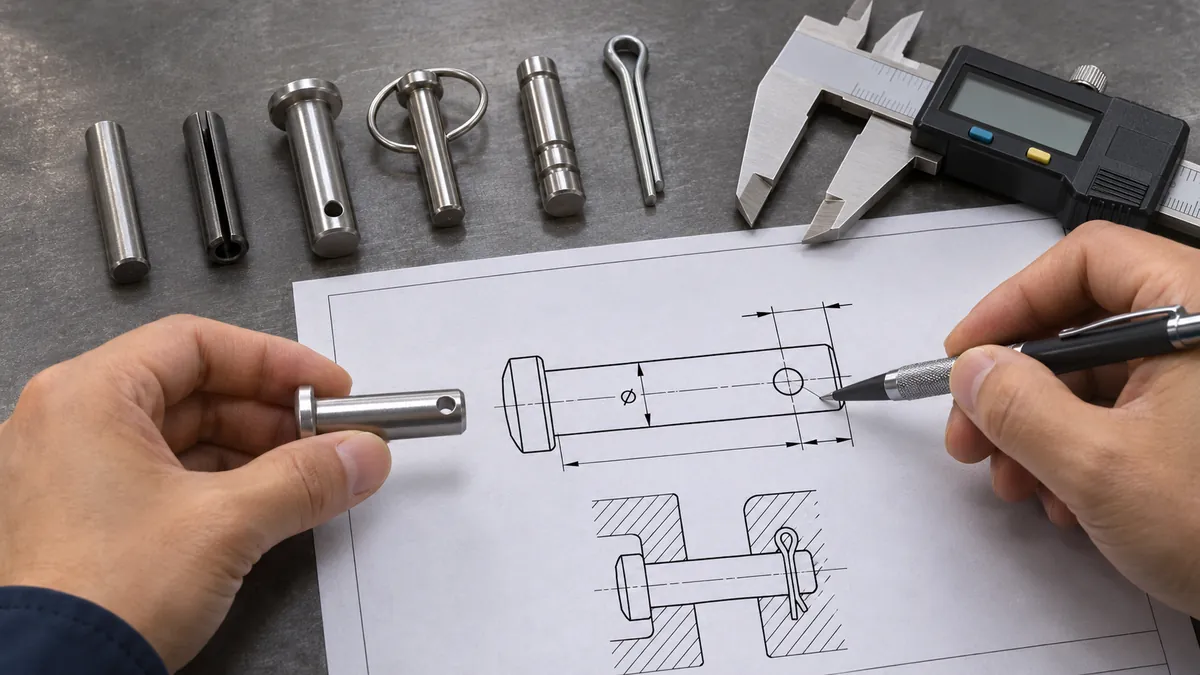
Common mechanical pin families
Solid dowel and straight pins
A solid straight or dowel pin is generally used as a locating or joining element in a hole arrangement defined by the design. Its fit with the mating holes matters. A pin’s role may be to repeatably position parts, not to act as a removable hinge axle. The exact hole and pin sizes, tolerances, surface condition and installation approach must come from the controlled specification and supplier data.
Do not assume every dowel is interchangeable because the nominal diameter looks similar. One locating pin may be intended for a particular fit, material pairing or installation process. If a sample is being measured, record which surface is measured and whether the measurement is of the pin body, coating, groove or another feature. A generic name does not establish the intended fit or application limits.
Slotted spring pins
A slotted spring pin has a hollow cylindrical body with a longitudinal slot and is designed so the body can flex in a specified installation. The slit and spring action distinguish it from a solid dowel. The exact size, material, slot, installation hole and maker’s dimensional range are model-specific.
The pin’s compliance does not mean it is a universal replacement for every solid pin. The host material and hole condition, assembly method, removal requirement and intended function all matter. If a supplier proposes a slotted pin instead of a solid pin, request the exact part data and review the hole interface and intended use. Do not infer a retention force, fatigue advantage or interchangeability from the visible slot alone.
Coiled spring pins
A coiled spring pin is formed as a coil, producing a different construction from a longitudinally slotted tube. Manufacturers may offer different duty families and application-specific variants. Their geometry, material, size, and performance statements are tied to the specific maker’s series and data. The term “coiled” identifies a family, not a universal specification.
When comparing a coiled design with a slotted spring pin or a solid pin, compare the exact application, host, dimensions and required evidence. Do not copy a performance comparison from a product maker’s catalog and apply it to another brand or size without confirming that it applies. If the pin is part of a pivot, also identify whether it should rotate with one part, stay fixed in the frame, or move within a bushing.
Grooved, knurled and barbed solid pins
Grooves, knurls and barbs are surface features that can change how a pin engages with a receiving material or assembly. These families should be specified by the actual design and maker data. Similar-looking surface features may have different geometry and intended use. They should not be treated as a universal “stronger” or “permanent” pin category.
Review the host part material, hole, insertion direction, removability and effect on the surrounding feature. A pin designed to retain in one type of host may damage or fail to hold in another. A supplier’s description should state which part of the joint the pin engages and which dimensions are controlled. Do not infer a host-material compatibility rule from a single product image.
Headed and shoulder pins
A head or shoulder can provide a stop, support a part or define a boundary in an assembly. Headed pins are common in a range of mechanisms, but the shape alone does not reveal whether the pin is meant to pivot, locate, carry load or remain removable. A shoulder dimension may be a functional interface and should be controlled on the drawing.
For a pivot, show the moving link, fixed member, washers or bushings, axial clearance and any retainer. Confirm which surfaces are intended to rotate against each other. If a pin is expected to rotate, the buyer should not assume a press-fit installation throughout the joint; if it should remain fixed, the drawing should show the intended fixed interface. The actual design determines the fit strategy.
Cotter pins and separate retainers
A cotter pin, clip or retaining ring may act as a secondary retainer for another component, such as a headed pivot pin or clevis pin. This component is distinct from the pin itself. It can prevent axial escape or make a joint removable, but its form, material and installation must match the assembly design.
State whether the retainer is included in the purchased part, supplied separately, or sourced by another party. Provide the matching hole, groove or slot and confirm the intended removal sequence. Do not call the cotter or clip the load-carrying pivot unless the design specifies that function. The pin, host and retainer operate as a system, and a change to one may affect assembly or service access.
Hollow pins and tubular pin forms
Some pin families are hollow or tubular. A hollow profile can be part of a spring pin design or another specified component, but “hollow pin” alone is too broad to select a part. The wall, slot or seam, ends, material, length and host arrangement matter. Identify the actual family and supplier designation.
Do not decide that hollow means weak or solid means better in all applications. A component’s purpose depends on the design and conditions. Compare only exact alternatives against the drawing and maker’s information, then confirm that the assembly’s requirements are met. Avoid generic performance rankings based on appearance or wall thickness.
How the pin works with the host and retainer
The host feature is part of the pin specification. A pin may fit into one member, pass through two members, enter a blind hole, sit inside a bushing, or connect components with a separate retainer. The same type of pin can function differently depending on the geometry. A straight pin inserted through aligned holes does not automatically become a pivot; it may be intended only to locate parts during assembly.
When a pin is removable, the design should identify the release path and tool access. If a cotter or ring is installed at the end, show where it sits and whether adjacent components block removal. A seemingly small change in head or retainer position can interfere with a nearby bracket, cover or foldable component. Consider the assembly order as well as the final shape.
The pin’s role also affects inspection. A buyer may need to verify length, diameter, head, groove, slot, surface finish or retainer presence. Visual checks cannot establish every hidden material or performance property. If the material grade or other controlled property matters, state the required evidence and the responsible supplier. Do not assume a certificate is included just because the item is called a pin.
For a hypothetical folding storage frame, a pin might connect a moving link to a bracket. Before choosing a “pivot pin,” the product team should identify which member rotates, which member holds the pin, whether the joint includes a bushing, and what prevents side-to-side movement or axial escape. The drawing should show the intended stack and retainer. This is an illustration of a review method, not a Koitor production example or a tested design.
Specify pins in a buyer RFQ
Include the following information when available:
- Assembly and function: identify the product, joint and intended role—locating, pivoting, alignment, stop, or another defined purpose.
- Controlled part identity: use the drawing number, revision, exact part number or approved sample. Avoid an unqualified “pin” name.
- Body form: solid, hollow, slotted, coiled, headed, grooved, knurled, barbed or another maker-defined type.
- Mating host: show the receiving hole, shaft, bushing, link stack, groove, slot or retainer and identify relevant material and reference surfaces.
- Dimensions and tolerances: mark the critical pin and host dimensions, including length, diameter, head, shoulder and feature locations where applicable.
- Retention arrangement: state whether the pin uses its own feature or a separate cotter, clip, ring, washer or other component.
- Motion and service: state whether the pin rotates, slides, stays fixed, is removable or is expected to be replaced during service.
- Material and finish: specify the required grade or finish where known, plus appearance or environmental needs. If open, ask for documented options rather than a vague substitution.
- Assembly and inspection: identify installation direction, access, included parts and acceptance checks.
- Change control: require written approval and revised documentation for any alternate design or maker’s part number.
If a design is not fully specified, mark open fields rather than inventing tolerance or load values. Ask the supplier to identify which information is necessary to quote or confirm the selected component. A drawing or physical sample can explain the joint, but the buyer should still agree on the controlled specification and which measurement or document serves as acceptance.
Compare proposals without assuming equivalence
When multiple suppliers quote, compare the exact part numbers and technical drawings. Confirm whether each proposal is solid, slotted, coiled or another construction; whether the retainer is included; how the pin engages the host; and what the supplier assumes about the hole or mating material. A price comparison that omits those details may compare different parts.
When comparing types of pins for a joint, use the drawing to distinguish the pin body from the retainer and host rather than treating the pin label as the entire connection.
If a substitute is proposed, review the full interface: pin diameter and length, head or shoulder, surface feature, material, finish, host geometry, retainer, motion and service needs. A same-diameter pin may still differ in body construction, tolerance, fit or retention. Do not approve it on a photograph alone. Record the change on the drawing or purchase record, and keep the approved sample tied to the same revision. A useful comparison also names the stage at which the pin is installed and the stage at which it is inspected. A press-installed pin may be hidden after assembly, while a removable pivot pin may remain accessible. State whether the buyer will verify a loose component, the installed joint, or both, and identify the agreed gauge or visual reference where applicable. Do not assume the component supplier and the finished-product assembler share the same acceptance criteria unless the purchase documents say so.
For a sample, document the host part, pin orientation, retainer, drawing revision and observed fit. If the pin is meant to rotate, check the intended movement with the mating parts assembled; if it is a locating pin, check the relative position it establishes. These observations support a fit decision but do not establish a certified load or cycle life. A written approval should specify which sample and revision were accepted and which characteristics remain subject to supplier records or engineering review.
For a small-batch OEM hardware project, coordination may be needed between the purchased pin and the fabricated frame or bracket. Drawing/sample review should identify who supplies the pin, who checks the mating feature, and who approves any change. Koitor’s approved company scope includes custom metal fabrication and basic assembly, but does not establish a particular pin product line, pin manufacture, laboratory test, or certified load service. Keep those capability boundaries explicit when discussing an actual project.
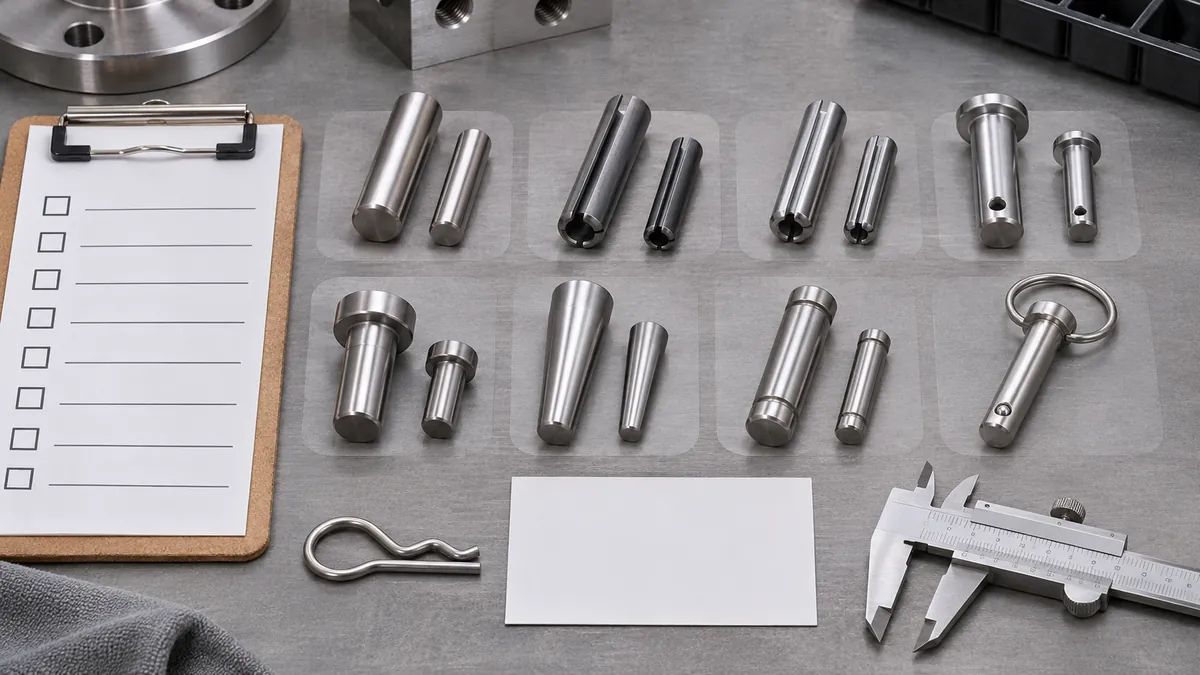
Common mistakes when sourcing pins
- Treating “pin” as a complete part description. Add construction, function, host, dimensions and retention.
- Choosing by diameter alone. Length, shoulder, slot, groove, material, tolerance and fit may differ.
- Confusing solid and spring pins. Their construction and host interaction are not automatically interchangeable.
- Calling every pin a pivot. A locating or assembly pin may be fixed rather than intended to rotate.
- Ignoring the separate retainer. A cotter or clip can be a distinct purchased item and assembly requirement.
- Assuming a groove or knurl proves permanent retention. Verify the exact product and host interface.
- Approving a substitution from a photo. Review the drawing, part number and maker evidence.
- Leaving motion and service access undefined. A non-removable joint and a field-serviceable joint have different requirements.
- Inferring load or fatigue from a catalog family name. Use data for the exact part and application.
- Failing to identify who supplies the component. Clarify responsibility for the pin, retainer and inspection evidence.
Häufig gestellte Fragen
Is a dowel pin the same as a pivot pin?
Not necessarily. “Dowel” commonly describes a locating pin family, while “pivot” describes a function in a moving joint. A particular pin may be designed for one or the other, but the drawing and supplier specification should state the intended behavior.
Is a spring pin a solid pin?
No. Slotted and coiled spring pin families have a hollow resilient construction, unlike a solid dowel or straight pin. The exact product and host determine whether a spring pin is suitable; do not assume the families are interchangeable.
Does the pin diameter prove that it will fit?
No. Length, tolerance, host-hole condition, surface features, material, finish, assembly method and retainer arrangement may also matter. Use the controlled drawing and exact supplier part designation.
Is a cotter pin the same as a pivot pin?
They commonly perform different roles. A pivot pin may connect moving members, while a cotter or clip may act as a separate retainer that helps prevent axial movement. The assembly drawing should show which component performs each function.
Can a slotted spring pin replace a dowel pin?
Not without reviewing the application, host, dimensions, installation and intended function. A spring pin and a solid dowel differ in construction and interface behavior. Request a documented supplier proposal and approve the change against the assembly requirement.
How do I specify a pin for a foldable metal frame?
Show the moving and fixed members, joint stack, intended rotation, pin retention, bushing if applicable, dimensions, access and any service requirement. The selected pin and retainer should be reviewed together with the frame drawing.
Does a knurled pin always stay in place?
No universal retention statement applies to every knurled pin and host. The specific knurl, host material, hole, assembly and maker’s instructions determine the interface. Do not assume a generic surface feature proves suitability.
Who should verify pin material or performance?
The responsible component supplier should provide the agreed part identification and documentation; a qualified engineer should review the assembly where its performance requirements demand it. A visual inspection alone cannot prove a hidden grade or rated capability.
Sources and scope
Scope note: This guide introduces mechanical pin families and RFQ questions. It does not provide engineering tolerances, insertion forces, load or fatigue ratings, installation instructions, standards compliance, or a claim that Koitor manufactures or stocks the pins discussed. Use the exact maker’s data and an appropriate engineering review for the assembly.
Review a pin interface for a hardware assembly
Share the current drawing or sample, the pin and retainer references, the host material, and the intended locating or pivot role. Koitor can discuss the surrounding custom metal hardware project within its confirmed scope.
OEM / EIGENE MARKE
Verwandeln Sie diesen Beschaffungsleitfaden in ein Produktdossier
Teilen Sie uns Ihr Zielprodukt, die Größe, die Oberflächenausführung, die Bestellmenge und Ihre Verpackungsanforderungen mit. Ihr Team erhält vor der Angebotserstellung eine praxisorientierte Prüfung der Herstellbarkeit.


 English
 Español
 Português
 Français
 Deutsch
 العربية