

A wall mounted retractable clothesline should be specified as a complete mechanism and mounting system, not just as a housing with a cord. The buyer needs to define line configuration, usable span, lock and receiver, operating sequence, mounting pattern, supplied hardware, and intended environment. A sample can confirm whether the named components fit and operate as agreed, but it does not by itself establish a safe load, wall-anchor suitability, cycle life, corrosion performance, or warranty. Those claims need model-specific evidence and a clear test owner.
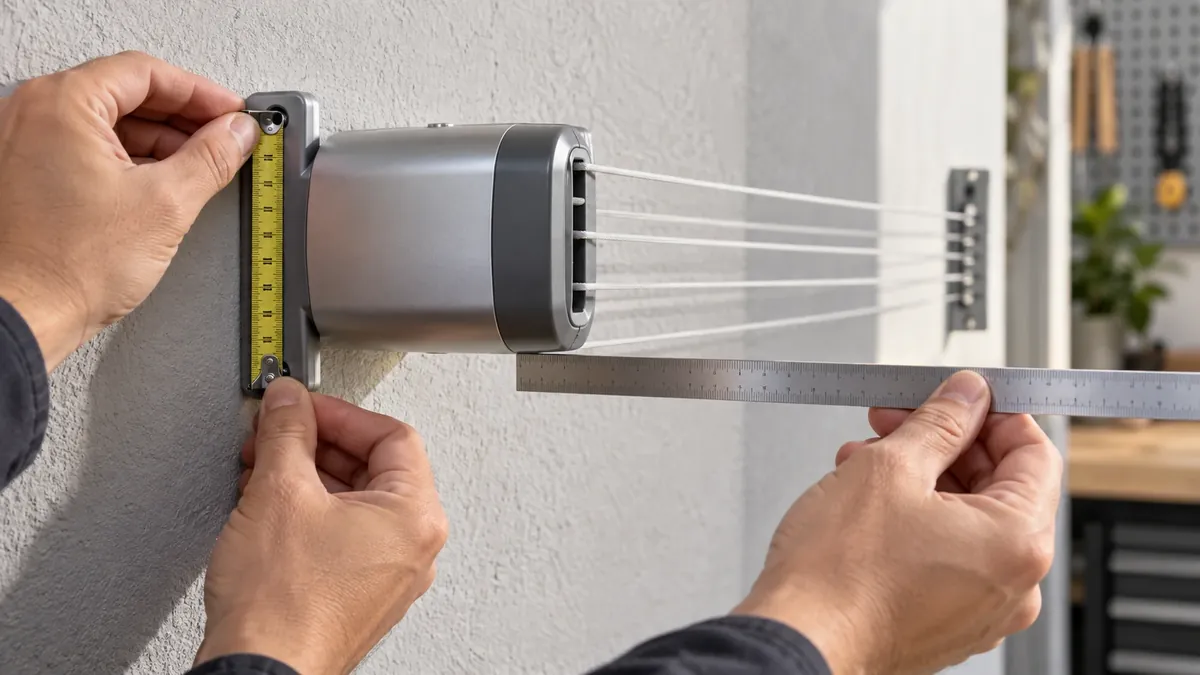
Identify the product architecture
Retractable clotheslines come in different architectures. A compact single-cord spring reel may extend to one receiver on an opposing wall. Other systems use several lines or a larger enclosure with different tension and support arrangements. Their parts, installation assumptions, span, operation, and carton contents may not be comparable. A buyer should select the product format before comparing supplier quotations.
Draw the complete installation. Show the housing, cord or lines, receiver, wall surfaces, mounting locations, expected span, and any user-operated lock. If the product is intended for indoor use, outdoor use, or both, state that clearly. Exposure, moisture, sunlight, temperature, and cleaning conditions can affect the material and finish requirements, but should not be reduced to a generic “indoor/outdoor” label without evidence.
The supplier brief should identify which components are included:
- Main housing and internal reel.
- Cord or multiple lines.
- Receiver, hook, or tensioning post.
- Lock, release, or retraction control.
- Mounting brackets, screws, anchors, or templates.
- Protective caps, end pieces, or other accessories.
- User instructions and installation hardware.
Some items may be purchased from another supplier. List who supplies, assembles, and verifies each part. A product photo can show accessories that are not included in a particular package, so confirm the actual bill of materials and carton contents.
Define the intended span and line arrangement
Usable span should be specified between the planned housing and receiver positions, not inferred from a marketing phrase such as “long reach.” Measure the intended wall distance and identify whether the cord needs to pass around a corner, across a doorway, or between different surfaces. If the project serves several room layouts, state the range and the assumptions for each.
Line count also changes the use case. A single line may serve a few garments; multiple parallel lines may support a different arrangement. Do not treat more lines as automatically greater capacity. The result depends on line material, tensioning mechanism, support points, mounting, and the buyer’s load requirement. Any capacity statement should be tied to the exact model and a defined test.
Clarify whether the span is adjustable and how the line is secured at the far end. Does the receiver engage with a hook, slot, clip, or another interface? How does the user release it and retract the cord? Is the line intended to stay extended or be returned after each use? These details affect both sample approval and instructions.
Avoid assuming a line remains taut under every installation. Line deflection can depend on cord length, tension, load distribution, anchor spacing, and temperature. If a “no sag” or tension claim is required, the buyer must define the load and measurement conditions and obtain supporting evidence. A short bench demonstration is not equivalent to a long-span installation with wet garments.
| Review point | Buyer input | Sample acceptance check |
|---|---|---|
| Intended use | Location, assortment, and operating context | Verify fit against the stated use |
| Product interface | Reference dimensions and connected components | Compare with the controlled drawing and sample |
| Order release | Finish, packaging, and approved revision | Record the accepted configuration before production |
Specify lock, release, and controlled return
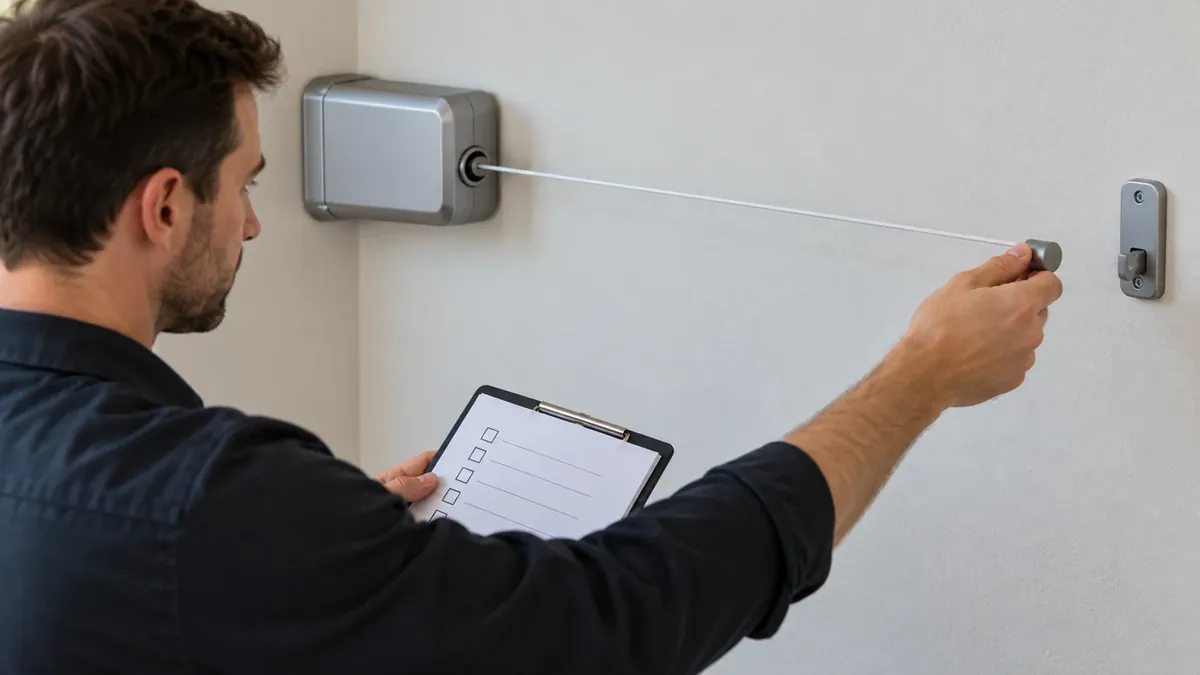
The operating sequence should be documented step by step. The user may pull the line from the housing, attach it to the receiver, engage a lock, and later release it. The exact operation varies by model. The buyer should not use generic instructions for a different mechanism.
During a sample review, check:
- Whether the line extends to the intended length without binding.
- Whether the lock engages and releases as the supplier describes.
- Whether the receiver holds the line in the named configuration.
- Whether release causes a controlled return under the agreed procedure.
- Whether the line retracts fully and seats within the housing.
- Whether normal operation exposes a pinch, snag, or abrasion point.
Record the sample model, line, receiver, and installation arrangement. A mechanism may behave differently when mounted than when held in the hand. Test the housing on a representative surface or fixture and use the actual receiver position and span. Do not instruct users to release a tensioned line without a verified operating procedure; sudden return could damage the product or create a user hazard. The supplier’s instructions and any applicable safety review should govern.
If the product includes a spring reel, identify who makes it and how it is inspected. Koitor’s current production of retractable clotheslines, spring reels, cords, locks, and outdoor post kits is unconfirmed. An importer should verify the full mechanism supply chain and not assume that a metal housing supplier controls every internal component.
Treat mounting as a separate design interface
Mounting is not simply a set of screws. The housing and receiver may be installed on different wall materials, and the actual fastening requirement depends on the substrate, hardware, product geometry, and expected use. Do not transfer a fixing recommendation from one wall type to another or give a universal DIY installation instruction.
Ask the supplier to provide the mounting pattern, bracket dimensions, hole sizes, fastener specification, and installation sequence. Clarify whether fasteners are included and what material or wall condition they are intended for. If a template is supplied, confirm that it matches the production part and identifies the correct orientation. If the installation requires a specific structural support or professional installer, that should be confirmed by the product owner and communicated accurately.
A sample fit review can assess whether the housing and receiver align on the planned surfaces and whether the screws or fasteners can be reached with the intended tools. It cannot prove that a wall anchor is suitable for every building material. The importer should identify who owns the substrate and fixing validation: product supplier, installer, building professional, or another responsible party.
Check the installed path for obstacles. Doors, cabinets, taps, windows, radiators, and walkways can affect placement. Consider whether a user can extend the line without contacting nearby objects and whether the line crosses an area where people may walk. These are placement questions for the named installation, not universal product guarantees.
Review materials and finish by component
The housing, bracket, cord, receiver, spring, and fasteners may use different materials. Identify each in the component list. Do not assume a metal exterior means the line, spring, or fastener has the same material or finish. For every part, state the buyer’s requirement or ask the supplier to propose an option for review.
For metal surfaces, inspect cut edges, bends, welds, finish coverage, and contact points. The sample should use the intended production-representative finish if appearance or corrosion is part of the approval. A preliminary bare-metal sample can help verify geometry but cannot represent final coating thickness, color, or surface condition.
If the product is intended for a humid room or outdoor setting, specify the environment and the evidence required. Avoid generic “rustproof” or “weatherproof” language without supporting documentation. If a corrosion test is required, identify the method, sample preparation, duration, and acceptance criteria. A test result for one component does not automatically establish service life for the assembled product.
Cord or line wear is a distinct issue from housing finish. The buyer should identify the line material, diameter or width, end attachment, and any replacement or spare-parts policy. If the cord is replaceable, clarify whether the user or service provider can replace it, which components are included, and how replacements are identified. Do not promise a cycle count or long service life without a defined test.
Define a meaningful sample test
The sample plan should use the intended housing, line, receiver, lock, mounting components, and operating instructions. Name the installation surface or test fixture, span, line count, and operating sequence. If the supplier submits a sample with substitute parts, record the deviation and decide whether it is suitable for the intended approval.
The review can include:
- Dimensional inspection of housing and receiver mounting patterns.
- Extension and retraction through the agreed operating sequence.
- Lock and release operation.
- Receiver engagement and line alignment.
- Visible wear, fraying, snagging, or damage after the agreed repetitions.
- Fit of supplied fasteners and installation template.
- Packaging completeness and instructions.
- Review of any required model-specific test evidence.
Use observable findings and avoid inventing pass/fail numbers. For example, “The receiver did not engage at the stated span when mounted at the approved mark” is actionable. “The line feels weak” is not a repeatable acceptance criterion. If a numeric force, load, or cycle requirement matters, define the method with the responsible engineer or test provider before approving the production specification.
A sample check cannot prove every wall installation or lifetime condition. Make clear which aspects were checked and which remain the responsibility of the buyer, supplier, installer, or testing organization. A visually correct sample may still require a separate safety or durability evaluation.
Compare supplier quotes on equal scope
A quotation comparison should include the exact model, line configuration, usable span, finish, mounting kit, packaging, and sample basis. Ask whether the quoted unit includes the receiver, fasteners, template, instructions, and any spare line. Confirm whether the sample uses production components or temporary substitutes.
Request quantity tiers on the same SKU and define whether multiple finishes or line lengths count as separate variants. Clarify tooling, sample charges, replacement parts, production lead-time basis, and quote validity. If one supplier quotes a housing only and another quotes a full mechanism set, the prices do not represent equivalent products.
Ask suppliers to identify subcontracted or purchased parts and the party responsible for their quality. A metal manufacturer may form the housing or bracket while buying the reel and line from another source. That arrangement is not inherently a problem, but it should be visible in the project scope.
Specify how the wall mounted retractable clothesline sample will be measured, installed, and approved before production release.
Record how the wall mounted retractable clothesline will be checked against the approved drawing, reference item, and sample acceptance criteria.
What to include in an RFQ
A useful RFQ should include:
- Intended setting and environment.
- Line architecture and number of lines.
- Target span and receiver position.
- Operating sequence and lock/release behavior.
- Housing, bracket, and receiver dimensions.
- Mounting pattern and substrate assumptions.
- Included fasteners, anchors, template, and instructions.
- Material, finish, cord, and replacement-part requirements.
- Packaging, labels, and SKU/model identification.
- Sample configuration and evaluation criteria.
- Any separate load, cycle, corrosion, or safety evidence requested.
If the buyer has not settled on a technical requirement, ask the supplier to state options and assumptions rather than allowing an ambiguous term to become a promise. Keep alternatives separate in the quotation so design choices and cost implications remain clear.
Approve revisions and pack-out details
An approved sample should be linked to its drawing, component list, operating instructions, and packaging revision. Changes to cord material, reel, lock, receiver, bracket, fasteners, or finish can affect operation and fit. Require supplier notification and approval before substitutions that alter the validated configuration.
Inspect the retail package for the complete kit. Confirm that the receiver and fasteners are present, the template is readable, the instructions match the supplied mechanism, and model labels are correct. If several span or line variants share similar packaging, differentiate them clearly. A pack-out check does not replace a product test but helps ensure the buyer receives the approved configuration.
Sourcing takeaway
A retractable clothesline is a system of moving and mounting parts. Importers should define the span and line architecture, identify the lock and receiver, specify the mounting interface, verify every supplied component, and approve the complete sample using agreed conditions. Keep claims about load, sag, cycle life, corrosion, wall compatibility, and safety tied to model-specific evidence.
For adjacent metal home-storage product sourcing, review Koitor’s OEM home-storage hardware information and confirm the exact product, mechanism, components, finish, and supply responsibilities directly with the factory.
Discuss Your Wall-Mounted Retractable Clotheslines Specification
OEM / EIGENE MARKE
Verwandeln Sie diesen Beschaffungsleitfaden in ein Produktdossier
Teilen Sie uns Ihr Zielprodukt, die Größe, die Oberflächenausführung, die Bestellmenge und Ihre Verpackungsanforderungen mit. Ihr Team erhält vor der Angebotserstellung eine praxisorientierte Prüfung der Herstellbarkeit.


 English
 Español
 Português
 Français
 Deutsch
 العربية