

Dish drying rack rubber foot pad specification work should freeze fit, hardness method, and scratch protection before the first freestanding rack is photographed on a counter. Importers who leave the feet as a “black rubber tip” note often discover missing pads in transit, scratched stone, or a replacement foot that will not stay on the wire.
This page is written for a freestanding metal dish drying rack whose feet sit on the counter at the wire or tube ends. It does not own a removable utensil cylinder, and it does not own plate-support tip caps on the tines. Those are different parts and should stay in their own files, even when they ship in the same carton.
Hardness, if you need a number, should be written as a project band with a stated method family such as ASTM D2240, not as a Koitor catalog proof value. This article does not publish a factory Shore figure. Retention, color, and a spare-foot plan belong in the same specification as the hardness band.
What should a foot-pad specification actually freeze?
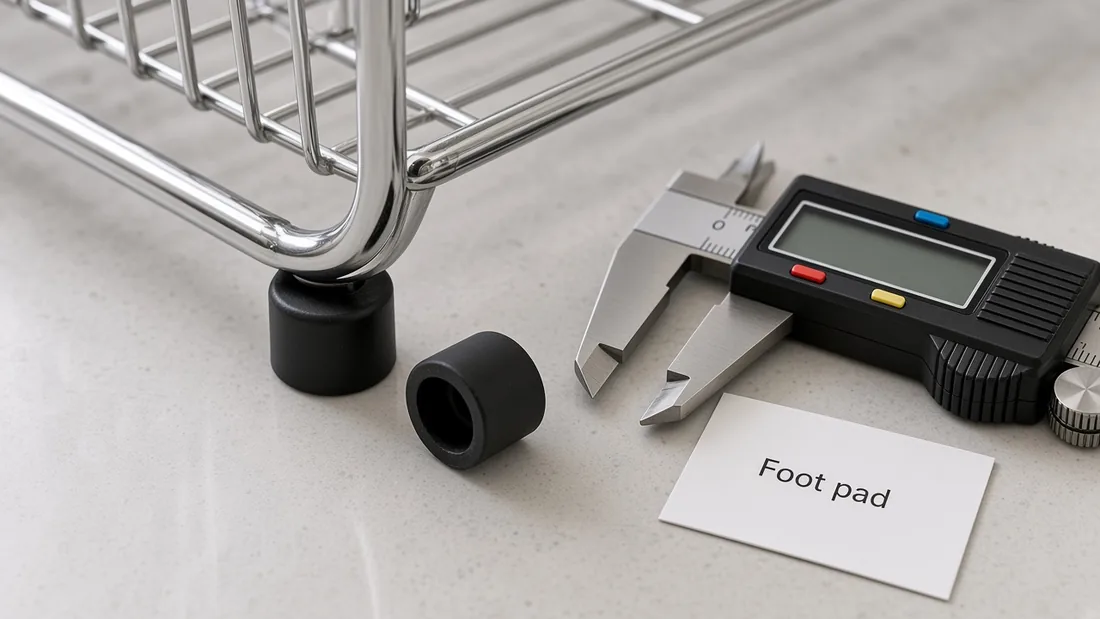
Fit comes first. For a press-on foot, freeze the wire or tube end geometry and the pad’s inner size and depth so the foot seats fully and does not spin off in a packed carton. For a molded or bonded foot, freeze the bond area and the end preparation. A sketch that only says “add rubber feet” is not a specification.
Scratch protection is a counter-surface question. A foot that is too hard, or that has a flash ridge, can mark a soft stone or a coated counter. A foot that is too soft, or that bleeds color when wet, can leave a dark ring. Trial the agreed foot on the counter family the listing shows, with a wet and a dry stand, and record what you see. Do not invent a universal “will not scratch” line.
Shore hardness for rubber hardware pads explains the method family. Use it to say how hardness will be measured, then write the band as a project agreement. Rubber compression set on mounting pads is the neighbor for permanent flattening. A dish-rack foot that sits under a wet load can take a set; point to that method rather than writing a new compression essay here.
Kitchen sink dish-rack drainage design still matters for the rack body, but drainage slots do not replace feet. Feet can stand in a puddle at the sink edge. If the program needs chemical or detergent caveats, write them as conditions, not as a claim that the compound is safe in every cleaner.
How should buyers trial retention, hardness, and counter contact?
Retention trials should include a pull or peel method you write down, and a packed-carton shake or ship trial, because many feet are lost before the rack reaches a kitchen. Pull-off on a bench and missing feet after transit are related, but they are not the same test. Record both, and keep the methods separate from any sampling-plan numbers.
Hardness trials should use the agreed method family and a stated specimen or foot face. Do not read a number off an unrelated gauge in a photograph and treat it as the specification. If a first-article photo shows a hardness gauge, ignore any readable digits unless they were taken under the written method and recorded in the file.
Counter trials should use the surfaces in the listing: stone, laminate, stainless, or a coated wood look. Wet the foot, stand the empty rack and then a typically loaded rack, wait the agreed time, and look for marks, rings, and slip. Slip resistance is also a project result, not a published Koitor coefficient.
| Control | What to freeze | Usual failure if left vague | Trial to run |
|---|---|---|---|
| Fit and retention | Wire or tube end size, pad inner size and depth, or bond area | Feet spin off in the carton or sit crooked on the counter | Seat check, pull or peel method, packed-carton trial |
| Hardness band | A project band and ASTM D2240 or another agreed method family | A verbal ‘soft rubber’ that changes by lot and by supplier | Method on a stated specimen; no invented catalog Shore proof |
| Counter contact | Foot face, flash ridge limit, and the counter family in the listing | Scratches, dark rings, or a shiny hard spot on stone | Wet and dry stand on the listed surfaces |
| Compression and flattening | A pointer to the compression-set method and an allowed sit time | Feet go permanent flat and the rack rocks | Sit trial plus the neighbor compression method if a number is required |
| Color and staining | Foot color and a wet-ring check | Black rings on a light stone, or a color mismatch in a later lot | Wet stand and a retained color standard |
| Spares and count | How many feet per rack, whether spares ship in the kit, and the spare identity | A missing foot scraps a good rack, or a spare from another SKU will not fit | Kit count and a spare fit check on the retained end geometry |
What should first-article and pack checks include?
First-article racks should arrive with all feet seated, a close-up of a seated foot on the end geometry, and the hardness and counter-trial notes if those were required. A lifestyle photo of a rack at a sink does not show whether the pad is fully on the wire or whether a ridge is present.
Pack checks should confirm that feet are present after the carton is handled, and that a spare, if promised, is in its bag. Do not pack loose spare feet where they can be mistaken for debris and discarded. If the rack is nested, check that a wire from the upper unit cannot hook a foot off the lower unit.
Replacement feet sold later must match the end geometry and the color standard. Aftermarket listings are a demand signal that feet get lost; they are not a Koitor specification. If your program will offer spares, keep a retained end or a gauge, as you would for any other wearing part.
What the factory can control, and what stays a project agreement
A factory can build or buy feet to a stated fit, apply them consistently, pack them so they stay on, and supply spares when the order asks for them. Custom kitchen storage rack manufacturing can also keep a retained foot and a retained rack end as the standard for later lots.
The factory cannot honestly publish a universal Shore number, a never-scratch claim, or a chemical-proof statement for every cleaner. Koitor can review foot-pad fit and construction as a family-owned China OEM manufacturer of bathroom and home-storage metal hardware; the buyer still has to freeze the band, the counter trial, and the spare plan for the program.
Incoming inspection should count feet, check seat, and compare color and face condition with the retained standard. Keep those methods out of the same sentence as a sampling plan. If a hardness check is in the program, use the written method, not a casual thumb press.
For quotation, send the wire or tube end size, the preferred pad family, the counter surfaces in the listing, and whether spare feet ship in the kit. MOQ, sample timing, and lead time remain project-specific under careful approved wording.
Buyer checklist for dish drying rack rubber foot pad specification
Use this list before the rack is photographed on a counter and before bulk pack is frozen.
- State that this file covers freestanding dish-rack feet only, not utensil cylinders and not plate-support tip caps.
- Freeze the end geometry and the pad inner size, depth, or bond area.
- Write a hardness band only as a project agreement, with a method family such as ASTM D2240.
- Trial retention on the bench and in the packed carton, as two methods.
- Trial wet and dry stands on the counter surfaces shown in the listing.
- Limit flash ridges and other face defects that can mark a counter.
- Check color and wet rings against a retained standard.
- Point flattening questions to the compression-set method rather than inventing a new essay.
- Count the feet, and decide whether spares ship in the kit and how they are bagged.
- Keep measurement methods and any sampling plan in separate clauses.
- Write chemical or detergent caveats as conditions, not as a blanket safe-cleaner claim.
- Keep a retained foot and a retained rack end for later spare lots.
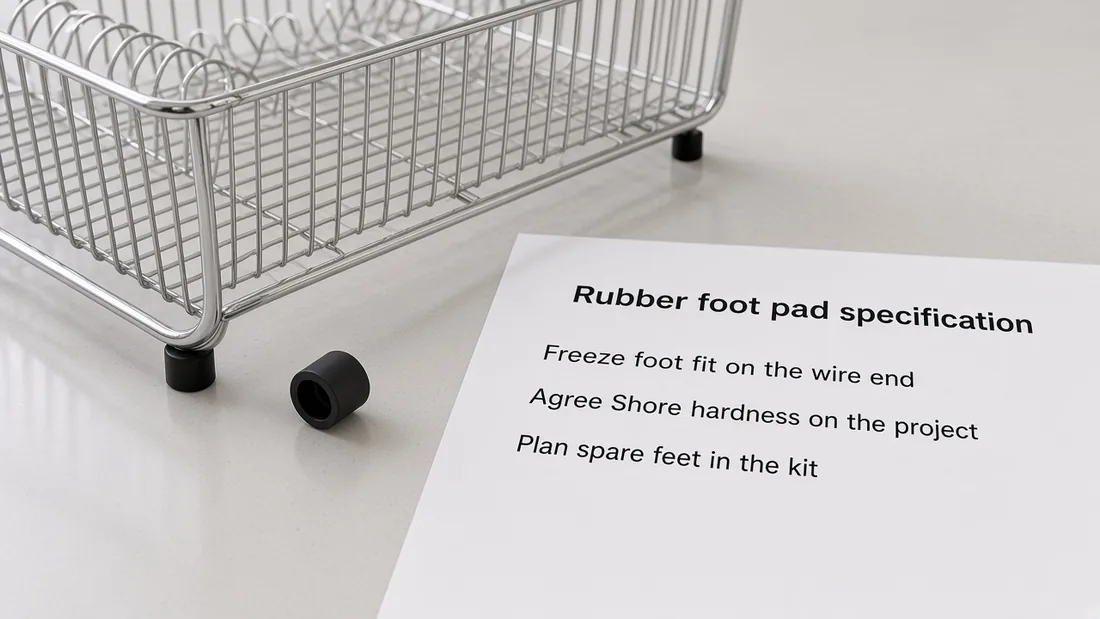
Wire-end burrs under a press-on foot will cut the inner wall and the foot will loosen later. Dress the end before the pad goes on, and check a cut-open foot on a first article if the program has had early drop-offs. A pretty outer face can hide a cut inside.
Tube ends can hide water if the foot seals the tube like a cap. If the tube is open, say whether the foot must vent or whether the tube end is closed before the foot is applied. This is not a drainage-design rewrite; it is a foot-and-end interface note so trapped water is not a surprise.
Color families sometimes get a grey or clear foot on a chrome rack and a black foot on a matte rack. Write the colorway map. A later ‘all black’ substitution will show in lifestyle photos and in a kitchen with a light stone.
Oil from food and some dish soaps can swell or glaze a compound. If the listing shows the rack at a sink, include a conditional cleaner note and a soak trial only when the program asks for one. Do not print a food-safe or FDA line unless the project has evidence you are willing to stand behind.
A rocking rack is often one short foot or one missing foot, not a bent frame. Incoming checks should stand the empty rack on a flat plate and look for rock before arguing about wire welding. The foot is part of the stance.
Nested packing is efficient and hostile to press-on feet. If two racks nest, add a separator or a bag rule that keeps a wire from peeling a neighbor’s pad. A ship trial of the nested pack is worth more than a single-unit drop test for this defect.
Do not specify a furniture-pad SKU from a hardware store as the production part unless the fit has been trialled on the actual wire end. Generic pads are a temporary field fix, not a frozen OEM foot.
Plate-support caps on tines protect dishes, not counters. If a drawing shows caps on tines and feet on the base, list them as two lines with two geometries. Mixing the calls will send the wrong spare to a customer who only lost a foot.
Utensil cylinders have their own seat and drain rules on a sibling page in this batch. A cylinder foot or a cylinder base pad, if one exists, is not this counter foot. Keep the language clean so a kit list cannot confuse the two.
When the end geometry, the pad fit, the hardness method, the counter trial, the pack retention, and the spare plan are written, dish drying rack rubber foot pad specification work is ready to quote. If the file only says “rubber feet included,” the first carton of missing or hard pads is already scheduled.
Lot changes of compound, color masterbatch, or a new foot tool should reopen the first-article photos of the seated foot and the counter trial. A new foot can look the same in a bag and still sit high or mark a stone.
Retail copy should follow the trial. “Non-slip, never scratch” is two claims that need methods and results, or they should stay out of the listing. “Rubber feet to help protect counters” is closer to what a trial can support when the results are on file.
Foot shape is part of stance. A narrow bullet foot can look neat and still rock on a grouted stone. A wider face spreads the load and can hide a slightly short wire end. Freeze the outer face, not only the inner hole, and trial it on a slightly uneven board as well as on a true plate if the listing shows a natural stone.
Height balance across four or six feet should be written as a stance check, not as a single foot-height number in isolation. One long foot at a corner will rock the rack and will also take more wear. Measure or compare all feet on the same first-article unit, then stand the rack.
Adhesive-backed generic pads are a field repair, not a substitute for a press-on or molded OEM foot, unless the program has trialled that adhesive on the actual end and on a wet sink edge. Water finds an open tube end and lifts a sticker pad. Do not add adhesive language to the specification unless that path is truly the design.
Temperature at a window or near a dryer vent can change how a soft foot feels and how easily it peels. If the rack will be stored on a balcony in some markets, say so and include a simple warm-and-cold handling check in the project file. Do not invent a service-temperature rating here.
Recycled or mixed-lot compound can shift smell, color, and hardness together. If a new lot smells strongly in the carton, open a review before the rack sits on a light stone. Smell is not a specification by itself, but it is a reason to re-run color and hardness checks.
Workers applying press-on feet need a positive seat cue: a shoulder, a mark, or a depth that can be seen from the side. A foot left half-on will look complete in a top photo and will come off in the first week. Incoming photos should include a side view of at least one foot per unit in the check sample.
Carton crush can oval a tube end and loosen a cap-style foot. Corner protection for the rack is also protection for the feet. A crush trial should inspect the feet, not only the wire grid.
Retail returns of “scratched counter” should ask which surface and whether a ridge or a grit was present on the foot. A stone-chip in the pad face will scratch even a well-chosen compound. The claim packet and this specification meet at that close-up of the foot face.
If the rack is sold with a draining board, the feet still belong to the rack, and the board has its own pads or ribs. Do not let one pad specification cover both products. Write two short lines if both touch the counter.
A second source for the same foot must pass the same fit gauge and the same color standard. A cheaper foot with a thicker wall can sit high and rock the rack. Approve the second source as a new first article, not as a silent purchase-order swap.
Education for the listing can mention that feet are replaceable when that is true, and can show where a spare is packed. It should not invite users to fit any hardware-store cap. The wrong inner size will split or fall off and will then be blamed on the rack.
Keep a simple application work aid at the line if seat depth is hard to see: a side gauge or a painted witness on a sample end. Guessing by thumb will scatter half-seated feet through a lot.
When a later colorway is added, repeat the counter-ring trial even if the fit gauge is unchanged. A new masterbatch can mark a light stone even when the inner hole is the same as the first approved colorway lot. Repeat the wet-ring check before the new color ships.
Frequently asked questions
Is there a single Shore value Koitor can publish for all dish-rack feet?
No. Write a project band and a method family such as ASTM D2240. This page does not offer a factory proof number.
Do missing feet in the carton mean the fit is wrong?
Often the pack or the nest is peeling them off, not only a loose fit. Run both a bench retention trial and a packed-carton trial.
Are plate-support tip caps the same part as these feet?
No. Tip caps sit on tines to protect dishes. These feet sit on the base to protect the counter. Freeze them as two lines.
Can a buyer claim the feet will never scratch any counter?
Only if the program has a method and a result on the surfaces you sell against, and you are willing to stand behind it. Most programs do better with a trial record and careful listing words.
Should spare feet ship in every carton?
That is a program choice. If they do, bag them, identify them, and confirm they fit the retained end geometry.
Can one foot height number replace a stance check?
No. Compare all feet on the same unit and stand the rack. One long corner foot will rock even if each pad is “in tolerance” when measured alone.
Should a draining board use this same foot specification?
No. If the board also touches the counter, write a separate pad or rib line. This file is the rack’s freestanding feet.
What should a first sample include?
A complete rack with all feet seated, a close-up of the foot on the end, the pack as it will ship, and any hardness or counter-trial notes you asked for. A sink lifestyle photo is not enough.
Work With Koitor Hardware
Need a dish-rack foot pad quoted to a fit and trial plan?
Send Koitor the wire or tube end size, preferred pad family, and whether spare feet ship in the kit. Our team can review the freestanding rack construction and small-batch OEM options before quotation.
OEM / PRIVATE LABEL
Turn this sourcing guide into a product brief
Share your target product, size, finish, order quantity and packaging requirements. Your team receives a practical manufacturability review before quotation.
 English
 Español
 Português
 Français
 Deutsch
 العربية