

Freight prepaid vs freight collect identifies who is billed for freight under a stated shipping arrangement: prepaid commonly assigns the freight bill to the shipper, while collect commonly assigns it to the consignee or receiver. The label does not, by itself, identify every charge included, prove that an invoice has been paid, or determine ownership or cargo risk. Importers should confirm both the named billed party and the charge scope with the carrier or forwarder for the actual shipment.
What do freight prepaid and freight collect mean?
In common freight terminology, “prepaid” names the shipper or consignor as the party responsible for the freight bill, while “collect” names the consignee or receiver. These are billing instructions or arrangements. They do not answer every commercial question between the buyer and seller. In particular, a freight-billing label should not be treated as a substitute for the sales contract, payment terms, or delivery term agreed by the parties.
A buyer can be responsible for paying a freight charge even when the shipment is described as prepaid, depending on the parties’ commercial arrangement and reimbursement terms. Conversely, “collect” does not mean cash-on-delivery in every context. The party named for the carrier’s or forwarder’s charge is not necessarily the same as the party that ultimately bears all economic costs under the buyer-seller contract. Record the document-level billing instruction and the commercial agreement separately.
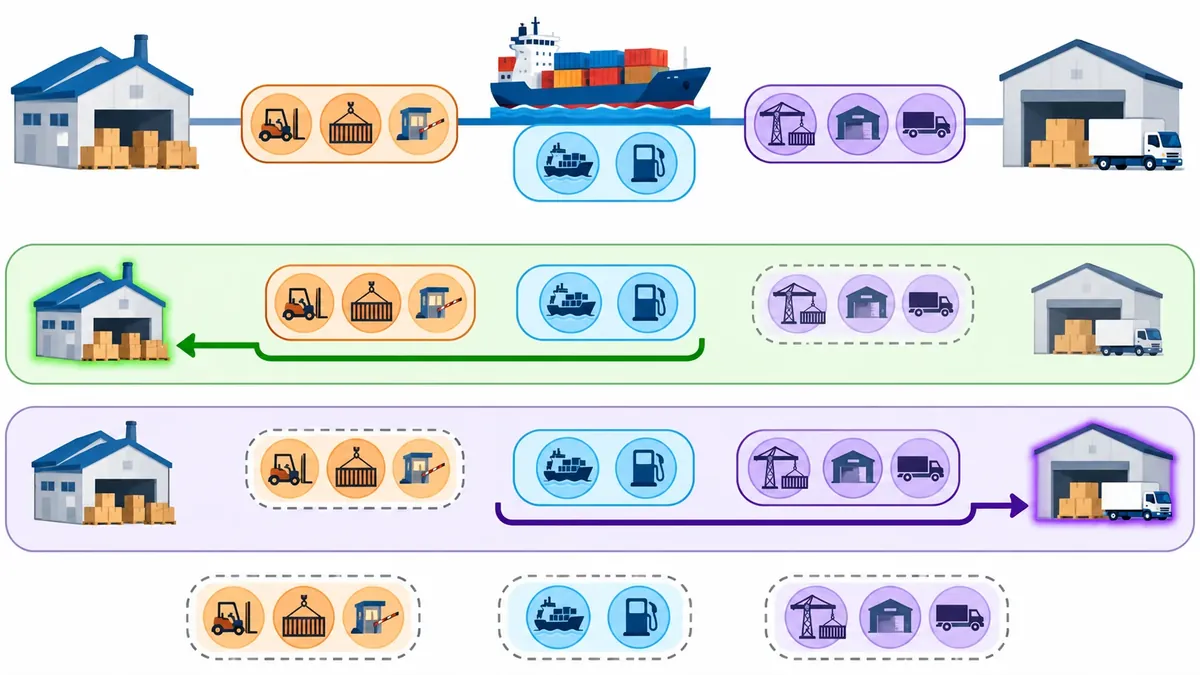
The second part of the question is scope. “Freight” can refer to a main carriage charge, but a shipment can also have origin and destination charge lines. A short prepaid/collect label may not place every one of those lines with the same party. The carrier or forwarder may distinguish standard prepaid instructions from an option that explicitly includes destination charges. The exact language, route and provider matter.
A shipment record should therefore answer two separate questions:
- Who is named to be billed? Identify the shipper, consignee, forwarder, NVOCC or other party shown in the actual instruction.
- Which charge lines are covered? Identify origin charges, main freight and destination charges, and record any exclusions or separate arrangements.
The same separation applies when the buyer is importing bathroom hardware. The buyer may have an ocean freight invoice, destination handling charges, local delivery and customs-related services from different providers. A label on the ocean document cannot automatically settle how each other supplier bills those services. Ask who issued each charge and what agreement or quotation covers it.
Which charges may be included?
For a transport comparison, it is useful to group charges by stage rather than assume one label includes them all. An origin group may include services performed before the main carriage. Main freight refers to the line-haul or ocean freight charge described by the provider. Destination charges arise at or after arrival and may be billed under separate instructions. The exact charge categories and names depend on the provider and route. This article does not define a universal tariff or list every possible fee.
A specific carrier example illustrates why the detail matters. Maersk’s U.S. export instructions distinguish a FreightPrepaid option from an ALLFreightPrepaid option and show that origin and ocean charges can be grouped differently from destination charges. The carrier also provides collect alternatives that distinguish charge groups. This is a named carrier and route example; it should not be converted into a rule for every carrier, forwarder, port, country or China-to-U.S. shipment.
| Charge group | Billing question | Qué grabar |
|---|---|---|
| Origin charges | Who is billed for services before the main carriage? | Charge description, named payer and provider quotation or instruction |
| Main freight | Who is billed for the principal transport movement? | Freight payer label, route, carrier/forwarder and reference |
| Destination charges | Who is billed for charges at or after destination? | Whether the line is included, separately billed or assigned under a specific option |
| Other services | Are customs, local delivery, storage or handling included? | Responsible provider, service scope and separate terms |
A charge matrix prevents one word from replacing a line-level agreement. If a quotation says “prepaid,” ask whether destination charges are included or will appear on another bill. If an invoice later shows a destination line, compare it with the exact option selected, the provider’s instructions and the shipment quotation. Do not assume the line is incorrect or included without checking the applicable documents.
The party named on a bill can also differ from the party who arranged transport. A forwarder may book a movement at the shipper’s request, while a different party appears as the billed account for one charge group. That does not automatically change ownership, delivery responsibility or who has authority to give instructions. Confirm these distinct issues under the governing sales and transport documents.
How should a buyer read a billing instruction?
Read the actual instruction as a combination of named party, charge group, issuing provider, route and shipment reference. A concise label is only one field. The buyer should also identify whether the instruction appears on the carrier booking, forwarder quotation, bill of lading, invoice, or another record. The same phrase can be used differently across a provider’s forms or service options, so the document source is part of its meaning.
A useful charge-scope map separates each cost group into a row and each responsible party into a column. For a fictional import, a buyer might see a provider option labeled FreightPrepaid and another labeled ALLFreightPrepaid. The first may, in that provider’s stated U.S. export example, assign origin and ocean charges differently from destination charges. The second expressly includes a wider group. This example teaches the buyer to ask a scope question; it does not prescribe the right option for another route.
Record the shipment’s actual names and terms:
- Shipper/consignor named for the charge.
- Consignee/receiver named for the charge.
- Carrier or forwarder that issued the instruction.
- Origin, main-freight and destination charge categories.
- Whether the provider quotation uses an all-in, prepaid, collect or other service label.
- Charges excluded from the quotation or billed by another provider.
- Booking, bill or shipment reference linking the instruction to the cargo.
- Date and source of the provider’s confirmation.
This is especially helpful for a mixed-SKU shipment of towel racks, shower baskets or metal storage hardware. The product invoice, packing list, freight quotation and transport bill have separate roles. Keep the product price and quantity in the commercial record. Keep each freight and handling charge in the responsible logistics provider’s record. Link them using the shipment reference rather than combining them into one ambiguous “shipping cost” field.
Does prepaid mean the freight has already been paid?
Not necessarily. “Prepaid” can identify which party is billed or responsible under the shipment instruction. It does not prove that an invoice has been settled, that a payment cleared, or that no balance remains. The buyer should check the invoice or account statement from the provider and the actual payment record. Keep the label on the transport instruction separate from the payment status in accounting records.
Likewise, “collect” should not be read as a universal cash-at-delivery requirement. It commonly indicates the consignee or receiver as the party billed for freight in the relevant arrangement. The carrier or forwarder can explain when and how it invoices that party. A buyer should not assume that the consignee pays a particular person at the port gate, that cargo must be released only after a specific payment, or that the seller has no financial role in the contract.
The distinction also does not determine ownership or risk of loss between the buyer and seller. Those issues may be addressed in the sales contract and applicable delivery term. A logistics invoice answers a billing question within its scope; it does not rewrite the sales agreement. For the separate delivery-term allocation question, see the existing guide to FCA versus FOB for containerized cargo. Do not infer that a prepaid freight label proves the seller bears all transport risk or that collect proves the buyer assumes it.
A worked payer-by-charge-scope example
For a freight prepaid vs freight collect comparison, imagine a buyer reviewing two written options for the same shipment. Option A identifies the shipper as billed for origin and main freight, while destination charges are listed separately for the consignee. Option B names a broader prepaid service that includes specified destination charges. These descriptions are fictional examples for explaining the comparison method; they are not a carrier quotation, price estimate or recommended booking. The buyer should use the exact provider wording and line items on the actual route.
The comparison begins by copying each quote’s included services into a shared table. The origin row should show whether the buyer, seller or another account is named. The main-freight row should record the carrier or forwarder reference. The destination row should indicate whether the charge is included in the quoted service, assigned separately, or not stated. If customs brokerage, terminal handling, storage or final delivery appears, it should have a separate row and an identified provider. A bundled amount can remain bundled if the supplier does not provide a breakdown, but the comparison should label it that way.
Next, the buyer identifies the commercial arrangement with the seller. The freight instruction may name a billing party, while the purchase contract may allocate economic responsibility differently. A seller could quote a product price that includes a freight component, or a buyer could reimburse a cost under a separate agreement. The transport label alone does not resolve that contract. Keep the quote, invoice and sales agreement together and ask the responsible commercial contact about any difference.
Finally, the importer asks the carrier or forwarder to confirm the selected option and named payer before the booking is finalized. A useful written confirmation states the option name, charge groups included, excluded services, invoice recipient and shipment reference. If the provider only confirms that the shipment is “prepaid,” ask whether that word covers destination charges on the actual route. Do not infer the answer from another provider’s example.
This method helps the buyer compare the actual obligation without assuming that a billing label predicts the total cost. If one quote omits a line, mark it “not stated” and obtain an answer. If the provider says a charge is variable, record what determines it or which later document will specify it. If the charges are split between providers, keep the issuer and payee in separate columns. The aim is a traceable comparison that explains what the buyer approved, not a universal formula for freight charges.
A review record can include the quotation date, validity period, currency, origin and destination, cargo scope, named party, included charge groups, exclusions, provider contact and booking reference. When the quote changes, note the revision and check whether the billing instruction changed with it. A route change, service change or newly added destination service may alter the line scope. Preserve the original quote so that a later invoice can be compared with the option that was actually accepted.
For hardware shipments, keep the product-side pack-out information available to the logistics provider when needed: carton count, dimensions, gross weight, palletization and any handling instructions that the supplier has confirmed. Those details help the transport provider scope the shipment. They do not make the hardware factory responsible for a carrier’s tariff or billing option. The buyer should identify which data the supplier supplied and which charges the transport provider confirmed.
The same comparison discipline applies if a supplier changes freight terms late in the order. Ask what changed: the billed party, the included charge group, the service provider, the route, or the price basis. Record the revised instruction and obtain approval from the party that controls the commercial commitment. A message that says “collect instead” may be too short to explain whether only main freight changes or whether other charges also move. The provider’s current written breakdown is the relevant evidence.
For freight prepaid vs freight collect, the buyer should keep the billing instruction separate from title, risk, customs filing and invoice settlement. Those subjects may interact with shipping but are governed by different records and decisions. If a question crosses into one of those areas, refer it to the contract owner, customs broker, bank, legal advisor or provider responsible for the relevant service.
How can importers compare freight quotations?
Do not rank two freight quotations by a single prepaid/collect word. First confirm that both providers quoted the same route, mode, shipment scope, timing assumptions, cargo information and service level. Then compare each charge group and identify the named billed party. A lower quoted main-freight line may exclude destination items that appear elsewhere. An “all-in” label should be accompanied by a defined list of included and excluded services.
A quotation comparison can use a table with one row for each provider and columns for origin charges, main freight, destination charges, local delivery, customs brokerage and any other relevant service. Use the provider’s own line names and preserve the currency and quotation validity period. If a provider bundles multiple items, ask for a breakdown suitable for comparison. Do not invent a charge allocation where the quote is silent; mark it as “not stated” and request written clarification.
A small illustrative example shows why. Provider A quotes a freight line as prepaid and separately lists destination charges as collect. Provider B quotes a wider prepaid option that includes certain destination charges. The two headline prices cannot be compared until the buyer knows which charge lines each includes and which party is billed. Even then, the buyer should compare like for like and confirm any exclusions. This is a comparison framework, not a real tariff or savings estimate.
The buyer should also confirm which entity will issue the invoice and where it will be sent. A line may be billed to an account holder that differs from the buyer named on the commercial order. Ask the provider to identify the billed party and the party responsible for payment under the actual agreement. Do not assume that a shipper name on the bill of lading is the payer for every line.
When communicating with a factory about an order, keep the request within the factory’s role. The supplier can provide accurate carton, package, weight and product information it controls. The importer and logistics provider should confirm the transport booking, charge options and payer information. Koitor should not be presented as a carrier, freight forwarder, customs broker, accounting advisor or guarantor of freight cost. Clear role boundaries help buyers obtain the right confirmation from the party that issues the charge.
Common prepaid and collect mistakes
Assuming one label covers every charge. Origin, main freight and destination items may be allocated differently. Ask for the scope of each line and option.
Equating billed party with ultimate commercial burden. The provider’s invoice instruction and the buyer-seller contract answer related but different questions. Review both records.
Treating prepaid as proof of settlement. A label on a booking or bill does not verify that an invoice has been paid. Check the invoice and payment record.
Treating collect as cash-on-delivery. Collect commonly names the billed consignee or receiver; exact billing and payment timing depend on the provider and agreement.
Inferring ownership or risk from the label. Freight billing does not automatically allocate title or risk between seller and buyer. Check the applicable delivery term and contract separately.
Using one country’s example as a universal rule. A carrier’s instructions for a named origin or route do not prove identical treatment on another lane or under another provider.
Comparing headline prices with different scope. One quote may include destination charges while another lists them separately. Normalize the included services before comparing totals.
Confusing freight with customs or local services. A carrier freight label does not automatically include customs brokerage, destination handling, storage, duties or local delivery. Confirm each provider and service scope.
Asking the wrong party to change the document. The issuer or billing provider controls its own instruction and correction process. Identify that party before requesting an update.
Leaving the payer field blank or ambiguous. A named payer and account reference reduce avoidable clarification. Use the actual party name and provider’s requested contact details.
Buyer checklist before confirming a charge instruction
- Identify the carrier, forwarder or other provider that issued the billing option.
- Record the actual shipper or consignor and consignee or receiver named for freight billing.
- Separate origin charges, main freight, destination charges and other services.
- Ask whether destination charges are included in the selected prepaid option.
- Compare quotations only after the included and excluded services are clear.
- Keep freight billing separate from the product invoice and sales delivery term.
- Verify payment status through an invoice or account record, not the label alone.
- Confirm which provider will invoice the named party and which reference to use.
- Record the booking, bill or shipment reference and date of provider confirmation.
- Ask the responsible provider about route-specific rules or changes before authorizing the booking.

Preguntas frecuentes
What is the difference between freight prepaid and freight collect?
Prepaid commonly identifies the shipper or consignor as the party billed for freight. Collect commonly identifies the consignee or receiver. The actual instruction and charge scope must be confirmed with the provider for the shipment.
Does freight prepaid include destination charges?
Not always. Some carrier options distinguish ordinary prepaid from an all-freight-prepaid option. Check the actual route-specific quotation and whether destination charges are listed separately.
Does freight collect mean the buyer pays cash when the goods arrive?
Not as a universal rule. It commonly identifies the billed consignee or receiver, but invoicing and payment timing depend on the provider’s arrangement.
Does prepaid freight mean the seller bears transport risk?
No such conclusion follows from the billing label alone. The buyer-seller contract and applicable delivery term address separate issues. Ask the appropriate commercial or legal advisor about the transaction.
Can a forwarder and carrier bill different parties?
They may issue different services and instructions at different transport layers. Read each provider’s document and confirm the named account and charge scope rather than assuming a single payer for all services.
How should I compare two quotes?
Compare the same route and service scope. Break out origin, main freight, destination and other lines; identify the billed party and any exclusions; then compare the total on a consistent basis.
What should I give the factory?
Provide accurate order, carton, package and shipment details the factory controls or has agreed to provide. The importer and transport provider should confirm booking instructions, freight payer and charge scope.
Is prepaid/collect the same as Incoterms?
No. The freight-billing label and a sales delivery term answer different questions. Compare the actual instruction and contract separately.
What if the invoice does not match the billing instruction?
Keep the invoice, booking and shipping references together and ask the provider that issued the charge to explain or correct its record. Do not assume the cause or change the bill yourself.
Can I use one provider’s prepaid rules for every shipment?
No. The specific carrier, forwarder, route, account and service option matter. Use current provider instructions for the actual movement.
Sources and scope
The terminology is informed by DHL Freight’s explanation of freight prepaid, Maersk’s U.S. export billing instructions, y ATS’s comparison of prepaid and collect billing. Maersk’s charge-scope example is specific to its stated U.S. export instructions; it is not applied as a universal tariff rule. Ownership, risk, customs, invoice settlement and payment conclusions are outside the supported scope.
This is general freight-billing education, not a route quote or legal, tax, customs, accounting or payment advice. Confirm the current option and charges with the provider responsible for the actual shipment.
Discuss a related hardware project with Koitor
Share the relevant drawing or sample, product revision, finish, order quantity, and packaging scope to clarify the manufacturing discussion.
OEM / MARCA BLANCA
Convierte esta guía de abastecimiento en un resumen del producto
Indícanos el producto que deseas, el tamaño, el acabado, la cantidad del pedido y los requisitos de embalaje. Tu equipo recibirá un análisis práctico de la viabilidad de fabricación antes de recibir el presupuesto.



 English
 Español
 Português
 Français
 Deutsch
 العربية