
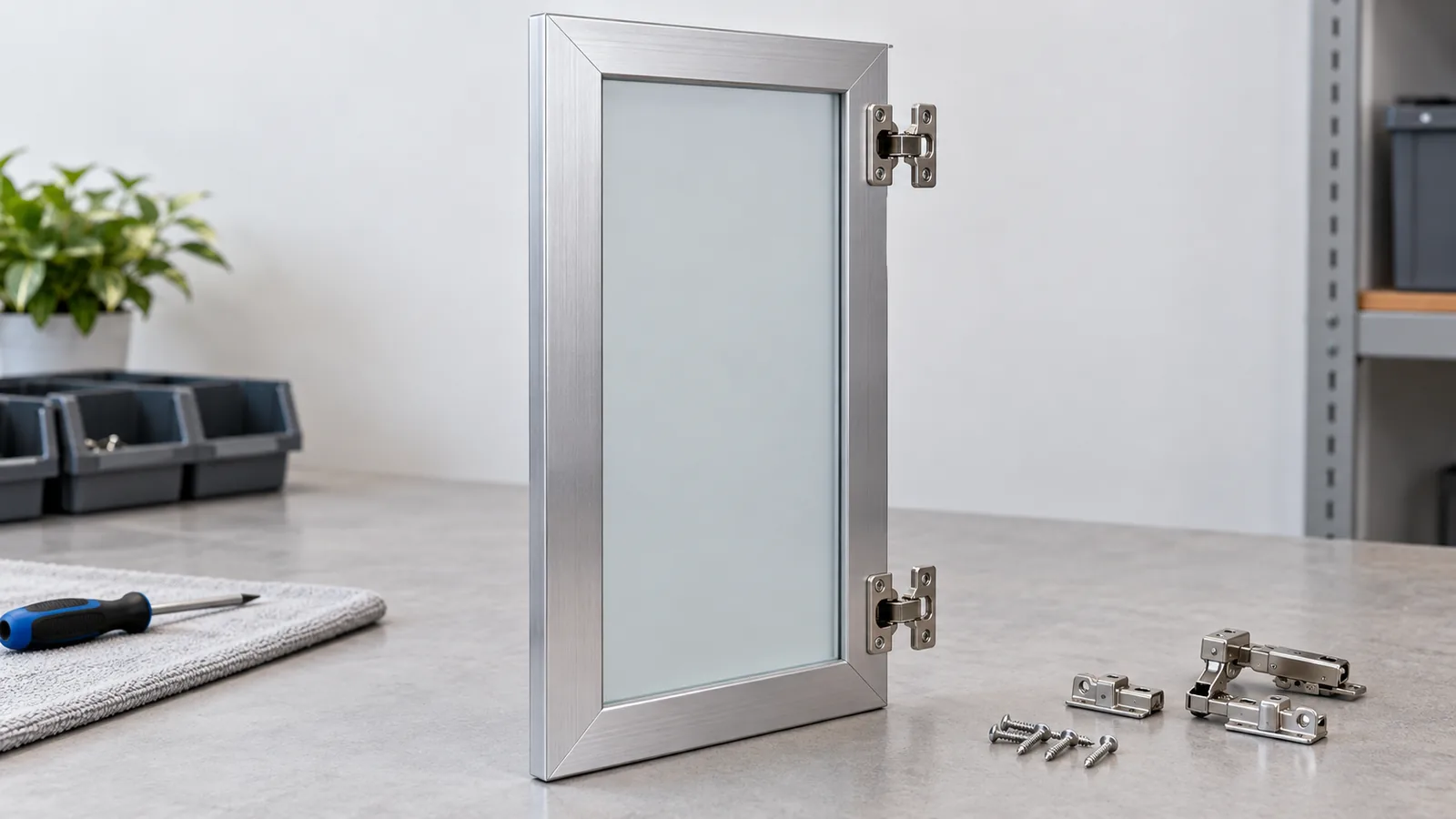
Aluminum-frame cabinet doors create a hinge interface that is different from a plain panel. The fitting must match the frame profile, the glass or infill arrangement if present, the corner construction, and the cabinet mounting geometry. Buyers should not order by the phrase aluminum frame cabinet door hinges alone. The RFQ needs the exact extrusion section and fitting model, and the representative sample must confirm that the hinge attaches without interfering with the infill, frame joint, neighboring door, or intended opening.
Hinge manufacturers may publish separate application information for narrow aluminum-frame fronts or specific profile families. Blum’s official hinge-system materials, for example, distinguish product guidance for different applications. That supports asking for model-specific compatibility evidence; it does not establish that a particular hinge fits every extrusion. Confirm the exact model and current installation instructions with the supplier. See Blum’s hinge system downloads.
Why Does the Extrusion Profile Control Compatibility?
An aluminum frame is a section with its own walls, grooves, slots, and joint features. The hinge fixing may depend on one of those features or on a dedicated adapter. If the frame supplier changes the extrusion, a fitting that worked with an earlier section may no longer seat or align. A product photograph rarely shows enough information to verify this interface.
Provide a section drawing that identifies the frame profile and all relevant internal dimensions. Include the outer dimensions, groove or channel position, wall thickness where the fitting engages, corner connection, and infill or glass placement. These details should come from the extrusion supplier’s controlled drawing. Avoid substituting a generic profile family name if several revisions or suppliers are possible.
The hinge side also needs to be described. State whether the door is inset or overlay, the cabinet-side construction, intended hinge position, opening requirement, and adjacent components. If an adapter plate or profile-specific fitting is required, show it in the assembly drawing and identify its source. The technical hinge supplier should confirm that the proposed combination falls within the model’s documented application.
What Should the Buyer Include in the RFQ?
Send the complete profile section and a door-corner detail, not only a front elevation. Identify the door frame supplier, extrusion revision, joint method, infill type if relevant, and finished door dimensions. If the infill is glass or another material supplied by a separate partner, state whether the hinge or fixing touches that part or only the aluminum frame. Do not imply a particular safety or material performance from the frame name.
List the hinge manufacturer, model, arm, plate, adapter or fixing accessory, and current document revision. Ask the supplier which profile dimensions determine compatibility and whether the fitting is designed for the stated door construction. If the exact profile is not yet selected, treat the quote as a conditional selection and require confirmation after the drawing is frozen.
| RFQ item | Pruebas del comprador | Supplier confirmation |
|---|---|---|
| Extrusion identity | Section drawing, supplier, profile code, and revision | Fitting compatibility and engagement feature |
| Door construction | Frame joints, infill, finished dimensions, and edge details | Hinge application assumptions and exclusions |
| Cabinet interface | Side panel, inset/overlay, mounting position, and clearance | Plate, arm, and opening fit |
| Fitting parts | Hinge model, adapter, fasteners, and document revision | Complete approved part combination |
| Sample basis | Door corner, full cabinet-side sample, and drawing revision | What the sample must demonstrate |
| Control de cambios | Approved extrusion and hinge schedule | Which supplier substitutions require reapproval |
Ask the supplier to mark the engagement point on the section. A brief annotated drawing often resolves ambiguity that an email description cannot. Record who owns the extrusion, hinge, adapter, and final assembly approval when these parts come from different vendors.
How Should Buyers Compare Hinge and Frame Options?
Compare proposed options on the same extrusion and cabinet geometry. A profile-specific fitting, a hinge using a separate adapter, or a revised frame section may each be possible depending on the supplier’s products. These are not guaranteed alternatives. Ask what changes to the door or frame each requires, which parts remain visible, and whether the installation sequence is compatible with the infill and frame joint.
Compare more than whether the hinge can be attached. Check the resulting overlay or inset, visible gap, opening path, and access around nearby fronts. Confirm that adjustment is possible without damaging the frame or losing engagement. If the fitting relies on screws, clamps, or a dedicated profile channel, ask the supplier for its installation method and any limitations. Do not invent a fastener size or torque; use the official instructions for the actual model.
The purchasing comparison should include adapter and accessory availability, sourcing responsibility, assembly operations, and replacement traceability. A low unit price may not represent the delivered cost if the profile needs an extra machining step or a special adapter. Conversely, a dedicated fitting is not automatically the better choice if it constrains the project to a supplier or profile that is otherwise unsuitable.
Aluminum frame cabinet door hinges should therefore be compared as a profile-and-fitting combination, with the approved extrusion section named in each quotation.
Ask each supplier to identify the controlled references that substantiate its proposal. A generic statement that a hinge is “for aluminum” does not tell the buyer which frame section, fitting parts, or mounting position have been checked. Include those specifics in the quotation comparison so the purchasing decision remains tied to an actual configuration.
When several suppliers share the interface, define the handoff explicitly. The extrusion supplier provides the profile and corner-joint information; the hinge supplier confirms the fitting against that section and the intended cabinet; and the buyer or designated integrator checks that the full product still meets its access and appearance requirements. A supplier’s confirmation should be attached to the same drawing revision used for sample approval. This avoids a common paperwork gap in which each party approves a different, incomplete view of the assembly.
Consider the production sequence as part of the comparison. If a hinge or adapter must slide into an extrusion channel before an end cap or corner part is installed, the assembly sequence needs to preserve access. If machining is required, identify the operation and its drawing reference, and confirm who performs it. These are project-specific questions; do not assume a particular Koitor capability or extrusion process from the general product category. Ask the relevant supplier to identify the operation, inspection point, and evidence it will retain.
For future repeat orders, preserve a physical or photographed reference of the profile end and hinge engagement. Keep the profile code, supplier, revision, and approved fitting schedule together. A sample drawer label or product image alone is not enough because profile revisions can be visually difficult to distinguish. Traceability makes it easier to investigate fit differences without guessing which generation of frame or adapter was used.
What Should the Representative Sample Demonstrate?
Build the sample with production-intent extrusion, corner joints, infill, hinge, adapters, fasteners, and cabinet side. Inspect both the hinge-side section and the visible door face. Confirm the fitting seats at the intended location, does not interfere with the infill or corner connection, and allows the door to move through the required path without contacting the frame or adjacent parts.
Review the installation sequence. Determine whether the hinge must be inserted before closing a frame corner, whether the infill blocks access, and whether the fitting can be inspected or replaced after assembly. The supplier should demonstrate any profile engagement using the actual components. Record whether the sample required hand adjustment, shims, or extra machining and whether those steps are approved production operations.
Check that the door remains aligned after repeated normal sample operation, but do not use an informal demonstration to claim lifecycle performance. If the project needs formal cycle, load, safety, or other testing, agree a separate test method with the component supplier and qualified provider. A fit sample answers fit and access questions; other requirements need their own evidence.
The approval record should include the extrusion drawing revision, hinge and adapter models, corner construction, infill condition, sample date, observed fit, and unresolved risks. If the frame supplier changes its profile or the hinge supplier changes the mounting accessory, pause and evaluate the impact before releasing repeat orders.

What Changes Can Invalidate a Previous Fit Review?
A profile revision can move a groove or alter the engagement surface while leaving the outside appearance similar. A different corner connector can change available space near the hinge. Changing the infill thickness or retention method may also affect the fitting area. Keep the drawing revision attached to the approved sample so receiving and engineering teams know which construction was reviewed.
Hinge changes need the same discipline. A different arm, adapter, plate, or fastener may shift the pivot or the mounting position. A “replacement equivalent” should be confirmed by the hinge supplier using the actual profile and cabinet geometry. Do not authorize substitutions solely because the part looks similar or shares a broad product category.
When a sample fails, document the profile code, fitting parts, contact point, and assembly sequence. Change one controlled variable at a time where possible. This helps the buyer tell whether the issue comes from the extrusion, frame joint, adapter, or cabinet position. If several suppliers are involved, nominate one person to update the combined drawing and communicate the approved change.
The buyer should distinguish a frame-compatibility question from an infill specification question. If a panel or glass piece sits inside the extrusion, record its position and retention method because it may occupy space near the hinge engagement. Do not treat a hinge-fit review as evidence that the infill itself meets any separate safety requirement. The responsible material and product suppliers must provide relevant data for their parts. In the assembly drawing, show where each component ends and which supplier approves that interface.
For incoming inspection, identify characteristics that can be checked without disassembling the door: profile code or label, hinge model where visible, alignment, and absence of obvious contact or damage. If internal engagement cannot be seen after assembly, retain a process record or approved pre-closure photo from the production supplier. These checks do not replace dimensional or performance testing, but they can help establish that the received assembly corresponds to the approved configuration. Agree the inspection method in advance so the supplier and buyer use the same reference.
Record aluminum frame cabinet door hinges by their complete component schedule, not by a broad material label that may cover several profile designs.
Aluminum-Frame Hinge Approval Checklist
- Extrusion section, profile code, supplier, and drawing revision are recorded.
- Frame joint, infill, hinge-side section, and cabinet mounting condition are shown.
- Hinge, adapter, plate, fasteners, and their technical-document revision are identified.
- The fitting supplier confirms compatibility with the actual profile and application.
- The representative sample proves seating, clearance, access, and installation sequence.
- Any machining, shim, or adjustment is documented as an approved process step.
- Profile or fitting substitutions trigger renewed fit review.

Preguntas frecuentes
Will any hinge marked for aluminum work with my extrusion?
Not necessarily. Compatibility depends on the exact profile, fitting model, mounting parts, and door construction. Provide the section drawing to the hinge supplier.
Can the glass or infill be used to support the hinge?
Do not assume so. The supplier must confirm the intended load path and fixing interface from the approved design. The drawing should show whether the fitting engages the frame or another component.
Is an adapter plate always needed?
No universal answer applies. Some systems may use a dedicated fitting or other arrangement. Confirm the selected model and installation instructions.
Who approves an extrusion change?
The buyer should control the change, with fit confirmation from the hinge supplier and extrusion supplier and a new representative assembly review where the interface is affected.
Does a visual match prove the profile is compatible?
No. Similar appearance does not establish matching groove dimensions or fitting engagement. Use controlled drawings and the actual sample.
Trabaja con Koitor Hardware
Koitor’s verified expertise covers metal bathroom and home-storage hardware, drawing and sample coordination, basic assembly, finish coordination, and supplier communication. Specialist aluminum extrusion and hinge design must be confirmed by their qualified suppliers. If a metal accessory interfaces with framed cabinetry, share the drawing or sample and the relevant assembly question.
Confirm the extrusion-to-hinge fit
Share the controlled profile section, hinge model, and representative assembly question for a clear supplier review.
OEM / MARCA BLANCA
Convierte esta guía de abastecimiento en un resumen del producto
Indícanos el producto que deseas, el tamaño, el acabado, la cantidad del pedido y los requisitos de embalaje. Tu equipo recibirá un análisis práctico de la viabilidad de fabricación antes de recibir el presupuesto.


 English
 Español
 Português
 Français
 Deutsch
 العربية