
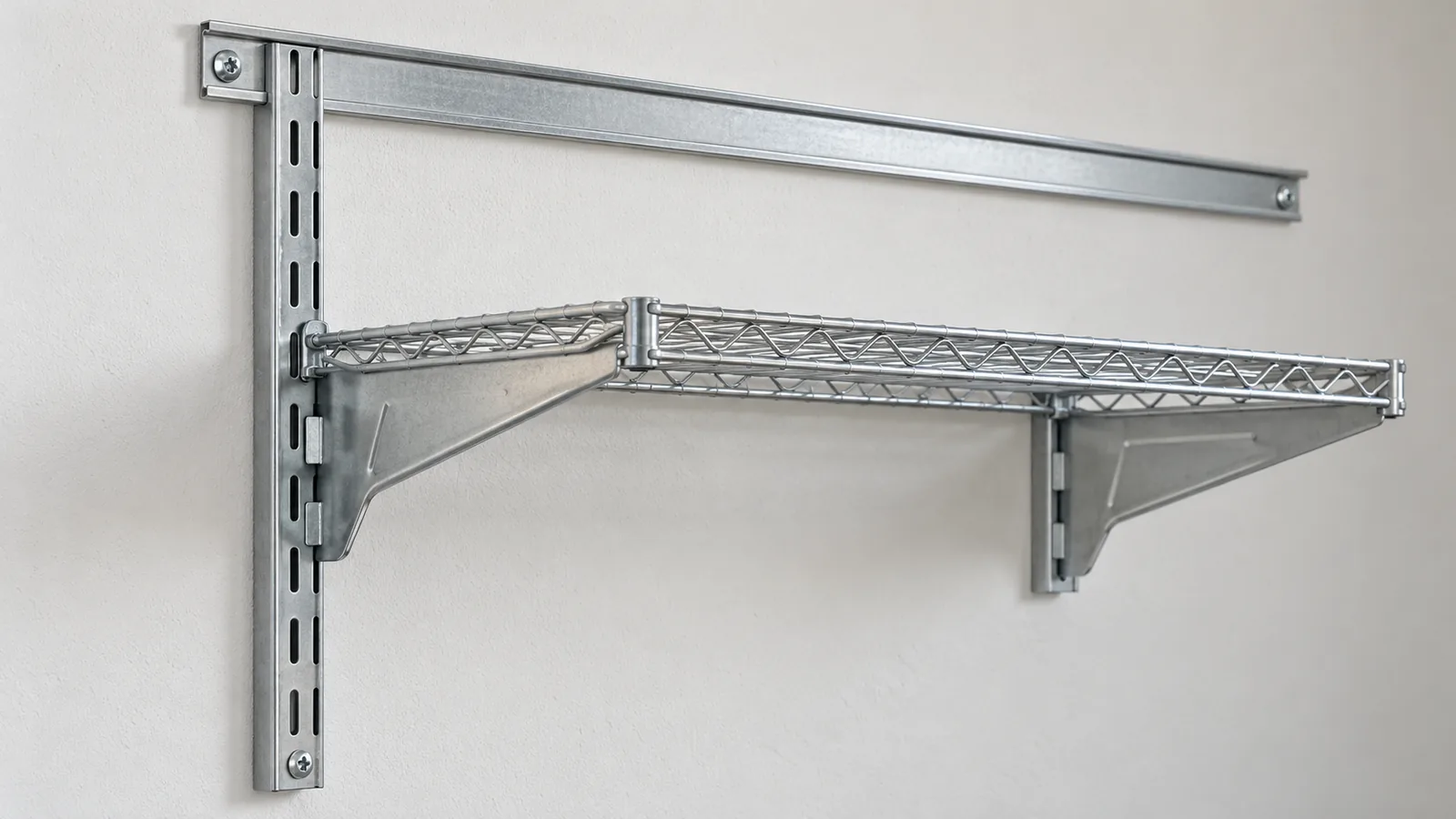
For a modular shelving program, wall rail slot pitch bracket compatibility is not established by matching a nominal width or by looking similar in a catalog photo. Buyers should approve the rail cross-section, slot pattern, bracket hook geometry, insertion direction, shelf interface and intended wall-fixing arrangement together as one system. A representative assembled sample and supplier-approved combination record are more useful than an isolated dimension.
That decision matters when an importer or private-label brand combines components from multiple sources, replaces a discontinued bracket, or develops an adjustable storage assortment. A bracket may appear to fit a slot while failing to seat fully, rocking under the shelf, or releasing when lifted. This guide sets out what to compare and what to ask the supplier without suggesting that every wall-rail system follows one universal standard.
What does compatibility mean in a wall-rail shelving system?
Compatibility means that the intended components connect, remain in their intended positions, support the specified shelf interface, and can be installed according to a documented method. It is an assembly-level decision, not a label assigned to a rail or bracket separately.
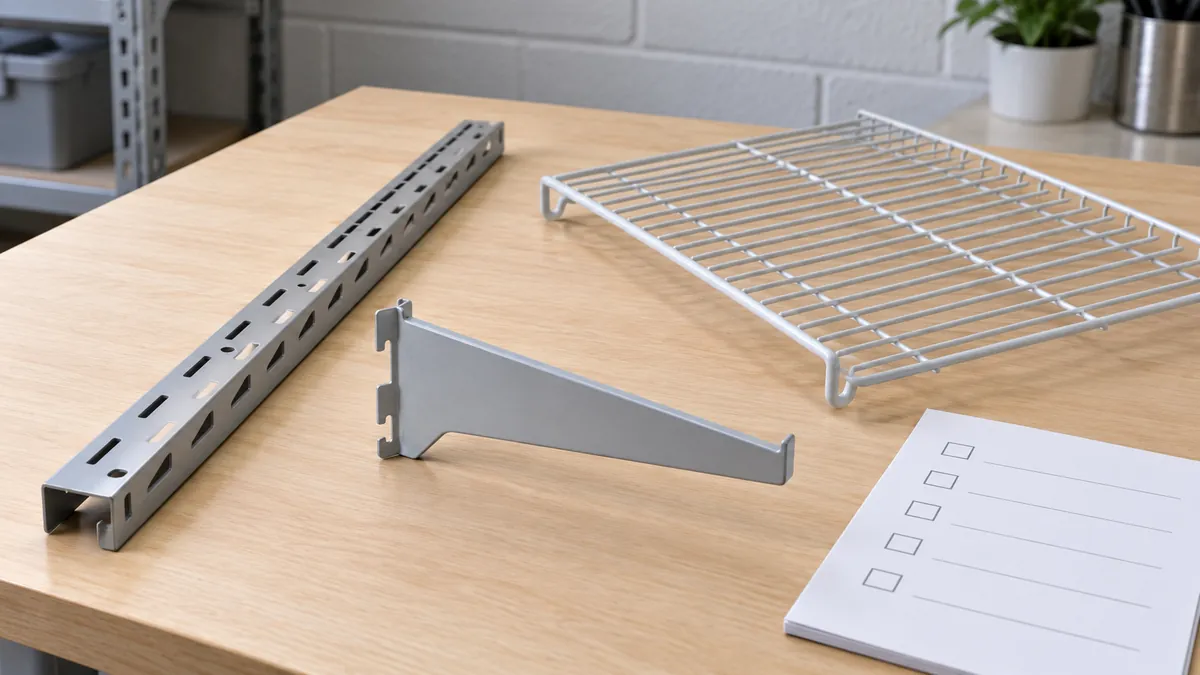
A common adjustable wall system includes a horizontal hang track or top rail, one or more vertical standards with slots, brackets that engage those slots, and shelves or other storage components carried by the brackets. Designs vary. Some systems use a top track to support vertical standards; others fasten standards directly to the wall. Slot shapes, spacing, standard depth, bracket teeth and retention details are product-specific.
For purchasing teams, the word “compatible” should therefore be qualified. Compatible with which exact rail profile and revision? Which bracket model? Which shelf material, depth and attachment method? Which installation arrangement and stated load condition? A supplier’s product family may answer some of these questions, but the product family name alone is not a substitute for the approved component list.
The article’s focus keyword is a search expression, not a recognized industry-wide dimensional standard. Do not assume a universal slot pitch, tooth spacing or load rating. When another supplier publishes dimensions or load guidance, treat it as applying only to that supplier’s described products and conditions.
Which interfaces should a buyer compare before combining parts?
Compare every physical interface that controls fit or retention. Start at the wall and trace the load path to the stored item: wall fixing to track or standard, standard slot to bracket hook, bracket to shelf, and shelf to the intended container or product.
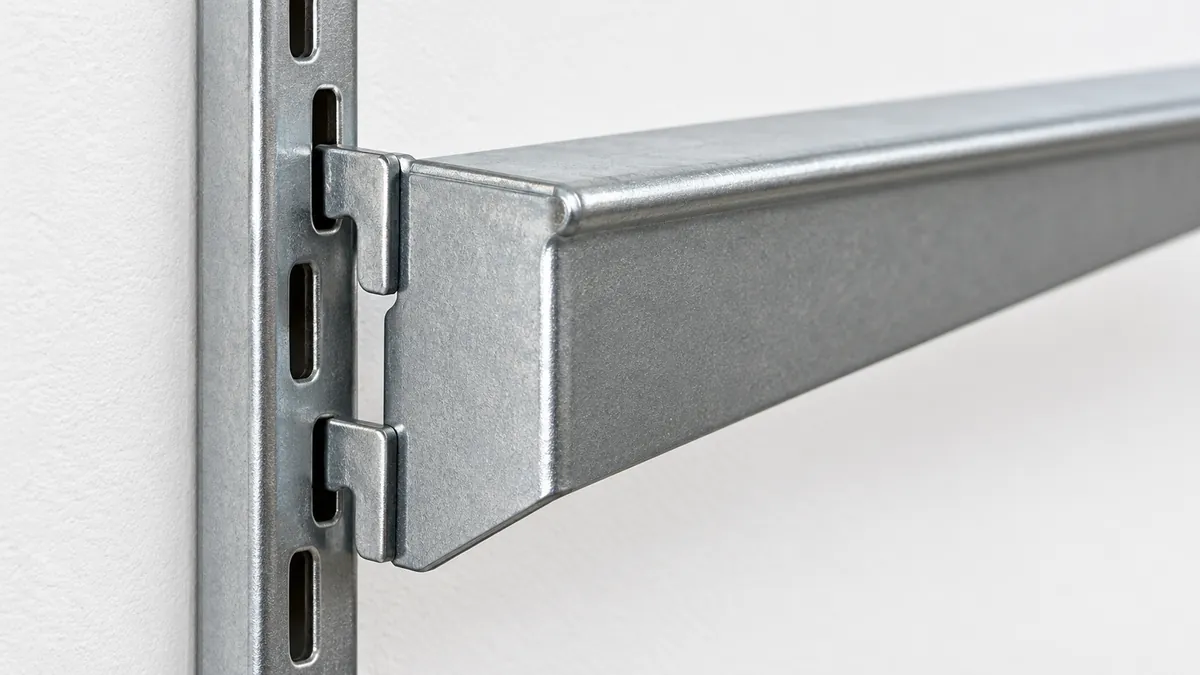
The rail and bracket interface deserves the closest attention. Record the rail’s section shape and orientation, slot length and width, slot spacing, slot edge condition, bracket tooth count and spacing, tooth thickness, engagement depth, and the direction in which the bracket is inserted and removed. The supplier should identify any locating tab, cover, safety feature or position restriction that affects assembly.
Next compare the bracket-to-shelf interface. A bracket may be designed for a particular shelf depth, edge profile or retention feature. A wire shelf, board shelf and formed metal shelf may have different contact and anti-lift details, even if their nominal depth is similar. Check whether one bracket supports one product, a pair of products, or a shelf plus an accessory. Do not assume a support’s unused side can carry another component unless that combination is documented.
Finally review the wall-side system. A top hang track may distribute or locate standards in a particular way; direct-to-wall standards may rely on a different hole pattern and fixing schedule. Substrate, fixing selection, wall condition and installation instructions affect the completed assembly. These are system inputs, not properties that can be inferred from the metal rail alone.
Two parts can share a nominal measurement while differing at the actual engagement surfaces. The slot width may appear similar but have different edge radii, depth, spacing tolerance or standard thickness. The bracket may enter the opening but not achieve the intended bearing contact. A tooth can catch one slot while another tooth remains unseated, causing the bracket to sit at an angle. A wall rail slot pitch bracket compatibility review must therefore compare the full interface, not just one repeated distance.
Slot pitch is only one coordinate in the pattern. It describes a repeated distance between features, but it does not specify the entire section, slot length, slot width, material thickness, tooth shape, hook offset, insertion path or retention behavior. A bracket that engages one slot pair may not align with the shelf interface or with an opposing bracket installed on another standard.
There can also be restrictions within a product system. For example, a current Elfa Décor+ bracket specification describes its bracket as assembling into that system’s standard slots and states specific planning rules, including a restriction on placing components in the lowest slots. That is evidence that system instructions can include position-dependent rules; it is not a transferable dimension, compatibility claim or load rating for another product.
For a substitute component, appearance is especially weak evidence. Product photographs may hide the rear of the bracket, the hook profile or a cover feature. A drawing should show relevant section views and datums, while a sample should confirm actual engagement. If the supplier cannot identify which system revision the part fits, treat the combination as unapproved until engineering review resolves it.
Use a matrix to make the approved combinations explicit. One row should represent one intended combination, not a broad claim that every bracket fits every rail.
| Interface or requirement | Buyer record | Sample approval check |
|---|---|---|
| Rail profile | Section drawing, orientation and revision | Confirm the rail is oriented as specified |
| Slot pattern | Slot width, length, spacing and tolerance reference | Compare repeated engagement points across the standard |
| Bracket engagement | Tooth count, thickness, spacing and insertion direction | Confirm every intended tooth seats fully |
| Retention behavior | Lift, slide or locking feature and limitations | Check the bracket stays seated under the defined handling sequence |
| Shelf interface | Shelf type, depth, edge and anti-lift detail | Verify the shelf rests evenly and cannot shift unexpectedly |
| Wall attachment | Track or direct-standard configuration and fixing instructions | Follow the approved wall assembly procedure |
| Permitted combination | Part numbers and revision identifiers | Sign off the actual rail, bracket and shelf as a set |
The table is a starting record, not a universal testing protocol. The responsible product engineer and supplier should define measurement points, tolerances and any performance checks for the intended product. Avoid adding a load number unless the complete product, wall condition, installation method and test approach are defined and supported by evidence.
If a supplier provides only a nominal rail width, ask for the missing interface drawing. If the supplier says a bracket is “standard,” ask which standard or product family that term refers to. If the answer is a named third-party system, request evidence of authorization or a clear statement that the part is an independently designed substitute; do not imply endorsement or interchangeability without permission and technical confirmation.
How should a buyer inspect bracket seating on a sample?
Inspect the complete sample in the same sequence described in the approved instructions. The goal is not to prove unlimited capacity; it is to detect mismatch, incomplete engagement, assembly ambiguity and uncontrolled movement for the defined use.
Before fitting, compare sample IDs and revisions with the matrix. Check for burrs, deformation, coating build-up or damage around slot edges and bracket teeth. Such conditions can interfere with engagement even if the nominal dimensions fall within a stated range. Record which surfaces are functional and whether the finish is allowed to build on them.
During assembly, observe the insertion direction and movement required to seat the hook tabs. Confirm that all intended teeth engage and that the bracket rests at the intended angle. Repeat the process on the opposite standard to see whether corresponding slots align. A single bracket fitted to one rail does not confirm the spacing relationship between two standards or the level of a full shelf.
After installing the shelf, check contact along the bracket supports, level, side-to-side alignment, interference and any anti-lift feature. Use the supplier’s instructions for any handling or retention check. If the sample rocks, binds, requires an undocumented adjustment, or can be removed in an unintended direction, pause approval and record the observed condition. Do not grind, bend or force the components to make them fit unless that modification is part of a formally approved design change.
The buyer should retain a dated photo set and sample sign-off identifying rail, bracket, shelf, fasteners and revision. Those records make repeat-order comparisons possible and help distinguish a design mismatch from a later manufacturing variation.
A substitute is acceptable only after the changed combination has passed the same level of drawing, fit and performance review required for the product’s intended use. Similar appearance, shared nominal depth or one successful insertion is not enough to establish equivalence.
The supplier-change request should identify what changed and why. A replacement may differ in slot pitch, standard thickness, bracket tooth shape, material, finish, forming route, tooling, supplier or installation hardware. Each change can affect fit, assembly time, shelf angle, finish damage or retention. The impact depends on the geometry and process, so do not assume that every change is critical—or harmless.
Ask for a redline or revision-controlled comparison. The supplier should identify dimensions and features that remain unchanged and those requiring fresh approval. If the new bracket is intended to work with an existing rail, include the actual rail sample or controlled drawing in the review. If the rail supplier has changed, recheck the bracket fit instead of relying on a previous bracket approval.
Keep compatibility claims narrow in product data. A useful statement names the rail and bracket series or refers to the buyer’s approved combination. Avoid statements such as “fits all slotted standards” unless the claim has been validated across a defined range and the commercial scope supports it. A narrow, supportable compatibility statement is better for distributors than a broad promise that leads to returns or installation complaints.
What should buyers put in an RFQ and quality record?
An RFQ should allow the supplier to quote and sample the same interface the buyer plans to sell. Include the intended storage product, rail arrangement, bracket type, shelf material and depth, finish, wall-fixing concept, target market, packaging requirements and any private-label documentation. Attach drawings with revision numbers and identify which dimensions control interchangeability.
Also ask for the supplier’s approved combinations and known exclusions. These may include a rail or bracket revision that is not interchangeable, a slot position that should not be used, a shelf depth range, an installation orientation, a specific accessory pairing or a wall condition that requires separate fixing review. Only the responsible system owner can confirm those rules for the actual product.
The purchase specification and incoming inspection plan can then focus on critical interfaces rather than checking every dimension with equal effort. For example, define how to inspect slot pattern, bracket thickness and tooth alignment; how many samples to fit; which shelf configuration to assemble; and what evidence to retain. Sampling frequency and acceptance criteria must be agreed by the buyer and supplier. This article does not prescribe an AQL, test load or universal tolerance.
The most common avoidable problem is treating a component as a commodity because it resembles a familiar system. A buyer may copy a product photo into an RFQ, specify only the shelf depth, and assume the supplier will infer the exact standard. That leaves the functional interface undefined.
Other mistakes include:
- approving a bracket sample without the production rail and shelf;
- measuring only nominal width while ignoring section profile and hook geometry;
- changing one supplier or revision without recording the impact on mating parts;
- assuming a top track, standard and wall fixing can be mixed across systems;
- accepting a verbal “universal fit” statement without a defined compatibility list;
- evaluating one side of a two-standard shelf rather than the assembled pair;
- failing to protect functional slots and teeth from burrs, deformation or finish build-up;
- relying on a load claim without knowing its test assembly, installation and conditions.
These mistakes are not evidence that all systems fail in the same way. They are practical review points for reducing ambiguity in a private-label sourcing program. The best corrective action is often to tighten the drawing, sample approval record and change-control process before bulk production.
How can an OEM manufacturer support a compatibility review?
A qualified OEM manufacturer can review buyer drawings or a physical sample for manufacturability, interface definition and repeatable assembly requirements. For metal storage hardware, that discussion may include forming details, edge condition, bracket geometry, welding or attachment approach, finish coverage, packaging separation and inspection references. The actual process depends on the design and must be confirmed for a particular project.
Koitor Hardware is a family-owned bathroom and home storage hardware factory and custom metal hardware manufacturer. Its practical role is to discuss relevant metal-part sourcing and production requirements when they fit the factory’s verified capabilities. This article does not claim Koitor makes a named third-party rail system, offers certified compatibility, or has tested a universal load rating.
For an OEM inquiry, send the rail and bracket drawings with revision identifiers, shelf dimensions and material, finish expectations, intended wall configuration, target order quantity, sample needs, packaging and market. If the buyer is evaluating an adjacent shelving component rather than an existing Koitor product, say so directly. Clear scope lets the supplier identify what can be quoted, what needs engineering review and what remains outside its confirmed capability.
What should a buyer checklist include before approving a system?
Before approving a modular wall-rail assortment, confirm that the commercial specification and sample refer to the same combination. A compact approval checklist is:
- Identify the rail, bracket and shelf models, suppliers and revision levels.
- Obtain the rail and bracket section details, slot pattern and engagement geometry.
- Confirm insertion direction, retention features and documented restrictions.
- Assemble the actual pair of standards, brackets and shelf intended for sale.
- Record observed seating, alignment, shelf contact and any interference.
- Agree the wall attachment method and the limits of the installation instructions.
- Define which interface dimensions are controlled during production inspection.
- Approve packaging and labeling so the correct components stay together.
- Require review before any supplier, tooling, material or geometry substitution.
- Keep photos, drawings, sample sign-off and approved combinations together.
This checklist keeps the buyer focused on interfaces rather than on a generic claim of interchangeability. It also creates a clear basis for sample review, incoming inspection and repeat-order change control.
Preguntas frecuentes
Is wall rail slot pitch enough to determine bracket compatibility?
No. Slot pitch is one part of the pattern. A wall rail slot pitch bracket compatibility review also checks rail section, slot dimensions, thickness, bracket tooth geometry, insertion path, retention and shelf interface for the intended system.
Can a bracket from one brand fit another brand’s wall standard?
It may appear to fit, but the buyer should not assume interchangeability. Confirm the exact rail and bracket combination with the system supplier, drawings and a representative assembled sample. Do not imply affiliation with a named brand.
Does a bracket that stays in one slot prove the full shelf is approved?
No. A single fit check does not confirm a pair of standards, shelf alignment, wall fixing or any performance claim. Approval should match the complete assembly and stated application.
What should a buyer do when a supplier changes a bracket design?
Request a revision comparison, identify affected mating parts, and repeat the relevant fit and sample checks. Record approval before the changed component enters production or shipment.
Discuss a project-specific rail and bracket combination
Share the rail and bracket drawings, revisions, shelf configuration, intended wall arrangement and representative sample requirements. Compatibility and performance must be confirmed for the exact components and installation.
OEM / MARCA BLANCA
Convierte esta guía de abastecimiento en un resumen del producto
Indícanos el producto que deseas, el tamaño, el acabado, la cantidad del pedido y los requisitos de embalaje. Tu equipo recibirá un análisis práctico de la viabilidad de fabricación antes de recibir el presupuesto.
 English
  Español
  Português
  Français
  Deutsch
  العربية