
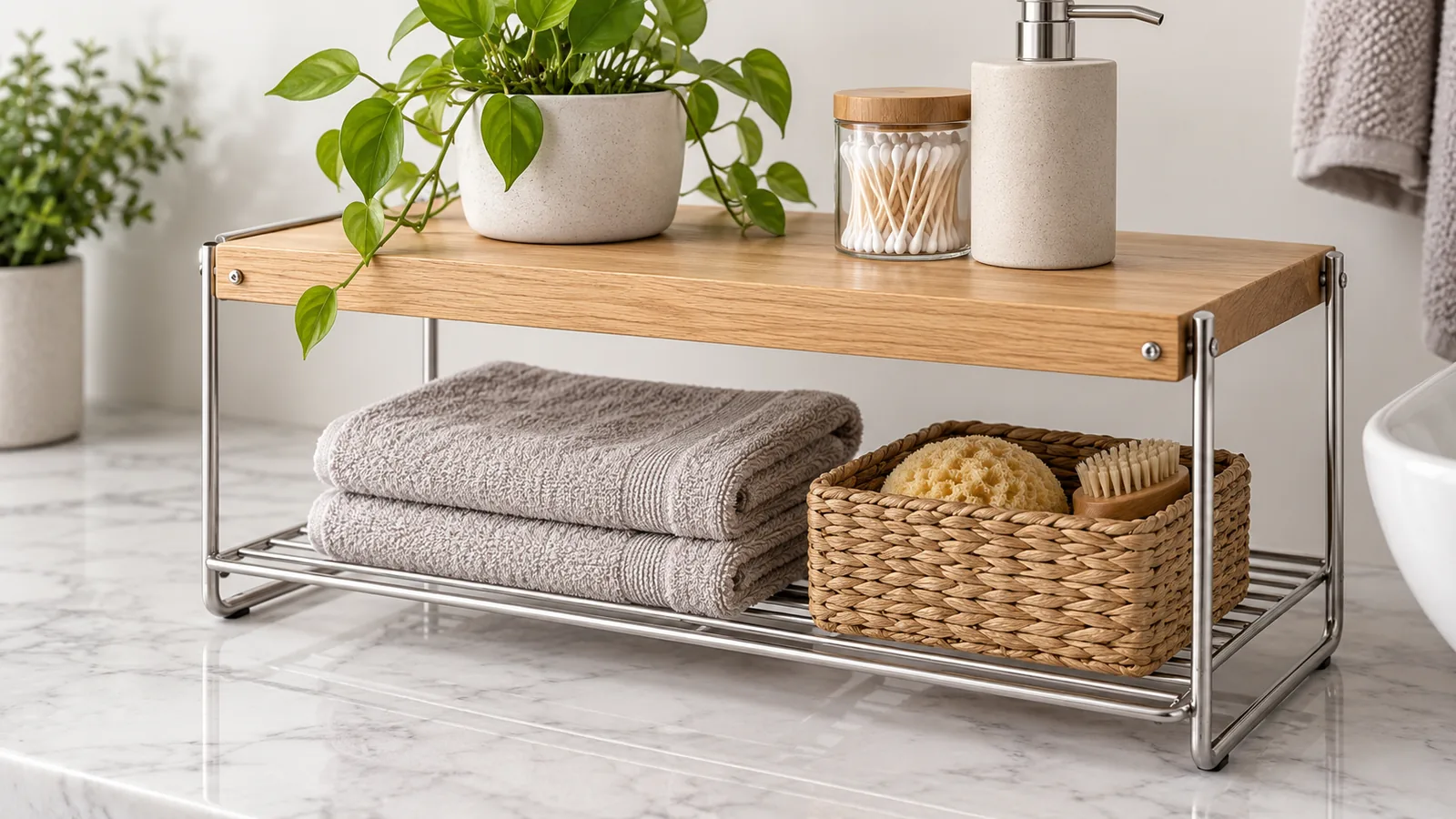
For importers sourcing steel-and-wood organizers, wood metal assembly differential humidity expansion is a project-specific interface question, not a universal gap or fastener value. Buyers should identify the actual wood construction and finish, the metal attachment geometry, the expected moisture conditions, and the checks required on a production-intent sample. Wood responds to moisture conditions differently from a metal frame, but the amount and direction of dimensional change depend on the wood material, grain orientation, panel construction, finish, and environment. Do not approve a generic “movement allowance” without reviewing the actual design.
Why does the metal-to-wood interface need a buyer specification?
The connection is where two different materials and production routes meet. A metal frame may be bent, welded, polished, coated, or assembled; a wood panel may be solid wood, veneer over a substrate, plywood, or another engineered construction. Those descriptions are not interchangeable. Each can respond differently to moisture, machining, edge finishing, and fastening.
The USDA Forest Service Wood Handbook explains that wood exchanges moisture with surrounding air and that dimensional behavior is related to moisture content, species, and direction within the wood. Its discussion of moisture and dimensional change also cautions that coatings can slow moisture exchange but do not eliminate movement. These are general wood-science principles, not a prediction of failure for a particular organizer. See the Wood Handbook chapter on moisture relations y the chapter on dimensional change.
For a product developer, this means “wood shelf attached to a steel frame” is not yet a complete specification. The interface may involve a screw through a bracket, a tab or clip, a captured panel, or a different project-specific arrangement. The buyer needs the supplier to show which surfaces locate the panel, which parts restrain it, and whether the connection is intended to allow any movement. Never infer a required clearance, screw torque, or service life from a generic photograph.
What wood and panel information should buyers request?
Ask the proposed supplier to name the actual construction before comparing samples. “Wood” may describe a natural wood component, a veneer-faced panel, a laminated board, or a different material with a wood appearance. For each component, record the material description, nominal thickness, grain or surface orientation where relevant, edge treatment, finish, and the intended exposed environment. If the supplier sources the panel from another partner, clarify who controls the specification and who approves a change.
A useful request is not a long list of material grades without context. It is a drawing or sample record that lets both parties identify the same part. Ask for:
- the panel construction and the source or responsible supplier, if known;
- the finished panel dimensions and the surfaces that are visible to the customer;
- the edge finish and any sealed or covered edges;
- the attachment points, fastener type, bracket footprint, and accessible assembly sequence;
- the room or use environment assumed for the product, including likely humidity exposure and cleaning conditions;
- any restrictions on standing water, direct shower spray, or prolonged wetting;
- the exact sample revision that will be compared with later production.
For solid wood, grain direction may affect dimensional behavior. For engineered panels, the core and face layers matter, and an exposed edge may not behave like a coated face. Buyers should therefore ask about the actual construction rather than assume that a familiar species name alone defines the part. If the supplier cannot disclose the panel source, the buyer can still require a controlled material description and change-approval process.
Do not insert an arbitrary moisture percentage or dimensional tolerance into a purchase order simply because another product uses it. The relevant values, if needed, must be selected for the material, geometry, manufacturing process, storage and use environment, and the buyer’s own acceptance plan. A wood specialist or product engineer may be needed where the panel is structural, where the design is tightly constrained, or where regulatory or safety requirements apply.
How can humidity-related movement affect a metal frame assembly?
Wood generally changes dimension as its moisture content changes; a metal frame and a wood panel may not respond in the same way. If the connection fully restrains movement that the chosen panel would otherwise make, the possible outcomes can include binding, a visible gap, a stressed fastener, local finish damage, or a panel that no longer sits as intended. These are conditional failure modes to investigate, not inevitable results of every steel-and-wood organizer.
The assembly geometry determines whether movement matters. A panel captured tightly on all sides behaves differently from one attached at discrete points. A long panel may present different questions from a small decorative insert. A screw close to an edge raises different design and assembly concerns from a bracket with a broad contact area. The buyer should ask the supplier or responsible design partner to explain the load path and the location strategy rather than assuming that adding more screws automatically improves the connection. In practical terms, wood metal assembly differential humidity expansion should be treated as a drawing-and-sample review question, not a standard gap copied across products.
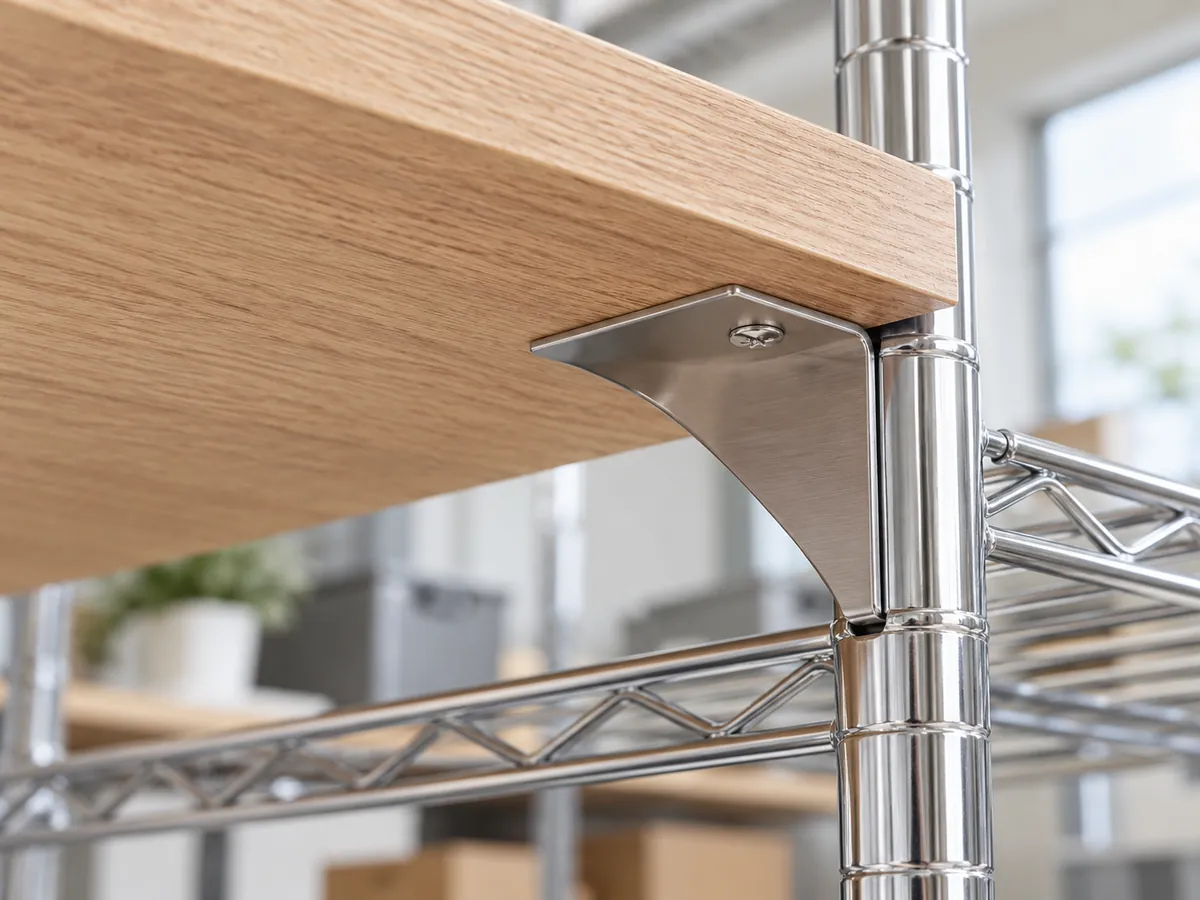
The illustration shows one plausible bracket-and-fastener arrangement only. It is not a Koitor product drawing, a tested joint, or a recommendation for every panel. The production design may use a different construction, and the buyer should approve the actual drawing and sample.
A project review should clarify whether the interface is designed to locate, support, retain, or conceal the panel. Some parts may perform more than one function, but those roles should be stated. If a buyer wants the panel to remain removable for packing or replacement, that need should be made explicit because it can affect brackets, fasteners, access, assembly, and the appearance of the finished product.
What should the drawing and RFQ show?
A useful RFQ makes the interface inspectable. Share the panel outline, relevant dimensions, visible faces, attachment locations, assembly orientation, finish boundaries, and any critical fit relationships. If the drawing does not show the reverse side or the panel edge, add a view or a physical reference sample. A supplier cannot quote or reproduce a hidden interface reliably from a styled product photograph alone.
| Buyer input | What to show or name | Por qué es importante |
|---|---|---|
| Panel construction | Solid, veneer-faced, plywood, or specified engineered panel; identify unknowns | Construction affects sourcing, edge treatment, and moisture response |
| Metal frame | Material and finish requirement, visible faces, section or wire geometry | Defines the metal-side parts and cosmetic inspection points |
| Attachment | Bracket or tab locations, fastener type, access, and assembly direction | Makes the joint and assembly sequence reviewable |
| Fit relationship | Panel position, contact surfaces, and any agreed clearance or movement strategy | Avoids relying on an unstated fit assumption |
| Use environment | Indoor room, likely moisture exposure, cleaning and care assumptions | Connects material choices to the intended application |
| Approval sample | Revision, materials, finish, hardware, and inspection points | Gives buyer and supplier a shared reference for later production |
The table is a documentation checklist, not a universal engineering specification. A qualified product designer should set numeric dimensions and acceptance limits for the particular product. Mark dimensions that control assembly or appearance as critical, identify how they will be measured, and show whether the finished surface or an unfinished edge is the inspection reference.
If several suppliers contribute components, clarify the handoff. The metal-frame supplier may not control panel sourcing or panel finishing. The buyer should identify who confirms panel dimensions, who supplies fasteners, who assembles the unit, and who investigates a mismatch. This prevents an interface issue from being treated as “the other supplier’s part” after a sample has already been approved.
How should buyers review a production-intent sample?
A sample is useful only when it represents the planned parts and assembly sufficiently for the question being reviewed. A hand-built prototype with temporary fasteners or a substitute panel may help explore the concept, but it does not automatically represent the later production version. Label what is representative and what remains provisional.
On the assembled sample, compare the panel position, edge appearance, bracket alignment, fastener seating, visible gaps, and contact between the metal and wood parts against the approved drawing. Check that the unit can be assembled using the intended sequence and tools, and that a fastener can be inspected or serviced if the product design requires it. Look for rubbing, pinch points, unsupported overhangs, or a finish surface that could be damaged during assembly. The check is visual and dimensional; it does not prove long-term performance in every humidity condition.
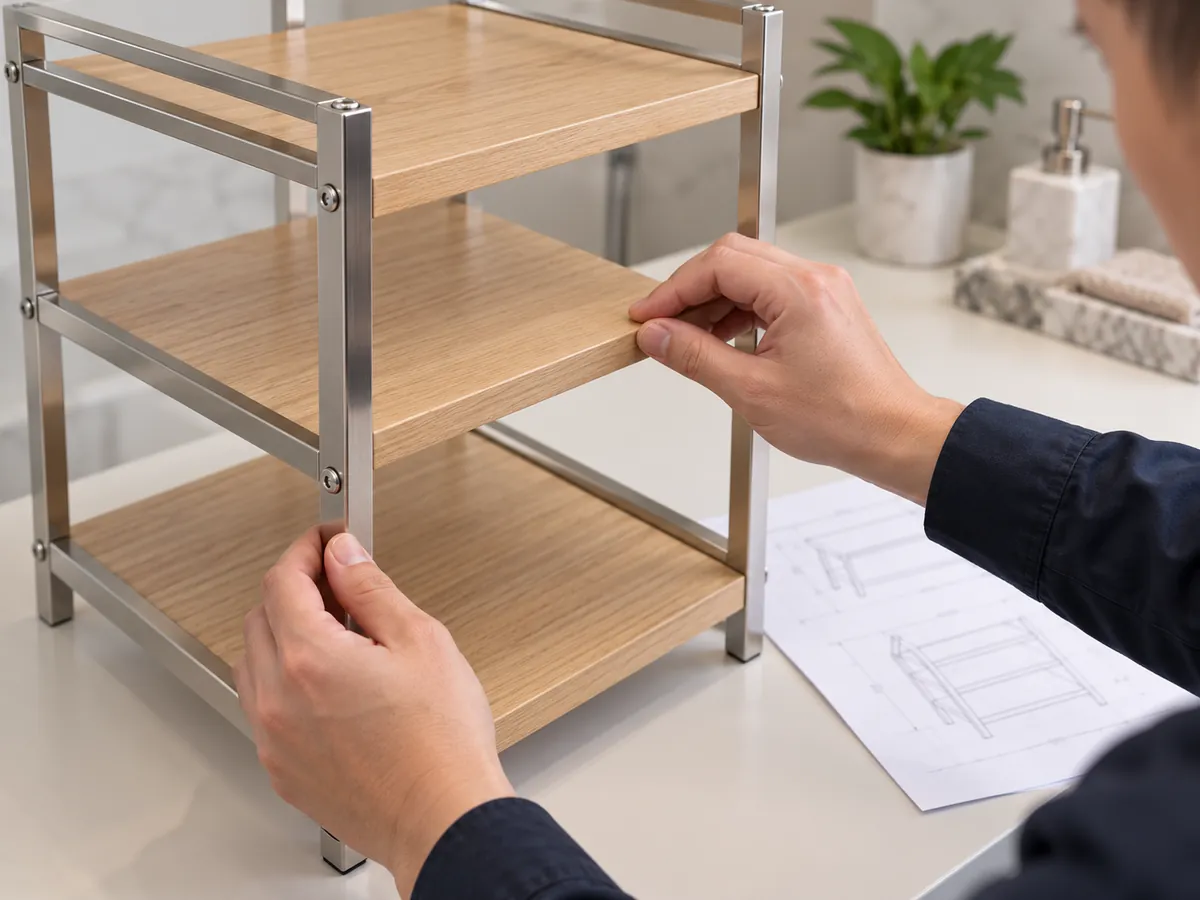
For a higher-risk application, the product team may define conditioning or repeat checks for samples stored under agreed environmental conditions. That plan should name the conditions, duration, measurement locations, and acceptance criteria before the test begins. Do not report a result as a universal service-life claim, and do not assume a short observation predicts every season, warehouse, bathroom, or customer home.
Record the approved sample with its revision, material descriptions, finish, hardware, supplier responsibilities, and photographs of the interface. If the panel source, finish, screw, bracket, frame geometry, or assembly method changes, decide whether the change affects fit or appearance and whether a new sample approval is needed. A “same color” substitution may still change construction; change control should focus on the properties that affect the buyer’s decision.
Which sourcing mistakes create avoidable disputes?
Several common process gaps are preventable even when the underlying design is sound:
- Using a styled photo as the full specification. A photo rarely shows the underside, hidden brackets, panel core, fastener, or assembly steps. Add drawing views or request a representative sample.
- Approving a substitute panel without noting it. A sample may look similar while using a different construction or edge finish. Identify temporary parts and keep them out of production approval.
- Treating a finish as a moisture barrier. The Forest Service reference notes that coatings can retard moisture exchange but do not stop dimensional change. Ask what finish is used on each face and edge; do not assume the coating makes the panel waterproof.
- Adding fasteners without reviewing the design. More screws can change appearance, assembly time, edge distance, or the restraint of the panel. Request a design explanation rather than using fastener count as a proxy for quality.
- Leaving responsibility between suppliers undefined. If one supplier owns the metal and another the panel, assign responsibility for interface dimensions and final assembly checks.
- Approving appearance but not assembly. A polished sample may still be difficult to build consistently or inspect. Include assembly access, part orientation, and the sequence in sample review.
- Making an unrecorded material change after approval. State which substitutions require written approval and identify the sample revision against which incoming or final checks will be compared.
A buyer can reduce ambiguity by asking for a concise interface control sheet: part description, material construction, drawing revision, attachment details, sample revision, critical visual checks, open questions, and change-approval owner. Keep this sheet aligned with the purchase specification and supplier’s quotation. It should clarify assumptions, not pretend to replace engineering calculations or material qualification. For an importer comparing concepts, wood metal assembly differential humidity expansion can prompt documentation of who owns the material and fit decisions.
How can a metal hardware OEM contribute without overstating capability?
A metal hardware manufacturer can review the frame, bracket geometry, forming and joining sequence, finish access, assembly method, packaging interface, and the clarity of drawings or physical samples. Koitor Hardware is a family-owned custom metal hardware factory focused on bathroom and home-storage hardware; approved capabilities include metal forming, joining, finishing, basic assembly, packaging preparation, and sample development from drawings or physical samples.
That experience can help the buyer ask better questions about the metal side of a combined product. It does not establish that Koitor manufactures wood panels, performs woodworking or wood finishing, or currently offers a complete steel-and-wood product. Buyers should confirm the responsible panel supplier, component sourcing route, assembly scope, and inspection ownership for each specific project.
When reviewing an adjacent product idea, share the whole interface rather than only the metal frame. A complete drawing, reference sample, target environment, finish expectation, packaging plan, and forecast quantity help a factory discuss manufacturability and project scope. If the product requires a separate wood specialist, the buyer may need that partner’s technical input before fixing the panel construction or acceptance criteria.
For related metal home-storage development, buyers can review Koitor’s OEM home-storage hardware information. Private-label teams may also review the private-label bathroom accessories page for metal product and packaging discussions. These pages describe relevant metal-hardware services; they are not claims about wood-part manufacturing.
What should buyers put on the approval checklist?
Before quotation, sample approval, or production release, confirm the following:
- Product scope: Is the supplier quoting the metal frame only, the panel only, assembly, or a coordinated finished set?
- Material identity: What is the actual panel construction, metal material and finish? Which descriptions remain unconfirmed?
- Interface drawing: Are panel edges, attachment locations, fasteners, access, and assembly orientation visible?
- Environmental assumptions: What room, humidity exposure, cleaning method, and care instructions define intended use?
- Fit and movement: Who sets any required fit allowance, how is it shown, and what technical input supports it?
- Sample approval stage: Which materials, finishes and hardware in the sample are production-intent, and which are temporary?
- Inspection: Which locations are checked for fit, edge finish, alignment, gaps, and fastener seating? What method and acceptance rule apply?
- Control de cambios: Which panel, metal, finish, fastener or process changes require buyer approval or sample re-review?
- Embalaje: Does the packing protect both the metal finish and panel edges, and does assembly or transport introduce contact risk?
- Ownership: Who resolves a mismatch between the panel and frame, and who records the approved version?
Keep the answers in a shared revision-controlled record. If a value cannot yet be set, mark it as open rather than allowing a supplier to infer it. For a potentially structural or safety-critical connection, obtain design review from a qualified engineer and agree any required test method before making performance claims.
Preguntas frecuentes
Does a metal frame prevent a wood panel from changing with humidity?
No. The frame does not eliminate the wood’s response to moisture. It can constrain or locate the panel, so the exact connection should be reviewed for the actual construction and environment.
Can buyers specify one movement gap for every steel-and-wood organizer?
No. A suitable fit depends on the panel material, dimensions, grain or layer orientation, finish, attachment design, and use conditions. A universal gap should not be copied without project-specific design evidence.
Does a production sample prove the assembly will remain unchanged in every bathroom?
No. A sample confirms the reviewed parts and conditions. It does not establish performance in every climate, cleaning routine, installation, or service duration. If environmental conditioning matters, define a relevant test and acceptance rule with qualified technical input.
What if the metal supplier does not make the wood component?
Separate the responsibilities in the RFQ. Name who supplies the panel, who controls its specification, who assembles the finished unit, and who approves interface changes. A metal supplier may still review the metal-side drawing and assembly fit without claiming to manufacture wood.
Review a Home-Storage Hardware Interface
Share the drawing or physical sample, panel construction, metal-frame scope, target environment and packaging needs so the metal-side design and project responsibilities can be discussed clearly.
OEM / MARCA BLANCA
Convierte esta guía de abastecimiento en un resumen del producto
Indícanos el producto que deseas, el tamaño, el acabado, la cantidad del pedido y los requisitos de embalaje. Tu equipo recibirá un análisis práctico de la viabilidad de fabricación antes de recibir el presupuesto.
 English
 Español
 Português
 Français
 Deutsch
 العربية