
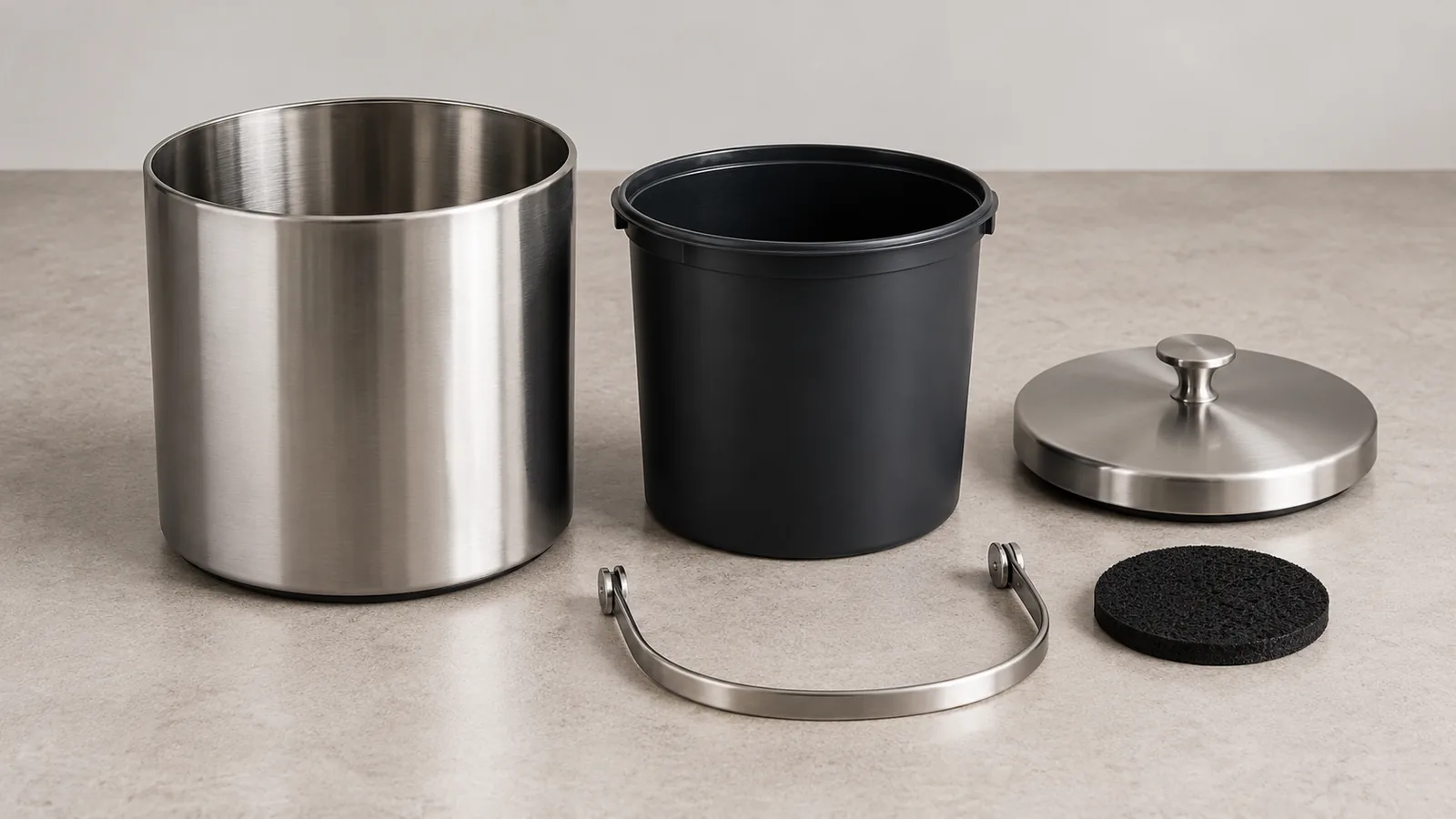
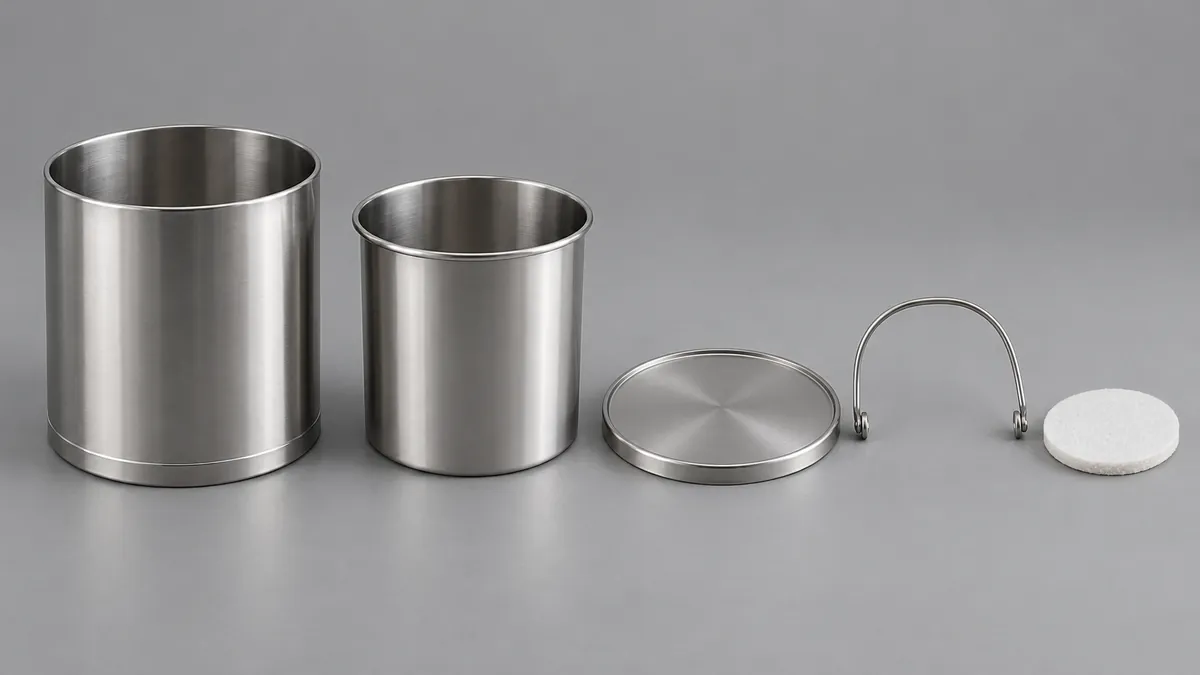
A countertop compost caddy manufacturer should quote the outer shell, inner pail, lid, filter holder and filter, handle, replacement parts and retail pack as one defined SKU—or mark each item as optional, buyer-supplied, outsourced or excluded. For importers, the sourcing decision is whether the parts fit and arrive as the same approved kit, not whether a catalog photo shows them together. Approve a representative sample with the lid/inner-pail interface and pack-out identified. This is a housewares example for buyer education; it does not claim that Koitor currently makes countertop compost caddies or supplies filters.
What should a countertop compost caddy quote include?
Start with the final shipped unit, then work backward to each component. A countertop caddy may be sold as one body with a lid, as a body plus removable inner pail, or as a kit that includes a filter insert and replacement filters. Some offers include a handle, liner or retail packaging; others leave those parts to the buyer. The supplier’s product name does not settle the scope.
Ask the supplier to mark each line as included, optional, buyer-supplied, purchased from another source, o excluded. If more than one company is involved, name the party that will coordinate fit and respond to changes. A complete-looking catalog photo can hide differences in bucket material, lid style, filter quantity, packaging and replacement-part availability.
| Component or work package | What to define in the RFQ | What to confirm on the sample or quote |
|---|---|---|
| Outer body | Material description, body shape, dimensions, finish and appearance reference | The quoted body, lid and handle details match the named SKU and drawing revision |
| Inner pail | Material, usable dimensions, handle, color and whether it is removable | It can be inserted, removed and returned without an unintended interference in the approved configuration |
| Lid | Lift-off or attached construction, grip, fit and intended open/closed positions | It sits as intended on the specified rim and clears the handle or nearby features |
| Filter and holder | Whether included, size, count, location, source and replacement identifier | The insert physically fits the holder and the quote states any replacement parts |
| Assembly and inspection | Which supplier assembles the kit and checks the interfaces | The approval record identifies the complete configuration, not only the outer shell |
| Retail and export pack | Unit contents, protection, labels, quantity per carton and artwork | A sample pack or written specification shows the same parts and presentation being quoted |
The table is a scope-planning tool, not a universal compost-caddy standard. Capacity numbers, component materials, lid construction and finish vary by product. Ask each supplier to return the same table with its quotation so you can compare like with like.
How should the shell, inner pail, lid, and filter fit together?
Treat the body and removable bucket as a dimensional pair. List the outer-body dimensions separately from the usable dimensions of the inner pail. Identify which measurements control insertion, removal, rim clearance and the intended countertop footprint. A capacity label by itself does not tell a buyer whether the bucket can be taken out comfortably or whether it matches the body being quoted.
The lid is another interface. Specify whether it lifts off or remains attached, how it is grasped, what position counts as closed, and whether the handle or filter holder affects that movement. If the design is intended to sit below cabinetry or beside another kitchen item, note those clearances in the brief instead of asking the supplier to infer them from a photo.
Define the filter as a purchased component with an identity, not only as a phrase in a marketing description. Record its dimensions, quantity per retail unit, mounting or pocket arrangement, replacement code and the party responsible for replenishment. A physical fit check can confirm that an insert fits the sample holder; it does not prove odor-control performance. If the retail claim depends on a performance result, define the test conditions and evidence needed before approving that claim.
The shell, inner pail, lid and handle may use different materials or finishes. State them by part. Do not infer a material grade from appearance, or assume that one material description applies to every component. If repeated wiping, moisture or a particular cleaning method matters to the product brief, name that use condition and ask the supplier to explain the proposed material and finish for the relevant part. Keep the buyer’s intended claim separate from what a supplier’s material list can verify.
A current retail example makes the variation visible. Chef’n’s EcoCrock product page describes a ceramic outer crock with an inner bucket and charcoal filter, and lists two filters. That configuration is one brand’s product description; it is not a universal specification, proof of filter performance for another design, or an OEM quote. Use examples to ask better questions, not to copy a competing SKU’s dimensions or materials.
How can importers compare supplier scope?
Compare offers after the kit contents are aligned. Ask each candidate to identify the contracting seller, the party supplying each component, and the party coordinating final assembly and pack-out. A supplier may advertise OEM or customization, but the buyer still needs a model-specific response showing what can change, what is purchased elsewhere and what the buyer must provide.
For a multi-source kit, name the interface owner. Who confirms the inner pail against the outer body? Who approves a lid revision that changes the filter holder? Who reconciles the handle attachment and pack arrangement? Who identifies an alternative component if the named filter is unavailable? The answer may be one supplier or several; it should be explicit before the sample is treated as a final reference.
A practical quote comparison includes:
- Same unit definition: caddy body, lid, inner pail, handle and filter count stated for each supplier.
- Same customization basis: color, surface finish, logo or artwork, and any changed dimensions separated from standard items.
- Same sample basis: whether the sample is a catalog item, modified sample or development sample, with revision and open changes recorded.
- Same packaging basis: included retail pack, protective materials, labels, carton contents and any buyer-supplied artwork identified.
- Same responsibility map: each supplier marks its work and outside purchases, and the quote identifies who coordinates the complete kit.
- Same replenishment assumptions: replacement filters or inner pails have a part identity and a stated source or an explicitly open status.
Do not treat a general OEM label as proof that every part is made in one facility. Also do not assume that outsourcing one component makes an offer unsuitable. A specialist can supply a component while another company controls the assembled SKU. The buyer’s decision is whether the handoffs, communication and acceptance steps are defined for the order.
A supplier’s self-description can help you prepare a question. Venus Kitchenware’s kitchen compost-bin page presents an OEM offer and describes customization and surface-treatment options. Read it as that supplier’s own presentation. Confirm the current project’s body material, lid finish, size and included parts in the quotation rather than treating a general page as an independently verified capability record.
For kitchen hardware categories, keep product-specific decisions separate. Koitor’s sink dish-rack drainage guide covers a different product and buyer question; a compost caddy’s lid, inner-pail and filter fit should not be copied from a dish-rack specification.
What should the sample and retail pack confirm?
Approve the complete saleable configuration, not a convenient sample of only the shell. The sample should identify the version of the body, lid, inner pail, handle and filter insert that the buyer expects to order. If one item is unavailable for the sample, record the exception and keep approval conditional until the missing interface is resolved.
On the sample, review the points that matter to the agreed design:
- Confirm body dimensions, opening and rim reference points against the approved drawing.
- Insert and remove the inner pail in the intended direction; record any catching, rocking or gap that falls outside the buyer’s acceptance criteria.
- Check lid seating, lifting motion and clearance around the handle or any filter holder.
- Confirm that the filter insert is the named type, count and size, and that it fits its specified location. This check confirms physical fit only.
- Compare the specified material and finish by part, including visible surfaces that matter to the buyer.
- Check that the quotation, sample contents and package list identify the same included components.
- Record sample revision, open changes, accepted exceptions and the approver before the sample becomes the order reference.
Do not use an unspecified “airtight,” “odor-proof,” food-contact or performance claim as a sample criterion. If the buyer intends to make such a claim, identify the applicable requirement and obtain suitable product-specific evidence through the appropriate technical or compliance review. The visual appearance of a filter or metal shell cannot establish those claims.
Plan the retail pack with the parts. Decide whether the inner pail ships inside the shell, beside it or in a separate compartment; how the lid and handle are protected; how replacement filters are counted and identified; and whether the buyer needs inserts, instructions, labels or a barcode. These are buyer-defined choices. Ask for the intended pack-out or a representative packing sample before the final approval, and confirm any carton or label revision before production.
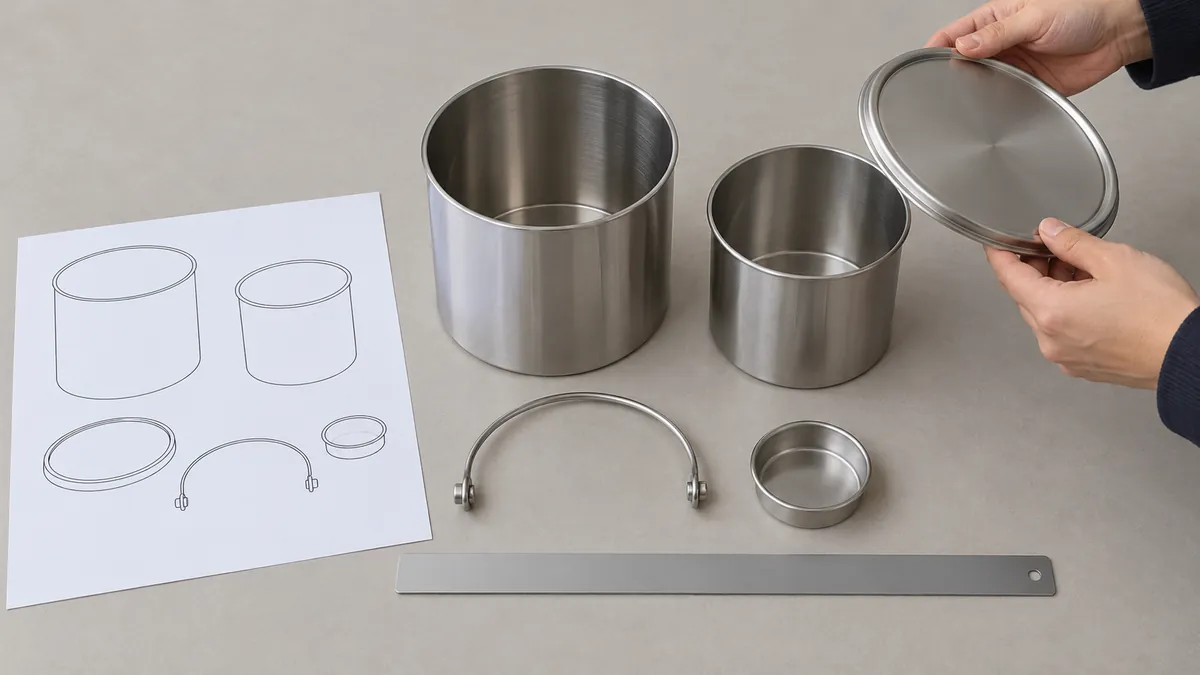
If the kit contains a spare filter or replaceable pail, give each replacement its own identifier. A buyer should be able to tell whether a reordered piece is the same size and interface as the item approved for the launch SKU. A product-specific review section on Chef’n’s page includes customer questions about replacement pieces for that model. This single page is not a survey and does not establish a category-wide problem, but it illustrates why importers may want to plan replacement-part identities before retail launch.
What do current supplier and product pages show?
Online product pages show that caddies vary in body material, inner-pail design, filter inclusion and customization language. For example, a Wellway Houseware Made-in-China listing displays a home-use countertop bin with product attributes for material, customization and package. Those marketplace fields describe a listing; they do not independently verify the future order, factory role or exact production arrangement.
This evidence supports a narrow buyer question: which configuration is actually included in the supplier’s offer? It does not show that every manufacturer has the same process, MOQ, lead time, performance or service model. A B2B search for a countertop compost caddy manufacturer can return consumer comparisons, retail products and supplier listings together. Use the search result to identify candidates, then verify the role and scope for the specific SKU.
Koitor Hardware is a family-owned custom metal hardware factory focused on bathroom and home-storage hardware. The project’s saved product library contains no exact countertop compost-caddy reference. This article therefore treats the product as an adjacent housewares example and does not claim that Koitor currently produces a compost caddy, inner pail or filter. A buyer considering a related metal organizer should confirm the actual product fit and current factory scope directly before treating Koitor as a candidate supplier.
What should you prepare before requesting a quotation?
Send each candidate the same short brief:
- Finished unit: a sketch or photo reference showing what the retail SKU must include.
- Part list: body, inner pail, lid, handle, filter holder, filter quantity, replacements, labels and packaging, each marked required, optional or not included.
- Controlled dimensions: outer body, usable inner-pail dimensions, opening, lid interface and handle clearance, each tied to a dated drawing revision.
- Material and appearance: describe the requirement by component, including the visible finish and color reference; ask suppliers to state any proposed alternative.
- Use and care context: note the buyer’s expected cleaning and countertop-use conditions without turning them into an unsupported product claim.
- Aprobación de la muestra: state what sample is required, who will approve it, which fit checks matter and how changes will be controlled.
- Supplier scope: ask each company to mark work performed, outside purchases, buyer-supplied items, exclusions and final pack-out responsibility.
- Replacement plan: identify which parts may be reordered separately and what code or dimensions will identify each one.
- Retail pack: define unit contents, protective arrangement, artwork or labels and the case-pack information you need the supplier to confirm.
If an input is undecided, mark it “supplier to propose” or “buyer to confirm.” Do not fill gaps with a material grade, filter claim, capacity, test result, MOQ or delivery promise copied from another listing. A clear open item is easier to resolve than an assumption embedded in a quotation.
Preguntas frecuentes
Does “countertop compost caddy manufacturer” mean the supplier provides every component?
No. A manufacturer or OEM may offer only a body, a standard product or a selected kit. Ask the supplier to identify the lid, pail, handle, filter and packaging included in the quote, then identify who supplies or coordinates every missing part.
Does a filter insert that fits prove it will control odor?
No. A fit check only establishes the physical relationship between the insert and its holder on the sample. Any performance claim needs its own defined conditions and supporting product-specific evidence.
Should a buyer approve the outer shell before the inner pail is finalized?
Not when the approved product depends on a removable inner pail. Confirm both parts together, including the dimensions and removal path that matter to the buyer. Otherwise the approved shell may not represent the final kit.
Is a supplier listing enough to verify the seller’s factory role?
No. A marketplace page or company catalog is useful for discovery and supplier questions, but it is not independent proof that the seller makes every listed part or controls every step. Ask who contracts for the order and who is responsible for the quoted SKU’s components and pack-out.
Trabaja con Koitor Hardware
Review a Metal Home-Storage Project
Koitor’s published focus is bathroom and home-storage metal hardware; this article does not claim a current compost-caddy or filter offering. If your project may overlap with that scope, share the drawing or sample and ask whether the requested product is a fit before discussing a quotation.
OEM / MARCA BLANCA
Convierte esta guía de abastecimiento en un resumen del producto
Indícanos el producto que deseas, el tamaño, el acabado, la cantidad del pedido y los requisitos de embalaje. Tu equipo recibirá un análisis práctico de la viabilidad de fabricación antes de recibir el presupuesto.
 English
 Español
 Português
 Français
 Deutsch
 العربية