
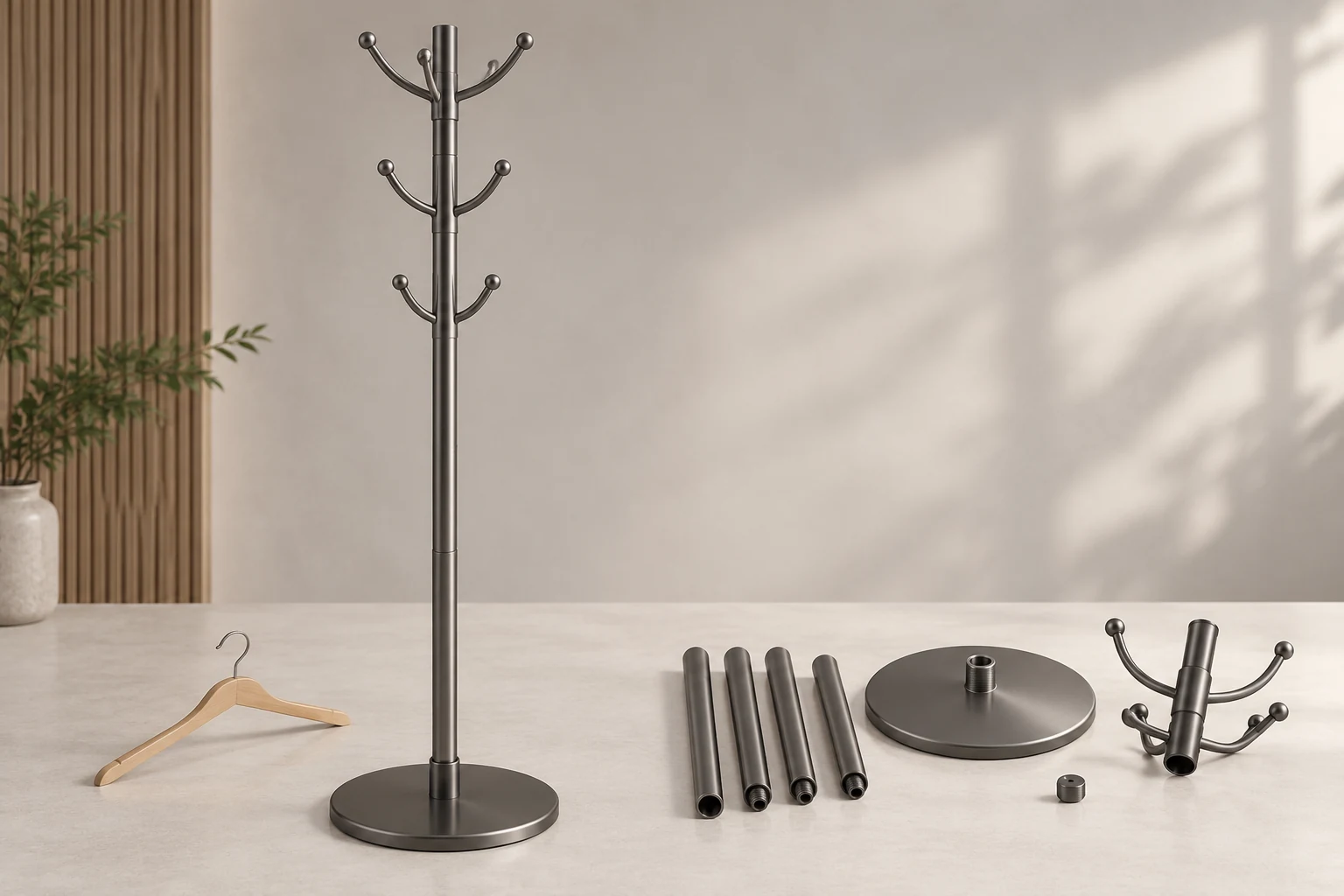
A freestanding coat rack needs a buyer-approved brief for its intended setting, hook and garment fit, assembly interfaces, sample revision, evidence, and retail pack. Importers should assess the exact product configuration they plan to sell instead of accepting generic wording such as “stable,” “heavy duty,” or “fits any coat.” Before approval, connect the supplier’s drawing, components, assembly information and packaging to one identified sample revision and a clearly stated use scenario.
What should an importer define before requesting a quotation?
First identify the product form. A single-pole coat tree, a multi-pole stand, an open garment rail, and a hall tree with shelves or a bench may all appear in the same entryway assortment, but they are different products with different parts and pack requirements. State whether the requested SKU is intended for a home entryway, office, hospitality area, retail display or another buyer-defined setting. The product brief should name the configuration and exclude features that are not part of the quoted SKU.
List the components the buyer expects to receive: base, upright, branches, hooks, umbrella ring, feet, trays, connector pieces, fasteners, tools, labels, instructions and carton inserts. Mark each item as included, optional or excluded. A lifestyle image may show accessories that are not in the retail box. A written bill of materials or configuration drawing helps prevent ambiguity between a sample, quotation and final pack.
The RFQ should also include the intended assortment, target quantity, finish and color reference, any private-label elements, and the desired flat-pack or assembled condition. If the product has variants, identify the model and revision for each. Ask the supplier to list any assumptions that affect price, production feasibility, assembly, or packaging so the buyer can compare quotations on the same basis.
| RFQ input | What the buyer should state | What sample approval should confirm |
|---|---|---|
| Product configuration | Coat tree, multi-pole stand, rail, or hall-tree combination | The sample matches the named product and bill of materials |
| Intended setting | Buyer-defined home, office, hospitality, retail, or other use | The reviewed scenario matches the product description and intended assortment |
| Hook layout | Count, orientation, spacing, projection and any variant | Intended garments or hangers can be placed and removed as specified |
| Assembly interfaces | Parts, joints, fasteners, threads, tools and instruction version | Components and assembly references match the approved revision |
| Finish and floor contact | Color reference, visible surfaces, feet or pads, cosmetic criteria | Appearance and contact parts match the signed sample reference |
| Pack-out | Retail box, inserts, labels, instructions and pack configuration | The boxed SKU contains the same components and approved information |
These are buyer inputs rather than universal dimensions or pass criteria. The buyer defines the acceptable values for the intended market, product configuration and evidence needs.
How should buyers review the declared use and stability evidence?
Ask the supplier to state the intended use and the exact configuration behind any stability or load statement. The product’s height, footprint, base construction, joints, hook arrangement and the position of hanging items may all matter to the evaluation. A base shape or product weight, considered alone, does not establish a universal performance result. The buyer should avoid approving a claim from a photograph or from an unrelated model’s data.
For sample review, identify the scenario to be assessed: which product version, how it is assembled, what is intended to hang, how the load or items are positioned, and which floor-contact components are present. Ask what documentation or test evidence supports any proposed stability, load or durability wording. If those claims are important to the market or application, the buyer should define the evidence requirement with an appropriately qualified provider. This article does not prescribe a test method, safe load, pass threshold or use instruction.
Record the sample identification, drawing revision, configuration, supplier statements and approval decision together. If the sample differs from the quoted version, document the difference and decide whether it needs correction or a new review. Do not make a positive or negative performance conclusion from an isolated consumer comment; forum reports can highlight questions, but they do not establish how frequently a product fails or why.
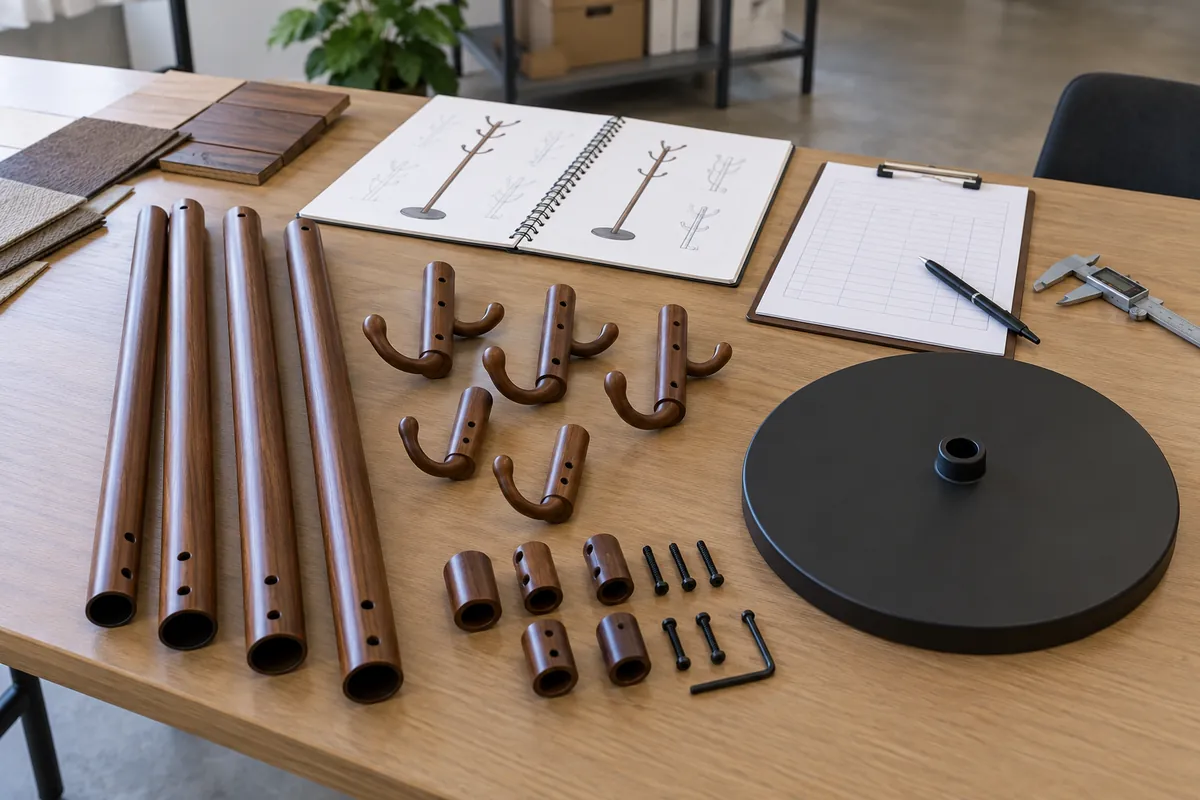
Product examples illustrate why buyers should keep information model-specific. Audo Copenhagen’s Afteroom Coat Stand page lists a particular material and hook configuration and links to product facts, drawings and assembly resources. Those details describe that SKU; they do not set requirements for another coat rack. A supplier’s metal coat-rack range also shows distinct base and accessory directions. Such commercial pages help buyers identify questions to ask, but they are not independent proof of stability or load performance.
How can importers check hook fit and garment clearance?
Define the intended hook and garment interface. Specify whether the target customer will use hangers, direct garment hanging, bags, hats or another stated combination. For hangers, identify the expected hanger shape or width range if that affects the product brief. For direct hanging, describe the garment types that matter to the assortment and note any delicate fabrics or features that should not snag. These are application inputs; do not claim a hook is suitable for every item without review.
On the sample, inspect hook tip shape, edge condition, projection, spacing, orientation and connection to the upright. Check that a representative hanger can be placed and removed without an adjacent hook or branch blocking it. Then arrange the intended combination of items and look for overlap, restricted retrieval or a layout that differs from the product image. If the SKU includes upper and lower hook zones, review each zone with the chosen items and the stated product orientation.
Treat spacing as part of the complete design rather than one number in isolation. The garment, hanger, hook shape, branch direction and neighboring items interact. The buyer should identify the fit condition that matters and use a representative sample or measurement reference to evaluate it. If the design changes after sample approval, review whether the hook count, position or orientation affects fit and the listing description.
What should be checked in assembly, joints and finish?
A flat-pack coat rack introduces a second approval question: can the buyer identify the included components and confirm that the approved version corresponds to the assembly information? Request a parts list, clear part identifiers, drawing or exploded view where appropriate, and the instruction revision intended for the retail unit. The review should note which parts are factory-assembled and which are supplied separately. This is a packaging and product-control check, not a consumer assembly tutorial.
Inspect the sample’s joints, connection points, threads, fastener engagement and alignment against the drawing. Record any visible looseness, gaps, misalignment, finish damage or mismatch as an observation with a defined disposition. Avoid vague comments such as “looks sturdy”; identify the part, location, revision and required correction. A buyer should also confirm that the same joints and components are represented in the approved production configuration.
Review finish and floor-contact components separately. Note the color or finish reference, which surfaces are visible, how the finish appears around joints and edges, and which feet or pads are included. If a product page will claim floor protection or resistance to wear, request supporting evidence for that specific claim and configuration. A visual check can compare appearance to a sample, but it does not prove long-term adhesion, floor compatibility, corrosion performance or wear life.
How should a buyer approve the flat-pack and retail version?
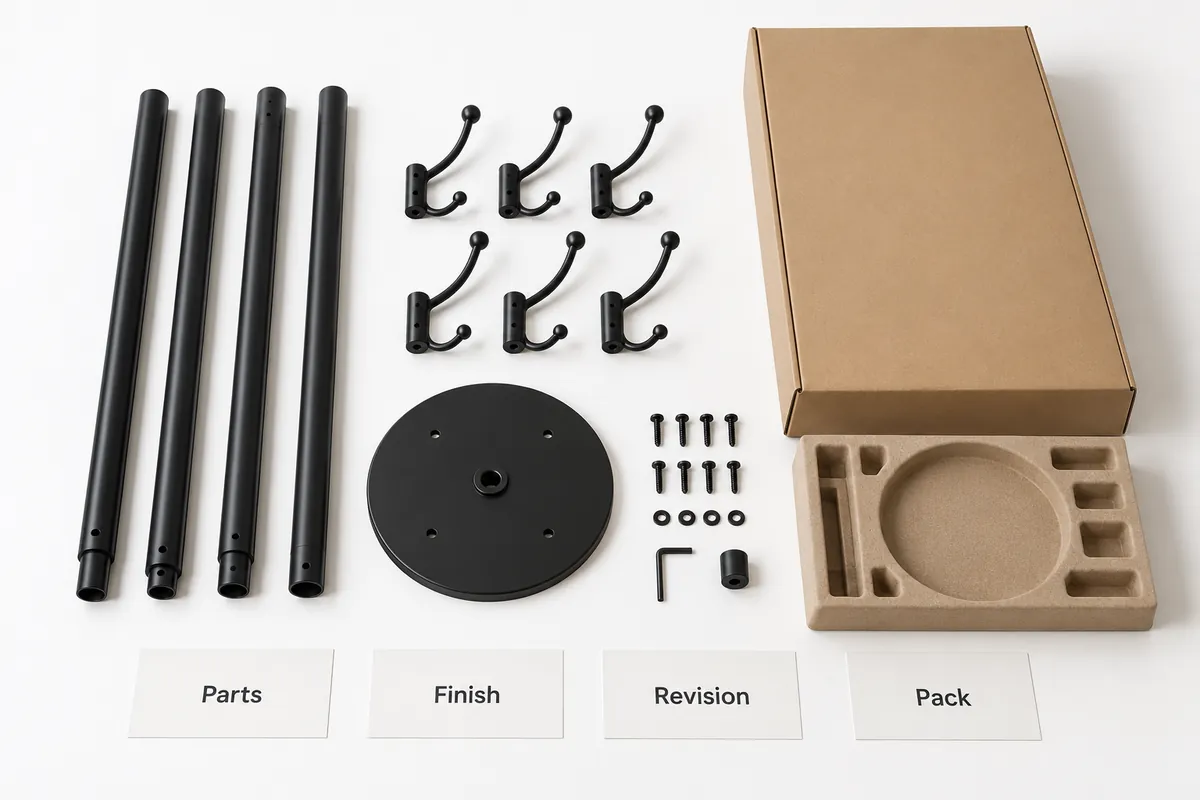
Ask for the final pack-out configuration, not only a product sample on a table. Confirm the carton dimensions and layout supplied for the intended SKU, how loose components are identified and contained, which surfaces are protected from contact, and what labels or instructions appear in the box. The packing plan should distinguish the base product from optional accessories. If the stand ships assembled, the buyer should approve that version and its transport arrangement as its own configuration.
Review the pack after the supplier has assembled the planned product set into its retail packaging. Check that the part list, instructions, label information and product description correspond to the same revision. If the buyer needs a claim about compact shipping, carton efficiency, scratch prevention or transit performance, define the evidence and acceptance criteria first; do not infer them from a flat-pack illustration or from carton dimensions alone.
Keep a sample-approval record that names the SKU, supplier, sample date, drawing revision, approved finish reference, bill of materials, packaging version and any open corrections. If a component, fastener, connector, coating, instruction sheet or carton changes after sign-off, ask whether the change alters fit, appearance, assembly, evidence or retail claims. Route that question to the buyer who owns the product specification and record the disposition before releasing the changed version. This simple change record supports repeat orders because it lets the receiving and quality teams compare the delivered SKU with the approved configuration instead of relying on an email thread or an unlabelled sample. It also makes it easier to separate a packaging correction from a design change that may require another sample review.
Common sourcing mistakes include:
- Approving a generic product image without freezing the SKU, drawing, finish and included components.
- Using “stable” or “heavy duty” without identifying the scenario and evidence behind the wording.
- Comparing quotes that include different hook layouts, bases, accessories or pack-outs.
- Treating a sample assembled from different parts as representative of the production version.
- Assuming one hook layout fits all hangers, garments and retrieval patterns.
- Accepting a supplier’s assembly instruction or part list without confirming its revision.
- Leaving carton, component identification and retail claims until after sample sign-off.
- Reusing another product’s load, stability or packaging claim without model-specific support.
A practical approval checklist is:
- Record the intended setting and the named coat-rack configuration.
- Confirm the drawing, bill of materials, sample ID and revision.
- Define the hook, hanger and garment fit questions for the target assortment.
- Review joints, finish, alignment and included floor-contact parts.
- Identify any stability or load claim and request evidence for the exact configuration.
- Confirm part identifiers, assembly-information revision and supplied components.
- Approve the production-intent retail pack, labels, carton and product description.
- Track open corrections and close them before purchase-order release.
How can a specialized OEM factory help with a new product brief?
Koitor Hardware is a family-owned factory and specialized OEM manufacturer focused on bathroom and home-storage hardware. Its approved company information supports general buyer education about metal-product drawings, samples, production discussions and packaging. It does not confirm that Koitor currently manufactures freestanding coat racks or provides coat-rack-specific stability tests, load ratings or certifications.
For a new metal product, a clear drawing or physical sample can help the buyer and a manufacturer discuss geometry, joints, surface finish, assembly interfaces and packing requirements against a defined revision. Small-batch production may be useful for assortment trials or product development when the request fits the factory’s verified capability and the buyer agrees on scope. Actual feasibility, materials, equipment, sample timing and quantity must be confirmed for the project; they should not be assumed from a neighboring product category.
A coat-rack request should therefore begin with a scope review. Share the product drawings or reference sample, target configuration, expected quantity, finish requirements, pack-out and any evidence required for buyer-facing claims. Koitor’s custom metal storage rack page describes its established category context. Buyers can use the contact page to submit a new project brief for review without assuming an unverified product capability.
Preguntas frecuentes
What does an importer need before approving a freestanding coat rack sample?
At minimum, align the product configuration, intended use, drawing and revision, hook and garment fit questions, assembly parts, finish, evidence requirements and retail pack. Keep the sample and its approval record tied to the same SKU and revision.
Does a heavier base prove a coat rack is stable?
No universal conclusion follows from base weight alone. The buyer should evaluate the complete product and the intended scenario using suitable model-specific evidence before making a stability or load claim.
Should coat-rack hook spacing use a standard measurement?
This research did not establish a universal spacing standard for the buyer’s range. Define the intended hanger or garment interface and check the named configuration with representative items.
What should be checked in a flat-pack version?
Confirm the parts list, component identification, assembly-information revision, included hardware, carton arrangement and buyer-facing description. The approved pack should match the approved product configuration.
Does Koitor currently make freestanding coat racks?
The approved company profile does not confirm coat-rack production. Koitor’s established focus is bathroom and home-storage hardware. A coat-rack request requires a separate capability and scope review before any supply claim is made.
Discuss a Metal Storage Product Brief
Have a new metal storage product brief?
Share a drawing or sample, target quantity, finish and packaging requirements. Koitor can first review whether the request fits its verified manufacturing scope.
OEM / MARCA BLANCA
Convierte esta guía de abastecimiento en un resumen del producto
Indícanos el producto que deseas, el tamaño, el acabado, la cantidad del pedido y los requisitos de embalaje. Tu equipo recibirá un análisis práctico de la viabilidad de fabricación antes de recibir el presupuesto.

 English
 Español
 Português
 Français
 Deutsch
 العربية