
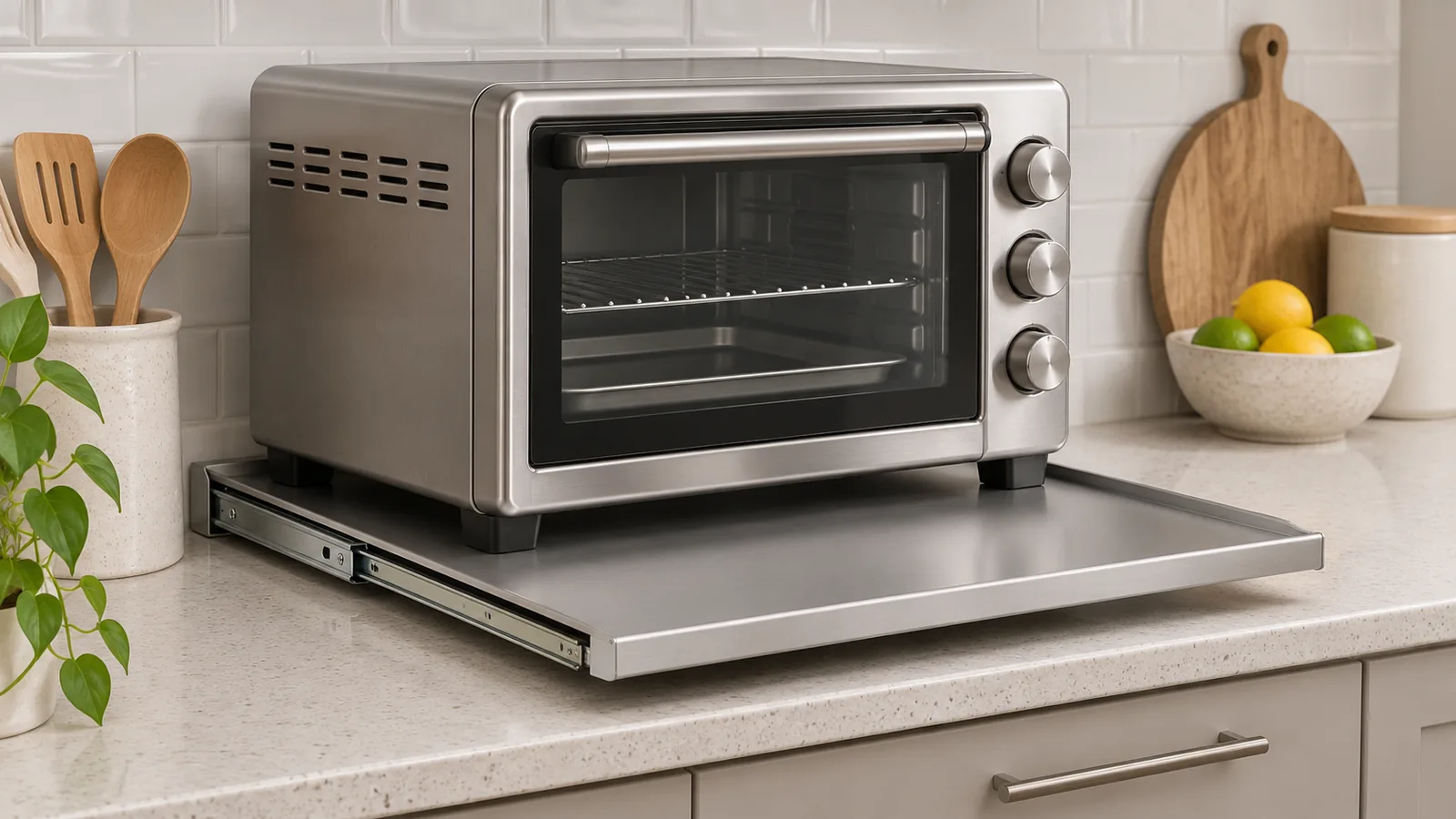
A countertop drawer with pull out shelf is not defined by the drawer alone. The buyer needs to define the appliance footprint, feet or base shape, intended shelf travel, counter clearance, installation method and how the appliance will be moved when the shelf is extended. Small differences in those interfaces can change whether a shelf is convenient, stable and compatible with the intended appliance assortment.
For a distributor, “fits under an appliance” is too broad to use as a reliable product claim. A product may accommodate one countertop oven or mixer but not another with a wider base, projecting feet or a rear cord. The practical development task is to state which configuration the sample represents and which limits should appear in the instructions or product page. This guide describes buyer checks for adjacent kitchen-storage hardware; it does not confirm that Koitor currently makes under-appliance drawers or pull-out shelves.
Define the appliance envelope and the purpose of travel
For this decision, record the countertop drawer with pull out shelf requirements in the controlled specification and sample review so the approved scope remains clear to purchasing, quality and the supplier.
Collect the exact appliance models expected in the product program before approving a frame. Record the overall width, depth and height, but also note the positions of feet, handles, doors, vents, cord exits and any protruding controls. A bounding box alone may miss the feature that prevents an appliance from sitting flat or makes it collide with a backsplash during movement.
Distinguish the appliance’s outside dimensions from the usable support area. A shelf may have a raised lip, side rails or a back stop that reduces the flat surface. If feet sit close to the edge, the usable area can be smaller than the outer width suggests. Place the actual appliance on the sample and confirm that all intended contact points sit on the support region with acceptable clearance around controls and ventilation openings.
Travel also needs a definition. Does the user pull the appliance forward only to reach items behind it, or must it move far enough to access a counter control, open an appliance door, or clean the surface below? The required travel affects rail length, overhang, exposed moving parts and the stability of the assembly. Do not infer full extension from a photograph. Measure the closed position, intended open position and any stop or retention feature on the sample.
The under-counter environment can vary between kitchens. Record the counter underside height, front edge profile, backsplash distance and adjacent cabinet or wall obstructions. A low appliance may fit below a cabinet when closed but hit the underside when the tray is pulled forward and tilted. A cord may also snag on the counter edge or adjacent object. Buyers should test the complete path rather than only the static closed configuration.
| Interface | Buyer input | Sample review |
|---|---|---|
| Appliance base | Model, footprint, feet and protrusions | Confirm all contact points land on the usable shelf |
| Shelf surface | Flat area, lip, rail and edge shape | Check that the appliance does not rock or catch |
| Vertical envelope | Appliance height and overhead clearance | Check closed and extended states |
| Travel path | Required extension and surrounding obstacles | Pull through the full intended movement |
| Power cord | Exit direction, length and bend path | Check for pinching, snagging and sharp edges |
| Counter contact | Intended attachment or placement condition | Confirm the sample matches instructions |
A current Yamajitsu under-appliance pull-out product example can help buyers identify one market configuration and its presentation. Its stated size and compatibility belong to that specific item. They do not establish universal appliance fit or a standard dimension for another supplier.
Compare the main configuration choices
Some products use a shallow pull-out tray on rails fixed beneath a countertop appliance. Others use a platform that supports the appliance from below and moves as a complete unit. A separate storage drawer may sit beneath the shelf or be integrated into the frame. These configurations may look similar in a listing, but the buyer’s questions differ.
A simple sliding platform can keep frequently used equipment near the front of a counter. It may also introduce a change in working height, vibration or cable movement. If the appliance is heavy, the user may need to pull it with one hand while stabilizing it with the other. Test the intended use rather than assuming that any smooth slide is convenient.
A configuration with a drawer adds a separate storage question: what items will be stored, how the drawer opens, and whether its contents affect movement or stability. A drawer used for light accessories differs from one that might hold dense items. Define its usable internal width, depth and height, stop position, handle clearance and any required organizer inserts. Avoid weight claims unless a separate agreed test supports them.
A pull-out shelf can also be offered as a platform for accessing an appliance that normally stays in place. Here, compatibility depends on both the appliance feet and the surface beneath the unit. A smooth or rounded foot may behave differently from a wide, flat base. If friction pads, retaining edges or straps are part of the design, identify the supplier and verify their placement on the actual sample. Do not assume that a metal tray alone prevents sliding.
Decide whether the product is freestanding, clamped, screwed to a cabinet, attached to an appliance or secured by another method. Each path affects installation instructions and the claim a distributor can make. For example, a product designed to sit on a counter should not be described as under-cabinet mounted. The bill of materials should name every fastener, pad or accessory and state whether it is included.
Review movement, stability and pinch points
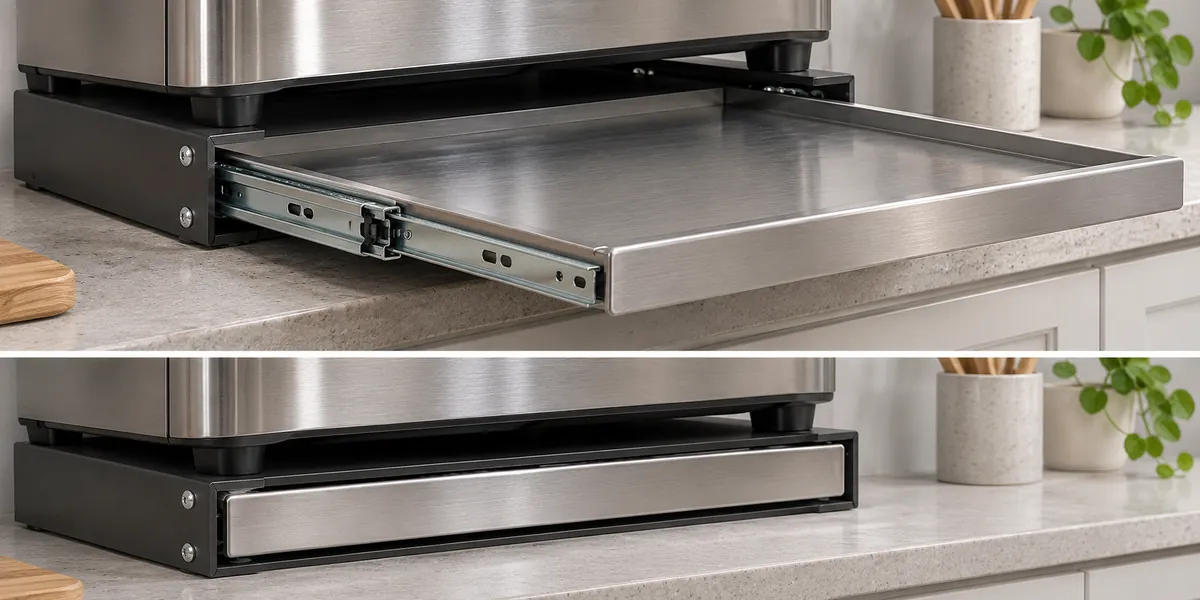
Operate the assembled sample with the appliance in place. Pull it slowly, pause at intermediate positions, then push it back. Observe whether the tray binds, racks sideways, lifts at one corner, drags on the countertop or moves the appliance. Record the direction and conditions of any movement. A single smooth pull with no load is not evidence for a loaded configuration.
Test the fully open state and the user’s likely grip. A short or narrow handle may cause a buyer to pull one corner rather than the center. That can twist the rails or skew a drawer. Check finger clearance around handles, stops and moving rails. If a gap closes during motion, ask the product engineer to assess it and determine whether an instruction, guard or design change is needed. Do not make a safety conclusion from a static photograph.
Check cord routing with the actual appliance. A rear-exiting cord can be trapped between the frame and wall; a side-exiting cord can catch a handle or adjacent object. The buyer should show the intended routing in the drawing or instructions, then repeat the movement at least several times during sample evaluation. This is a practical fit check, not a cycle-life test.
Consider the effect of the counter surface and edge. A polished stone top, laminate surface or textured worktop may interact differently with a freestanding base or rubber pad. If the product is fastened below the counter, confirm that the installation substrate and fastener are defined. Avoid asserting suitability for every counter material. The installation scope should tell the user what is required and what is excluded.
Create a repeatable sample-approval sequence
An approval record should identify the shelf drawing revision, the specific appliance model tested, accessories included and the intended installation location. Photograph the closed state, mid-travel state and fully extended state. Include a view from the side that makes overhead clearance and cord routing visible.
A practical check sequence is:
- Verify shelf dimensions, usable flat area, lip height and rail positions against the drawing.
- Place the lightest and heaviest representative appliances on the tray; check foot support and rocking.
- Confirm that vents, controls, handles and doors remain accessible as intended.
- Pull the loaded shelf through the complete travel path and observe skew, lift and obstruction.
- Check the cord path and adjacent surfaces in closed, mid-travel and open positions.
- Open and close any integrated drawer with its intended contents and record clearances.
- Review sharp edges, finish, contact pads and packaging protection.
- Record deviations, exclusions and changes that trigger a targeted retest.
These checks answer a sample-fit question. They do not establish long-term rail life, a rated load, anti-tip performance or safety compliance. If the buyer requires those claims, define the exact method, load, cycle count, installation, environmental condition and acceptance criteria separately. Ask for evidence linked to the same production configuration.
Manage assortment, carton and product claims
When a range supports several appliance sizes, create a compatibility matrix rather than a single broad promise. Include each tested model or dimensional envelope and list any restrictions such as handle projection, foot geometry, minimum cabinet height or required counter depth. If the product has multiple sizes, give each a separate SKU and identify the corresponding drawing and packaging.
Carton design can affect whether the shelf arrives aligned. Rails, trays, handles and detachable parts may need protection against scratches or deformation. Review the packaged sample for contact between metal parts and visible faces. If accessories are packed separately, label them clearly and confirm the instruction sheet explains their use. Do not make a drop-test or transit-performance claim unless that test was conducted for the agreed package.
A change to the appliance assortment may invalidate part of the original approval. A new appliance can change its weight, center of mass, feet, cord route or envelope. Reopen only the affected checks and record the reason, sample, revision and result. That keeps the buyer from treating an old fit decision as a guarantee for a different product.
For OEM sourcing, share drawings, physical references, finish requirements and target packaging. Koitor’s confirmed background covers custom metal bathroom and home-storage hardware, drawing- and sample-based development within current capability. The available company facts do not establish current production of under-appliance shelves. Confirm exact feasibility before treating this concept as a Koitor item. Buyers reviewing a relevant kitchen metal-organization project can explore the custom kitchen storage rack manufacturer page or use the contact page to describe the intended project.

Buyer checklist before placing an order
- Name the appliance models or dimensional envelopes used for fit approval.
- Record feet, vents, handles, door swing and cord exit in addition to outside dimensions.
- Define whether the product is freestanding, mounted or attached to another item.
- Confirm usable shelf area, required travel and overhead clearance.
- Test with representative appliances and intended accessories in the complete installation.
- Check loaded movement, cord routing, drawer operation and adjacent clearances.
- Specify what the carton includes and how rails and visible surfaces are protected.
- Align product-page fit claims, instructions, package artwork and approved sample.
- Identify which appliance or drawing changes require a targeted recheck.
Preguntas frecuentes
Is a countertop drawer with pull out shelf compatible with every appliance?
No. Fit depends on the shelf’s usable area, appliance footprint, feet, controls, vents, cord route, overhead clearance and intended movement. Verify the actual models or a defined envelope.
Should a buyer use appliance weight as the only fit criterion?
No. Weight may matter to structural review, but geometry and use path also matter. A lighter unit with widely projecting feet or an awkward cord can present a different fit issue from a heavier compact unit.
Does smooth rail movement prove the shelf is suitable?
No. Test the loaded sample in the intended location. A no-load movement check does not establish rated load, cycle life or behavior for every countertop and appliance.
Does a pull-out tray need to move fully beyond the counter edge?
That depends on the intended user task and configuration. Define the access goal and verify the whole travel path, including cord clearance, support and stability, rather than assuming one extension is right for every program.
Does this guide confirm Koitor manufactures these shelves?
No. It explains buyer specification decisions for an adjacent kitchen-organization product. Confirm current capability for the exact design before requesting a production commitment.
Discuss a Relevant Metal Hardware Project
Share the product scope, drawings or samples, quantities and requirements relevant to this decision. Koitor can clarify whether a metal hardware project fits its confirmed production scope. The countertop drawer with pull out shelf specification should state the intended interface and review conditions.
OEM / MARCA BLANCA
Convierte esta guía de abastecimiento en un resumen del producto
Indícanos el producto que deseas, el tamaño, el acabado, la cantidad del pedido y los requisitos de embalaje. Tu equipo recibirá un análisis práctico de la viabilidad de fabricación antes de recibir el presupuesto.
 English
 Español
 Português
 Français
 Deutsch
 العربية