

A buyer evaluating a separable table connector release clearance question should approve a complete interface across two independent table sections, not just a loose fitting. The decision includes the mating parts, the reference table edges and undersides, the intended joining motion, the supplier-defined separation method, and where the hardware sits when the tables are apart. A connector that appears to bring two edges together still may not suit the furniture geometry or the buyer’s handling routine.
This is a sourcing and sample-approval guide for importers, furniture-accessory distributors, hospitality project buyers, and private-label product managers. It is not an engineering certification, a furniture stability assessment, or an installation instruction. The buyer should obtain the current drawing and instructions from the supplier responsible for the connector and the furniture party responsible for the tables. Do not infer a load rating, safety lock, lifting method, or permitted fastener from an illustrative image or from a different product in the same catalog. For buyers assessing separable table connector release clearance, the controlling record is the approved configuration, supporting evidence, and named approval owner.
Why Does the Connector Need Three Separate Approval States?
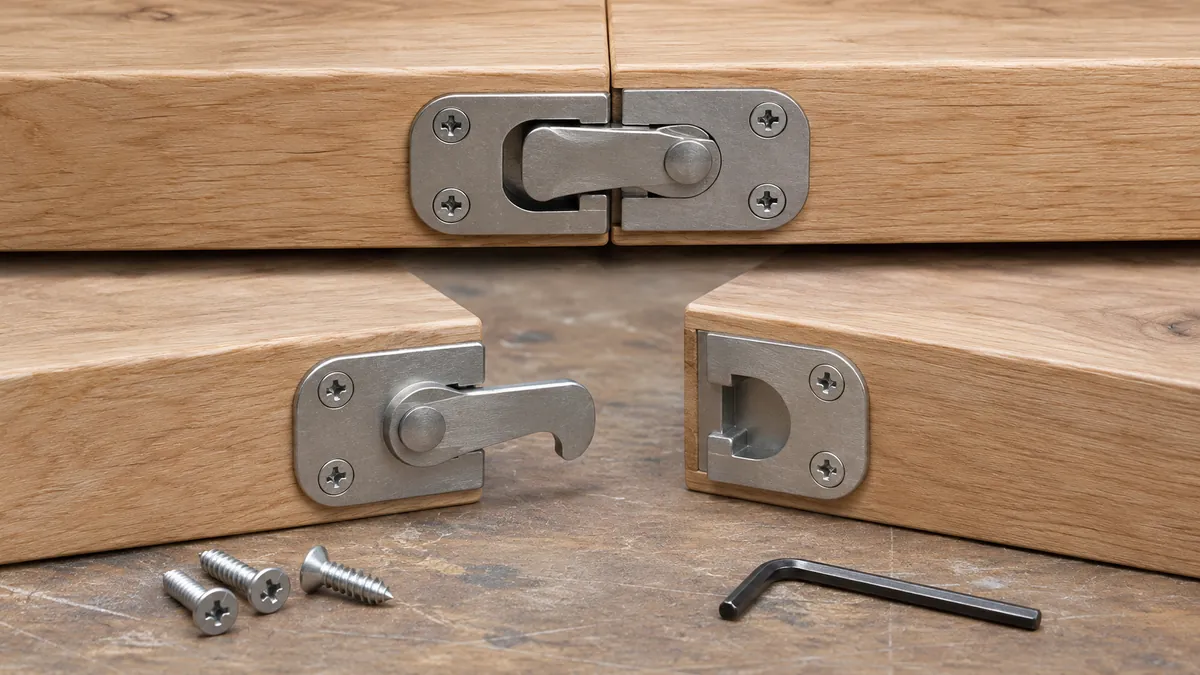
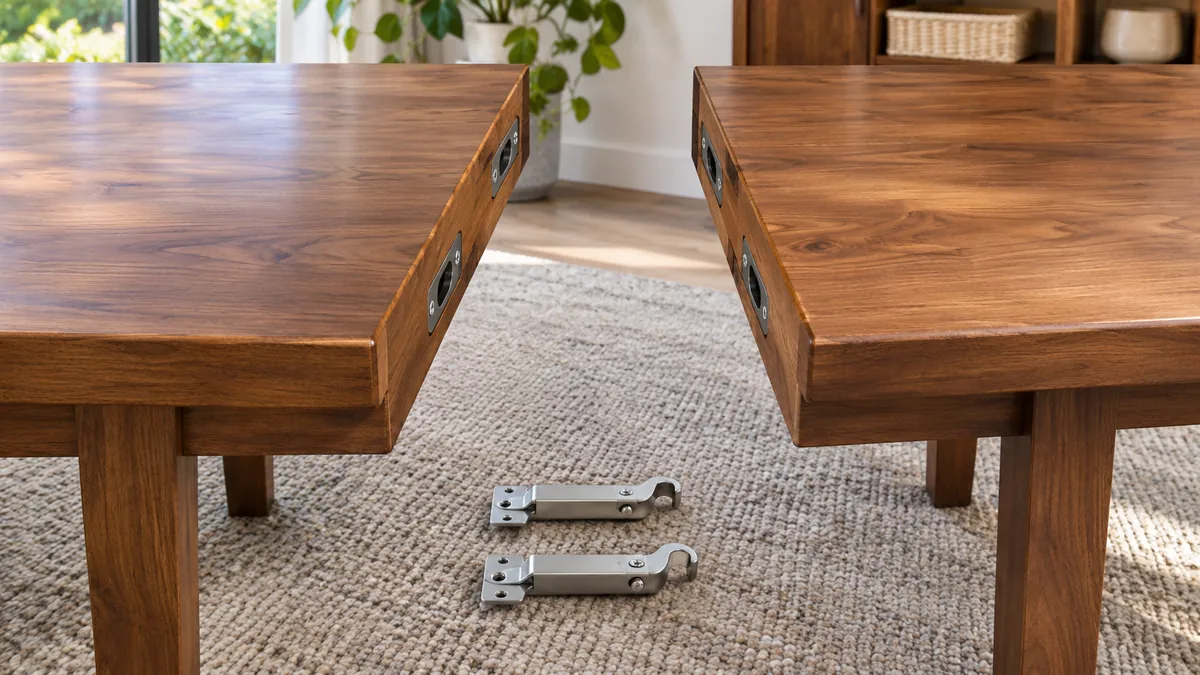
A connector can pass through three distinct states during its working life: two table sections are brought together and engaged; a person intentionally separates them using the supplier’s specified action; and the hardware is parked or otherwise kept clear when the tables are no longer joined. Each state answers a different purchasing question.
The joined state asks whether the two reference sections can be presented in the intended relationship and whether the connector parts engage as specified. The release state asks whether the buyer understands how the designated parties are expected to disengage the pair. The parked state asks whether loose, pivoting, or retained hardware has an agreed position when not in use. A sample that demonstrates only engagement has not answered the other two questions.
These distinctions are supported by a manufacturer-origin table-fittings catalog that describes one steel fitting’s snap joining, pull separation, and pivot-to-park operation. It also lists other fittings with different construction and operation. Those statements belong to the named models in that catalog; they should not be transferred to another connector or treated as current availability. See the Häfele table and furniture fittings catalog. Buyers should confirm the current model, drawing revision, components, and operating instructions directly with the quoted supplier.
A practical review separates observable facts from assumptions:
| State | Pregunta del comprador | Evidence to request or record | What it does not prove |
|---|---|---|---|
| Joined | Which mating components are intended to engage, and on which two table sections? | Part identities, current interface drawing, reference table geometry, and representative sample | A structural capacity, a safe lifting method, or compatibility with unlisted tables |
| Released | What deliberate action does the supplier specify to separate the pair? | Written operating instruction and a sample review by the responsible furniture party | That any person can release it safely or that a different model releases the same way |
| Parked | Where does each connector half or movable feature sit when tables are apart? | Underside or edge view, movement envelope, and stored-state sample | That the hardware clears every leg, frame, cable, or adjacent object in all applications |
The three-state approach also keeps the RFQ intelligible when more than one company supplies the table, connector, screws, inserts, or installation service. If each party assumes another owns the interface, a buyer may receive a fitting without a defined place, counterpart, or use condition. Assigning responsibility early is part of specification control, not bureaucracy.
Define the Reference Pair Before Comparing Quotations
A connector’s identity is incomplete without the furniture it is intended to connect. Before asking suppliers to quote, define a reference pair. Include the table type, edge relationship, underside construction if known, and whether the sections are intended to sit edge-to-edge, with a deliberate gap, or in another supplier-defined arrangement. Identify whether the tables are identical, mirrored, or different sizes. Include the revision of each drawing.
The purpose is not to send a supplier an exhaustive furniture engineering file when it is not needed. It is to prevent a supplier from assuming a geometry that the buyer did not intend. A table pair might have an apron or frame close to the edge, a support located under the proposed connector, or a top construction that limits where a fixing can be considered. Those facts can affect the interface review. If the buyer does not know the construction or fixing owner, record the unknown and ask the furniture maker to resolve it rather than guessing.
A useful RFQ reference record contains:
- A product or project identifier for each tabletop and its revision.
- A plan view showing which edges face one another.
- An underside view identifying visible supports, aprons, frames, or obstructions.
- The intended presentation: flush, separated by a specified design gap, or still under review.
- The connector supplier’s model or proposed component pair, if already identified.
- Which company supplies each connector component and any fastener kit.
- The party responsible for approving the tabletop construction and any proposed fixing.
- The expected table arrangement and the states in which the connector is used.
The record should distinguish buyer-provided dimensions from supplier-confirmed dimensions. A photograph can help show orientation, but it cannot replace a controlled drawing when a precise relationship matters. If a supplier marks up a drawing, preserve the revision and date so the agreed state can be found later. Do not merge different model references into a generic phrase such as “standard connector.”
For a distributor assortment, the reference pair is a baseline, not a promise that one connector fits every table. A product family may involve different counterpart pieces, mounting arrangements, or movement patterns. The buyer should ask which variants are interchangeable only when the supplier’s documentation confirms that fact. Similar appearance is not a reliable substitution rule.
Specify the Joining State Without Turning It Into a Strength Claim
During a joined-state review, identify the exact components that meet and the way the supplier says they are engaged. Record the order of presentation, any orientation marks, and the visible result that the responsible parties intend to approve. If the supplier describes a snap, hook, slot, pivot, or other mechanism, preserve the supplier’s model-specific terms. Do not relabel a retaining feature as a lock unless the responsible supplier explicitly identifies it as one and provides the relevant evidence.
A sample review can establish whether the supplied components are present and whether they can be arranged as the drawing indicates under the reviewed conditions. It can help reveal obvious mismatches between the proposed connector position and the reference furniture. It does not establish a structural rating, fatigue life, permissible handling load, or suitability for a particular venue. Those claims require evidence from the party competent and responsible for the complete furniture system.
The buyer should document observable acceptance points, for example:
- Correct part identities and quantities are present in the sample kit.
- The two intended table sections are identified and oriented correctly.
- The supplier-specified mating sequence is understood by the reviewers.
- The interface appears in the intended position on the sample reference pair.
- Any visible gap, offset, or movement is compared with a defined design expectation rather than an invented universal tolerance.
- The connector does not occupy an area that the furniture drawing reserves for another component.
- The sample’s fasteners and attachment items are identified as supplied, excluded, or still undecided.
- Open questions are assigned to the connector supplier, furniture maker, buyer, or installer.
Avoid turning visual fit into an unqualified performance statement. “The parts engaged in the reviewed sample” is a bounded observation. “The tables are locked together,” “the joint is safe,” or “the fitting carries the assembled furniture” are much broader conclusions and should not be published or placed in an order specification without appropriate substantiation.
Where the connector is expected to align two sections, ask which part establishes alignment and which part merely retains a relationship. An interface can permit some movement or depend on the table geometry. The buyer should not expect a connector to correct a misaligned frame, uneven floor, warped top, or dimensional variation unless the responsible engineering party has defined that function. Record what the supplier says the fitting does, what it does not do, and what the furniture structure must accomplish independently.
Review the Release Motion as a Buyer-Controlled Procedure
Release must be more specific than “removable.” Ask the supplier to describe the intended action using the actual sample: which side is approached, which component is moved, in what direction the separation occurs, and whether the tables must first be unloaded, supported, repositioned, or handled by designated personnel. These are questions for the responsible supplier and furniture team to resolve, not instructions for an unqualified reader to improvise.
A connector that separates by pulling, lifting, sliding, turning, or pivoting may require different access and clearance. A buyer should not assume these actions are interchangeable. A mechanism that is easy to connect could require space beneath a top to release. A connector that pivots away might have a different parked location from a loose part that must be removed and stored. Each behavior changes the kit, packaging, instructions, and inventory implications.
For sample approval, use a written review protocol supplied or confirmed by the connector and furniture parties. The protocol should identify the sample revision, the reviewers, the approved table pair, and the operation being demonstrated. If the supplier’s instruction is missing or ambiguous, hold the sample approval and request clarification. Do not create a pull-force test, cycle test, clearance tolerance, or ergonomic criterion by guesswork. Any prescribed measurements or performance tests must come from the accountable technical party or the buyer’s approved specification.
A release record might capture:
- The supplier’s name and exact connector model.
- The drawing and operating-instruction revisions.
- The table pair and its revision.
- The specified release direction or sequence, using supplier terminology.
- Whether another component must be moved or removed first.
- Any table support or handling step required by the furniture owner.
- Whether the demonstration is a visual check, a fit check, or a separate engineering evaluation.
- The unresolved risks and the party expected to answer them.
This procedure prevents a common documentation gap: the catalog explains a component’s nominal operation, while the distributor’s customer needs a consistent pack, instructions, and service answer. The importer should not add unverified consumer instructions. Instead, it should decide whether the supplier’s documentation is complete for the product being sold and whether translations, diagrams, or customer support materials need approval.
Treat the Parked Position as Part of the Product Envelope
When the tables are apart, the connector still occupies space. It may stay on one tabletop, pivot under it, be removed and placed in a bag, or remain attached to another component. The correct condition is model-specific. Record the actual stored position and check it against the underside and edge envelope of the reference table. Include the movement path if a component pivots or slides.
The check should be done with the relevant table structure represented. A tabletop-only board may omit an apron, cross-member, frame, leg, cable tray, or folding hardware. If these items are absent from the sample, label the review as preliminary. The buyer should request an underside view or a furniture sample that includes the nearby obstructions before declaring the parked state approved.
A simple parked-state matrix can make the review actionable:
| Question | Example record | Owner |
|---|---|---|
| Does the connector remain attached? | Retained on table A; table B has the mating piece | Connector supplier confirms model behavior |
| Where does it sit when unused? | Position shown in supplier drawing revision and sample photo | Supplier proposes; furniture maker confirms envelope |
| What moves to reach that position? | Pivoting feature or removable counterpart, as supplier specifies | Supplier defines; buyer reviews instructions |
| What can it approach or contact? | Apron, frame, leg, folding feature, cable, or adjacent stored item | Furniture party validates with complete geometry |
| What happens to loose parts? | Included in a labeled kit, retained, or separately stored | Buyer and supplier agree packaging and BOM |
| Is the review complete? | Full reference structure present or preliminary tabletop-only review | Buyer records status and open actions |
The table does not create a universal clearance standard. It prompts the parties to identify what needs to be checked. If an item could contact another part, the buyer should ask the responsible design party whether the intended state is acceptable. Do not claim that a visual review proves pinch safety, snag resistance, or long-term durability.
The parked state also influences logistics and service. A detachable counterpart that is small enough to be separated from the table can be lost, mixed across variants, or omitted from a replacement order if it lacks a clear part identifier. A pivoting component may need protective packaging so that it does not scratch the finished surface or become trapped against another part in transit. These are packaging and configuration questions to confirm with the supplier, not evidence of a particular failure rate.
Make Fixings, Responsibilities, and Evidence Explicit
A connector quotation should identify what the supplier is pricing. Ask whether the quoted item includes the mating counterpart, any movable portion, fasteners, inserts, cover pieces, or only the metal fitting. If another supplier provides the table or fixing system, identify the interface and the party that approves the attachment. A buyer should not assume a screw supplied for one furniture construction works in another.
The drawing package should show the location and orientation proposed for the connector, but the competent furniture party must approve whether that location and fixing suit the table. The buyer’s review can check whether the drawing and sample refer to the same model and revision. It should not prescribe screw penetration, torque, edge distance, or substrate capacity without a valid design basis. These factors depend on the table construction, attachment method, material, and supplier instructions.
A responsibility matrix is useful when a buyer coordinates multiple suppliers:
| Decision | Connector supplier | Furniture supplier | Importer/distributor |
|---|---|---|---|
| Identify connector components and model revision | Provides current product information | Confirms interface received | Keeps approved item reference |
| Define intended engagement and release | Provides model-specific instructions | Confirms operational fit within furniture use | Ensures instructions and product record match |
| Approve attachment to table construction | Provides fitting information within its scope | Owns table structure and proposed fixing | Routes the review and records sign-off |
| Confirm joined and parked geometry | Supplies connector drawing/sample | Supplies complete table geometry | Ensures all variants are represented |
| Establish performance claim and evidence | Supports only its documented component claim | Owns whole-furniture/system claim as applicable | Avoids broader marketing claims than evidence supports |
| Manage revisions and replacement parts | Identifies changed component/model | Confirms furniture compatibility | Updates SKU, BOM, images, and instructions |
A buyer may be the coordinator without being the technical approver. That distinction matters. If the importer owns the product description but neither supplier confirms the complete application, the importer must avoid claims that the evidence does not support. The selling page should describe verified components and limitations accurately.
The buyer should ask for evidence matched to each claim. A catalog page can show that a model is offered and describe a stated operation. A drawing can document geometry. A sample can demonstrate a configuration under observed conditions. A test report can address only its defined method, specimen, and result. None should be treated as proof for a different model, table construction, or complete furniture assembly.
Build the SKU and RFQ Around Controlled Variants
A distributor’s task is to create a stable assortment that can be quoted, replenished, and explained. A connector family can have several forms that look similar but differ in counterpart, mounting, operation, material, finish, or package contents. Each difference should be treated as a controlled variant until the supplier confirms interchangeability.
For each proposed SKU, the product record can include:
- Buyer-facing product name and internal SKU.
- Connector supplier, exact model, and revision.
- Mating component references and quantities.
- Intended use with a named table family or approved reference pair.
- Joining, release, and parked-state drawings or photos.
- Supplied and excluded fasteners.
- Material and finish only as verified for the quoted model.
- Package contents, labels, and instruction revision.
- Any applicable exclusions and open technical approvals.
- Replacement-part cross-reference and the evidence behind it.
Avoid combining data from adjacent rows in a catalog. The K1441 research pack specifically warns against transferring loading language from a neighboring model to the fitting under review or transferring material properties from a distinct product family. A catalog may describe several products on one page. The model identifier is the boundary for claims. If the supplier cannot confirm that a stated attribute applies to the quoted SKU, keep it out of the product copy and ask for written confirmation.
A request for quotation should also state what is not yet known. For example, a buyer may be evaluating connector style before the table designer has finalized the underside layout. That can be a preliminary price inquiry, but it should not be represented as a final compatible configuration. Ask suppliers to separate the component price from any optional work or purchased parts only if they can quote that breakdown. Do not suggest that tooling, certification, manufacturing methods, or lead times are included unless the supplier confirms them.
Change control matters after approval. A change in connector model, counterpart, finish, fixing, table underside, or operating instruction can affect the approved relationship. Define which changes require renewed review and who must authorize the revision. Keep the approved sample, annotated drawing, BOM, and packaging record linked to one revision. This avoids treating a retained sample as approval for a later combination.
Create a Sample Review That Can Be Repeated
A sample review is useful only when another reviewer can tell what was examined. Record the sample date, model, supplier, drawing revision, table pair, reviewers, parts present, and the exact states observed. Photograph the joined arrangement, the supplier-demonstrated release configuration, and the parked state. Label images as illustrative evidence of that sample, not as proof of every variant.
A repeatable review can follow this sequence:
- Verify the sample parts against the proposed BOM and package list.
- Confirm the table references and revisions match the review plan.
- Ask the supplier to demonstrate the specified joining state using its instructions.
- Record what the connector visibly does and which facts remain unverified.
- Ask the supplier to demonstrate its intended release operation.
- Review the parked state against the complete underside and edge envelope.
- Record interference questions, missing context, or mismatched variants.
- Assign each open action to a named party and a due date.
- Save the accepted sample reference and document revision together.
- Reopen the review if the model, furniture, fixing, or instructions change.
Do not add an arbitrary pass/fail threshold. If an assembly feature is supposed to sit flush or align within a defined range, the responsible design specification should state that range and how it is measured. If the specification does not exist, record a design question rather than inventing a number. This protects the buyer from presenting a subjective impression as a technical acceptance criterion.
The sample is also not a substitute for whatever whole-furniture qualification the table manufacturer or project owner requires. If the application involves commercial seating layouts, temporary event setups, transport, storage, or frequent reconfiguration, ask those responsible parties to establish applicable use conditions and evidence. The connector supplier may not own the complete table design, and the distributor should not make that assumption on the supplier’s behalf.
Questions Buyers Should Resolve Before Purchase
Does a successful joined sample prove structural capacity? No. It shows a particular sample configuration could be arranged as observed. Structural capacity and system suitability require evidence tied to the exact connector, furniture, attachment, and use conditions from the responsible technical party.
Can a connector be specified by photograph alone? A photograph can communicate an appearance or point to a reference item. It does not reliably define the mating parts, dimensions, fixing, revision, or intended operation. Use an identified model and controlled drawing or written supplier confirmation.
Is the release motion the same across all separable connectors? No. The research pack’s manufacturer-origin catalog describes more than one fitting and distinguishes their constructions and operations. The buyer must preserve model-specific instructions rather than generalizing from one mechanism.
Does “parked” mean the component is automatically clear of the entire table? No. It describes the agreed unused position that must be reviewed against the actual underside, edge, frame, and nearby hardware. The buyer and responsible furniture party determine whether the represented geometry is acceptable.
Can a load statement for a neighboring catalog item be applied to the quoted connector? No. A statement belongs to the model and conditions that the source identifies. Ask the supplier for the exact evidence and model mapping before using any performance claim.
Who approves the fixing? The party responsible for the table construction and attachment design should confirm the fixing arrangement. The connector supplier should identify its supplied parts and interface information. The importer coordinates and records, but should not invent installation parameters.
A Practical RFQ Decision
Before comparing quotations, prepare a reference pair and ask each supplier to identify the exact connector set, the joining state, the specified release action, and the parked state. Require current drawings and instructions for the quoted model; list supplied and excluded parts; name the furniture party that approves the attachment; and record which claims have evidence. Use a representative sample to compare the documented states against the complete table geometry. Hold the decision when a counterpart, fixing owner, release instruction, or parked position is unclear.
A clear separable table connector release clearance specification is therefore a controlled relationship, not a standalone noun in a line-item description. It helps the importer compare like with like, control variants, and prepare an accurate distributor record. It does not certify the complete furniture system or guarantee that one fitting suits every table. When a project also involves bathroom or home-storage metal hardware, Koitor’s verified scope can be reviewed through its OEM home-storage hardware information; for this adjacent connector application, share drawings or a reference sample through Página de contacto de Koitor so the team can assess whether the request fits its confirmed capabilities.
Trabaja con Koitor Hardware
Discuss an Adjacent Metal Hardware Scope
Koitor’s confirmed focus is bathroom and home-storage metal hardware. For an adjacent product, share a controlled drawing, representative sample and any bought-in component scope so the team can assess whether the request fits its confirmed capabilities. This review does not imply that the complete product is currently manufactured.
OEM / MARCA BLANCA
Convierte esta guía de abastecimiento en un resumen del producto
Indícanos el producto que deseas, el tamaño, el acabado, la cantidad del pedido y los requisitos de embalaje. Tu equipo recibirá un análisis práctico de la viabilidad de fabricación antes de recibir el presupuesto.
 English
 Español
 Português
 Français
 Deutsch
 العربية