
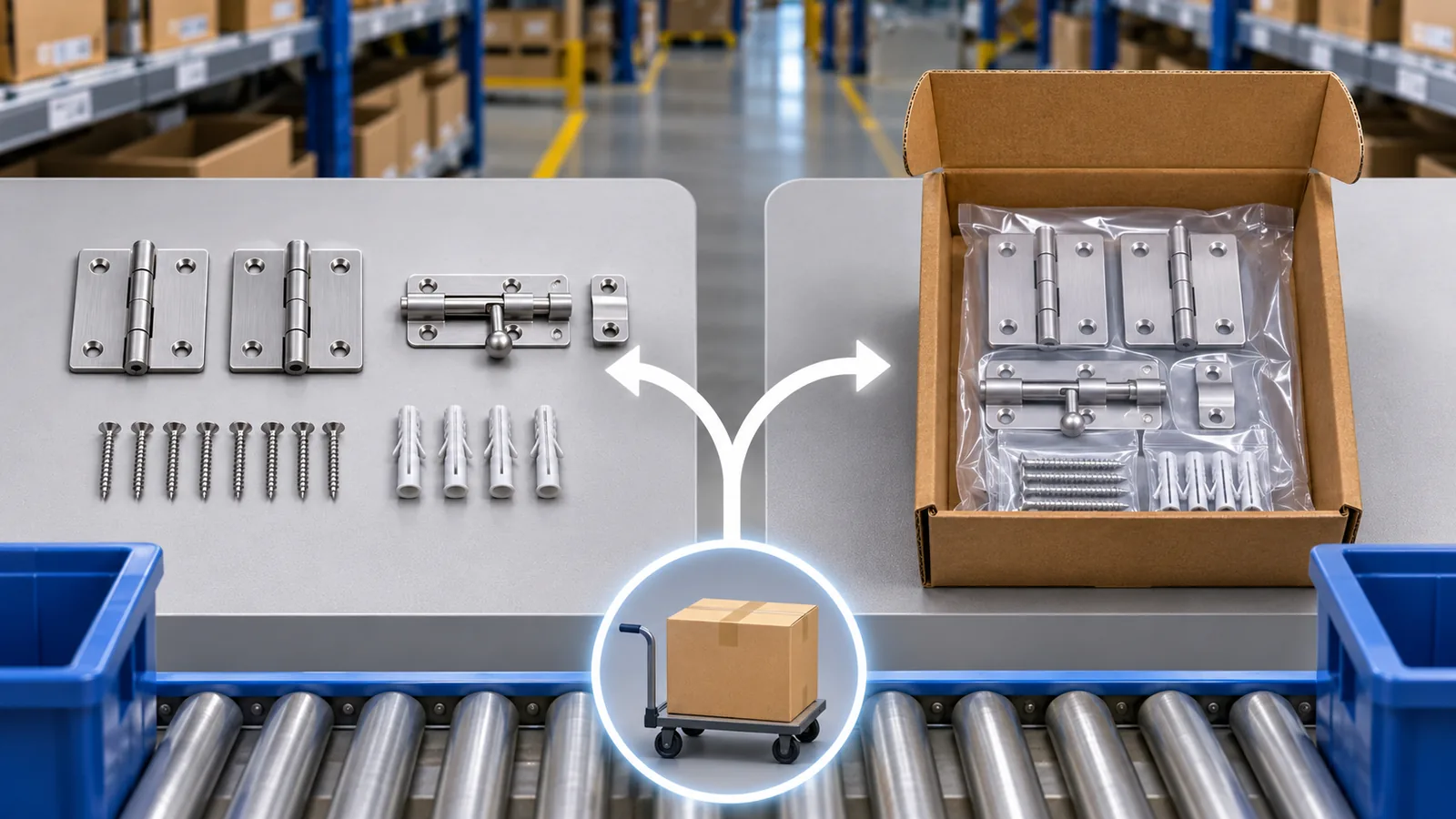
For importers deciding between physical vs virtual product bundles, separate the offer customers see from the unit the factory assembles, packs, and ships. An online listing can group several separate products into one offer while a fulfillment operation picks them independently; a physical bundle is prepared as a combined unit before it is offered or shipped as such. Platform rules, retail requirements, and product identity policies vary, so the buyer should state the intended commercial offer and physical pack-out independently in the supplier brief. Physical vs virtual product bundles require different inventory, labeling, and pack-out controls. A physical vs virtual product bundles decision should be reflected in the SKU and channel instructions.
What is the difference between a physical bundle and a virtual bundle?
A physical bundle is assembled or packed as a defined unit before it reaches the next fulfillment stage. Its components may be placed in one carton, bag, tray, sleeve, or kit package, with one bundle identity or a defined set of component identities. The precise structure depends on product design and the recipient’s requirements. For a hardware example, a towel ring, robe hook, and mounting kit could be physically prepared together if the buyer requests that configuration and confirms the contents.
A virtual bundle is a grouped commercial offer that may remain a set of separately stocked products until an order is fulfilled. Depending on the platform or seller’s process, the items may be picked separately and shipped in one or more parcels, or gathered at a fulfillment point. The word “virtual” does not guarantee that a particular platform will combine the items into a single parcel, preserve a specific seller’s inventory logic, or allow every assortment. Platform eligibility and operating rules must be checked for the seller’s account and market.
The key difference for an OEM factory is the physical production and packaging instruction. A factory can only pack what is specified and agreed. “Sell these items as a set online” does not say whether the components should be assembled at the factory, packed together in a master carton, shipped as separate SKUs, labeled as a kit, or left for the importer’s fulfillment partner. Those choices change bill of materials, packing steps, inspection points, packaging materials, carton dimensions, labels, and sometimes product identification.
GS1’s guidance on multi-packs and bundles distinguishes product identification considerations in its own standards context. It does not replace a retailer’s or marketplace’s current account-specific rules. The buyer should confirm the relevant product identity and trade-item requirements directly for the intended supply chain. See GS1’s guidance on bundles and multi-packs.
| Buyer concept | Physical bundle | Virtual or offer bundle |
|---|---|---|
| Customer-facing offer | A combined set is sold as a defined unit | Multiple separate products are grouped into one offer |
| Factory action | May assemble, bag, box, label, or kit components | May pack each SKU separately unless buyer specifies otherwise |
| Inventory identity | Bundle may need its own item identity under relevant rules | Components may retain separate stock identities |
| Fulfillment | A prepacked unit can be picked as one unit | Fulfillment process may pick components individually |
| Carton configuration | Defined by the approved pack-out | May vary by order or fulfillment provider |
| Main buyer instruction | List every included component and pack condition | State that offer grouping is commercial only and name the physical dispatch units |
Amazon’s public bundling article describes physical and virtual bundle options in its selling context, but current eligibility, marketplace workflows, and account limits can change and should be confirmed in the seller’s own account. The transferable buyer lesson is limited: an online grouping and a precombined physical pack are distinct operating decisions. Refer to Amazon’s product bundling overview for that platform’s described options, not as a universal factory or retailer standard.

What should the factory pack-out instruction say?
A complete pack-out instruction names the physical unit that must leave the factory. Begin with the bundle or SKU identity and list every included component, quantity, fastener, insert, instruction sheet, label, and protective material. If a component is intentionally excluded, state that clearly. The factory should not infer contents from a product photograph, e-commerce title, or marketing copy.
Clarify who combines the items. The factory might assemble components before packing, place separately packaged items into one outer carton, or ship products as independent retail units that a distributor later groups. Name the responsible party and the handoff location. “Bundle set” by itself does not identify the assembly owner. If an e-commerce fulfillment center creates the set, the factory’s shipping configuration may need to support separate pickable SKUs rather than a finished retail kit.
State the physical packing hierarchy. For example: component item → inner package → retail set carton → master carton → pallet or shipment unit. Not every project uses every level. Identify whether the buyer needs one retail-ready bundle, multiple individual units in a wholesale carton, or a mixed-SKU shipment. Define quantities at each level and how the packages are labeled. This prevents the quantity “one” from being interpreted as one accessory, one retail set, or one master carton.
Describe the assembly state. A physical bundle could contain products fully assembled, partly assembled, or unassembled with a shared fastener kit. The chosen state affects labor, protection, inspection, and customer instructions. If the factory combines items that were previously separate, review whether the components can damage one another in transit. Metal edges, hooks, mounting plates, screws, and decorative finishes may require separators or individual wrapping. The bundle should be checked as packed, not only as loose components.
Specify component substitution rules. If one finish or part is unavailable, should the factory hold the bundle, ship a partial set, or request approval for a substitute? Do not silently replace an item based on a similar appearance. Identify whether substitutions are prohibited or require written authorization. Include the revision or SKU identifiers that distinguish accepted components from a previous assortment.
The instruction should also state what evidence the factory returns. A buyer may request a pack-out sample, photos of each layer, carton dimensions and gross weight, a component checklist, or a label proof. The sample should represent the intended production state. A photograph can document contents but does not prove the quantity, protective performance, barcode quality, or platform compliance by itself.
A pack-out matrix helps convert marketing language into an executable order:
| Campo | Buyer instruction example |
|---|---|
| Offer name | Customer-facing name for the set; not an assembly instruction |
| Bundle/SKU identity | Buyer-approved identifier for the physical or virtual offer |
| Included items | Component SKU, quantity, finish, revision, and pack state |
| Assembly owner | Factory, importer, distributor, or fulfillment provider |
| Factory dispatch unit | One combined retail pack, separate retail units, or bulk components |
| Inner protection | Individual bags, separators, edge guards, or other approved materials |
| Shared hardware | Fastener type, quantity, and whether it is a shared or component-specific kit |
| Printed materials | Installation instructions, language, label, and revision |
| Carton hierarchy | Units per inner pack, retail pack, master carton, and shipment unit |
| Pruebas de aprobación | Sample, checklist, photo set, label proof, and approver |
How should SKU and product identification work?
Product identification should match the actual item and pack configuration. A commercial offer containing several separate SKUs may not have the same identity as a factory-prepacked bundle. Whether a combined pack requires a new identifier depends on the buyer’s supply chain and the applicable identification rules. The buyer should confirm with GS1, the retailer, marketplace, or recipient that controls the item data. A factory should not invent or reassign the buyer’s identifiers.
Keep component identities available even when the components are packed together. The buyer may need to replenish one item, investigate a shortage, service an individual component, or change the assortment later. The bundle identity should point to a controlled component list and revision. If a physical kit has a shared carton label, the component SKUs should remain traceable in the packing record where the buyer’s system requires it.
Define how the offer changes when components change. A revised hook, finish, fastener, or instruction may change fit or customer expectations. The buyer should decide whether the bundle remains the same item identity, needs a new revision, or requires a new listing or identifier under the relevant channel’s rules. Do not treat a component substitution as purely a factory matter if it changes the set the customer buys.
Make labels correspond to the unit that is scanned and shipped. If the factory carton is the retail unit, identify the bundle at that level. If each component remains individually sold, each component package may need its own label while the master carton uses a separate shipping label. If an importer later creates a bundle, the factory should not print a finished-set label unless asked. This division prevents duplicate, conflicting, or inaccurate item labels.
Use a current, approved data sheet for names, dimensions, finish, included items, and warnings or installation information. The product listing and factory bill of materials should agree on what is in the set. A virtual offer can create a customer expectation that all products arrive together; if fulfillment may split delivery or substitute stock, the seller should make sure its customer-facing claims are accurate for that program.
How should a buyer compare factory and fulfillment options?
Compare the full route rather than the unit price alone. A factory-prepacked kit may add assembly, inspection, protective inserts, a larger carton, and a new label. A virtual offer may reduce factory kit work but require the importer or fulfillment provider to coordinate stock across several SKUs. Neither is automatically less expensive or more reliable. Model the relevant work and controls for the buyer’s actual channel.
Ask the factory to quote the same physical scope under alternative scenarios. Scenario A could be separate individually packaged units in a master carton. Scenario B could be one combined retail bundle. Scenario C could be components shipped separately to a fulfillment center for final grouping. For each, specify quantities, packaging, labels, inspection, cartons, and documentation. Do not compare one scenario’s retail-ready pack against another scenario’s bulk component price.
Check whether the bundle components are manufactured or sourced on the same timeline. If one accessory has a longer lead time, physical kitting can hold the entire set until every component is ready. Separate SKU inventory can sometimes allow partial fulfillment, but that depends on the buyer’s process. Establish a rule for partial sets, backorders, and substitutions. The supplier should not ship a bundle missing an item unless the buyer approves that outcome.
Review packaging protection and carton fit with the actual parts. A towel bar, ring, and hooks have different shapes and contact points. A shared carton can reduce package count but create contact damage if internal dividers do not separate plated or coated surfaces. A smaller carton may improve handling but compress protective material or make unpacking difficult. Request a production-intent pack-out sample and inspect the items after they are removed.
Consider downstream labeling and receiving. Warehouse employees need to know whether one carton represents a single bundle or multiple individual items. The packing list should use the same unit of measure as the order and label. If a customer orders one bundle but the fulfillment record counts three component units, establish how those identities map in inventory. Reconciliation should not depend on staff remembering an undocumented conversion.
A brand selling across multiple regions may have different language, instruction, label, or assortment requirements. A physically prepacked bundle may need different pack variants for each market. If the components are identical but paper inserts vary, state how inserts are controlled and which revision is allowed. Do not mix localized instructions or labels in a bulk run without a clear segregation plan.
How can buyers prevent bundle errors in sampling and production?
Use a structured sample approval. First approve the component list and revisions. Then verify that each component fits its intended function and that the shared hardware is complete. Next inspect the assembly or packing sequence, protective materials, printed information, bundle label, carton, and shipping unit. Finally, ask someone unfamiliar with the design to unpack the sample and confirm that the pieces and instructions are understandable.
Count the contents in the sample. A pack can look complete while missing a small screw bag, wall plug, instruction card, or one component. The component checklist should state quantity by item, not merely “accessories included.” If shared fasteners are used across several products, make sure the quantity matches the intended installation and does not depend on a customer borrowing parts from another package.
Review whether small hardware is controlled as a separate pack. Labeling should identify screw type, count, finish if relevant, and intended component where ambiguity could cause misassembly. Avoid placing visually similar parts into one unsorted bag if the user needs different sizes or drives. The factory’s packing instruction should state whether items are mixed, separated, or individually labeled.
Have the approved sample signed off by the functions that own the result. Product development may approve function, purchasing may approve commercial scope, quality may approve checks, packaging may approve protection, and the channel owner may approve labels or item data. One person can coordinate, but the record should make unresolved decisions visible. A sample with a pending label or substituted component is not complete for that specific approval.
Before mass packing, confirm the production traveler or pack-out sheet carries the same bundle revision as the approved sample. If a component, finish, inner protection, or label changes, document the change and which checks it affects. A photo of the first packed carton can be helpful, but periodic verification may still be needed according to the buyer’s risk and order plan. Avoid promising that one sample guarantees every production unit.
For shipment handoff, make the packing list, carton marks, commercial documents, and purchase order agree on quantities and units. If one SKU is a set of three components, specify whether the invoice lists one set or three pieces, and how the receiving team will record them. The buyer’s ERP and channel system should not count the same physical contents twice.
What common mistakes should buyers avoid?
The first mistake is assuming that a bundle title tells the factory what to pack. A title is customer-facing copy. It does not specify assembly, inner packages, components, labels, or shipping unit. Attach a controlled bill of materials and pack-out matrix.
The second mistake is treating virtual grouping as factory kitting. The online offer may combine products while the factory still ships each SKU separately. If the buyer expects one assembled retail carton, state it explicitly and inspect a sample. If the buyer expects separate items, state that too.
The third mistake is omitting component identities and revisions. A bundle can drift when one item is replaced with a visually similar part. Identify each component, finish, and revision, and define change approval.
The fourth mistake is overlooking GTIN or retailer requirements. The right item identity depends on the actual trade item and recipient rules. Verify it with the responsible organization; do not guess or reuse a component code automatically for a different pack.
The fifth mistake is assuming one carton always means one fulfillment unit. The carton may be an outer shipping case holding several retail packs, or it may itself be a retail-ready set. Label the hierarchy and units at each level.
The sixth mistake is evaluating packaging only while the carton is open. Contact damage can occur during movement, vibration, or compression. Review separators, bagging, clearances, and the packed sample. Any transport test should be selected for the actual distribution risk and not implied by a visual inspection.
The seventh mistake is allowing a marketplace rule to substitute for the buyer’s factory instruction. Platform programs and account policies can change. Confirm current requirements directly and translate the relevant packing outcome into the purchase order and supplier specification.

Buyer checklist and frequently asked questions
Before production, answer the following:
- Is the bundle a physical pack, a virtual offer, or both at different stages?
- Which party assembles or groups the products?
- What exact components, quantities, finishes, revisions, and fasteners are included?
- What is the factory dispatch unit and the downstream fulfillment unit?
- Which item identifiers apply to each component and the combined pack?
- Are labels, instructions, languages, and artwork approved for the target channel?
- What inner protection prevents metal components from contacting one another?
- What are the case-pack, master-carton, and shipment quantities?
- What happens when one component is short, delayed, changed, or discontinued?
- How will a production sample and first pack-out be approved?
- Which records connect the pack list, purchase order, inventory system, and channel listing?
Does an online bundle mean the factory must prepack the products?
No. An online offer can group separately stocked items. The buyer must state whether the factory should physically assemble and pack them together or whether a downstream fulfillment operation will create the order.
Does a physical bundle need its own product identifier?
It depends on the applicable product identification rules and the recipient’s requirements. Ask GS1 or the relevant retailer, marketplace, or trading partner whether the specific pack is a new trade item and what identifier it needs.
Can a factory ship the components in one carton without making a retail bundle?
Yes, if the buyer defines that outer carton as a shipping pack holding separate retail units. Specify each component’s inner packaging and label, the number of units per carton, and how the receiving system should record them.
Should all bundle components be individually packed?
Not always. The right protection depends on surface finish, geometry, contact risk, and how the customer receives the set. Approve a representative packed sample and confirm that protective materials do not damage finishes or obscure item identification.
Does Koitor already offer this exact bundle?
The project’s source files do not confirm a current SKU for this specific accessory bundle. Koitor’s OEM capabilities should be discussed against a concrete product list, drawing or sample, pack-out requirement, and order scope.
Trabaja con Koitor Hardware
For a custom bathroom or home storage hardware project, share the component list, drawings or samples, finish requirements, pack-out instruction, and target order scope. Koitor Hardware can discuss confirmed OEM manufacturing capabilities for the specific configuration; the required bundle and packaging must be reviewed project by project.
Discuss Your Hardware Project
OEM / MARCA BLANCA
Convierte esta guía de abastecimiento en un resumen del producto
Indícanos el producto que deseas, el tamaño, el acabado, la cantidad del pedido y los requisitos de embalaje. Tu equipo recibirá un análisis práctico de la viabilidad de fabricación antes de recibir el presupuesto.


 English
 Español
 Português
 Français
 Deutsch
 العربية