

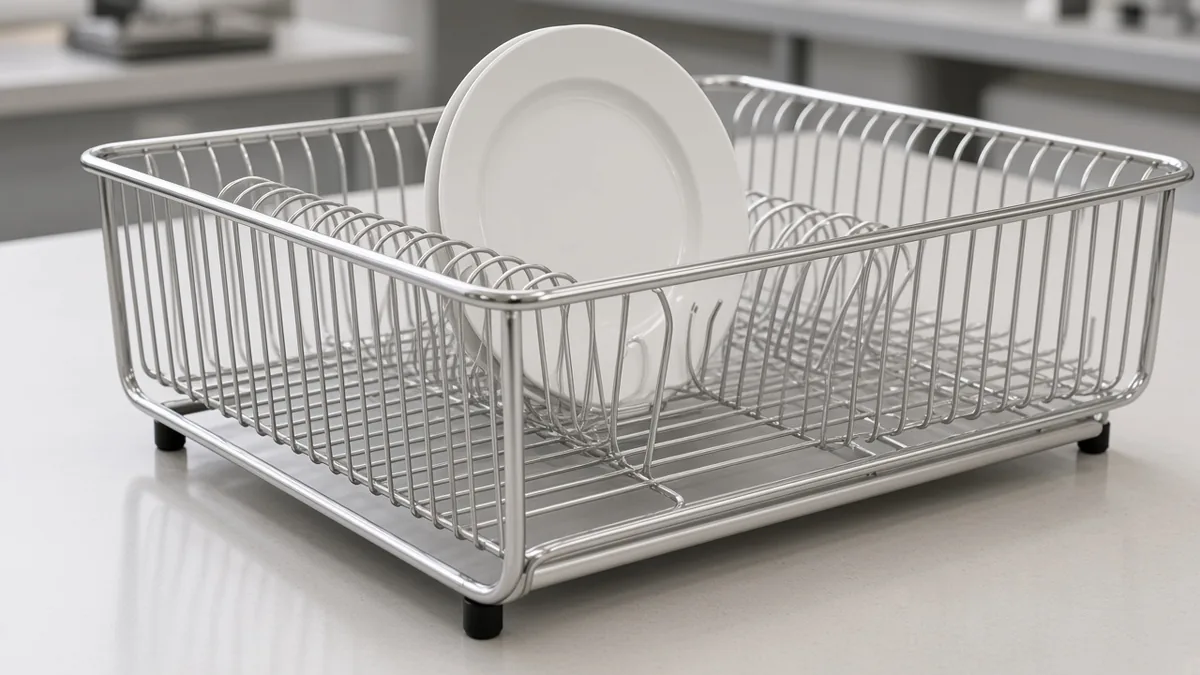
Tine count does not settle dish drying rack plates fall off. A plate can stand in a legal pitch and still slide off the back if there is no rear stop, or if the stop is too low for the named plate and lean. Freeze the back rail or rear stop against that plate, and keep a tip-over file and a tine-pitch file on their own pages.
This guide is for importers and private-label teams writing freestanding metal dish racks that are photographed with upright plates. It is not a tine-pitch or splay page, not a tip-cap page, and not a one-side unload tip-over page. The decision is whether a named plate stays on the rack when it leans back.
Koitor is a family-owned custom metal hardware factory. We can review the tine field, the rear stop, the named plate, and the wording you want to print. We do not invent a rail height, a safe plate size, or a “plates cannot fall” promise for a stop we have not agreed how to observe.
Why tine pitch does not close rear retention
Tine pitch answers how many plates fit and whether they splay or sit too tight. That file can pass while a plate still has no back to lean against, or while the back rail is lower than the plate’s lean. Count is not a stop.
Tip caps on tine ends are a cap-retention decision. A cap can stay on and still leave the back of the rack open. Keep caps on the cap file. Keep the rear rail here.
One-side unload tip-over is a stability decision: the rack itself rocks or falls when one side is emptied. A rack can sit firmly on its feet and still let a plate slide off the open back. Those two failures are often described with the same casual word, “it fell,” and they need to be split.
kitchen sink dish rack drainage design matters for how water leaves the rack or the drain board, not for whether a leaning plate has a back stop. A well-draining rack can still be backless. Do not borrow a drainage sentence and print it as a plate-retention line.
Retail photographs that show plates standing neatly are listing impulses, not evidence, unless the same plate, lean, and back geometry were on the sample. A styled shallow plate can hide a missing rail that a dinner plate will find.
How should a named plate and lean be frozen?
Name the plate before you name a result. Record diameter or size family, whether it is a dinner plate, side plate, or shallow bowl used as a plate, and the lean you will merchandize. A saucer cannot support a dinner-plate listing photograph.
Name the rear geometry as it will be shipped: a full back rail, a partial rail, a high back wall, a low wire, or a backless frame. “Has a back” is not a specification if the wire is too low for the named lean.
Do not invent a rail height or a Koitor safe plate size. If the project wants a stated height, measure it on the sample and write it as a project figure. Until then, stay with the named plate and the lean you can photograph.
Agree how the plate is inserted. Some users drop it between tines and let it lean back; some rest the rim on a front rail. If the merchandising shows a steep lean, that is the observation lean. A gentle, hand-held lean is a weak basis for a steep photograph.
If the rack also holds bowls or mugs in another bay, do not let those items stand in for the plate check. Bowls often sit in a different field. Write the plate field separately.
What about backless designs and claim exclusions?
A backless rack can still be an honest SKU if the listing does not imply a back stop. The file should then say the design is open at the back, and any “holds plates upright” line should be limited to the tine grip you actually observed, or dropped.
If a later lot adds or removes a rail, the file needs a new observation. A backless photograph cannot support a railed sentence, and a railed sample cannot support a backless carton.
Do not print that plates cannot fall off, that any plate will stay, or that the rack is safe for every dish size. Safer language names the plate, the lean, and the stop you observed.
Corners and cut-out plates, and plates with a very sloped rim, may need their own note or an exclusion. A flat dinner plate is not automatic evidence for every rim family in the buyer’s assortment.
What belongs on the tip-over or tine-pitch page instead?
Tine count, pitch, and splay belong on the pitch page. Tip-over under one-side unload belongs on the tip-over page. Tip caps belong on the cap page. Drainage belongs on the drain-board or drainage page. If a complaint is “plates fell and the rack tipped,” split the record before you rewrite any artwork.
What should the importer freeze before artwork is approved?
Use a written rear-stop file. The checklist and the matrix remind you which decisions to freeze. They do not replace the named plate or the lean photographs.
Do not approve a dish drying rack plates fall off line until the named plate, the lean, and the rear geometry are in the pack. An empty tine field is not a back-stop check.
If production later changes rail height, back-wall wire, tine height, or the merchandised plate, the file needs a new observation. A copied “holds plates” sentence from a shallow-plate studio shot is not evidence for a dinner plate.
A first-article pack should include the plate size, the lean, a side photograph of the rim against the stop, and a note if the design is backless.
Instruction and lifestyle images should use the same plate family. A marketing saucer should not be asked to support a dinner-plate headline.
If the rack is sold with a drain board that changes the back height or the lean, observe the plate on the board. A board can raise the front and change how the plate meets the rail.
After-sales photos should show the back of the rack and the plate that fell, not only a pile of dishes on the counter. Ask whether the rack tipped or the plate slid off the back.
A finish-only change can often keep the prior stop record if the rail and tine geometry did not change. Confirm those functional parts first.
When the plate, the lean, and the stop agree, the listing can stay modest and still be useful. Name the plate family you observed and leave unbounded cannot-fall language off the page.
Send the drawing, the plate set, and the intended sentence before the artwork is locked. A factory can quote the rack while the lean observation is still being written, but a retention headline should wait for the named plate against the actual back.
Wide plates and charger plates deserve an exclusion when only a standard dinner plate was run. Overhang at the sides is a different miss than a fall off the back, and both should be named if they appear in merchandising.
A very short tine field can let a plate pivot even when a rail exists, if the rail sits too far behind the tine contact. The stop and the tine have to work as a pair. Do not judge the rail in isolation from where the plate sits in the field.
Folding or roll-up racks are out of scope unless that is the actual SKU, and they often change the back geometry when opened. This page stays on a freestanding metal rack with a defined tine field and a defined back, or a defined backless design.
Warehouse packing that flattens or bends a back rail is a transit issue that can create an in-use fall later. Incoming inspection should include the rail geometry, not only a rust and scratch check, if a rear-stop claim will be printed.
If a later complaint shows plates falling only when the rack is overfilled past the merchandised count, sort that against the pitch file and against this stop file. Overfill can both splay tines and lift a plate over a low rail. Split the cause before you change the artwork.
Wet plates and dry plates do not lean the same way. A wet, soapy rim can slip along a low wire that a dry studio plate stayed on. If the merchandising is a sink-side use, include a wet plate in the observation, or write that the check was dry and keep a wet-use sentence off the artwork.
Rim diameter is not the only variable. A thick restaurant plate can sit higher in the tines and meet the rail at a different point than a thin retail plate of the same diameter. If the buyer serves both families, observe both or write an exclusion.
A rear wall made of many short vertical wires can still have a gap a sloped rim will find. Do not assume a “back wall” photograph is a continuous stop. Check the named plate at the actual gap height, not only the overall wall height.
Front rails and plate grooves, if present, can change the lean and should be in the file, but they are not a substitute for a back stop unless the brief says the plate is meant to sit in a locked groove. A groove that only locates the front edge can still leave the back open.
Kids bumping a plate, or someone pulling a mug past a leaning plate, is an incidental side load. If the project wants a recovery after a bump, write that bump as a method, without turning it into a child-proof slogan. If you did not include a bump, do not imply the plate will shrug one off.
Sink-side placement against a backsplash can hide a missing rail in a photograph and then surprise a user on an open island. Record whether a wall was behind the rack during the check. A restrained backsplash shot is a weak basis for an open-counter retention line.
Incoming bent rails should be pulled from the stop sample, not “flexed back” informally and then used as proof. A rail that takes a set in transit is a packing issue, and a bent rail is not the geometry you will defend in the listing.
After-sales videos should be watched for whether the plate went off the back, off the side, or over a low front. Those three exits are different records. Ask for a still frame of the back geometry before you treat the video as a rear-stop failure.
When the named plate, the lean, and the rear geometry agree, the listing can stay modest and still be useful. Name the plate family you observed and leave unbounded cannot-fall language off the page until a wider set exists.
A later finish-only change can often keep the prior stop record if rail height, back-wall wire, and tine geometry are unchanged. Confirm those functional parts first, then keep or retire the sentence. Keep the retention headline tied to the rack you will actually ship.
If the buyer also wants a drainage or rust sentence, keep those on their own files and only cross-check whether a drain board or a coating change altered the lean or the rail. A rust-resistant finish does not become a back stop, and a drain board does not become a plate-retention claim unless the board itself is part of the observed back geometry.
First-article photographs should include a side view with the rim clearly against the stop, a back view that shows whether the rail is continuous, and a top view that shows where the plate sits in the tine field. A single lifestyle image from above will not let a later inspector see the contact that failed.
If merchandising also shows plates facing the other way, toward a low front, write that facing as a different lean or exclude it. A rear-stop file does not automatically cover a forward fall over a low front rail.
Send the pack with the drawing before the listing is locked. A factory can quote the rack while the lean observation is still being written, but a holds-plates headline should wait until the named plate has been photographed against the actual back on the shipped geometry.
If a later review finds only a carton or color change, the prior stop record can stay, provided the rail, tine field, and merchandised plate family are unchanged. Confirm those functional parts first. A new carton photograph is not, by itself, a new retention claim.
Keep the artwork inside the plate family and the back geometry you actually observed. A modest sentence that names the dinner plate and the rail is stronger than a borrowed height figure or a copied cannot-fall headline with no lean photograph behind it. That is the standard this page is willing to support.
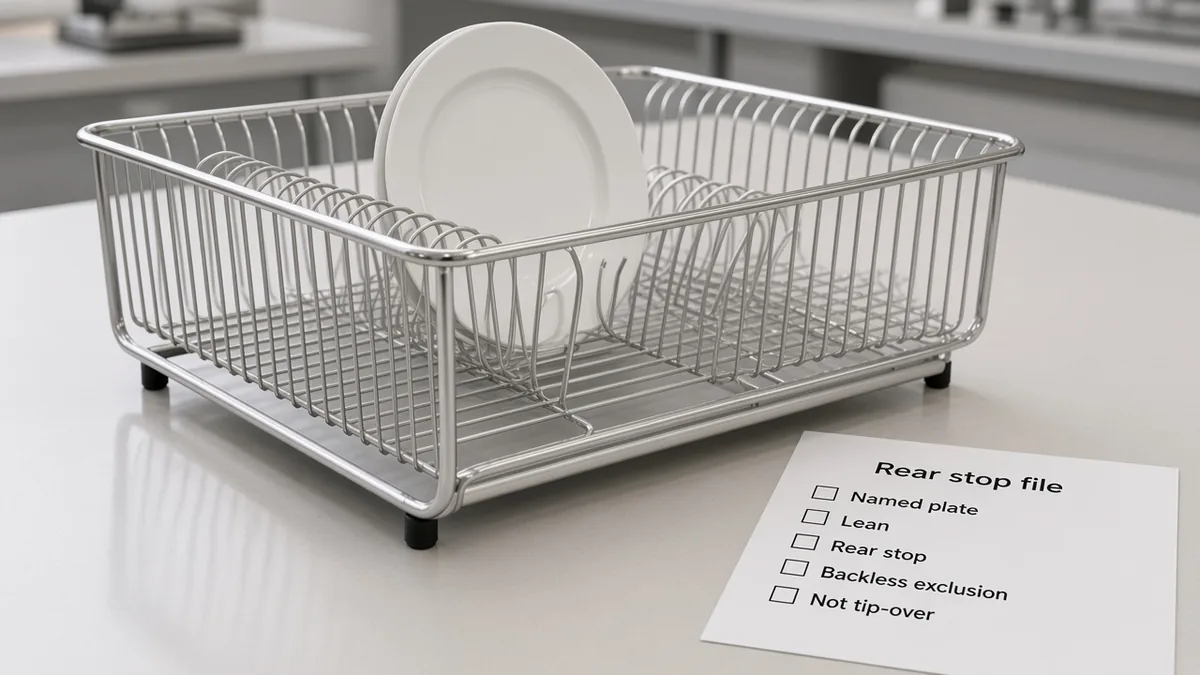
| Claim impulse | What to freeze | What the sample should show | What to keep off artwork until then |
|---|---|---|---|
| Plates stay upright | Named plate, lean, and rear geometry | The plate stays on the rack in the agreed lean | An unbounded cannot-fall or any-plate slogan |
| Works for dinner plates | The dinner-plate size actually used, or an exclusion | The merchandised dinner plate was the plate you ran | A saucer or side-plate photo used as proof of a dinner plate |
| Tines are tight, so it will not fall | A split between tine pitch and rear stop | The pitch was acceptable, and the back was judged separately | A pitch pass treated as a back-stop pass |
| Rack is stable, so dishes stay | A split between tip-over and plate fall-off at the back | The rack stayed put, and the plate was judged separately | A tip-over pass treated as a rear-retention pass |
| Open-back design looks fine | An honest backless description, and any limited tine-grip claim | The listing does not imply a rail the SKU does not have | A holds-plates-upright line that assumes a back the frame omits |
- Write the product as a freestanding metal dish rack with a defined tine field, not as a folding, roll-up, or over-sink SKU unless that is the actual unit.
- Name the plate family, size, and lean used in merchandising.
- Name the rear geometry: full rail, partial rail, low wire, or backless.
- Do not invent a rail height or a safe plate size.
- Photograph the plate leaning against the stop from the side, not only from above.
- Keep tine pitch, tip caps, drainage, and tip-over on their own files.
- If only one plate family was observed, write an exclusion for the others.
- If the design is backless, do not imply a rear stop in the listing.
- Keep unbounded cannot-fall language off the artwork.
- Send the drawing, the plate set, and the intended sentence before the artwork is locked.
How can a family-owned OEM review the stop?
Koitor can review the tine field and rear geometry, the named plate, and the wording you want to use. That is a construction and acceptance discussion, not a universal dish-size certification. Fabricación de estanterías de almacenamiento a medida para cocinas is the usual starting point when the rack family itself still needs development.
If you already have a plate set and a back-rail outline, attach them. If you only have an empty-rack photograph, say that. We can help you tighten the stop and the sentence, but we will not invent a rail height to fill a blank. For a rear-stop review, send the rear-stop brief to Koitor with the drawing and the intended claim.
MOQ, sample timing, and bulk lead time stay on the quotation path and depend on the product, the finish, and the order. They are not a substitute for the lean observation.
Preguntas frecuentes
Can dish drying rack plates fall off be cleared by a tine-pitch check?
No. Pitch tells you whether plates fit side to side. It does not tell you whether a named plate stays on when it leans back. Take the rear-stop record on the actual plate.
Do we need a published rail height to sell the rack?
Not from this article, and not as an invented Koitor figure. You need a named plate, a lean, and the actual back geometry. If a later project wants a stated height, measure it on the sample and write it as project evidence.
How is this different from tip-over?
Tip-over is the rack itself rocking or falling, often when one side is unloaded. This page is a plate sliding off the back while the rack may still be standing. Split those complaints.
What if the design is intentionally backless?
Then say so, and do not imply a rear stop. Any upright-plate line must be limited to the tine grip you observed, or dropped.
What if merchandising shows both dinner plates and shallow bowls?
Observe both, or write an exclusion. A bowl often sits in a different field and lean than a dinner plate.
Can Koitor write the plate-retention sentence for us?
Koitor can review a rear-stop sentence against the named plate family and the back-rail photographs, as a construction and acceptance discussion. The buyer still owns what is printed. If the lean observation is not in the pack, the safer path is to narrow or drop the line.
Trabaja con Koitor Hardware
Need a rear-stop brief reviewed?
Send Koitor your freestanding dish-rack drawing or sample, the named plate set, and the rear-stop sentence you want to print. Our team can review back geometry and claim wording as a construction and acceptance brief before quotation. MOQ can start from about 100 pcs depending on the product; samples usually take 5–7 working days after details are confirmed; bulk production usually takes 4–6 weeks depending on the project.
OEM / MARCA BLANCA
Convierte esta guía de abastecimiento en un resumen del producto
Indícanos el producto que deseas, el tamaño, el acabado, la cantidad del pedido y los requisitos de embalaje. Tu equipo recibirá un análisis práctico de la viabilidad de fabricación antes de recibir el presupuesto.

 English
 Español
 Português
 Français
 Deutsch
 العربية