
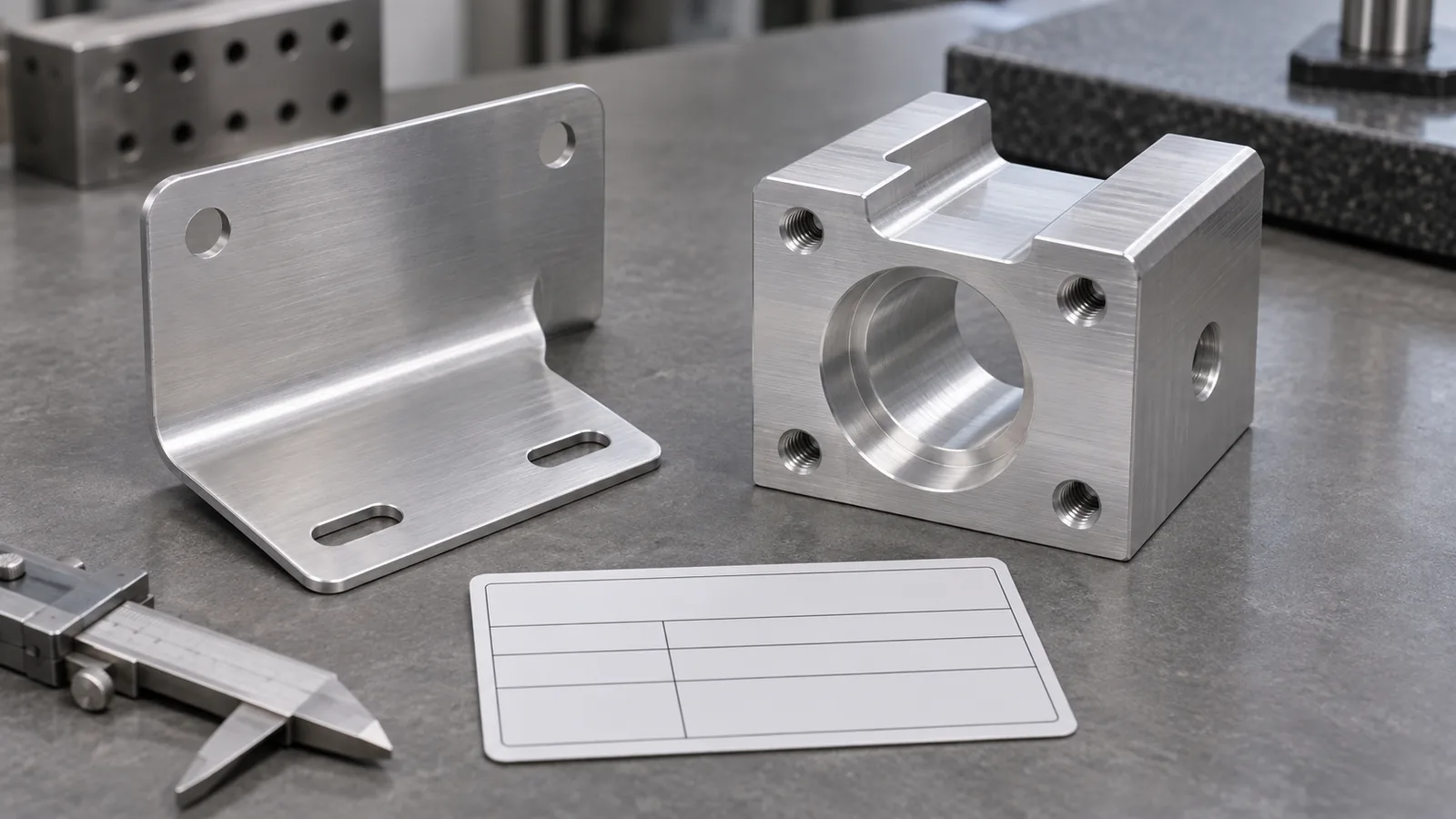
6061 vs 7075 aluminum is not a choice between a universally “good” and “better” metal. They are different heat-treatable alloy families, and the useful decision depends on exact temper, product form, part geometry, manufacturing route, joining constraints, finish and required performance. A higher published strength value for a particular 7075 condition does not automatically make it the right material for a fabricated bracket or storage component. Buyers should define what the part must do and verify the complete material and process basis before comparing quotations.
Start with alloy, temper and product form
6061 is an aluminum alloy in the 6xxx family, which includes magnesium and silicon as principal alloying constituents. 7075 belongs to the 7xxx family and includes zinc as a principal alloying constituent. These family-level descriptions help distinguish the materials, but they do not provide a complete product specification. A buyer still needs the exact grade, temper, product form, dimensions and governing specification where required.
Temper describes a material condition produced through processing. It is not interchangeable with the alloy number. Common supplier comparisons often cite 6061-T6 and 7075-T6, but those are specific conditions and should not be generalized to every form or temper. If the quote says “6061” while the drawing specifies 6061-T6 plate, ask the supplier to confirm it is pricing the requested condition and product form. The same applies to 7075.
Product form matters because sheet, plate, bar, tube and extrusion can have different dimensions, manufacturing histories and available conditions. A strength value from an extrusion or bar chart does not automatically describe a formed sheet bracket. A design that requires bending, machining or joining may need a form that a general comparison table does not discuss. The buyer should compare equivalent stock before using published property information.
| Buyer dimension | 6061 consideration | 7075 consideration | What to verify |
|---|---|---|---|
| Alloy family | 6xxx family, with magnesium and silicon as key alloying constituents | 7xxx family, with zinc as a key alloying constituent | Full designation and applicable material specification |
| Temper | Common examples include T6, but other conditions exist | Common examples include T6, but other conditions exist | Full temper and supplier documentation |
| Product form | Sheet, plate, bar, tube or extrusion must be stated | Same; availability and fabrication assumptions are supplier-specific | Form, dimensions and stock condition |
| Strength comparison | Depends on exact alloy, temper, form and requirement | Often selected where a particular condition’s strength is relevant | Property actually needed for the component |
| Joining | Route and design must be reviewed for the exact material | Joining can be a significant constraint; do not infer suitability from strength data | Approved joining method and acceptance requirements |
| Forming and machining | Depends on geometry, temper, tooling and stock form | Depends on geometry, temper, tooling and stock form | Supplier feasibility review on the actual part |
| Finished-part performance | Not established by alloy name alone | Not established by alloy name alone | Design analysis, test or documentation as required |
The matrix is a buyer framework, not a numerical material datasheet. It intentionally avoids generalized strength, corrosion, cost or fatigue rankings.
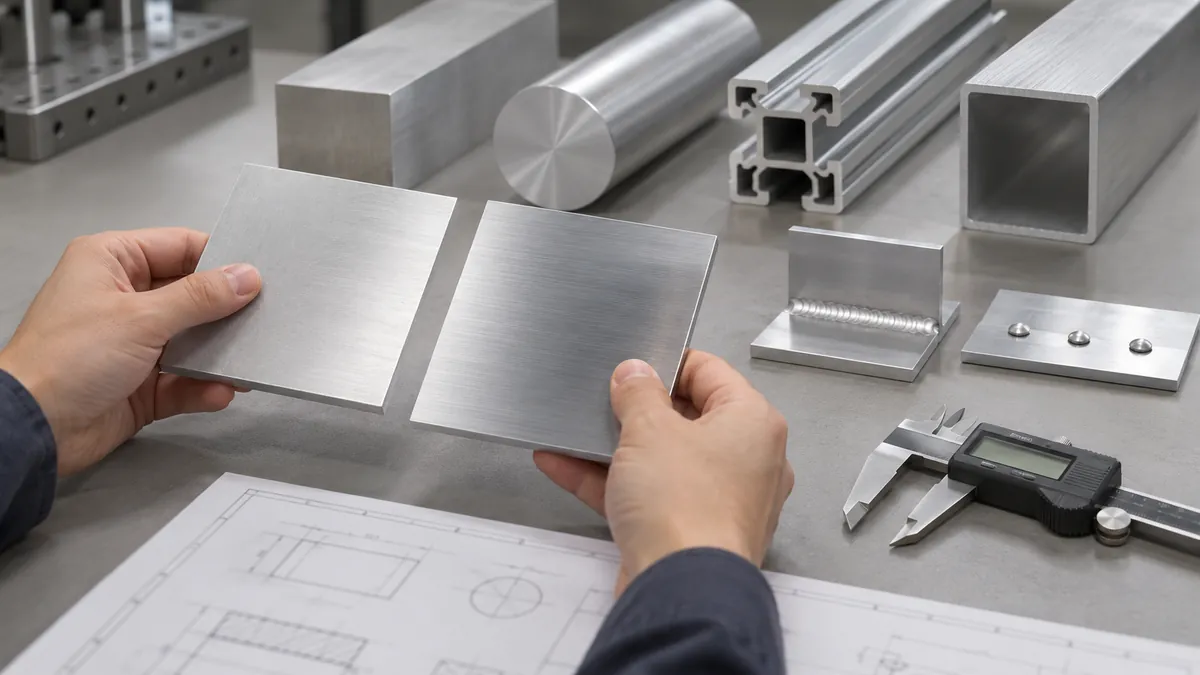
Strength is only one design input
A material property table may lead a buyer to focus on tensile strength. That can be relevant, but it is not the whole part decision. A fabricated component may be limited by a bend, hole, weld, fastener, mounting surface, geometry or load path. The performance of an assembly depends on how the pieces are designed and joined, not just on a stock material’s listed property.
Before substituting a higher-strength material, identify the characteristic the design needs. Is the concern deflection, permanent deformation, weight, packaging, wear, or another defined property? How is the part loaded and supported? Which features determine fit? Does the design allow the manufacturing route required by the proposed alloy? A vague goal such as “make it stronger” does not tell a supplier which change to make or how to verify success.
A stronger material may also change forming, machining, joining, finishing or sourcing assumptions. A design optimized for one alloy and temper may not translate directly to another. If the geometry requires a bend or weld, ask the qualified supplier or engineer to review the actual condition and process. Do not assume a property table predicts the strength of a completed bracket or that a numerical advantage in one metric compensates for every manufacturing constraint.
Consider joining before approving a substitution
Joining is an important constraint when a product design relies on welded assemblies. The process, material condition, joint geometry, preparation, sequence and acceptance criteria all matter. A supplier should review the specific alloy and temper for the proposed method rather than assume that the higher-strength stock can be joined in the same way as the current part. This is a process-specific engineering question; this article does not prescribe weld settings or assert that any particular joint is suitable.
If the part is mechanically fastened, identify the hole pattern, fastener interface, material stack and critical fit. A material change can affect the design and fabrication sequence even when the overall shape stays constant. The buyer should not assume that changing from 6061 to 7075, or the reverse, is a drop-in substitution for every mounting bracket.
Surface finishing and service environment should also be considered without making blanket corrosion claims. Alloy, temper, surface preparation, finish, design and exposure all contribute to the outcome. If the component will be used in a humid bathroom or another demanding setting, identify the actual environment and finish requirement and ask for evidence that addresses it. Do not rely on a generic “corrosion resistant” statement or a comparison table that does not match the supplied product form and condition.
A product team may decide that an alloy is unsuitable because of a specific joining or forming requirement. That decision should be documented against the actual design. If the supplier suggests a different joint or a mechanical fastening alternative, review fit, appearance, serviceability and other product constraints before approving. The material choice and connection design should be considered together rather than evaluated as separate labels.
Compare quotations on the same specification
A fair quote comparison holds the material, temper, product form, dimensions, quantity, finish and acceptance criteria constant. Ask the supplier to list any assumption or proposed substitution. If one supplier quotes plate and another quotes extrusion, or one includes machining while another does not, the prices are not directly comparable. Ask for the cost and lead-time scope to be separated where that helps identify the difference.
The supplier should state which operations are included: cutting, forming, machining, joining, finishing, inspection and packaging. The intended final condition and documents should also be clear. A quote may assume a stock condition or available size that differs from the drawing; resolve the mismatch before the purchase order. Do not transfer a supplier’s inventory, process limit or price statement from a public article to another provider.
A material certificate should be evaluated by what it actually documents. Confirm whether it identifies the alloy, temper, product form and lot as required by the contract. A certificate does not automatically prove the finished assembly’s load performance or every drawing dimension. Likewise, a sample can show the features inspected on that sample but cannot replace material records or unspecified testing. Keep evidence aligned with the requirement it is intended to verify.
A practical material review workflow
- Define the component function. Identify the load path, fit, use environment and critical features.
- Specify the complete material. State alloy, temper, product form, thickness or section and applicable specification.
- Identify the real design driver. Say which property or manufacturing problem the material change is meant to address.
- Review forming and machining. Ask how the actual geometry and stock condition affect the route.
- Review joining. Confirm the proposed method and acceptance basis for the exact alloy and temper.
- Confirm finish and environment. Identify surface preparation, cosmetic requirements and use conditions.
- Normalize supplier quotes. Compare equal quantities, operations, documentation and quality scope.
- Approve substitutions. Record the technical owner, evidence, new revision and any sample requirement.
- Retain the material record. Link the approved condition and lot documentation to the purchase.
This sequence prevents an alloy label from becoming a proxy for the whole design decision. A supplier can propose an alternative, but the design owner must approve any change that alters a controlled requirement. If the material is open during prototyping, identify that status and do not imply that the prototype validates an unapproved production condition.
Hypothetical hardware example
Imagine a bracket used in a storage system. The initial design uses 6061 in a stated temper and includes a bent flange, a welded tab and a set of mounting holes. A team sees a comparison chart showing a higher strength value for a 7075 condition and asks the supplier to substitute it. Before doing so, the buyer should confirm that the comparison matches the exact product form and temper, then review whether the bend and joining route remain appropriate for the actual geometry.
The buyer also needs to state which part requirement motivated the change. If the problem is deflection under a known load, the design engineer should review the complete load path and identify evidence needed. If the concern is material availability, the supplier should list the substitute condition and how it affects price, lead time and fabrication. The buyer should compare samples or calculations only within their defined scope and update the drawing if the alternate material is approved.
This example is hypothetical. It is not a Koitor project, customer result, engineering analysis or claim that Koitor stocks or processes either alloy. It illustrates why a higher material property cannot replace a design and process review.
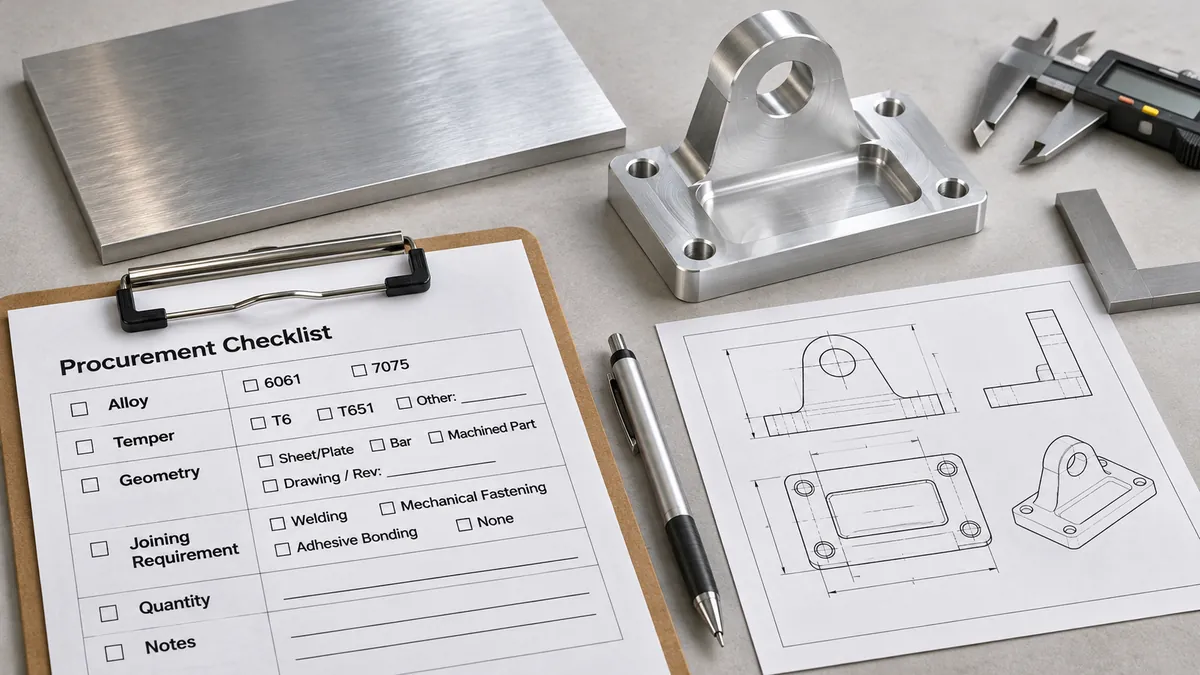
Review a substitution as a product change
A material substitution affects more than the bill-of-material line. It can affect stock availability, product form, fabrication sequence, joining, finish, inspection, part labeling and the evidence supplied with each order. Treat the proposed change as a product change with an identified reason, affected requirements and approval record. If only the alloy changes while temper and form remain unspecified, the proposal is still incomplete.
The design owner should identify what evidence would make the substitution acceptable. That may involve checking a drawing dimension, reviewing a sample assembly, confirming material documentation or asking for a focused engineering assessment. The specific evidence depends on the part; this article does not prescribe a universal test package. The supplier should state which assumptions are outside its quote and which differences require buyer approval.
When a prototype is built from one aluminum condition and production is proposed in another, record the distinction. The prototype can help evaluate shape or fit, but it does not automatically demonstrate the production material’s joining or mechanical behavior. Mark which aspects were approved and which remain open. Before production, update the material callout, drawing revision and inspection records so the accepted basis is consistent across purchasing and manufacturing.
For repeat orders, compare the proposed stock condition with the previously approved one. A supplier may suggest a different form due to availability or yield; the buyer should determine whether that changes fabrication or finished-part requirements. Avoid accepting “same grade” as sufficient if temper or dimensions differ. Likewise, do not reject an alternative solely because its label changed; evaluate the actual product impact and required evidence.
If the substitution is not approved, provide a clear purchasing direction: maintain the current material, revise the design, or hold the order pending technical review. An undocumented middle ground—where the supplier uses one material and the drawing lists another—creates avoidable acceptance and traceability problems. Keep the final decision with the authorized product owner and communicate it to the supplier before the next production step.
Keep material evidence connected to the part
Material records should be linked to the component number, revision, order and lot as required by the contract. A generic product data sheet may explain a material family but not identify the material used in a particular order. A certificate should be checked for the designation and traceability fields the buyer specified. If those fields are missing, ask whether the supplier can provide the requested evidence or whether the purchase requirement needs clarification.
Do not assume a certificate establishes performance of the finished bracket. It may address material identity or a stated property while leaving fabrication, joining, dimensions and coating outside its scope. Conversely, a final dimensional report does not prove alloy identity. A complete acceptance plan may need more than one type of evidence, but each document should answer a defined question and point to the correct part or lot.
If the supplier proposes a different material source or sub-supplier, review whether the existing approval still applies. The requirement might call for an exact source, an equivalent specification or simply a documented grade and temper. The contract determines that boundary. Record any approved change, and preserve the updated material basis so future buyers and production teams do not rely on an old certificate or sample from a different condition.
Review joining and finishing as part of the material choice
When a bracket or frame is assembled from several pieces, the joint may govern how useful a material substitution is. A design team should identify whether the connection is welded, mechanically fastened or assembled by another approved method. It should also state whether the joint is visible, what surfaces are cosmetic and whether post-joining finishing is included. The alloy and temper should be considered alongside those requirements, not selected from one data point in isolation.
Ask the supplier to review the actual joint geometry and process sequence for the specified condition. If the supplier cannot confirm the proposed route, request an engineering clarification before ordering. A proposed alternate joint or material may be viable, but it may also change the part count, appearance, assembly time or inspection plan. The buyer should evaluate those effects with the design owner rather than assume the supplier’s substitution preserves the product in every respect.
For mechanically fastened parts, check whether the material and product form support the specified holes, threads, inserts or mating surfaces. If the component is coated or finished after fabrication, clarify how the process affects contact surfaces and visible areas. These checks do not establish a universal advantage for either alloy; they identify the features that must be matched to the actual design and supply route.
If the part is tested or inspected, make sure the method evaluates the intended characteristic. A material record may identify an alloy and temper; a dimensional report may show a hole or flange condition; a sample assembly may show fit. None should be described as proof of a separate performance property unless the test and acceptance basis cover it. Keep the product requirements and evidence traceable to the same approved revision.
The 6061 vs 7075 decision should be revisited if a material, temper, geometry or joining route changes after sample approval. Determine which previous reviews still apply and whether another sample or record is needed. A change to a noncritical cosmetic feature may be handled differently from a change to a mounting interface or joint. Record the buyer’s decision so production does not proceed on an assumed equivalence. A careful 6061 vs 7075 comparison therefore follows the complete part through material, fabrication and acceptance.
Common sourcing mistakes
- Choosing by one strength value. Define the component’s actual requirement and review the whole design.
- Omitting temper. Alloy number alone is not a complete material callout.
- Comparing different product forms. Sheet, plate, bar, tube and extrusion data may not be interchangeable.
- Ignoring joining constraints. Ask for a process-specific review for the exact material and geometry.
- Assuming higher strength means better finished performance. Geometry, joints and fabrication can control the result.
- Changing material and process together. Separate changes so the impact can be assessed.
- Comparing unequal quotations. Align material, quantity, finish, operations and records.
- Assuming a certificate proves the assembly. Check what the document covers and what still needs inspection.
- Relying on general corrosion rankings. Specify the actual environment, finish and acceptance basis.
- Approving a substitution informally. Update the controlled drawing and record technical approval.
Preguntas frecuentes
What is the main difference between 6061 and 7075 aluminum?
They are different heat-treatable alloy families with different alloying systems. The practical comparison depends on exact temper, product form, design and manufacturing route.
Is 7075 always stronger than 6061?
The result depends on the specific grade, temper and product form being compared. A generalized strength ranking does not establish the best choice for a fabricated component.
Is 7075 suitable for welding?
Do not answer from the alloy number alone. Joining suitability depends on the exact condition, process, joint design and required result. Ask a qualified supplier or engineer to review the actual part.
Can I substitute 7075 for 6061 in a bracket?
Not automatically. Confirm temper, stock form, bends, joining, finish, dimensions and the design requirement. Obtain technical approval and update the controlled specification.
Does 6061-T6 mean the same thing as 6061?
No. T6 is a temper designation that identifies a condition. Include the full alloy and temper in the material requirement.
Which alloy is more corrosion resistant?
A universal comparison is not enough to approve a product. The alloy, temper, finish, design, environment and maintenance all matter. Define the actual exposure and verify the relevant requirement.
What should be on the material certificate?
The purchase specification determines the required documentation. It may need to identify the alloy, temper, product form and lot. Check the document scope and traceability rather than assuming it proves every part property.
How can Koitor support a material decision?
Koitor Hardware is a family-owned custom metal hardware factory with approved drawing and sample communication. Buyers can share the material callout and part requirements for discussion. This does not imply Koitor stocks or processes either alloy in every temper or form.
Sources and scope
- Worthy Hardware: Difference Between 6061 and 7075 Aluminum Alloys
- SendCutSend: Aluminum Alloy Comparison
Scope note: This buyer guide avoids numeric property rankings and process recipes. Confirm exact alloy, temper, form, joining route and acceptance with the responsible technical supplier. No Koitor stock, process, corrosion or performance claim is made.
Review an aluminum material substitution for a hardware part
Share the controlled drawing, alloy and temper, product form, joining route and required result. Koitor can discuss the surrounding custom metal hardware project within its confirmed scope.
OEM / MARCA BLANCA
Convierte esta guía de abastecimiento en un resumen del producto
Indícanos el producto que deseas, el tamaño, el acabado, la cantidad del pedido y los requisitos de embalaje. Tu equipo recibirá un análisis práctico de la viabilidad de fabricación antes de recibir el presupuesto.


 English
 Español
 Português
 Français
 Deutsch
 العربية