

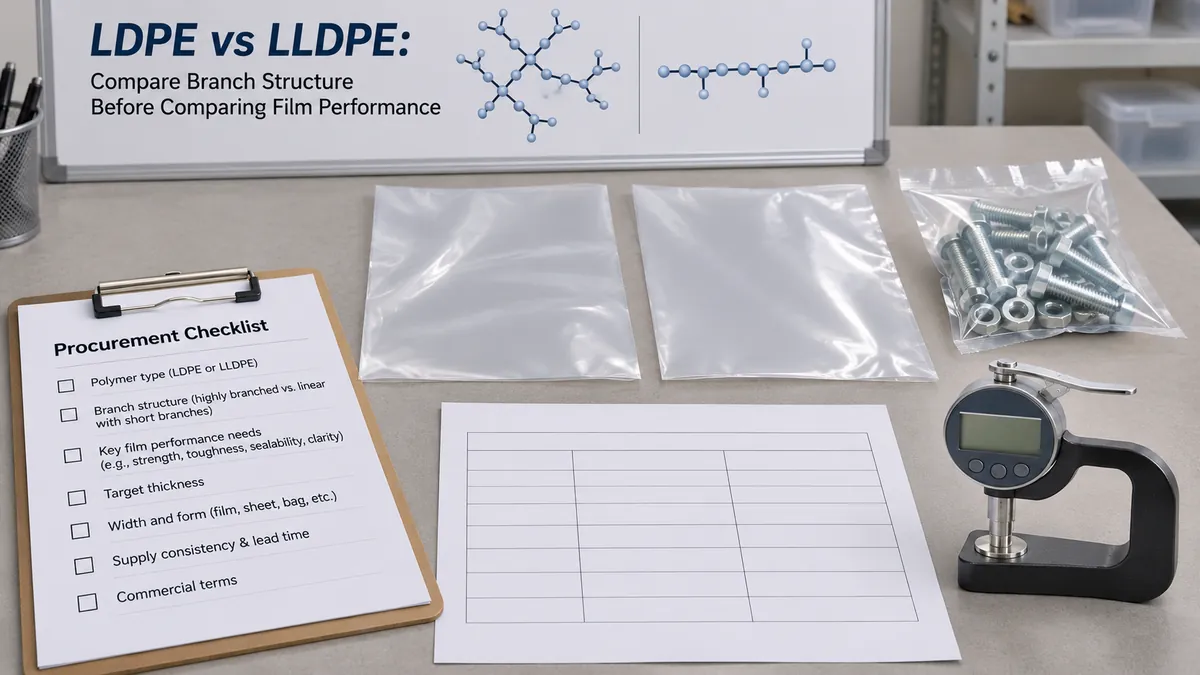
LDPE vs LLDPE compares two polyethylene materials with different polymer structures, but a resin acronym alone cannot predict finished-film performance. Conventional LDPE has long-chain branching. LLDPE has a relatively linear backbone with short branches; “linear” does not mean branch-free. Those structural differences can influence typical film behavior, but the actual grade, blend, thickness, processing, additives and package design matter. A buyer should compare the complete film specification and intended packaging function rather than rank the materials from density labels alone.
What the two material names mean
LDPE is low-density polyethylene. Conventional LDPE has more extensive branching, including long-chain branching. LLDPE is linear low-density polyethylene; its backbone is comparatively linear and includes short branches. Both are polyethylene materials, and both can be used in film and other forms. The naming contrast is about structure and material family, not a complete specification for a finished bag, liner or protective wrap.
A general comparison often associates LDPE film with flexibility and LLDPE film with different strength or stretch behavior. Such tendencies are useful for screening, but they are not universal specifications. Grade, molecular characteristics, blending, thickness, additives, extrusion and converting conditions can change the finished product. A particular package may use a blend or multiple layers, so one acronym might not describe the entire structure.
The buyer should distinguish resin identification from film identification. A supplier’s material sheet may describe a resin grade, while a packaging quotation may describe a film gauge, construction, color, dimensions, sealing method or converted bag. Those are different levels of the supply chain. If the buyer orders finished bags, it must define package requirements in addition to the base polymer family.
| Buyer dimension | LDPE consideration | LLDPE consideration | What to verify in the finished film |
|---|---|---|---|
| Polymer structure | Conventional LDPE has long-chain branching | Relatively linear backbone with short branches | Exact grade and whether film is blended or multilayer |
| Density label | Family-level label, not a finished-film guarantee | Family-level label, not a finished-film guarantee | Supplier’s material and construction description |
| Flexibility | Typical behavior depends on grade, gauge and converting | Typical behavior depends on grade, gauge and converting | Handling and package-use requirement |
| Puncture/tear behavior | Cannot be inferred from acronym alone | Cannot be inferred from acronym alone | Test or acceptance basis for the actual film |
| Stretch and sealing | Depends on grade, process and package design | Depends on grade, process and package design | Seal, closure and line requirements if applicable |
| Espesor | Material name does not identify film gauge | Material name does not identify film gauge | Nominal thickness and allowed variation |
| Package protection | No universal protective performance | No universal protective performance | Product, transport and handling conditions |
| Sustainability or compliance | Not established by resin family alone | Not established by resin family alone | Applicable claim evidence and jurisdiction |
The matrix is a decision aid, not a set of universal property rankings. It intentionally avoids density ranges, puncture numbers and guaranteed film performance.

Why film performance depends on more than resin family
Grade and formulation
The resin grade and formulation can matter as much as the family label. A film may contain a blend of polymers or additives selected for converting, appearance, handling or another specification. The buyer should ask the supplier to identify the construction at a level appropriate to the purchase. If a commercial formula is proprietary, the supplier can still provide a compliant description and evidence for the required performance without disclosing confidential recipe details.
Do not assume that a bag described as “LLDPE” contains only LLDPE or that a film described as “LDPE” has a single homogeneous structure. Ask whether the material is a monolayer, blend or multilayer when that information affects the package requirement. If the supplier proposes a substitution, determine whether the construction changes or only the source within an approved specification.
Gauge, dimensions and converting
Thickness affects how a film handles, but a gauge by itself does not prove protective performance. Confirm nominal thickness, tolerance, measurement method and where the reading applies. A supplier quotation should distinguish roll stock from converted bags or liners and identify dimensions, seal or closure, perforation, gusset or other features relevant to the package.
The conversion process can affect the result. Extrusion, winding, sealing, cutting and bag making each have their own controls. A material data sheet does not necessarily establish the quality of the converted package. Buyers should evaluate the final form they receive and define the package characteristics that matter to their product and distribution route.
Test method and acceptance
The word “stronger” is too broad for a purchase requirement. A packaging buyer may need resistance to puncture, tear, impact, stretching or seal failure, but each is a different characteristic. The package design, specimen, conditioning and test method affect results. Ask the supplier to state which test or data supports a claim and whether it covers the actual film construction.
A test result on a resin sample may not represent a finished bag with a different gauge, blend or seal. Likewise, an appearance check cannot establish a mechanical property. If packaging protection is critical, work with the product and quality teams to define the test conditions and acceptance criteria. This article does not provide test values or recommend a universal method.
Package function and handling conditions
A material choice should be connected to the package’s job. Is it an inner protective sleeve, a shipping bag, a liner, a retail package or a temporary cover? What product does it contain? What handling and transport conditions are relevant? A film selected for one role may not meet another role, even if the resin family is the same.
State whether the package must prevent surface scratches, keep components together, separate dissimilar parts, contain moisture or support a seal. These requirements may involve more than film material; thickness, design, closure, inserts, carton packing and handling also matter. Do not attribute package performance to LDPE or LLDPE alone unless evidence isolates the material under the relevant conditions.
Compare quotations for the same package
A fair LDPE vs LLDPE review holds package dimensions, nominal gauge, construction, quantity, color, printing, closure and performance criteria constant. Ask the supplier to list material assumptions and identify whether the offer is for film stock or finished packaging. If one quotation includes a blend or multilayer structure and another does not, the offers are not directly comparable.
The supplier should state any relevant exclusions: artwork, tooling, printing, seals, inserts, cartons, inspection records or shipment packaging. A lower unit price may reflect a different gauge, package size or conversion scope, not a material advantage. Do not compare costs until the required package and acceptance criteria align.
If the package is supplied with hardware components, identify whether the bag or sleeve is included in the product purchase or provided by a packaging supplier. Clarify which party is responsible for material identification, dimensions, pack quantity, label and protection during transport. This avoids assuming that the resin comparison covers the entire packing system.
A buyer workflow for film material selection
- Describe the package function. State what the film must protect, contain or separate.
- Identify the delivered form. Specify roll stock, bag, liner, sleeve or another converted item.
- Define construction. State resin family or approved construction and ask whether blends or layers are used when relevant.
- Specify gauge and dimensions. Include thickness basis, allowed variation, width, length and conversion features.
- Name the performance need. Identify the specific handling, sealing, puncture or tear requirement.
- Set the verification method. Define which records, tests or samples demonstrate acceptance.
- Compare equal commercial scope. Align quantity, converting, printing, packing and inspection.
- Control material changes. Obtain approval for grade, blend, thickness or construction substitutions.
- Retain the approved sample and record. Link them to the package revision and order.
This process helps prevent a resin-family label from becoming the sole acceptance criterion. A supplier may recommend a film construction, but the buyer should confirm it meets the package function and evidence requirement. If the exact grade is unknown, label it as a supplier proposal and keep the specification open until the responsible owner approves it.
Make the order record reproducible
The purchase order should connect the approved film specification to the supplier’s quote and sample. Include package dimensions, gauge, construction, closure, color or print requirements and acceptance basis where relevant. Identify whether the material name is fixed or whether the supplier may propose an alternate. If an alternative is allowed, state what evidence the buyer will use to decide whether it is acceptable.
For repeat orders, verify that the supplier is using the same grade or an approved equivalent, the same film construction and the same converting scope. A packaging change can occur even when the line item name remains unchanged. The buyer should determine whether the change affects the package’s fit, protection, seal, appearance or handling. If it does, update the specification and review a new sample before shipment. Do not assume that a previous approval applies to a different gauge or multilayer construction.
If the order is split across production lots or shipments, ask how each lot will be identified and which records travel with it. A label can support identification, but it does not alone establish the resin construction or a tested performance. Keep the supplier’s documentation and any accepted sample linked to the relevant order, package revision and lot. This makes a future discrepancy easier to investigate and avoids comparing an incoming bag with an undocumented sample from another source.
At reorder, compare the purchase specification with the prior approved record instead of relying only on an old email or sample left in a warehouse. Confirm the supplier, product form, gauge, construction and any approved deviations. If a source changes its grade or converting site, ask whether the change affects the evidence already reviewed. The buyer may decide that the prior approval remains applicable, but that decision should be explicit and traceable.
If a mismatch appears on receipt, first identify whether the issue is a label error, a dimensional difference, a construction change or a performance concern. The resolution depends on the purchase requirement. Hold the affected package from use if the discrepancy could compromise the protected product, and obtain the supplier’s explanation and any supporting records. Do not edit the acceptance record to match the delivered material without the technical owner’s approval.
For packaging used with multiple product SKUs, the buyer should check that the specified dimensions and pack quantity suit each item. A film may be acceptable for one part but too small, too loose or otherwise unsuitable for another. If the bag is shared across products, identify the intended SKU range and check the worst-case geometry or package configuration. The supplier’s resin designation cannot resolve a mismatch between package size and the actual product.
When a packaging specification is revised, withdraw or mark superseded copies so purchasing and receiving teams do not use different gauge or construction requirements. Include the effective date or order applicability when a transition is approved. If old and new packaging must coexist during a run-down period, identify which SKUs and shipment dates use each version and how the buyer will distinguish them on receipt.
Keep a retained reference sample only if storage conditions will not distort the film, and label it with material, gauge, supplier, lot and approval date. Replace it when the package specification changes.
Separate film material from package design
A film material is one input to the complete protective package. Package geometry, bag size, closure, sealing, inserts, carton layout and handling can all influence whether the product arrives in an acceptable condition. If a hardware component has sharp corners or cosmetic surfaces, the product and packaging teams should review how it is separated and protected. A resin switch by itself may not resolve a package-design issue.
Describe the way the packaging is used in the supply chain. Is it placed around each individual item, used as an inner liner, or packed as a bundle? Does a buyer need a printed label or lot identification? Is the film removed before retail sale or retained during storage? These questions help the supplier quote the correct finished item. They also prevent a film spec intended for one step from being treated as the full shipping-protection plan.
When a supplier recommends reducing gauge, ask what requirement supports the change and how the new film will be evaluated. Lower material use may affect handling or protection, while a thicker film may add cost or packing volume. Neither is inherently superior. The product owner should decide based on the package function and an agreed comparison. A careful LDPE vs LLDPE review should not rely on a generic rule that thicker material always performs better.
Manage claims and regulatory information carefully
If the buyer needs a regulatory declaration, food-contact statement, recycled-content claim or recyclability information, specify the jurisdiction and document required. Resin names alone do not prove that a finished package meets a legal or market requirement. The film may include pigments, additives, adhesives or multiple layers, and those elements can change what evidence is needed. Use current supplier documentation and official requirements for the applicable market; do not copy broad claims from a material comparison article.
Likewise, environmental claims require more than identifying LDPE or LLDPE. A package may be difficult to collect or recycle depending on its construction and local system, and the base polymer acronym does not describe the full lifecycle. This guide does not claim that either material is always more sustainable. Buyers should rely on the evidence and terminology appropriate to their product, location and claim review process.
The specification should identify who provides any required declaration and whether it applies to the resin, the converted film or the complete package. A supplier’s generic brochure may not cover the actual ordered construction. Confirm document date, product scope and jurisdiction before using it in a customer-facing claim.
Hypothetical packaging example
Imagine an importer purchasing metal bathroom accessories and protective bags for shipment. One supplier offers LDPE bags and another offers LLDPE bags. The buyer should first clarify the package role: does the bag separate parts to avoid surface marks, protect a finish from handling, or serve as retail packaging? It should specify dimensions, gauge, pack quantity, sealing method and any test or sample review needed.
The buyer should then compare the actual films under equivalent conditions. If one is a multilayer or blended film, record that difference. If a supplier recommends a thinner gauge, assess whether the package still fulfills the stated protection and handling function. A simple hand pull or visual inspection may help screen samples, but it should not be represented as a standardized puncture or tear test. If a specific property is critical, define a reproducible method with the quality team.
This example is hypothetical. It is not a Koitor packaging specification, customer order or test result. It demonstrates how a resin comparison should be translated into package requirements rather than a generic material ranking.
Common sourcing mistakes
- Treating density as a complete performance measure. Define the package requirement and the test basis.
- Assuming LDPE and LLDPE are pure, single-layer films. Confirm the supplier’s construction where relevant.
- Comparing different gauges. Hold thickness and dimensional scope constant.
- Using “stronger” without a test. Identify puncture, tear, stretch, seal or other required behavior.
- Comparing resin stock with converted bags. Include converting and closure operations in the quote.
- Assuming packaging protection comes from resin alone. Consider package geometry, inserts and handling.
- Copying generic values from a material chart. Verify grade, form, method and supplier documentation.
- Making recycling or compliance claims from the acronym. Check full construction and applicable evidence.
- Approving a substitute based on a quick hand test. Use the agreed sample or test plan.
- Leaving pack responsibility unclear. Identify who supplies, labels and verifies the film package.
Preguntas frecuentes
What is the main difference between LDPE and LLDPE?
Conventional LDPE has long-chain branching. LLDPE has a relatively linear backbone with short branches. Typical film behavior can differ, but grade, gauge, formulation and converting affect the finished product.
Is LLDPE stronger than LDPE?
There is no universal answer for every film. The result depends on exact grade, blend, thickness, processing and test method. Specify the performance characteristic needed and request relevant evidence.
Does “linear” mean LLDPE has no branches?
No. LLDPE is described as having a relatively linear backbone with short branches. The name should not be interpreted as branch-free.
Can I replace LDPE packaging film with LLDPE?
Not automatically. Compare package function, construction, gauge, dimensions, sealing, handling and acceptance evidence. Obtain approval before changing the controlled specification.
Does the resin name tell me the bag’s puncture resistance?
No. A resin-family label does not establish a finished bag’s puncture or tear performance. The grade, formulation, film thickness, converting and test conditions matter.
What should an RFQ include for protective film?
State the product being protected, package form and dimensions, gauge, material construction, quantity, closure, printing or color, required performance and inspection or test records.
Can a supplier use a blend or multilayer film?
That depends on the buyer’s specification and application. If the construction matters, state whether blends or layers are permitted and require disclosure or evidence as appropriate.
How can Koitor help with a packaging discussion?
Koitor Hardware is a family-owned custom metal hardware factory. Buyers can discuss how a package relates to a broader hardware project and clarify project requirements. This does not claim Koitor manufactures or supplies LDPE or LLDPE film.
Sources and scope
Scope note: This guide uses qualitative structural differences and avoids universal film-property rankings, numerical density values, UV or chemical guarantees, recycling claims and process settings. Confirm exact construction, grade and test evidence with the responsible packaging supplier.
Clarify film specifications for a hardware shipment
Share the package function, dimensions, gauge, construction and acceptance needs. Koitor can discuss how packaging fits the broader custom hardware project within its confirmed scope.
OEM / MARCA BLANCA
Convierte esta guía de abastecimiento en un resumen del producto
Indícanos el producto que deseas, el tamaño, el acabado, la cantidad del pedido y los requisitos de embalaje. Tu equipo recibirá un análisis práctico de la viabilidad de fabricación antes de recibir el presupuesto.


 English
 Español
 Português
 Français
 Deutsch
 العربية