
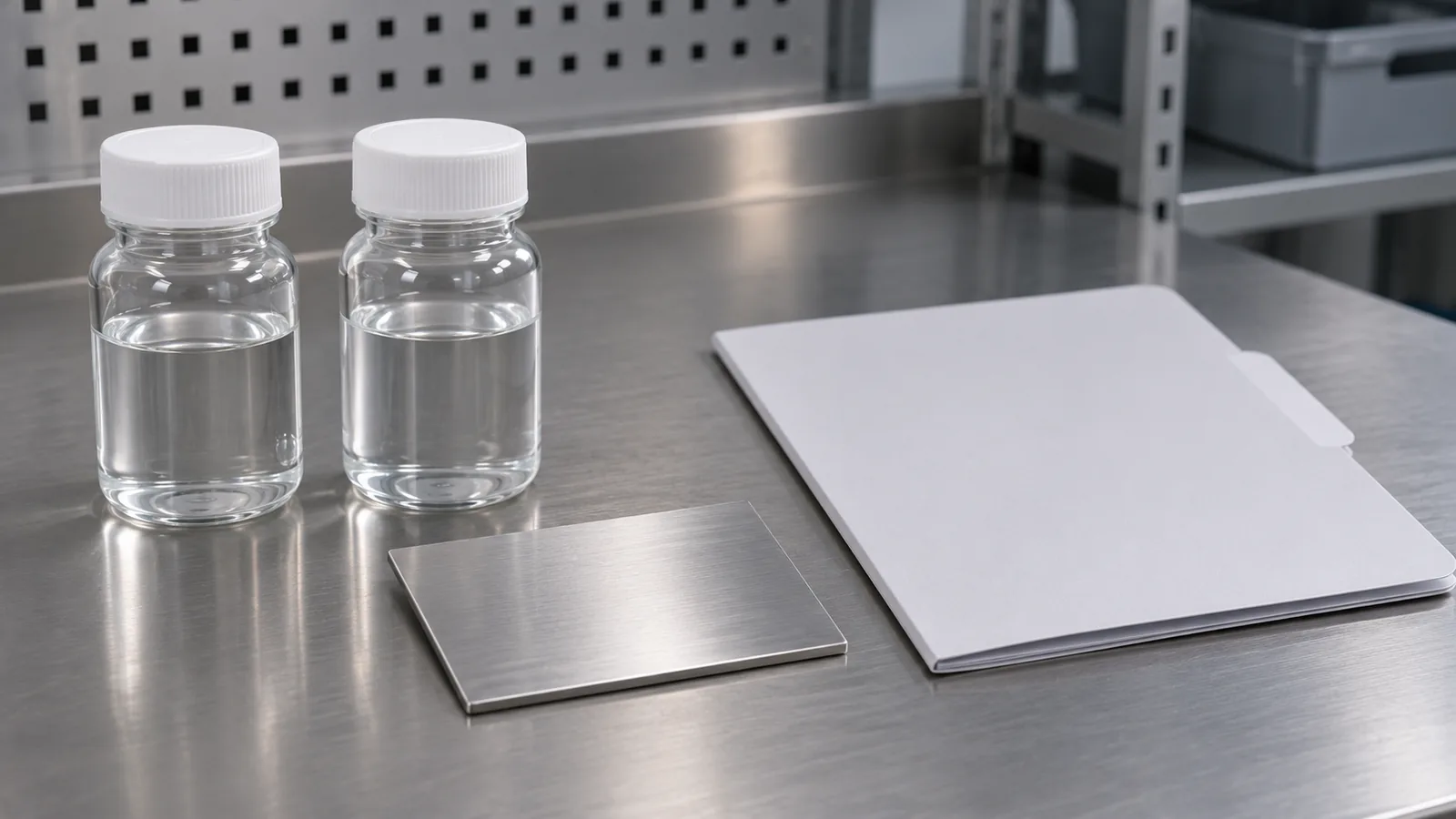
Denatured alcohol vs isopropyl alcohol is a comparison between a formulation description and a different chemical identity. Denatured alcohol generally refers to ethanol made unsuitable for drinking through added denaturants; isopropyl alcohol identifies propan-2-ol. A denatured product can also contain water and other ingredients, and some formulations may include isopropyl alcohol without making the two names synonymous. For a buyer reviewing a surface-preparation proposal, identify the exact commercial product, formulation and intended operation before considering compatibility with a coating, adhesive, plastic or metal finish. Neither label alone proves residue behavior or suitability for a hardware component.
For an importer sourcing metal bathroom or home-storage hardware, the useful question is not which liquid is universally better. It is which product the supplier intends to use, on which surface, for what operation, and under which current product instructions. This is a documentation and process-scope review, not a handling recipe, medical comparison or regulatory determination.
What problem does a denatured alcohol vs isopropyl alcohol comparison solve?
The comparison helps buyers clarify a manufacturing instruction that uses a broad phrase such as “alcohol wipe” or “clean the surface with alcohol.” Those words may not identify the chemical or the commercial product. If a buyer approves a generic description, different suppliers may interpret it differently, and an apparently small product substitution can change the formula or the material that contacts a finish.
Consider a hypothetical metal accessory with an adhesive pad or printed label. A supplier may propose cleaning a surface before bonding. The buyer needs to know whether the product is a denatured ethanol formulation, an isopropyl alcohol product, or another commercial mixture; which adhesive and substrate are involved; and whether the product maker’s instructions cover that exact use. A product with a familiar name can still contain additional ingredients, so a generic category does not answer every compatibility question.
The distinction is particularly important when comparing product documentation. One supplier may cite a specific commercial grade and current product data sheet, while another may mention only “denatured alcohol.” Those responses do not establish equivalent formulation or application. Ask for the product identity and the applicable document rather than trying to infer the formula from its appearance, smell or a short shop-floor label.
The supplier-authored discussion from Alliance Chemical supports a bounded identity point: denatured alcohol is ethanol with denaturants, formulations vary, and a formulation may contain isopropyl alcohol as an ingredient without making the two terms identical. This article does not use that source to provide a denaturing recipe, purity recommendation, legal classification, health guidance or universal residue claim.
What do the two alcohol names establish?
Isopropyl alcohol identifies propan-2-ol as a chemical substance. Denatured alcohol describes ethanol that has been made unsuitable for drinking by adding denaturants. The term “denatured” therefore describes an altered product formulation, not a second name for isopropyl alcohol. Because commercial products can include water and other ingredients, the family label may not fully identify the product supplied.
For purchasing, keep four levels separate:
- Base chemical: ethanol or propan-2-ol, where that identity is stated.
- Formulation: denaturants, water or other ingredients included in a commercial product.
- Product designation: the supplier’s exact name, grade or product code.
- Intended operation: the surface, process stage and task the product is meant to support.
These fields answer different questions. A chemical name does not identify every additive. A product designation does not itself prove compatibility with a given coating. An instruction to use a product does not necessarily state the finished product’s care recommendation. The buyer should preserve the manufacturer’s actual wording and avoid extending it to uses it does not cover.
| Buyer review field | Denatured alcohol | Isopropyl alcohol | What must still be confirmed |
|---|---|---|---|
| Name describes | Ethanol with denaturants | Propan-2-ol chemical identity | Exact supplier product and current formulation |
| Formulation variation | Denaturants and other ingredients can vary by product | Commercial product may include water or other ingredients | Product specification, grade and batch documentation as applicable |
| Intended operation | Cannot be inferred from the family name | Cannot be inferred from the chemical name | Purpose and product-maker instructions |
| Surface compatibility | Not universal across coatings or polymers | Not universal across coatings or polymers | Exact substrate, finish, adhesive and supplier guidance |
| What the term does not prove | No universal recipe, residue result or performance | No universal compatibility or residue result | Method, conditions, scope and responsible approver |
This table is a prompt for supplier clarification, not a chemical-selection chart. It deliberately avoids concentrations, denaturant recipes, residue rankings and hazard comparisons. Those details require the exact product documentation and relevant professional guidance. The article does not tell readers how to apply, mix, store or dispose of either product.
How should a buyer review a proposed cleaning or preparation process?
Begin by identifying the exact surface and stage. Is the supplier preparing bare metal, a powder-coated face, a plastic component, a rubber pad, an adhesive interface or an assembled product? If multiple materials are exposed, list each one. A process instruction intended for one substrate should not be assumed to suit the full assembly.
Next, ask for the exact product identity and current technical documentation. The TDS may describe product properties and approved applications. The SDS provides product-specific safety information. A buyer should not substitute a generic web article for either document. If the relevant surface is not addressed in the manufacturer’s instruction, ask the finish or adhesive supplier to confirm whether the proposal falls within its scope.
Then define the operation. Is the liquid intended to remove a named contaminant, prepare a bonding surface, dilute a coating, or serve another function? These are distinct purposes. The buyer should not assume that a product suitable for one operation is suitable for another. Do not add a concentration, contact time, wiping process or pass criterion unless the responsible technical party has specified and approved it for the exact product and substrate.
Record the scope in a short process note: product name, supplier, target surface, intended operation, supporting document revision and approver. If a sample is reviewed, state exactly what was checked. A visual appearance check is one observation; it is not automatic proof of adhesive performance, coating compatibility, chemical purity or user safety.
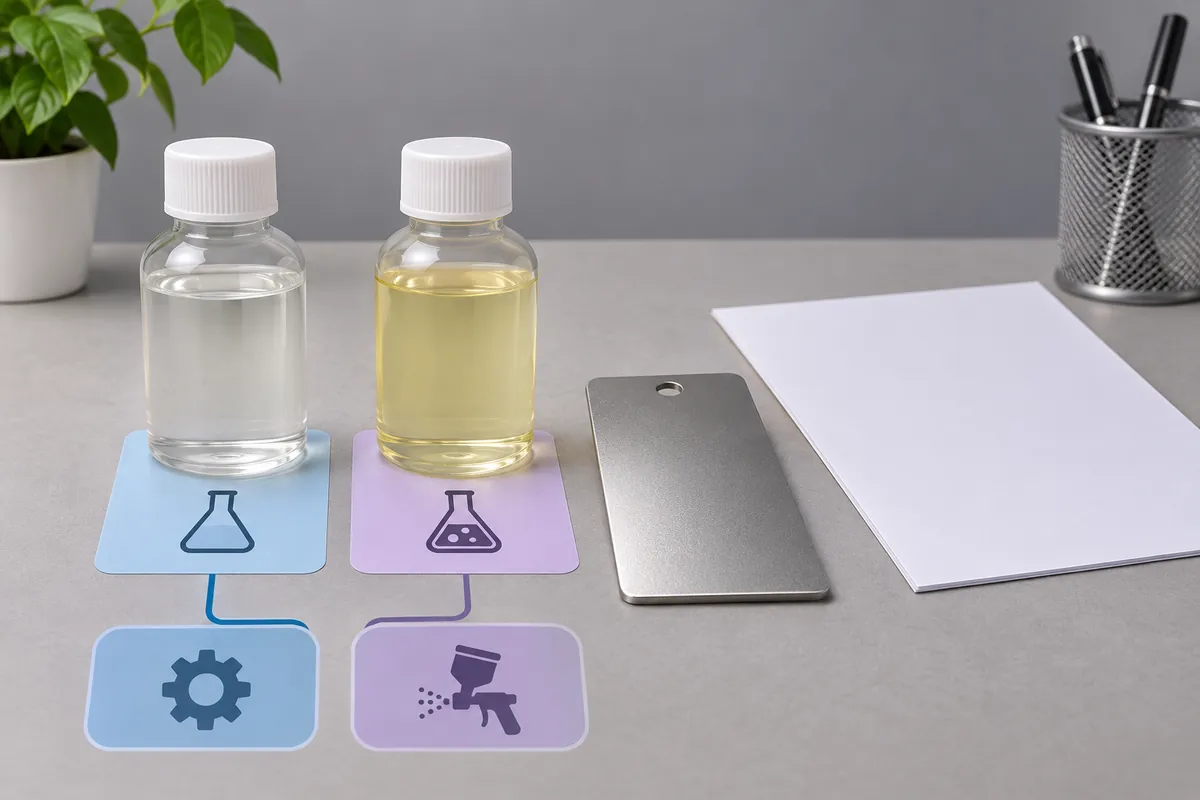
For example, a private-label buyer may receive a metal hook with a bonded pad and ask the factory to prepare the contact face. The specification should identify the actual pad material, adhesive and coated or bare surface involved. If the chemical supplier’s documentation covers only a different material, the buyer should request a product-specific confirmation rather than assume equivalence. The proposed operation may belong to the hardware manufacturer, adhesive supplier or coating supplier; document who owns that decision.
This distinction also protects product documentation. A manufacturing preparation step is not automatically an end-user cleaning or care instruction. The buyer should not publish consumer-facing advice based on a factory process note without review. Keep industrial process language and product-care language separate, and source each from the responsible product maker.
What documentation should be requested before substitution?
Before approving an alternative product, ask the supplier to provide enough information to identify what is changing. The request should not seek a denaturing formula or proprietary ingredient disclosure unless the project has a justified basis for that request. It should establish whether the new product is a different chemical, a different formulation or only a different supplier designation.
The buyer can request:
- Exact product identity: supplier or manufacturer name, commercial designation and product code.
- Current documents: the relevant technical data and safety data documents, with revision date where available.
- Formulation scope: whether the product is a denatured ethanol formulation, isopropyl alcohol product or another defined mixture, as stated by the product maker.
- Target surface: the coating, substrate, adhesive, pad or other material the product will contact.
- Intended operation: cleaning, surface preparation, dilution or another stated purpose, without adding unapproved use instructions.
- Compatibility basis: the maker’s current guidance or project-specific confirmation for the named product and surface.
- Change record: the approved revision, supplier response, approver and any limitations.
If the buyer is comparing two quotations, use the same fields for both. One quote may name a specific commercial product; another may provide only a generic chemical family. Mark that difference instead of treating the offers as identical. The buyer may conclude that the extra detail is unnecessary for a low-risk, defined operation, or may require further review for an important adhesive or finish. The decision should be based on the actual product and application.
Do not use a document title as a substitute for reading its scope. An SDS is not the same as a TDS; each serves a different documentation purpose. Neither by itself certifies compatibility with every finish or component. If a product change affects a coating or adhesive, obtain the confirmation from the party responsible for that material system. For related no-drill bathroom products, Koitor’s no-drill bathroom hardware page covers the product category, but it is not a chemical compatibility approval for a solvent.
What mistakes make the comparison unreliable?
The main mistake is treating denatured alcohol as a single known formula. Its denaturants and other ingredients can vary. The name alone does not establish the exact commercial composition or the purpose for which a specific product is sold.
Other errors include:
- Calling denatured alcohol and isopropyl alcohol synonyms. One describes an ethanol formulation; the other identifies propan-2-ol.
- Assuming a denatured product contains no isopropyl alcohol. Some formulations may include IPA as an ingredient without changing the meaning of the product category.
- Assuming two products with similar names have identical formulas. The supplier’s exact designation and current documents should be checked.
- Using appearance or smell as identification. Those are not reliable product records or compatibility evidence.
- Transferring a use instruction across surfaces. A bare-metal procedure may not cover a coating, rubber, adhesive, plastic or printed label.
- Inferring residue behavior from the chemical family. Residue depends on product formulation and conditions; do not promise “no residue” without evidence.
- Treating a product as universally acceptable for preparation. The purpose and substrate must be within the maker’s instructions.
- Conflating factory process with consumer care. Manufacturing steps need not be appropriate end-user directions.
- Requesting a generic “alcohol certificate.” Ask for the actual product documentation and the relevant compatibility evidence instead.
- Approving a substitute without a revision note. Keep the product identity and approver connected to the product or process version.
If the supplier cannot name the product, the buyer does not yet know what is being proposed. If the product is named but the target surface is not covered, compatibility remains an open question. These are different gaps and should be recorded separately. The buyer can ask the chemical maker, adhesive supplier or finish supplier to address the relevant scope instead of assuming the hardware factory can establish every chemical claim.
How can an OEM supplier support this review?
A metal hardware OEM can clarify the product drawing, surface finish, assembly stage and which component a proposed preparation step affects. Koitor Hardware is a family-owned custom metal hardware factory focused on bathroom and home-storage products. Its relevant role is to discuss the hardware product, sample and project scope within confirmed capabilities. This does not imply that Koitor formulates alcohol products, performs chemical analysis or approves every solvent application.
For a small-batch product or private-label project, the buyer can provide the drawing or sample, identify the coating or adhesive, and attach the supplier’s exact product instruction. The team can then separate questions about metal geometry and assembly from questions that belong to the chemical or coating product maker. That makes the technical owner clear before a sample or process is treated as approved.
When a product is changed, the buyer should decide whether the new solvent affects the production note, finished appearance, adhesive scope or end-user documentation. If the process remains unchanged but the product designation changes, retain the new product documents and obtain confirmation where the old approval no longer applies. If the coating or adhesive itself changes too, review that as a separate change rather than rolling everything into one broad statement.
Small-batch OEM development can help the buyer validate the product configuration and sample fit before larger commitments, but the acceptance criteria should be stated in advance. MOQ, sample timing and production schedule depend on the product, quantity, finish and packaging; they should be confirmed for the actual project. No generic solvent comparison can promise a production result.
Los compradores pueden consultar las opiniones sobre Koitor’s OEM home-storage hardware information and use the project contact page to share the drawing or sample. Include the exact product and unresolved surface question so the discussion stays within the right project boundary.
Buyer checklist before requesting a quotation
- Identify the exact alcohol product and supplier, not just “alcohol.”
- Distinguish denatured ethanol formulation from isopropyl alcohol identity.
- Attach the current TDS and SDS where relevant.
- Name every exposed surface and component.
- State the intended operation and manufacturing stage.
- Ask the responsible chemical, adhesive or coating maker to confirm scope.
- Keep factory preparation instructions separate from consumer care directions.
- Record what the sample review actually demonstrates and what it does not.
- Preserve supplier substitutions and document revisions in the approval record.
- Do not add recipes, concentrations or handling steps without approved instructions.
How should the buyer handle an incomplete supplier answer?
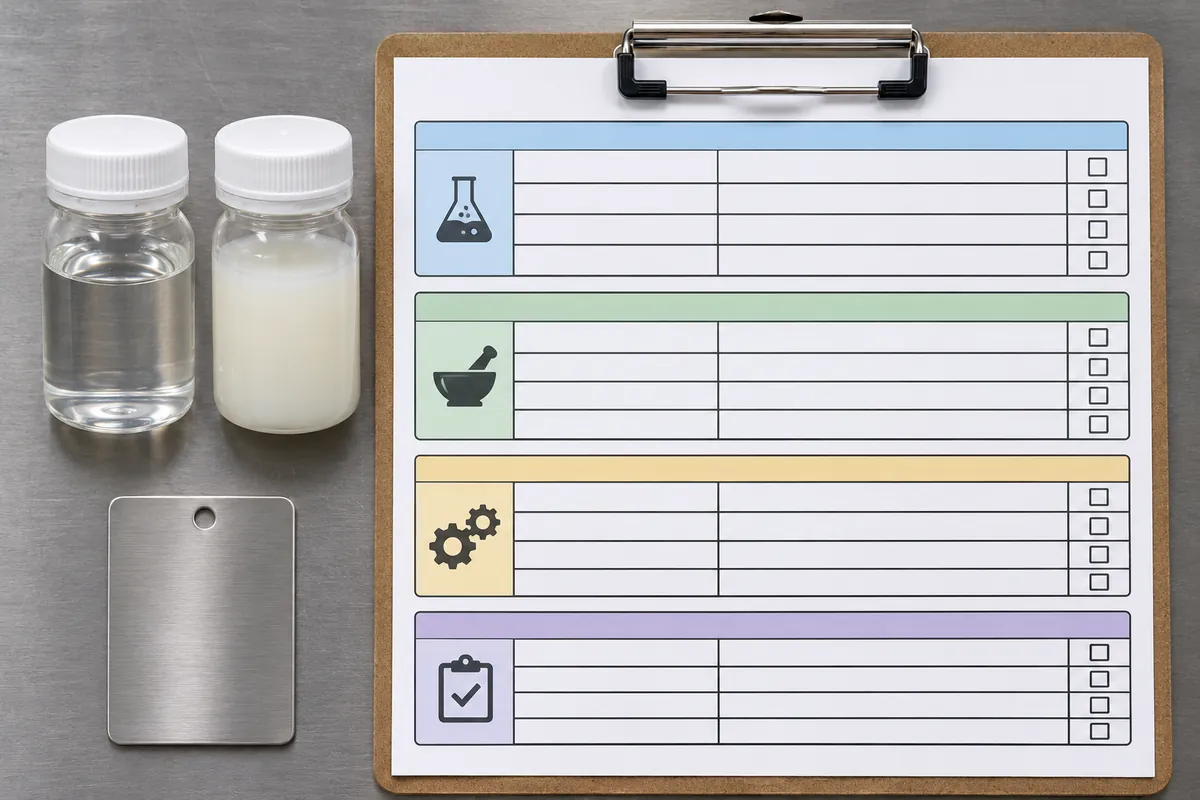
An incomplete answer should be recorded as an open scope item rather than interpreted as approval. If a supplier replies only “IPA” or “alcohol,” ask whether that is the exact commercial product name, a shorthand for the base chemical, or a general description of a proposed process. Then ask for the document that supports the stated use. This keeps the conversation factual without asking the supplier to disclose a proprietary formulation that is not needed for the purchase decision.
The buyer can classify the response in three practical ways:
| Response received | What it establishes | What remains open |
|---|---|---|
| A chemical-family term only | The supplier has described a broad category | Exact product, formulation and operation |
| Product name and current document | A specific commercial product is identified | Whether its documented scope covers this surface and process |
| Product-specific compatibility confirmation | A responsible supplier has addressed a stated application | Whether the project configuration and revision still match |
This is a recordkeeping distinction, not a three-level safety rating. A buyer should not score an answer as acceptable simply because it includes a product code. The product code helps identify what to review; it does not replace the relevant product-maker instruction or the buyer’s approval criteria.
If the hardware assembly includes several materials, capture them separately. A metal body, coating, elastomer pad, pressure-sensitive adhesive and printed mark may each have a different supplier or evidence owner. The useful question is not “Is alcohol safe?” but “Which named product is proposed for which named surface, for which operation, and who has confirmed that scope?” A narrowly phrased question is easier for the responsible supplier to answer and reduces the chance that a generic response will be applied to a different component later.
When a supplier cannot provide the missing information immediately, keep the proposal pending and identify the next owner: chemical maker for product identity and instructions, coating maker for finish compatibility, adhesive supplier for the bond interface, or hardware supplier for component and process details. Do not convert a pending documentation item into an informal shop-floor instruction. Once the scope is resolved, preserve the answer with the drawing, sample or process revision it covers. If the product or surface changes, reopen the review rather than carrying the old approval forward automatically.
How can a product change be reviewed without restarting the entire project?
When a supplier proposes a substitute, compare the old and new product records field by field. Confirm whether the base chemical changed, whether the formulation or product designation changed, and whether the target surface or manufacturing stage changed. If only the supplier designation changed, keep the supporting documentation with the new designation and ask whether the existing approval still covers it. If both the chemical product and the finish or adhesive changed, treat those as separate revisions so that the reason for each decision remains clear.
This review can be proportionate. A buyer does not need to reopen unrelated drawing dimensions when the only change is a named cleaning product, but should not assume the new product is covered by an approval tied to another formulation. The change record can state the affected operation, the unchanged product features, the document reviewed, the question left open and the person who authorized continuation. That gives a future quality reviewer a traceable basis without turning a general product comparison into an unbounded technical investigation.
Para denatured alcohol vs isopropyl alcohol, the useful comparison remains the exact chemical identity and commercial formulation, not a generic claim that one is more suitable. If the supplier cannot show that the proposed product’s documented scope matches the named substrate and operation, preserve the item as pending and request clarification from the responsible maker. Keep any end-user care language outside the manufacturing approval unless the product-care owner separately reviews it.
Preguntas frecuentes
Is denatured alcohol another name for isopropyl alcohol?
No. Denatured alcohol generally describes ethanol with added denaturants, while isopropyl alcohol identifies propan-2-ol. Some formulations may contain IPA as an ingredient, but the labels are not synonyms.
Does every denatured alcohol product have the same formulation?
No. Formulations can vary by product. Check the supplier’s exact designation and current documents rather than assuming one universal formula.
Can I use either product on a powder-coated part?
No universal compatibility conclusion follows from the names. Identify the coating, exact product and operation, then check the coating maker’s current instructions or obtain project-specific confirmation.
Does a sample that looks clean prove the surface is ready for adhesive?
Not by itself. Visual appearance is a limited observation. Any adhesive or coating acceptance requirement needs an appropriate method and supporting evidence.
Can this comparison be used as a handling guide?
No. Use current product-specific safety documents and qualified workplace guidance for handling, storage or disposal. This article does not provide those procedures.
Trabaja con Koitor Hardware
Clarify a Surface Preparation Question
Share the hardware drawing or sample, finish or adhesive, exact proposed product and process stage. Koitor can discuss the metal product scope; the responsible chemical or coating supplier should confirm product-specific instructions.
OEM / MARCA BLANCA
Convierte esta guía de abastecimiento en un resumen del producto
Indícanos el producto que deseas, el tamaño, el acabado, la cantidad del pedido y los requisitos de embalaje. Tu equipo recibirá un análisis práctico de la viabilidad de fabricación antes de recibir el presupuesto.

 English
 Español
 Português
 Français
 Deutsch
 العربية