
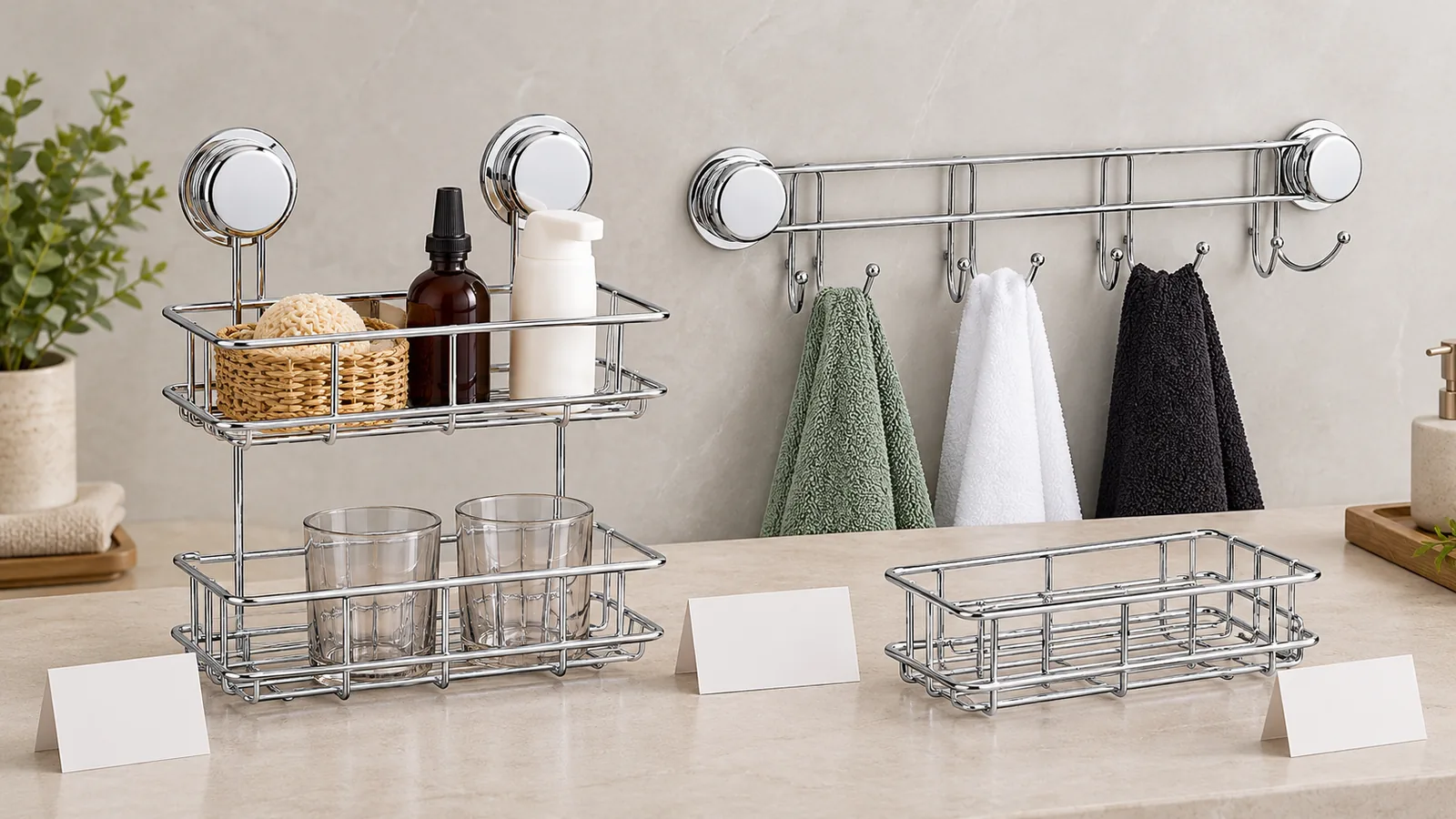
Bathroom accessories assortment planning should start with the buyer’s channel, use cases and launch constraints—not with a long supplier catalog. An importer can define a focused core range, add extensions only when each solves a distinct need, and map every finish, mounting system, package and SKU-level minimum before requesting quotes. This method makes it easier to compare products without assuming that related items share the same parts, process, MOQ or sales potential.
A range plan is a working decision document, not a forecast. Use the buyer’s own channel data to decide which items deserve launch priority; use supplier evidence to confirm what can be made and quoted as specified.
The most useful bathroom accessories assortment planning process makes product role, configuration, quantity basis and evidence gaps visible together.
What decision should an assortment plan solve?
A good plan answers three practical questions: which products belong in the first range, which variants can wait, and what must be confirmed before sampling or quotation. For metal bathroom and home-storage hardware, the range might include wire baskets, towel hooks, towel bars, shelves or soap-holding products, but a buyer should not include an item merely because it appears in a supplier’s catalog.
Start with the channel and customer problem. A distributor serving plumbing retailers may need a compact set of recognizable products and replacement-friendly packaging. A private-label e-commerce brand may care more about product photography, clear dimensions, installation information and parcel-ready pack-out. A hospitality buyer may specify a different set of functions and replenishment needs. These are planning prompts, not claims about what any channel will sell.
Write down the intended customer, use case, target channel, price architecture if buyer-owned, launch timing and the evidence available for each product. Separate known sales data from assumptions. If the buyer has no data for a proposed extension, mark the gap and decide whether a limited test, a sample review or a later phase is appropriate.
The range should be evaluated as a family of distinct products, not as a collection of visual variations. A second size or finish may create a separate SKU, carton, label, instruction set or stock position. The cost of that added complexity belongs in the decision even when the item itself appears similar.
How should buyers choose core products and extensions?
Choose core items around clearly different buyer needs. An extension should add a new use case, size, mounting option, finish or channel fit that the buyer can explain. If two products perform the same role and differ only cosmetically, the buyer should ask whether both are needed at launch or whether one can wait until evidence supports the second.
For a first range, make each proposed SKU earn its place. Record the reason for inclusion, expected buyer, channel, specification status, package requirement and unresolved questions. A product may be a core item because it anchors a category or fills a documented gap; another may be a test extension whose performance is uncertain. Label those roles explicitly instead of presenting every item as an equal launch priority.
Do not equate fewer SKUs with lower risk in every case. A narrow range can leave a channel need unanswered, while an oversized range can multiply sample, packaging and inventory work. The useful goal is a manageable set with a reasoned role for each line and a defined path for adding or removing variants.
A phased structure can help:
- Core phase: products that directly match the buyer’s established channel or category requirement.
- Test phase: limited extensions that address a plausible but less-validated need.
- Later phase: options held until buyer feedback, sell-through or reorder evidence justifies the additional complexity.
The buyer owns the demand decision. A manufacturer can clarify product construction, customization and production questions, but should not be asked to invent the buyer’s market size or sales forecast.
Which products can share finishes, components or processes?
Related products may share a finish family or some purchased components, but similarity is not proof of interchangeability. Compare the actual mounting interface, wire or sheet construction, joints, dimensions, finish route and packaging. A chrome finish on one product may not match another product’s appearance if the substrate, geometry, preparation or finishing route differs.
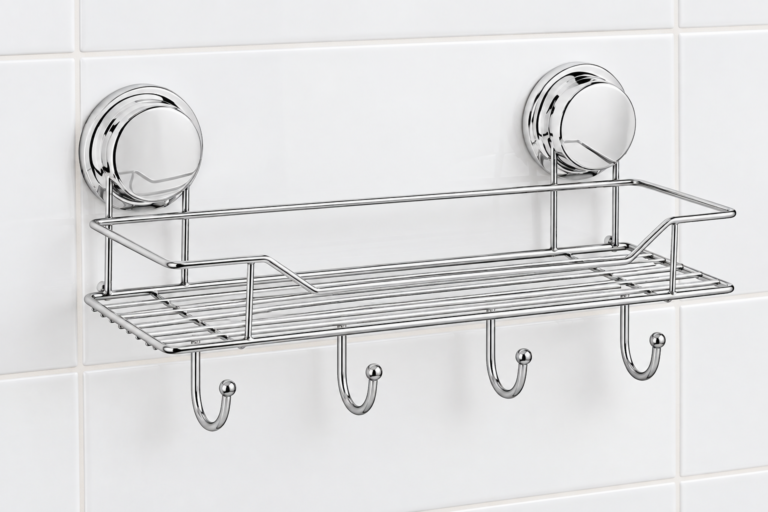
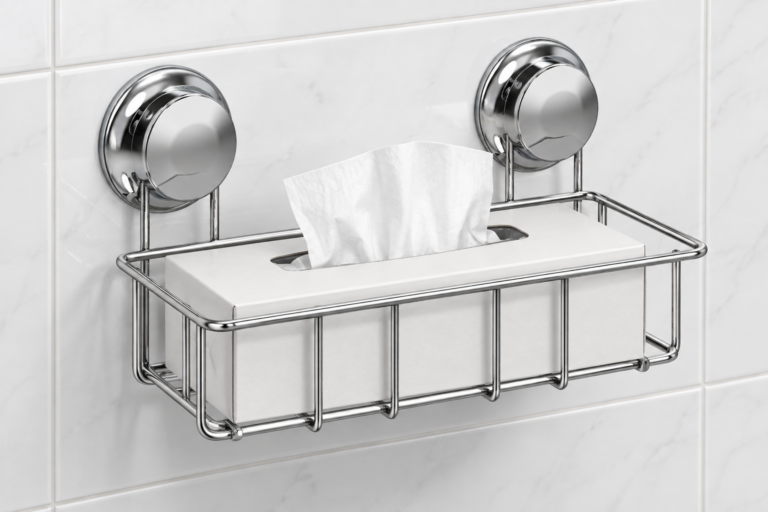
When suction-mounted items are part of the range, treat the suction assembly as a defined configuration. Identify the actual cover, base, cup, connector and support-wire layout for each SKU. A towel hook rail with two spaced suction covers is not equivalent to a basket with a different support arrangement. Do not assume that one mounting component fits every product simply because both use suction.
For shared components, ask suppliers to list the part number or description, product variants that use it, and any differences in finish, size or fit. Check whether a common component creates a supply dependency or whether a product requires its own part. A component family can simplify a buyer’s assortment, but only after physical fit and project scope are confirmed.
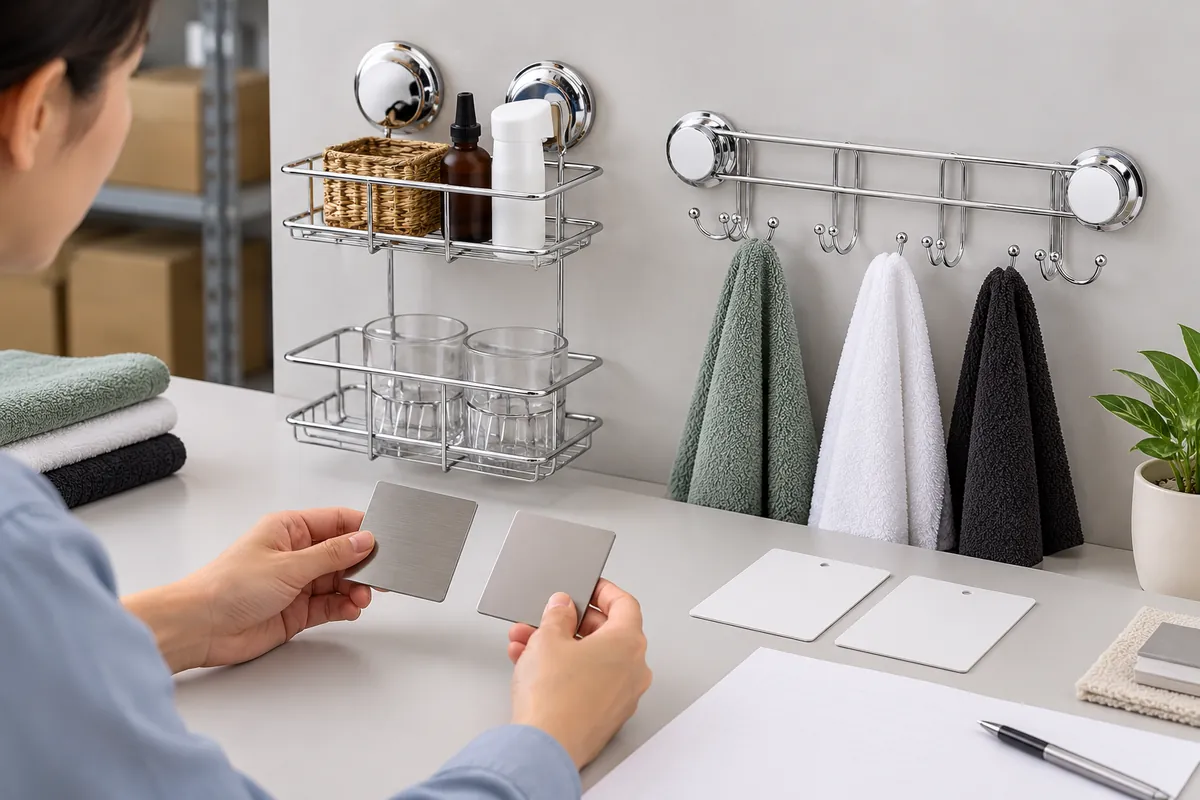
Finish planning also needs real sample approval. Select the buyer-facing finish references and determine which surfaces will be compared. Coordinate lighting and viewing conditions when judging color or gloss, especially across different shapes. Do not infer a finish’s corrosion performance from color or shine; performance requirements need their own agreed specification and evidence.
How do MOQ and packaging change the range decision?
Ask whether MOQ is quoted per product, finish, size, package or combined order. There is no safe assumption that related SKUs can share one minimum. A supplier should state the basis for each proposed item and identify any setup, material or packaging conditions behind the quoted quantity. If a buyer plans to combine variants, confirm that the supplier accepts the exact combination and records it in the quotation.
Map packaging at SKU level. Product dimensions, included hardware, user instructions, retail carton, master carton and label may differ across the family. A shared package architecture can be useful, but verify that the insert or carton protects each product and keeps its components identified. Do not force one box onto different products without a fit review.
For every proposed SKU, compare the practical burden of carrying it: minimum quantity, sample requirement, finish approval, component sourcing, carton size, storage space, documentation and reorder handling. A new finish may create its own approval and stock decisions even when the metal product remains unchanged. A new size may require revised inserts or instructions even when the outer appearance is similar.
| Range field | Buyer records | Por qué es importante |
|---|---|---|
| SKU role | Core, test extension or later phase | Shows why the item is in the range |
| Product configuration | Size, mounting, included parts and drawing revision | Prevents unlike variants being grouped |
| Finish and material | Buyer requirement or supplier proposal and evidence | Separates preference from confirmed specification |
| Shared components | Part identity, fit and affected SKUs | Tests whether family-level assumptions are valid |
| MOQ basis | Per SKU, finish, package or confirmed combination | Makes quantity quotes comparable |
| Embalaje | Unit pack, instructions, carton and label | Reveals SKU-specific pack-out work |
| Open decision | Evidence gap, owner and due point | Prevents an assumption from becoming a commitment |
| Launch phase | Core, test or deferred | Controls the sequence of samples and purchase decisions |
How should buyers phase sampling and launch decisions?
Sample the products that resolve the largest decisions first. That may be the item with a new mounting system, a finish that must coordinate across the line, a size that affects packaging, or a product with multiple custom parts. A sample plan should say what each sample will validate and which other SKUs depend on its outcome.
Use a family matrix to identify shared rules and exceptions. For example, a common chrome finish may be reviewed across several geometries, while a suction cover or support wire may require a separate check on each product. Record the product ID, drawing revision, sample type, finish reference, included hardware, review result and any change request. Do not let approval of one sample silently approve a different SKU.
Phase the launch using buyer-owned evidence. The buyer may test a limited set, gather channel feedback, and then decide whether to release another size or finish. Set a review point before the next order, and define which evidence would justify adding or dropping an extension. Avoid calling a product a proven best seller unless the buyer has reliable sales records to support that statement.
Keep the supplier’s quotation connected to the exact matrix revision. If the buyer changes the range, finish or package after quotation, ask for an updated scope and quantity basis. If a supplier proposes an alternative design, record it as a separate option rather than blending it into the buyer’s original product requirement.
What should an importer include in the assortment RFQ?
Send a controlled range brief rather than a list of product names alone. Include:
- Target channels and customer uses for the planned range.
- Proposed core products and extensions, with the reason for each SKU.
- Drawings, reference photos or physical samples with revision identifiers.
- Product dimensions, mounting method and included components.
- Material and finish requirements, or a request for a clearly identified supplier proposal.
- Finish-reference samples and the method for comparing appearance.
- Requested sample type, quantities and what each sample should validate.
- MOQ basis requested for each SKU, size, finish and package configuration.
- Unit packaging, master-carton and labeling assumptions.
- Tooling, component, setup or development questions to quote separately.
- Open questions, buyer-owned assumptions and the person authorized to approve changes.
A clear RFQ helps the supplier explain which items share confirmed components or production steps and which need separate consideration. It does not guarantee that every product can meet every quantity or schedule; those details must be confirmed for the actual design and order.
Koitor Hardware is a family-owned custom metal hardware manufacturer for bathroom and home-storage products. Buyers can share drawings or a physical reference through the contact page and discuss a product-family brief with the team. For more about Koitor’s OEM home-storage hardware manufacturing scope, review the service information and confirm project-specific capability, finish, MOQ, timing and pack-out in the quotation.
What should buyers check before approving the range?
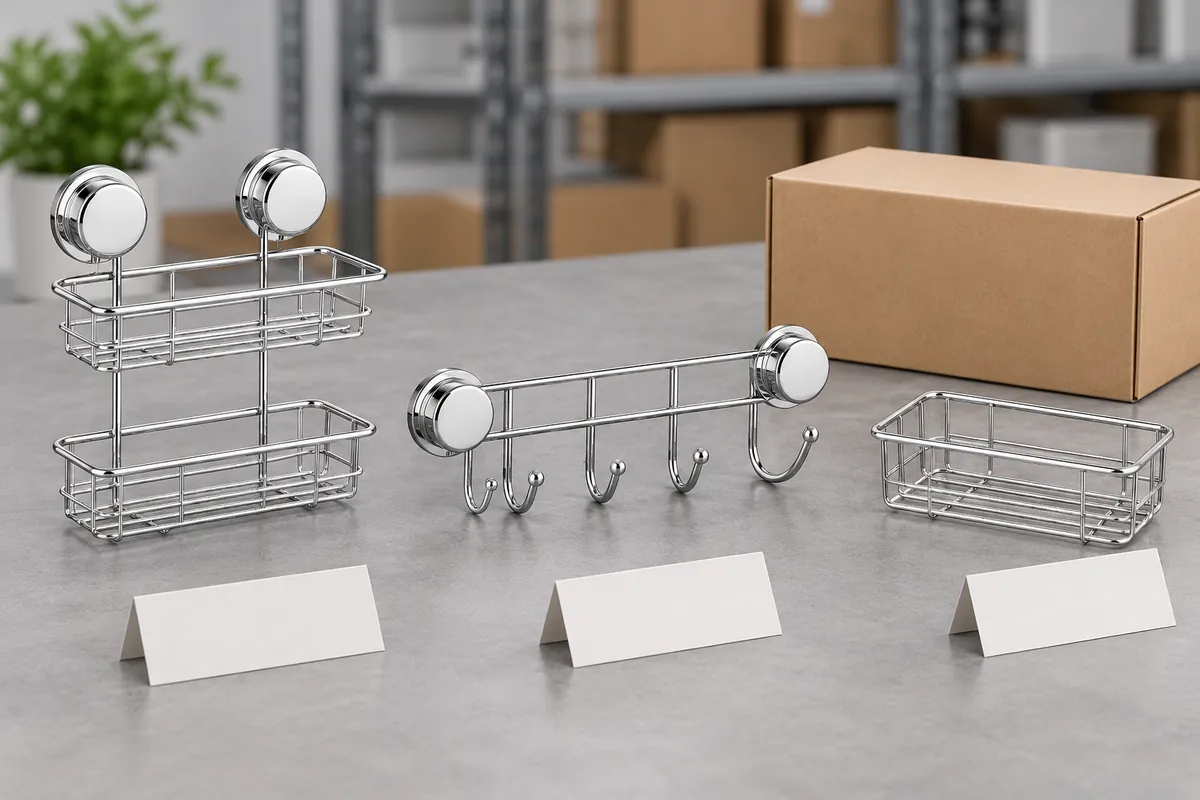
Before approving a first assortment, verify that every item has a distinct buyer role, a defined configuration and a quantity/packaging basis. Confirm which decisions are supported by channel evidence and which remain assumptions. Keep product facts, supplier proposals and buyer hypotheses visibly separate.
A final range review should answer:
- Which products are core, test extensions or deferred?
- Does every variant solve a distinct use case or channel need?
- Are mount, size, finish and component differences documented by SKU?
- Has the supplier stated MOQ basis per item and any permitted combination?
- Are sample, tooling, finish approval and revision costs separate and clear?
- Does each package configuration fit the product and its included parts?
- What is known about the buyer’s channel, and what still requires testing?
- Who owns the final approval and when will the range be reviewed again?
The range is ready for quotation when suppliers can respond to a stable, revision-controlled brief. It is ready for purchase only when the buyer has compared scope, confirmed quantities and packaging, and resolved the open decisions that materially affect launch or reorder handling. Revisit bathroom accessories assortment planning when buyer-owned feedback or reorder evidence changes the case for an extension SKU.
Preguntas frecuentes
How many bathroom accessory SKUs should a buyer launch first?
There is no universal number. Start with the products supported by the buyer’s channel plan and available evidence, then classify uncertain variants as test or later-phase items. MOQ, packaging, inventory capacity and product role all affect the decision.
Can different bathroom products share one MOQ?
Only if the supplier confirms the exact combination and quantity basis in writing. MOQ may vary by product, finish, size or package. Do not assume that combined products qualify for one shared minimum.
Should every product in an assortment use the same finish?
Not necessarily. A coordinated finish family may help a buyer present the range consistently, but finish availability, appearance and approval should be checked on each relevant product. The buyer should define acceptable references and decide whether a different finish serves a specific channel need.
Can one sample approve an entire product family?
Usually not without a defined equivalence rule. A sample may represent one configuration, while other sizes, mounts, finishes or component kits differ. List what each sample covers and review critical differences separately.
When should an extension SKU be added?
Add it when buyer-owned evidence, customer feedback or a defined channel requirement supports the product role and the supplier scope is confirmed. A plausible idea alone can remain in the test or later-phase list until the buyer has enough evidence.
Planning a Bathroom Storage Range?
Share your core products, proposed extensions, finish references and target quantity basis. Koitor can discuss the confirmed metal-hardware scope and identify which configurations require separate sampling or quotation.
OEM / MARCA BLANCA
Convierte esta guía de abastecimiento en un resumen del producto
Indícanos el producto que deseas, el tamaño, el acabado, la cantidad del pedido y los requisitos de embalaje. Tu equipo recibirá un análisis práctico de la viabilidad de fabricación antes de recibir el presupuesto.

 English
 Español
 Português
 Français
 Deutsch
 العربية