
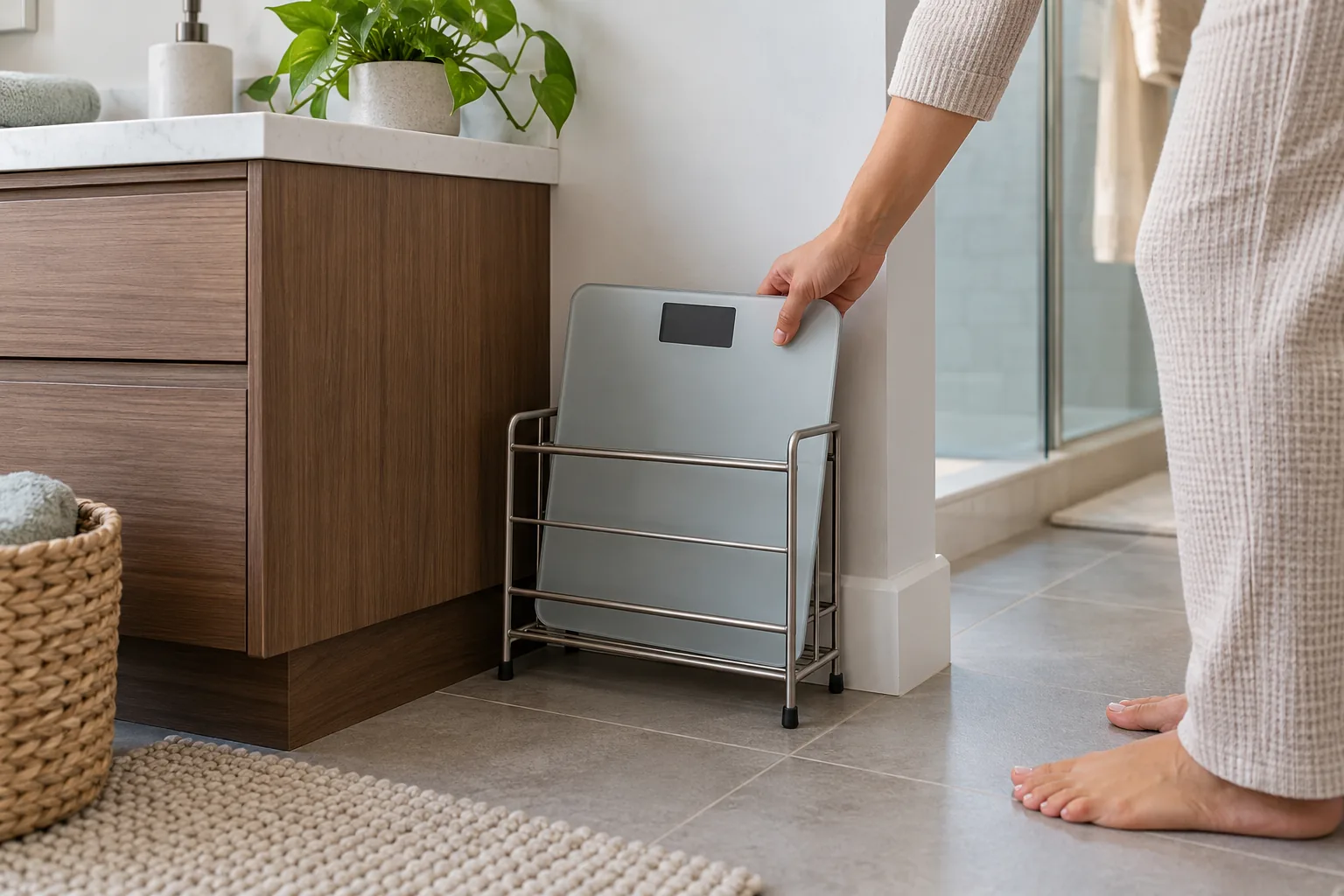
A bathroom scale storage rack should be matched to the exact scale models and storage method the buyer intends to support. Before approving a design, record the scale’s width, depth, thickness and any feet, protrusions, cable or handle; confirm the manufacturer’s instructions allow the proposed storage orientation; then test insertion, removal and return to normal use. A holder’s stated dimensions or metal construction do not establish compatibility with every scale, and a storage accessory must never be presented as a platform for standing or weighing.
Which Scale Models Belong in the Fit Matrix?
Start with a list of approved scale models, not a generic label such as “bath scale.” Models can differ in overall outline, thickness, base geometry, feet, display location and other features. Even products from the same brand may have different housings or instructions. If an assortment is expected to support several models, use samples or manufacturer specifications for each model and keep the matrix version-controlled.
For each reference scale, record the source and date of dimensions. Manufacturer-published dimensions are useful for initial screening, but a physical sample can reveal protrusions or packaging variations that a simple width-height-depth listing misses. Mark whether the measurement includes feet or a removable accessory. Do not fill gaps using a photo estimate and present it as confirmed.
| Fit-matrix field | Buyer record | Por qué es importante |
|---|---|---|
| Brand and model | Exact identifier and revision if available | Prevents a generic fit claim |
| Overall envelope | Width, depth and thickness | Defines the starting fit boundary |
| Feet/protrusions | Position and projection | Can reduce clearance or snag |
| Display and controls | Location and visibility | A holder may obscure access |
| Cable or handle | Presence and location if applicable | May affect storage orientation |
| Manufacturer storage guidance | Source and exact model | Confirms permitted storage approach |
| Holder opening | Usable clear dimensions | Determines actual insertion |
| Contact surfaces | Pads, rails, edges or supports | Identifies points for sample review |
| Retrieval path | Lift, slide or other movement | Reveals user-access constraints |
| Product revision | Drawing and sample identity | Links approval to the sold item |
What Architectures Should Buyers Compare?
Some products use an over-scale bridge or bay that also serves as a shelf; others use a wall-mounted holder designed to store the scale separately. These architectures answer different buyer questions. A bridge design needs the scale-storage opening and any top surface to be separately specified. The top shelf’s permitted use and load, if any, must not be confused with the scale holder’s fit. A wall-mounted design introduces wall interface, fixing and reach questions.
Yamazaki’s product pages show these distinct approaches on specific models, including a steel rack that stores a scale in a designated bay and a wall holder with model-specific fit information and protective contact features. Those examples demonstrate that products should be compared by their stated architecture and dimensions. Their numbers and claims are not universal, do not apply to unrelated scales, and do not establish Koitor product specifications.
Before comparing prices, identify the intended installation and use. A freestanding or bridge-style holder may use floor space; a wall holder requires a compatible wall and approved fixing method. The buyer should compare the product envelope, access, included parts and packaging on equal terms.
How Should Clearance and Retrieval Be Checked?
Measure the holder’s usable opening, not only its external size. A body can appear wide enough while an inward rail or bracket reduces the clearance. The sample review should test the largest and smallest reference scales. Insert each scale in the manufacturer-permitted orientation, observe contact points, then remove it using the motion a user will actually perform.
Check whether the scale can be gripped without pressing controls, scraping adjacent fixtures or contacting a potentially vulnerable display. Review what supports the scale: side rails, a shelf, a ledge or other geometry. If the scale is stored upright, confirm that the exact model manufacturer allows that orientation. Do not infer that all digital scales can be stored vertically or transported the same way.

The buyer can review the route from storage to use: remove the scale, place it in its normal measurement location, and return it to storage afterward. If the scale has model-specific calibration or settling instructions, users should follow those instructions. Withings, for example, documents a calibration-related guidance page for its Body Scan model. That guidance is specific to that model and should not be generalized into a waiting rule for all scales.
What Contact and Protection Details Need Review?
Identify where the holder touches the scale: feet, housing edges, underside, side faces or display area. Check whether pads, liners or protective components are included and whether their positions correspond to the contact surfaces. If the product uses an insert, confirm its material, attachment and replacement status. A pad’s presence is not proof that the scale cannot scratch, slip or be damaged.
Review the finish and edge condition on the actual sample. Note burrs, sharp transitions, exposed ends, rough weld zones or finish irregularities that could matter at a contact point. Separate this visible inspection from a formal performance claim. If a buyer intends to claim “scratch resistant,” “anti-slip” or another outcome, suitable evidence is needed for the exact design and use conditions.
A contact review should include more than a clean new sample. The team may evaluate what happens when the scale is inserted repeatedly, whether the holder moves, and whether pads remain in place. Any such evaluation should be documented as a product-specific development check, not presented as an industry-standard method unless the method is actually defined and applicable.
How Should Buyers Separate Storage Loads and User Loads?
This distinction is essential for products that combine a storage bay and a top shelf. The force associated with storing a scale is different from a person standing on a weighing platform. A bathroom scale holder or bridge must not be described or illustrated as a place to stand unless that use is explicitly designed, evaluated and approved by the manufacturer for the exact product. The ordinary purpose of a scale is separate from the purpose of its holder.
If the rack has a top surface, the buyer should ask the product owner to define its intended use and any verified load criteria. Do not infer a load rating from steel thickness, frame appearance or a scale’s own weighing range. Weighing capacity of the stored scale says nothing about the storage rack’s load capacity.
For wall-mounted designs, the installer or qualified project professional must assess the actual wall, backing, fastener and installation. A product drawing can identify holes and dimensions, but it cannot reveal the site substrate. Do not present a generic fastener list as suitable for every bathroom wall.
What Should Be Included in an Importer RFQ?
A useful RFQ contains a scale reference list, a drawing for the holder, intended storage orientation, installation location, desired finish, contact protection requirement, quantity and packaging expectation. Ask the supplier to identify the exact dimensions it will use to assess fit, the sample configuration, included parts and any unknowns. If several scale models are included, list every model separately.
Require a sample test plan that states who provides the scale, who records fit, which surfaces are inspected and what results remain subjective. Make the buyer and supplier agree what constitutes acceptable insertion and removal. If no numeric criteria are defined, do not invent them after observing a sample. Agree the method before approval so the result can guide later production and reorders.
For packaging, confirm that the holder and accessory parts cannot damage the scale if sold together. Where the scale is not included, the product packaging should not suggest that a scale is part of the kit. Keep product identification, assembly instructions and model compatibility records consistent across the sales page and carton.

Importer Fit and Approval Checklist
- Name the exact scale brand and model for every compatibility statement.
- Confirm dimensions from a current manufacturer source or physical sample.
- Record feet, buttons, display, cable and other relevant protrusions.
- Check model-specific guidance for storage orientation.
- Measure the holder’s clear opening and contact surfaces.
- Test insertion, removal, normal use and return to storage.
- Keep a storage-bay check separate from any shelf-load check.
- Do not represent a storage accessory as a platform for standing.
- Confirm fixing decisions with the installer for the actual wall.
- Review pads, edges and finish on the product sample.
- Tie any claims to exact model, design revision and supporting evidence.
Review the Return-to-Use Sequence
The buyer should look at the entire movement from the scale’s storage position back to the place where a user steps on it, then back again. The rack must not cover the display or controls in a way that makes the scale difficult to retrieve or read. If the reference scale requires a particular surface, orientation or handling instruction, the user should follow its manufacturer’s guidance. The storage holder does not modify those instructions and should not be presented as a measurement platform.
Withings’ Body Scan help material discusses calibration behavior for that model after movement. This reinforces a narrow procurement point: review the exact device’s own instructions when designing a retrieval workflow. Do not generalize its guidance to other scales or promise measurement accuracy from a holder. The sample plan can record whether the product is easy to remove and return, while device operation remains governed by the device maker.
Consider the surface where the scale is used and stored. A bathroom mat, tile edge or cabinet front may affect how the user handles the scale, but the importer should not assume that the rack solves those floor conditions. If a scale has a cable, handle or removable foot, include it in the fit record. If the assortment changes, review whether the same rack opening and contact points still work.
For a multi-SKU program, maintain separate records for the holder, reference scale and any soft contact part. A replacement pad can change the clear opening or stored angle. A packaging change can add a protective sleeve or instruction card that alters the customer’s setup. These changes should be reviewed before reusing a compatibility description.
Keep the product page, package and setup guide consistent about whether the scale is included. If it is a demonstration sample only, label that clearly. A buyer should also verify that the photographed holder configuration matches the supplied parts and that no extra block or pad is hidden in the image. That small content check prevents the illustration from suggesting a fit or accessory feature that was never part of the approved sample.
The buyer should also define where a user places the scale during ordinary cleaning of the bathroom. The holder may need to be moved to reach a wall or floor, so check whether its footprint and components can be handled as intended. Do not imply that the accessory itself is waterproof, washable or suitable for cleaning chemicals without product-specific guidance. Keep those claims outside the fit approval unless evidence is available.
Record the approved bathroom scale storage rack scope with the sample identity and current drawing revision so later product changes trigger the right review.
Preguntas frecuentes
Can one holder fit every bathroom scale?
No. Dimensions, feet, controls and manufacturer guidance differ. Define a model list and verify every stated fit.
Does a wall holder’s advertised maximum thickness establish fit?
Only for the model and conditions covered by that manufacturer’s specification. Verify the exact scale and opening in the product drawing or sample.
Can users stand on a bridge rack that stores a scale?
Do not assume that. Storage and standing are different use cases. Never communicate a standing use unless the exact product is explicitly designed and verified for it.
Does a pad prove anti-slip or scratch protection?
No. It identifies a contact feature, not an independently verified outcome. Substantiate any performance wording for the exact setup.
Should every digital scale be stored vertically?
No universal rule applies. Consult the exact scale manufacturer’s instructions before approving a storage orientation.
Does a scale’s weighing capacity tell the buyer the rack’s capacity?
No. The two products have different functions and must have separate specifications and evidence.
Koitor Scope and Buyer Next Step
Koitor’s confirmed capabilities cover custom metal hardware development discussions, sample work, forming, finishing, assembly and packaging. Current manufacture of a bathroom scale holder, validated compatibility list, anti-slip performance, tip resistance or load rating is not confirmed. Buyers may review the home-storage OEM context y bathroom hardware page, then send reference-scale models, drawings, sample dimensions and target quantities through the contact page. Fit and all performance claims remain specific to the resulting design and evidence.
When comparing supplier proposals for bathroom scale storage rack, use the same reference samples and acceptance notes to keep the purchasing decision traceable.
Developing a Scale-Storage Accessory?
Share the reference scale list, manufacturer storage guidance, holder drawing, contact requirements and sample plan for a bounded fit discussion.
OEM / MARCA BLANCA
Convierte esta guía de abastecimiento en un resumen del producto
Indícanos el producto que deseas, el tamaño, el acabado, la cantidad del pedido y los requisitos de embalaje. Tu equipo recibirá un análisis práctico de la viabilidad de fabricación antes de recibir el presupuesto.



 English
 Español
 Português
 Français
 Deutsch
 العربية