
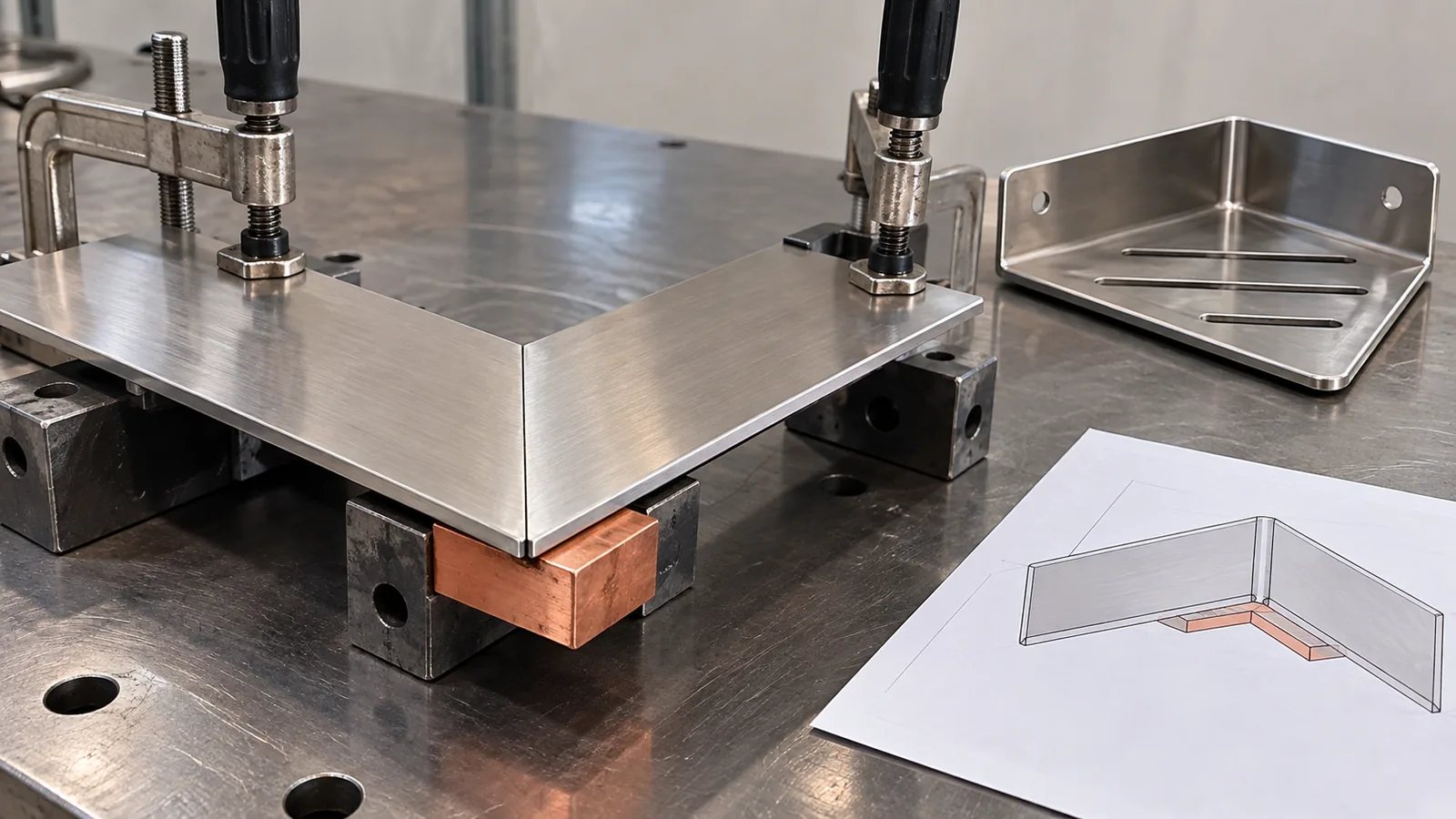
Welding copper backing bar chill bar thin sheet burn through is a buyer search expression for a practical question: whether a removable heat-sink support is appropriate for a thin welded shelf corner, and how the supplier will prove the resulting joint still meets the design requirement. A copper or aluminum chill bar can conduct heat away from a weld area, but it does not replace good fit-up, a suitable welding procedure, or inspection of the finished assembly. The buyer should specify the joint and functional outcome, then review representative samples made with the proposed support and removal method.
This guide covers backing support as a heat-management option for thin sheet-metal hardware corners. It does not prescribe welding settings, promise elimination of burn-through, or replace the broader question of weld-joint design. Koitor’s manufacturing profile includes metal fabrication and welding, but no specific use of a copper chill bar on this product is established here. The particular process route and acceptance criteria must be confirmed for each project. That boundary is central when buyers evaluate welding copper backing bar chill bar thin sheet burn through proposals from different suppliers.
Why can thin sheet corners be sensitive to weld heat?
A thin section has limited material around the joint to absorb heat and maintain shape. Depending on the joint gap, edge preparation, process, travel, material, and fixture, excessive local heat can contribute to burn-through, distortion, or an inconsistent weld profile. TWI notes that an overly wide root gap on an unbacked weld can require a larger weld pool and may lead to melt-through and loss of control. Miller’s sheet-metal guidance discusses several controls, including process selection, fit-up, technique, and use of a backing or chill bar.
These references explain general process considerations, not a guaranteed result for a bathroom shelf corner. A small shelf may use a different joint from a single-sided butt weld, and access, surface appearance, corrosion protection, and assembly geometry can be more important than root appearance. The design owner and supplier should identify the actual seam and the defect or fit condition they need to control.
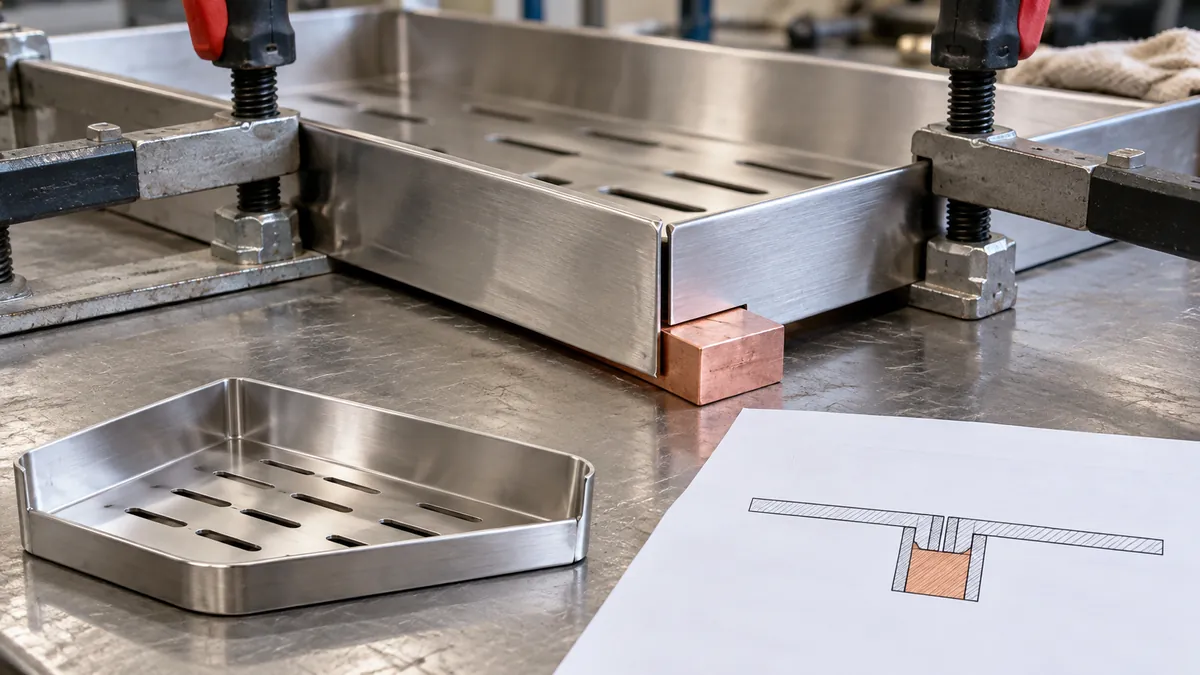
The copper bar is one possible thermal support. Miller describes placing a backing or chill bar in contact with the heat-affected area and notes copper or aluminum as common choices for heat dissipation. In an actual fixture, the benefit depends on contact, geometry, clamping, access, and process conditions. A bar that only touches one edge or leaves a gap beneath the intended seam may not provide the assumed support. Do not select copper solely because it is familiar or because an illustration shows it under a joint.
What should the buyer specify before evaluating a copper chill bar?
Start with the controlled drawing: part number, revision, sheet material and thickness as specified, finished shape, seam location, joint type, and the functional surfaces that must remain aligned. Identify whether the weld is visible, whether the inside or outside surface matters, and what post-weld finishing or coating follows. If the supplier proposes a process change or backing support, keep the proposal tied to that revision and product condition.
Next, ask the supplier to explain how the bar contacts the joint and how it is held in place. Is it beneath the seam, inside a formed corner, or supporting only one sheet? Can the torch or electrode reach the joint without the bar obstructing access? Can the bar be removed without damaging the part or leaving an unacceptable surface mark? These questions help distinguish a workable setup from a generic process label.
Clarify the purpose of the backing bar. It may act as a heat sink, physical support, or both, depending on the setup. If the design requires backing to support a particular root contour or close a gap, state that separately from the thermal objective. For thin shelf corners, a backing route should be reviewed in the assembled geometry, because the shelf profile may limit placement or removal.
Do not specify a universal copper grade, bar dimension, contact pressure, or welding parameter without process engineering evidence. The actual requirement depends on the weld procedure, material, joint, and tooling. A buyer can request the supplier’s proposed configuration and identify which aspects require approval, while leaving process details to the qualified manufacturing owner.
How do backing options compare for this buyer decision?
The table compares starting points for a supplier discussion, not ranked recommendations. The best route depends on the joint design, access, production scale, appearance requirements, and the evidence available from representative samples.
| Support route | Potential role | Buyer questions | Limitation to confirm |
|---|---|---|---|
| Removable copper bar | Conductive backing or heat sink close to the seam | Does it contact the intended area, stay secure, and come out cleanly? | Access, contact variation, removal, and surface marking are setup-specific |
| Removable aluminum bar | Alternative conductive support in some setups | Is the proposed material and geometry suitable for the process and part? | Do not assume it behaves identically to copper or meets the same process need |
| Fixture-only support | Holds the corner and controls alignment without a separate chill bar | Does the fixture maintain fit-up and shape through the approved process? | May not provide the same thermal effect; verify the finished seam and geometry |
| Joint redesign or alternate weld layout | Changes access, fit-up, or required weld extent | Does the design maintain function while improving manufacturability? | Requires design-owner approval and drawing revision control |
Ask the supplier to compare only options that are feasible for the part. If the seam is not a single-sided butt weld, do not import assumptions from butt-joint examples. Likewise, gas purging is a separate process question from a backing heat sink; it should not be presented as the substitute for bar contact or joint support without a specific technical rationale.
What evidence should sample approval include?
Use samples that represent the approved material, geometry, and process condition. Record the part revision, material/thickness identification where available, joint configuration, backing-bar concept, fixture or setup reference, and sample identity. The purpose is to let the buyer and supplier discuss the same configuration rather than an undocumented “similar” weld.
Review the finished corner against the product requirements. Depending on the design, this may include visible profile, alignment, distortion, fit with mating components, edge condition, and the specified finishing state. If the project requires a particular weld inspection method or acceptance limit, define it before sample review and have the responsible design or quality authority approve it. Do not invent a visual threshold or imply that a photograph demonstrates internal weld integrity.
Where useful, ask for a before/after view of the support arrangement and the finished sample, plus a concise note describing what was changed between trials. Such records can show that the bar was positioned as proposed and identify the sample reviewed. They are not a substitute for dimensional or destructive/non-destructive examination if the contract requires those methods.
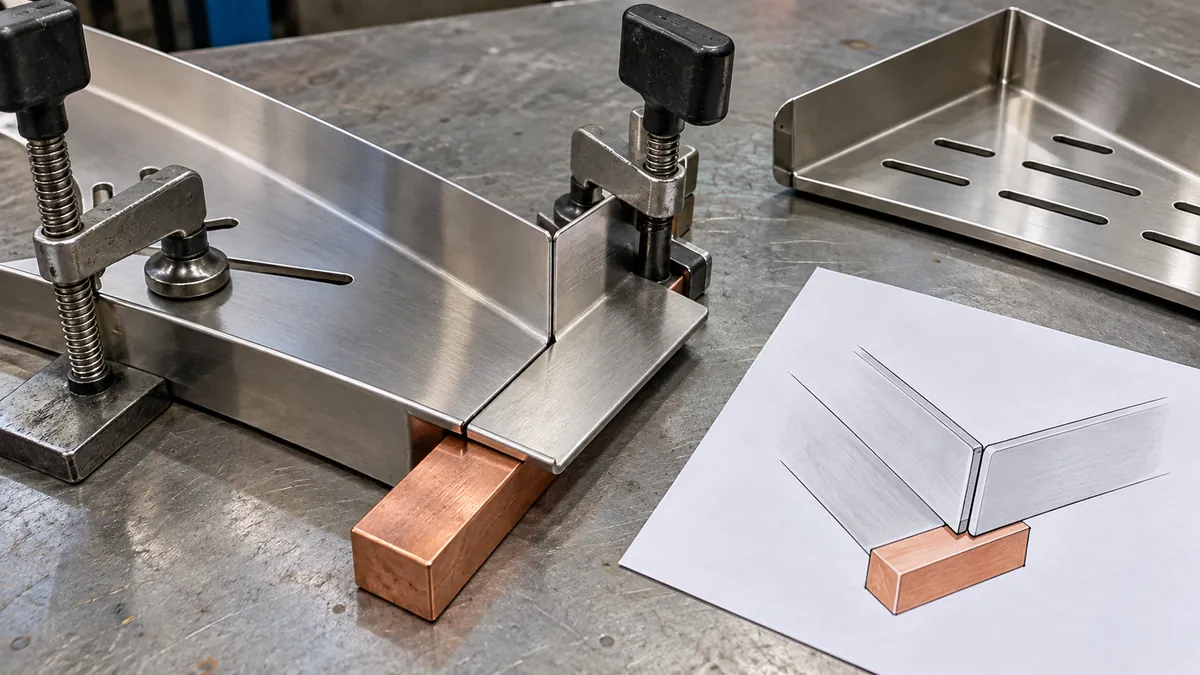
The buyer should also define what requires renewed approval. Changes to material, thickness, seam design, fixture, backing bar, welding process, supplier, or finishing route may affect the result. The list should reflect project risk; it is not necessary to treat every minor adjustment as a customer approval event. Agree notification and review responsibility in advance.
What failure modes can remain after adding a backing bar?
A chill bar does not correct poor fit-up. If the edges do not align or the gap varies, a thermal support may not produce a consistent weld. TWI highlights the relationship between root gap and melt-through risk for an unbacked joint; buyers should use that as a reason to clarify the actual design and fit-up, not as a numeric acceptance rule for another seam.
The bar can also create access or removal problems. A bar placed too close to the corner may block the torch, while a bar that cannot be removed from a formed profile may complicate the sequence or risk scratching the finished part. A surface that is clean in a loose coupon trial may behave differently in a constrained assembly. The sample should reflect the real shelf geometry and planned sequence.
Heat can still distort the part or affect its finish. A bar may change heat flow, but the overall result depends on the full welding and fixture approach. The finished component should be evaluated for fit and appearance in the condition that matters to the buyer. Avoid promising that a chill bar eliminates distortion, discoloration, or rework.
Finally, the support itself may vary between setups. Contact surface wear, clamping position, contamination, or a replacement bar can change the interface. Ask the supplier how the setup is identified and maintained if these factors are relevant to repeat orders. A sophisticated log is not automatically required; the record should be enough to trace the approved setup and review meaningful changes.
How should buyers balance process flexibility and repeatability?
The supplier should be free to recommend a workable manufacturing route, but approval should attach to a defined product result and reviewed process configuration. If the backing bar is a proposed control, request a sample and explanation of the contact area, access, removal, and inspection plan. Avoid requiring copper where another qualified support or joint design achieves the approved outcome more appropriately. A welding copper backing bar chill bar thin sheet burn through proposal should be compared with alternatives using the same joint and acceptance criteria.
Cost discussions should include setup and handling rather than treating the bar as a standalone material purchase. A custom-shaped support may require design and upkeep; a standard bar may be simpler but less adaptable to a formed corner. These are project-specific trade-offs, and no savings should be assumed without a quote and comparable scope. For small OEM lots, the buyer can ask whether the setup is reusable and how a later design revision would affect it.
When comparing suppliers, look for clear reasoning and sample evidence rather than confident process claims. One supplier may propose a copper bar; another may propose fixture changes or a modified seam. Compare whether each proposal addresses the same drawing revision, required geometry, finish condition, and acceptance criteria. Keep the design owner responsible for approving any change to the joint itself.
What belongs in the RFQ and approval record?
At minimum, identify the drawing and revision, material/thickness specification, seam and finished condition, functional requirements, sample quantity or representation, evidence expected, and change triggers. Ask the supplier to state the proposed backing method and any assumptions. If the buyer wants an inspection report, sample photographs, sectioning, or another examination, define the method and acceptance criteria before work begins.
The buyer decision is not simply “copper or no copper.” It is whether the proposed manufacturing setup produces an acceptable shelf corner under the controlled specification, and whether the buyer can trace the reviewed sample to the production configuration. Document open questions as open; do not convert a process suggestion into a performance guarantee.
Preguntas frecuentes
Does a copper bar guarantee that thin sheet will not burn through?
No. It can act as a backing or chill bar, but burn-through also depends on joint fit-up, process, material, and the actual setup. Verify representative parts against the approved criteria.
Is copper always better than aluminum for a backing bar?
No universal choice follows from the material name alone. The supplier should explain the proposed material and geometry for the specific process and sample; the buyer should assess the result and any relevant handling or maintenance needs.
Is a backing bar the same as gas purging?
No. A bar provides physical support and/or a thermal path depending on its arrangement. Gas purging is a separate process control. The need for either depends on the joint and specification.
Can a sample photo prove that the weld is acceptable?
A photo can help document visible appearance and setup, but it does not prove every dimension or internal condition. Use the inspection method and acceptance criteria defined for the project.
Should the buyer put welding parameters in the drawing?
Only where the project’s engineering and quality authorities require controlled process details. Otherwise, define the product requirements and approval evidence, and have the supplier propose a qualified manufacturing method for review.
Does this article confirm Koitor uses copper chill bars?
No. It explains a buyer’s evaluation framework. A specific process, tool, material, or production capability must be confirmed for the project.
Sources
Review a Welded Shelf-Corner Requirement
Share the current drawing, material/thickness requirements, and the seam condition you need a supplier to evaluate. Koitor can discuss fabrication and sourcing questions within the confirmed project scope; process suitability and acceptance criteria must be confirmed for the specific product.
OEM / MARCA BLANCA
Convierte esta guía de abastecimiento en un resumen del producto
Indícanos el producto que deseas, el tamaño, el acabado, la cantidad del pedido y los requisitos de embalaje. Tu equipo recibirá un análisis práctico de la viabilidad de fabricación antes de recibir el presupuesto.


 English
 Español
 Português
 Français
 Deutsch
 العربية