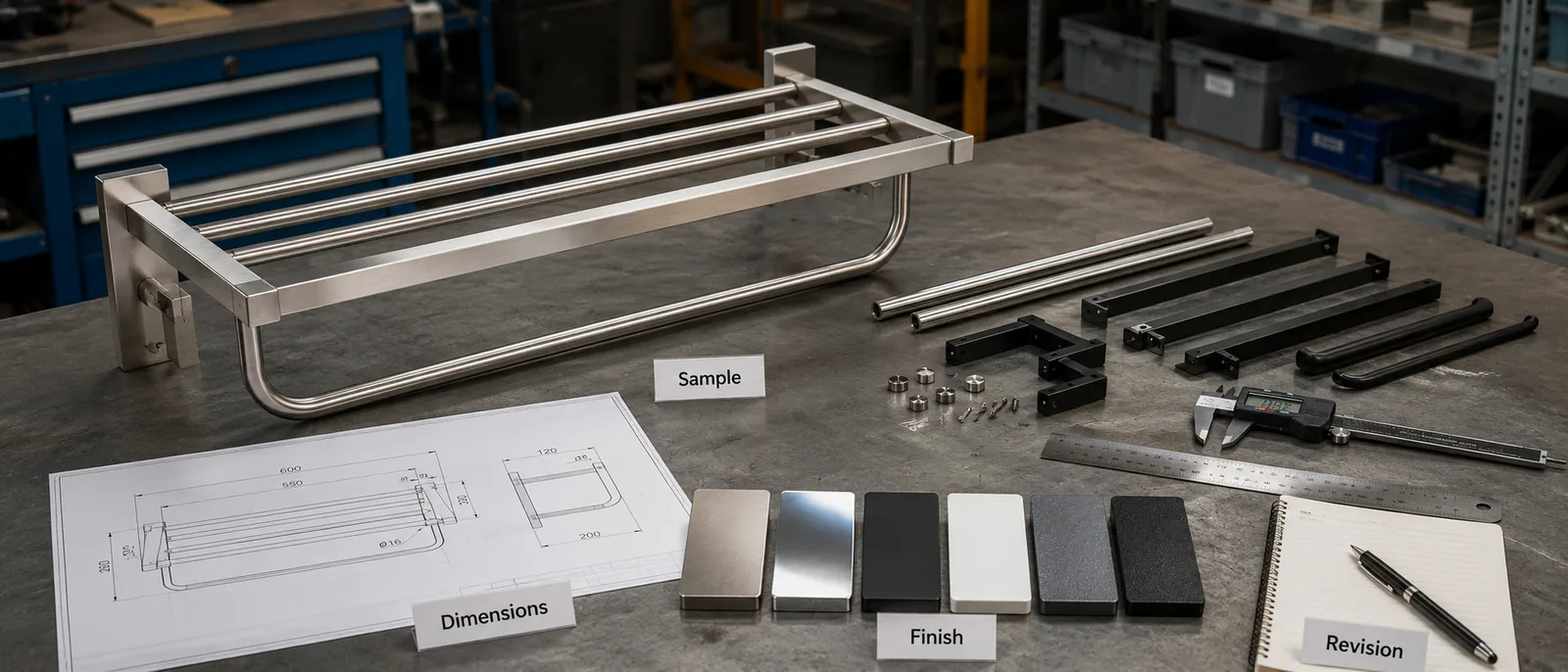
A custom bathroom towel rack manufacturer can develop an OEM product from a physical sample when the buyer and factory first document the sample’s dimensions, materials, joints, finish, mounting method and packaging requirements. The sample should be treated as a technical reference, not as a complete specification. A reliable project converts what can be measured from the sample into an agreed drawing, confirms deliberate changes, produces a prototype and records approval points before small-batch production.
What Should a Buyer Send With the Physical Towel Rack Sample?
A buyer should send the complete towel rack sample together with a short project brief that explains what must remain unchanged, what should be improved and how the product will be sold. The physical object gives the factory a starting structure, while the brief prevents the factory from guessing the commercial intent.
The sample should include all parts needed for installation and use: wall brackets, decorative covers, screws, anchors, connectors, end caps and any assembly hardware. If the retail package, instruction sheet or protective inserts affect the product presentation, include those items as well. Missing hardware can delay quotation because the factory cannot confirm the complete bill of materials or packed configuration.
Buyers should identify whether the sample is a visual reference, a functional benchmark or a product that needs close dimensional reproduction. These are different development tasks. A visual reference may allow changes to tube size, bracket structure or mounting details. A functional benchmark may preserve bar spacing and installation behavior while allowing a different appearance. A close dimensional reference requires more detailed measurement and revision control.
Useful commercial inputs include the target market, expected order quantity, preferred material, finish direction, packaging format and target launch timing. If the buyer is building a coordinated bathroom range, the factory also needs to know whether the towel rack must match a towel ring, tissue holder, shower caddy or hook bar.
Before sending a third-party product, the buyer should confirm that it has the right to develop or reproduce the design. Sample-based manufacturing does not remove the buyer’s responsibility to review design ownership, branding and market-specific requirements.
Sample Package Checklist
- One complete towel rack in usable condition.
- All mounting plates, covers, fasteners, anchors and loose components.
- Photographs showing the product installed and viewed from key angles.
- A list of features that must remain unchanged.
- A list of requested improvements or cost targets.
- Preferred material and finish, if already decided.
- Expected order quantity and trial-order requirement.
- Retail box, label, instruction sheet or packaging reference when relevant.
- Market and installation context, such as tile, masonry or other wall conditions.
- Authorization to use the sample as a development reference.
For a wider view of towel rack structures and OEM options, buyers can review Koitor’s Fabricación a medida de toalleros de baño capacidades.
How Does a Factory Convert a Sample Into a Manufacturable Specification?
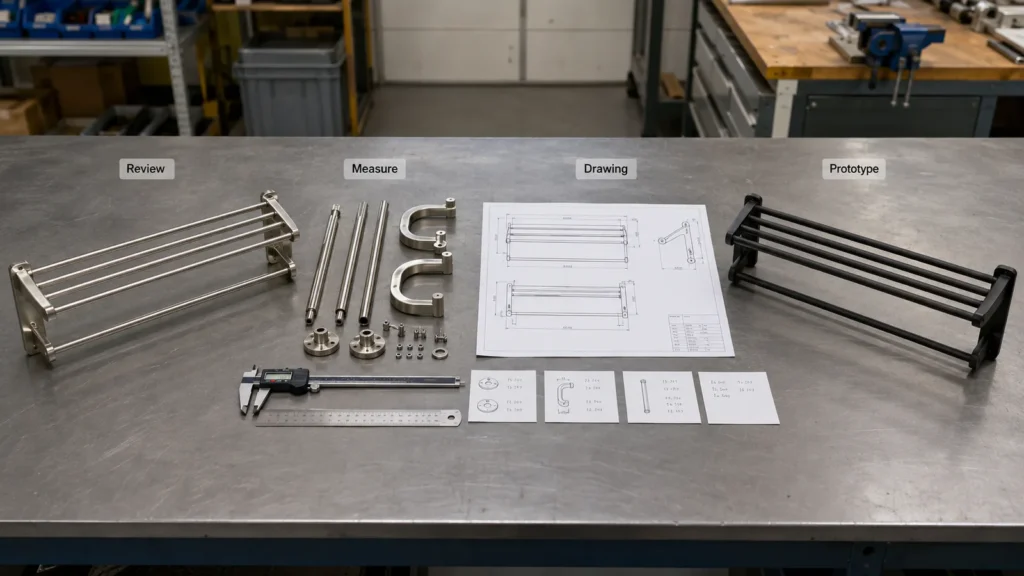
The factory converts the sample into a manufacturable specification by measuring the complete assembly, separating it into components, identifying likely materials and processes, and recording every decision in a controlled drawing or sample sheet. The goal is not merely to copy visible dimensions. The goal is to define a product that can be quoted, sampled, inspected and repeated.
The first step is an incoming sample review. The factory records the sample condition, overall size, weight where useful, installation method, visible finish and included accessories. Photographs should capture front, side, rear, underside, mounting points and important joints. Existing damage or deformation should be marked so it is not mistaken for an intended feature.
The second step is dimensional mapping. Overall width, height and projection are only the beginning. An OEM towel rack may also require bar diameter or tube section, bar spacing, bracket thickness, mounting-hole distance, wall clearance, end-cap depth and assembly tolerances. Measurements should state the reference points because decorative curves and coated edges can make informal measurements inconsistent.
The third step is component and process review. A towel rack can combine tube, wire, sheet-metal brackets, machined connectors, plastic caps and mounting hardware. The manufacturer evaluates how parts may be cut, bent, punched, welded, ground, polished, finished and assembled. If the sample contains a costly or unstable feature, the factory can propose a practical alternative for buyer approval.
The fourth step is finish definition. A sample may show stainless steel, plating, powder coating or another finish, but appearance alone may not confirm the complete material and finishing route. The buyer and factory should agree on the intended material, color, texture, gloss direction, visible cosmetic zones and acceptable reference sample. Rust resistance and finish performance depend on material, preparation, product geometry, use environment and project-specific requirements.
The final step is drawing confirmation. The controlled drawing should include revision identification, main dimensions, material notes, finish direction, critical joints, mounting details and component list. Any deliberate difference from the original sample should be highlighted rather than hidden in a new drawing.
How Do Physical Samples and Drawings Differ as Development Inputs?
Physical samples show real proportions, assembly behavior and surface appearance, while drawings provide explicit dimensions, revisions and inspection references. The strongest development package uses both: the sample communicates the product, and the approved drawing controls what the factory must reproduce.
| Development Input | What It Shows Well | Main Limitation | Best Buyer Practice |
|---|---|---|---|
| Muestra física | Overall appearance, handling, joint locations, installation concept and finish impression | Hidden materials, tolerances and intentional design details may be unclear | Add written change notes and approve a measured drawing |
| 2D drawing | Dimensions, hole locations, component relationships and revision control | May not fully communicate feel, finish or assembly sequence | Mark critical dimensions and pair it with finish references |
| Modelo 3D | Geometry, interfaces and component visualization | May omit process, finish, packaging and inspection requirements | Provide a drawing or specification sheet with the model |
| Photos or video | Installed appearance, movement and contextual details | Cannot reliably control scale or hidden features | Use as supporting evidence, not the only specification |
| Approved prototype | Final combination of structure, finish, assembly and presentation | Can lose value if revision and approval records are missing | Label the approved version and retain matching records |
When a buyer sends only a sample, the quotation may initially contain assumptions. Those assumptions should be listed clearly, especially for material grade, wall thickness, finish route, mounting hardware and packaging. A price comparison is meaningful only when suppliers quote the same interpreted specification.
When a buyer sends only a drawing, the factory may still request a physical reference for appearance, grip, installation feel or finish. Neither input is automatically superior. The right combination depends on the product’s complexity and the decisions that matter to the buyer.
Which Towel Rack Details Must Be Confirmed Before Prototyping?
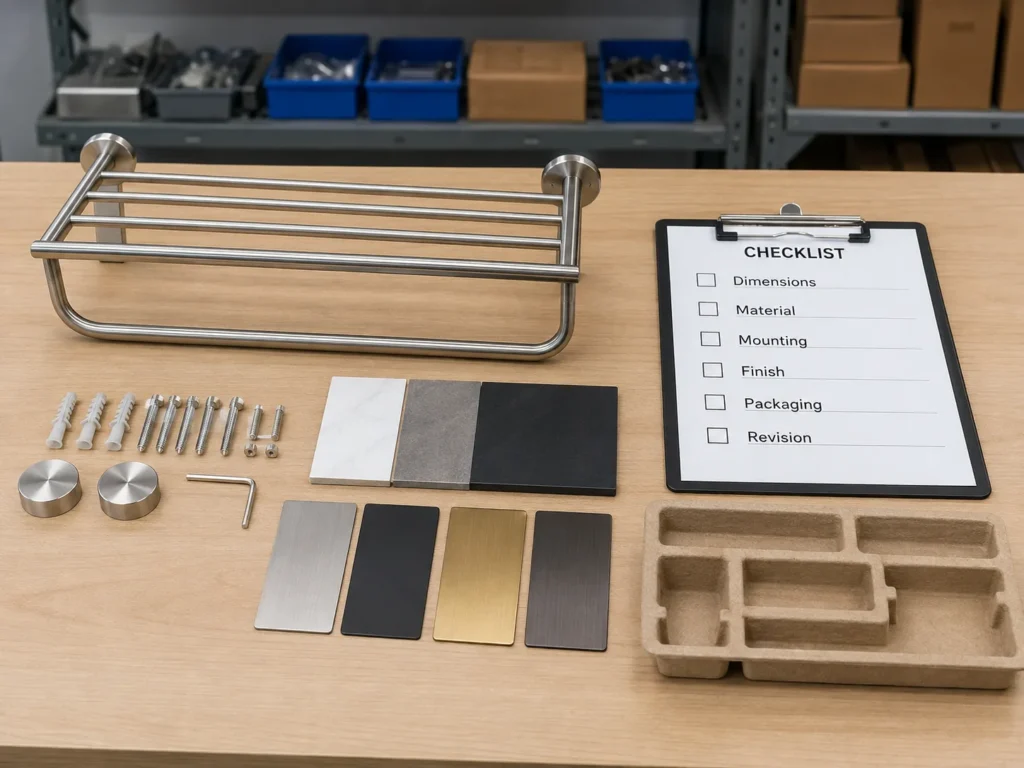
Before prototyping, the buyer and manufacturer should confirm the towel rack’s dimensions, load expectations, material, joint design, mounting interface, finish, hardware, assembly and packaging assumptions. Unresolved details at this stage usually return later as sample revisions, quotation changes or inspection disputes.
Structure and Dimensions
Confirm overall width, height, wall projection, number of bars, bar spacing and usable hanging area. Identify dimensions that affect installation or coordination with other bathroom accessories. If the sample is bent or worn, decide whether measurements should follow the current object or the intended original geometry.
Critical dimensions should be distinguished from reference dimensions. Mounting-hole centers, bracket alignment and mating-part clearances often need closer control than a decorative radius. The tolerance approach should match the manufacturing process and product function rather than apply one strict value to every feature.
Material and Joint Method
Confirm whether the product uses tube, solid wire, sheet or mixed components. Material selection affects appearance, weight, fabrication and finish options. Joint locations should be reviewed for visibility, access and practical production. Koitor Hardware can use processes such as resistance welding, laser welding or TIG welding depending on the structure and project needs, but the appropriate route should be confirmed during development.
Buyers should mark primary cosmetic zones. A joint hidden behind a mounting cover may have different appearance priorities from a weld on the front bar. This does not remove the need for sound fabrication; it helps the factory plan finishing and inspection around the retail-visible areas.
Mounting and Hardware
Mounting details need special attention because the sample may not include the original wall anchors or installation instructions. Confirm bracket orientation, screw access, cover retention, wall clearance and the intended installation sequence. Hardware suitability can vary by wall condition, so project-specific mounting requirements should be reviewed for the target market.
Finish and Packaging
Define whether the target is brushed stainless appearance, polished appearance, powder-coated color or another agreed finish. Use a physical finish reference when possible. Packaging should separate visible surfaces, contain loose hardware and prevent brackets or fasteners from rubbing against the towel bars.
These decisions also affect cost and MOQ. A custom finish, specialized component or complex retail pack may change the practical production quantity. MOQ can start from 100 pieces depending on structure, material, finish and packaging, but it should be confirmed after the specification is stable.
How Should Buyers Review and Approve the First Prototype?
Buyers should review the first prototype against the approved drawing and written requirements, then test installation, assembly, appearance and packaging as separate approval areas. A prototype is not approved simply because it resembles the original sample in a photograph.
Begin with revision identity. The prototype label, drawing number and change list should match. If the factory made a manufacturability suggestion, confirm that the sample includes the agreed change. Uncontrolled verbal changes create confusion when a second sample or bulk batch is produced.
Next, check dimensions with the same reference points shown on the drawing. Focus on mounting-hole spacing, bar alignment, wall projection, bracket fit and other critical interfaces. Record measurements rather than using only comments such as “slightly wide” or “not straight.”
Install or assemble the prototype using the intended hardware and instructions. Check whether tools can reach the screws, covers seat correctly, bars remain aligned and the rack feels stable under the buyer’s project-specific evaluation. Any load or durability requirement should be defined and confirmed for the project instead of assumed from appearance.
Review finish under consistent lighting. Inspect front faces, bar ends, bracket edges, welded areas, undersides and contact points. Compare the prototype with the approved finish reference and record cosmetic zones. If the sample will be used for retail photography or buyer presentations, confirm that its appearance is production-representative.
Finally, pack and unpack the product. Check whether hardware remains contained, visible surfaces are separated and the product can be removed without scratching. A good prototype approval covers the delivered product, not only the bare rack on a factory table.
First Prototype Approval Checklist
- Verify product name, drawing number and revision.
- Confirm every requested change from the reference sample.
- Measure overall size and all critical mounting dimensions.
- Inspect bar alignment, bracket position, joints and visible surfaces.
- Check material and finish against the agreed reference.
- Install or assemble the rack with intended hardware.
- Review wall clearance, tool access and cover fit.
- Evaluate stability and any project-specific functional requirement.
- Inspect packaging contact points and loose hardware control.
- Record approval, rejection or revision requests with dated photographs.
- Retain an approved reference sample where practical.
Samples usually take 5-7 working days after the main design and materials are confirmed, depending on the project. A revision can require additional time if it changes tooling, material, finishing or purchased components.
What Common Mistakes Delay Towel Rack Sample Development?
The most common delays come from incomplete samples, unrecorded assumptions, changing requirements and approval feedback that is visual but not measurable. A custom bathroom towel rack manufacturer can move faster when the buyer controls decisions and revisions as carefully as the factory controls production details.
One mistake is asking the factory to “make the same product” without defining whether the same means dimensions, material, weight, finish, mounting method or retail appearance. The factory may interpret the request differently from the buyer. A one-page brief can prevent several rounds of avoidable clarification.
Another mistake is changing several variables after the first prototype. Changing bar diameter, bracket shape, finish and packaging together makes it difficult to identify which revision affected fit or cost. Buyers should prioritize changes, update the drawing and request a new revision label.
Approving from photographs alone is also risky. Photos can support rapid communication, but they do not confirm exact dimensions, finish texture, assembly feel or packaging protection. For important private-label projects, the buyer should review a physical prototype or arrange an appropriate representative approval process.
A further mistake is requesting a final price before the specification is stable. Early budget estimates can help screen a project, but material, construction, finish, accessories and packaging all affect the final quotation. Suppliers should state assumptions, and buyers should compare quotations after those assumptions are aligned.
As a custom bathroom towel rack manufacturer, Koitor Hardware’s practical approach is to review the physical sample, identify structure and manufacturing questions, prepare or confirm drawings, develop the sample and discuss packaging before small-batch production. As a family-owned custom metal hardware factory, Koitor supports direct communication for towel racks and related bathroom and home storage hardware.
After sample approval, bulk production usually takes 4-6 weeks depending on quantity, complexity, material availability, finish and packaging. A small-batch trial order can help the buyer verify market response and production consistency before planning repeat orders.
Additional product-development and sourcing guidance is available through Recursos de Koitor.
Preguntas frecuentes
Can a factory quote a custom towel rack from photos only?
A factory may provide an initial estimate from clear photos and dimensions, but a reliable quotation usually needs a drawing, physical sample or confirmed specification. Hidden joints, material thickness, mounting components, finish and packaging can materially affect the price.
Should the original sample be returned after development?
The buyer should agree on sample ownership, storage and return instructions before shipping. If the original is valuable or unique, record its condition and use tracked shipping. The factory may need to retain it until the prototype and drawing are approved.
How many prototype rounds are normally required?
There is no universal number. A well-documented sample with limited changes may need fewer rounds, while a redesigned structure, new finish or revised mounting system may require additional confirmation. Each round should have a clear revision list.
Can the manufacturer improve the original towel rack structure?
Yes, the manufacturer can suggest practical changes to joints, components, assembly or packaging based on manufacturability. The buyer should approve every change because it may affect appearance, function, cost or compatibility with the intended product range.
What should be approved before a small-batch trial order?
Approve the controlled drawing, material, finish reference, mounting hardware, prototype, packaging method, inspection points, quantity and lead-time basis. Project-specific performance requirements should also be defined and confirmed before production.
Trabaja con Koitor Hardware
Have a Towel Rack Sample Ready for OEM Development?
Send Koitor your physical sample, photographs, required changes, finish direction, packaging idea and expected quantity. Our team can review the structure, measurement points, manufacturability and sample-development path before quotation.
OEM / MARCA BLANCA
Convierte esta guía de abastecimiento en un resumen del producto
Indícanos el producto que deseas, el tamaño, el acabado, la cantidad del pedido y los requisitos de embalaje. Tu equipo recibirá un análisis práctico de la viabilidad de fabricación antes de recibir el presupuesto.
 English
  Español
  Português
  Français
  Deutsch
  العربية