
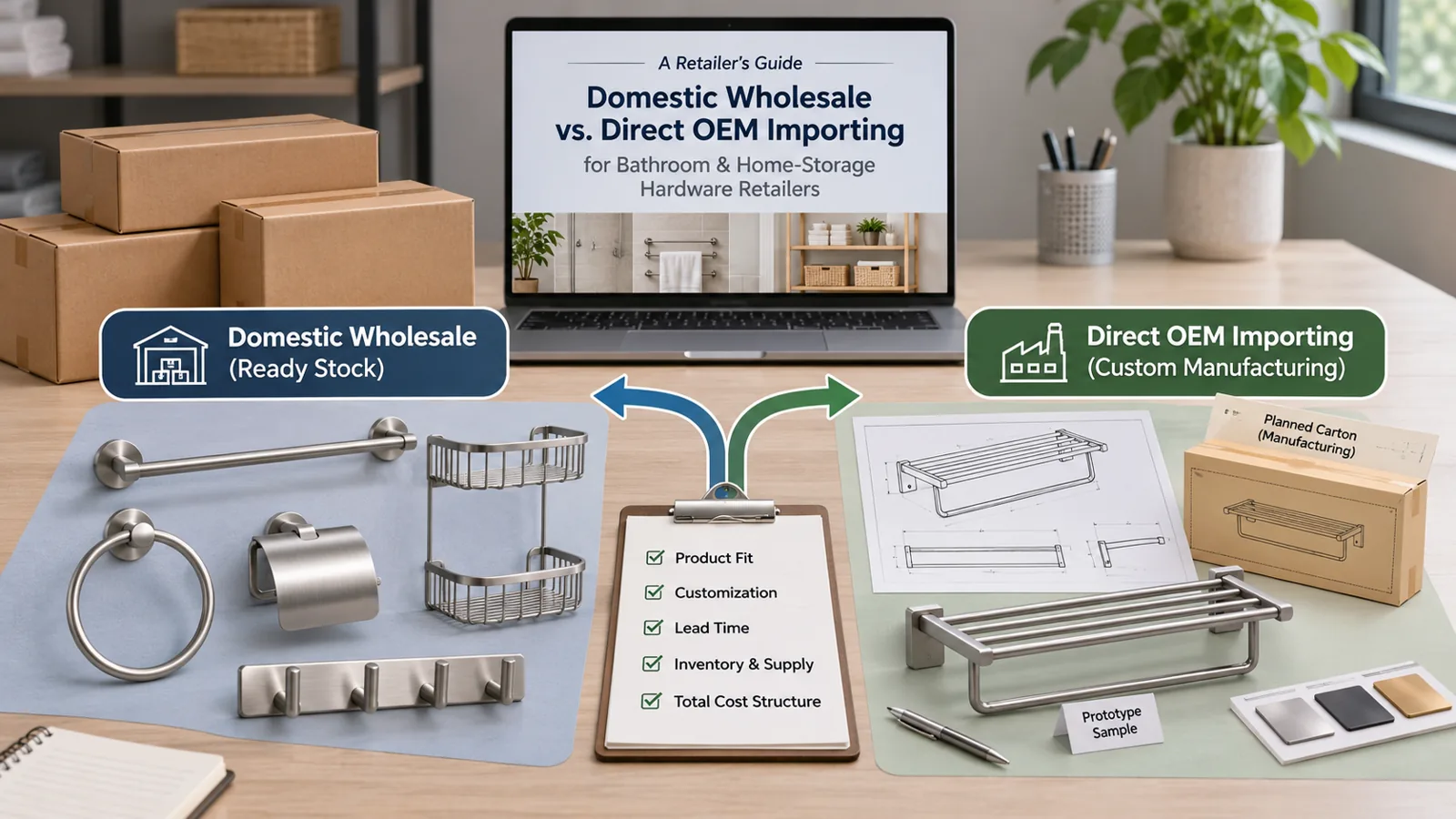
Buyer Decision and Project Scope The buyer should document import direct or buy from wholesaler as a named requirement. The buyer should record the exact "import direct or buy from wholesaler" requirement in the sourcing file.
Buyer Decision and Project Scope
Direct answer: choose the purchase model that matches the product need and operating capacity
A bathroom or home-storage retailer should buy from a domestic wholesaler when an available stocked SKU meets the requirement and the retailer values accessible replenishment, smaller purchasing commitments, or local fulfilment. Consider direct OEM import when a clearly defined product, finish, packaging, or brand requirement is not met by stock alternatives and the retailer can manage specification, sampling, order commitment, import responsibilities, and repeat planning. Defer the decision when the requirement or demand case is not clear.
These are conditional choices, not universal claims that one channel is cheaper or safer. CBI’s sector guidance describes producer-to-importer and producer-to-small-retailer channels and discusses logistics and administration. Wurm documents a stock-based wholesale offer for resellers, while JTC lists bathroom products in a wholesale assortment. Each source describes a particular model; actual terms vary by supplier. See CBI channel guidance, Wurm’s reseller offer, y JTC’s bathroom assortment.
This guide helps a retailer decide whether to accept an existing finished product or commission a production run. It does not provide current tax or customs advice, calculate a universal break-even quantity, or promise a specific factory minimum order, lead time, or overseas stock position.
Start with the product gap, not the factory quote
Before asking suppliers for prices, write down what the retailer needs the product to do in its assortment. Identify the target customer, category role, required dimensions or mounting approach, finish, packaging, label, and any evidence needed for the retailer’s claims. Then compare those requirements against actual stocked alternatives.
A product gap is specific. “We need a black shower basket that fits a defined wall layout and arrives in our retail packaging” is more useful than “we need a better product.” The retailer should establish whether an available SKU actually fails the requirement, or whether a perceived difference is only a preference that can be addressed through range selection or merchandising.
Separate non-negotiable requirements from desirable features. If no stocked product meets a critical installation or brand requirement, a custom production discussion may be reasonable. If the only difference is uncertain styling or an untested forecast, the retailer may first buy a smaller range of stock products or delay commitment.
A supplier quotation cannot resolve a product requirement that the retailer has not defined. A low factory price is not comparable to a wholesale offer until both cover the same product, finish, packaging, quantity, delivery scope, and responsibilities.
What buying from a domestic wholesaler can provide
A wholesaler may hold finished products for reseller purchase, offer an existing assortment, and handle some local order or fulfilment steps. These features can help retailers that want to test category demand, replenish smaller amounts, or avoid managing a production specification. The actual service depends on the supplier’s terms; verify stock, reorder conditions, substitutions, delivery, returns, and product documentation directly.
An existing SKU also reduces the number of development decisions the retailer must make before ordering. The buyer may be choosing among documented product options rather than defining a new drawing, sample, finish, label, and carton. That can be useful where the product already meets the commercial and technical need.
Stock availability is not guaranteed indefinitely. Ask whether the product is currently held, how a stockout is communicated, whether substitutes may be shipped, and whether a discontinued SKU can be replaced with a different revision. A retailer should not assume that “wholesale” means unlimited stock, low minimums, or local returns unless the offer says so.
The buyer should also clarify who owns product claims, instructions, packaging content, and returns. Local fulfilment may simplify some interactions, but it does not automatically establish the product’s manufacturing source or technical performance.
What commissioning a direct OEM order changes
A direct OEM order typically creates a more defined production relationship: the retailer supplies or approves product requirements, reviews samples, agrees on finish and packaging, and commits to an order under specific commercial terms. The exact process varies by manufacturer and contract. Direct import does not mean the buyer can skip product development, supplier qualification, inspection planning, or shipment coordination.
OEM production can be relevant where the retailer needs a meaningful difference from stock, such as a controlled size, mounting interface, finish, set configuration, or private-label package. The retailer must be prepared to define and approve those differences. A sample should be tied to a drawing or specification and revision; a photo or verbal description is not a stable production reference.
A production order also places work on the retailer’s team. Someone must own specification, sample comments, purchase-order control, product claims, import documents, quality acceptance, packaging, logistics, and reorders. A small team without time or systems for these tasks may find a stocked wholesale purchase more suitable, even if a customized item is attractive.
Do not assume direct OEM automatically creates a lower total cost, better quality, shorter lead time, or exclusive product. Those outcomes depend on the actual offer, scope, volume, requirements, and execution. Request evidence and compare like-for-like terms.
Compare three realistic decision scenarios
Scenario 1: the stock product meets the need and demand is uncertain
Suppose a retailer is evaluating a towel bar or shower basket category, and one domestic stock item meets the required dimensions, finish, packaging, and documentation. Demand is not yet established. A wholesaler purchase may let the retailer test the assortment without committing to a bespoke product development cycle. This is a conditional example, not a claim about any particular supplier’s quantities or terms.
The retailer should still check reorder availability and substitution rules. If the product disappears, the plan may need an alternate SKU. A low initial commitment does not guarantee future continuity.
| Buyer input | Record before approval |
|---|---|
| Named product or component | Exact model, code, and revision |
| Interface or project condition | Reference sample, drawing, or site input |
| Evidence and owner | Source, reviewer, and unresolved questions |
| Release status | Approved scope and excluded claims |
Product Fit and Specification
Scenario 2: a defined product requirement is missing from stock options
Suppose the retailer needs a particular mounting layout or packaging configuration that available products do not offer. If that difference matters to the buyer and can be specified, a direct OEM conversation may be appropriate. The retailer should supply a drawing or sample reference, state critical features, and define how the sample and production output will be approved.
The retailer should also ask whether a standard product or minor approved modification can meet the need. A custom request is not automatically justified by a small visual preference. The development scope should match the customer requirement.
Buyer checks for import direct or buy from wholesaler
Scenario 3: repeat demand may exist but the retailer lacks import capacity
A retailer may receive requests for a private-label range but lack staff or processes to manage purchase orders, sample revisions, import coordination, or quality issues. In this situation, using a wholesaler, distributor, or sourcing partner may be more suitable, depending on their actual scope. The retailer may also defer the custom project until it can assign an owner.
This is not a judgment about retailer size. It is a question of operational fit. The buyer should name the work required and determine who will own each part of it.
Use a same-horizon comparison worksheet
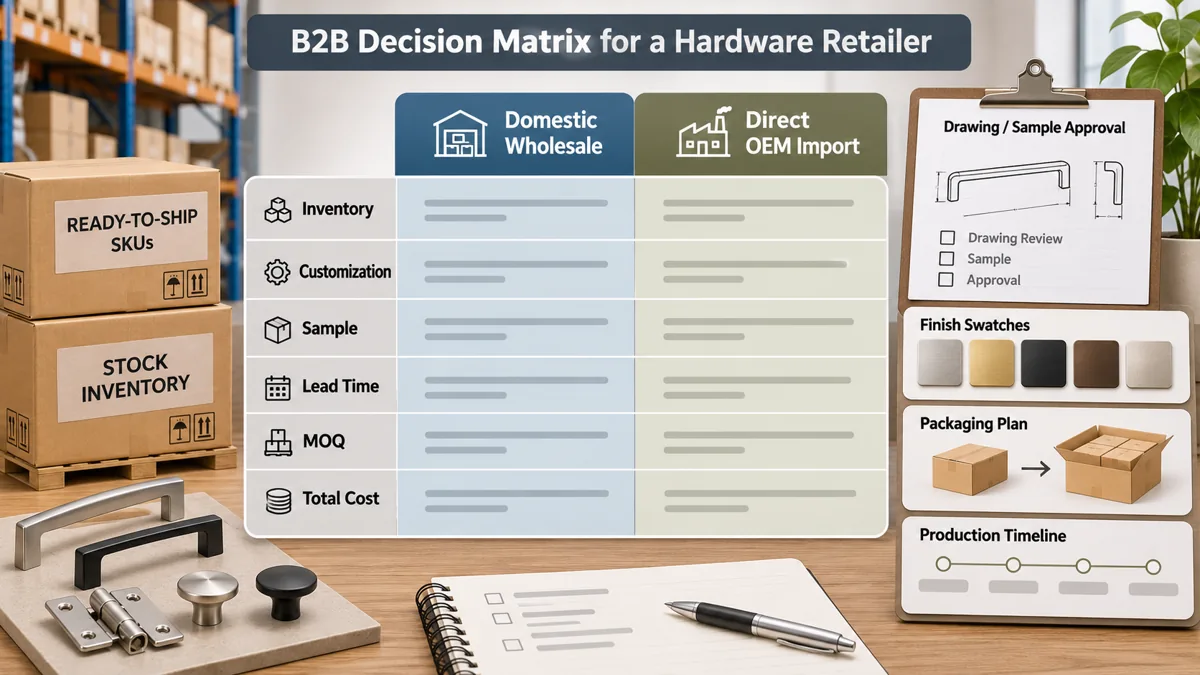
Compare actual offers over a buyer-defined period, such as the next assortment review or replenishment cycle. Do not use an arbitrary universal break-even quantity. The comparison should include the exact product scope and account for the retailer’s own planning assumptions.
| Decision field | Stocked wholesale | Direct OEM import |
|---|---|---|
| Product requirement | Existing SKU and documented options | Defined product changes and approved spec |
| Initial commitment | Supplier’s actual terms | Quoted production and order terms |
| Replenishment | Confirm stock and reorder policy | Confirm production and repeat-order process |
| Product development | Existing offer and available documents | Samples, revisions, approvals, and release |
| Branding and packaging | What the wholesaler offers | Buyer-defined packaging scope |
| Responsibility | Quote-specific fulfilment and returns | Named importer, quality, claims, and logistics owners |
| Substitution | Supplier’s written substitution terms | Change-control and approval terms |
| Unsold inventory | Buyer’s actual return or stock policy | Buyer’s exit or disposition plan |
| Unknowns | Stock continuity and future revisions | Demand, development, order timing, and import workload |
Fill the table with written supplier terms and retailer data. If a field is unknown, mark it rather than guessing. The worksheet is a decision aid, not a financial forecast.
A retailer may also compare a hybrid path: begin with a stocked product to learn which features matter, then commission an OEM version after the requirement is demonstrated. That path can be useful in some cases, but it still requires clear product differences and a new approval process.
Determine what “custom” means before ordering
The word “custom” can refer to a new dimension, finish, mounting pattern, logo, packaging, kit, or a combination. State the actual change and identify which components or documents it affects. A new carton or label may be a different scope from a changed metal geometry. The buyer should not assume every change has the same cost, timing, or approval needs.
Provide a controlled drawing or physical sample where applicable. Identify reference surfaces, critical dimensions, finish target, cosmetic faces, and packaging. If the buyer does not have a formal drawing, describe what information is missing and ask what the manufacturer needs for a feasibility review. Do not treat a marketing image as a manufacturable specification.
The retailer should approve a sample against the defined requirement and retain its revision. Comments should describe a specific change and show which version supersedes the previous one. An approved sample does not replace all production quality controls; the buyer should separately agree on inspection scope and acceptance criteria.
Only make product claims that have evidence. A custom size or finish does not by itself prove load, corrosion, durability, or compliance performance. If those claims matter, define them with the responsible technical parties and retain relevant documentation.
Check the importer’s operating responsibilities
Direct import can require the retailer to coordinate more than product selection. Before committing, identify who will handle the supplier agreement, purchase order, payment milestones, sample release, product labeling, import documentation, freight booking or coordination, receiving, inspection, and customer claims. The precise responsibilities depend on the transaction and should be confirmed in the actual contract.
Do not assume that a factory will act as importer of record or provide local inventory. Do not assume a wholesaler handles every after-sales issue. Ask each provider what it does, what it excludes, and what evidence or service it supplies.
If a sourcing agent or distributor is involved, clarify its authority, fees, inspection role, communication channel, and responsibility for changes. A third party may support parts of the process, but the retailer still needs a documented decision owner for approvals and claims.
For import-related legal, tax, product-safety, and labeling questions, obtain current advice for the destination market and product. This article compares commercial purchasing models and does not interpret current jurisdiction-specific requirements.
Forecast and inventory exposure without false precision
The retailer should use its own sales history, customer commitments, planned promotions, assortment strategy, and storage capacity to estimate likely demand. A forecast is a planning input, not a guarantee. Record what assumptions drive the decision and how the buyer will respond if actual sell-through differs.
For a stock purchase, ask about available quantity, reorder timing, discontinuation notices, and substitutions. For an OEM run, understand the quoted order quantity and commercial commitment, production schedule, and repeat-order terms. These are offer-specific and should not be replaced by generic assumptions about wholesalers or factories.
Plan an exit for unsold or superseded inventory. The retailer can consider markdown, transfer, bundle, or discontinuation according to its business policies. For OEM packaging or branded products, the retailer may have fewer resale options; determine that exposure before ordering.
A direct order may appear attractive when comparing a unit quote, but the retailer should include all costs and tasks that apply to its transaction: samples, packaging, logistics, inspection, financing, duties, local handling, and returns. Use actual quoted values and current professional advice where needed. Link to a detailed small-batch landed-cost guide for cost categories rather than duplicating its calculations here.
Sample Review and Change Control
Reorder continuity and product changes
Retailers should ask both channels how changes are communicated. A wholesaler may alter its assortment, source, or packaging; an OEM supplier may change a drawing, process, finish, or component. Neither channel should be treated as permanently fixed without written expectations and buyer controls.
For OEM, the retailer can define that supplier changes affecting approved characteristics require notice and review. Keep the production reference tied to a drawing revision, sample, and purchase order. For wholesale, retain product codes, current specification information, and any notice about replacement or supersession.
If a product is discontinued, decide whether a substitute can be accepted. Compare the actual customer requirement and product interface, then identify which claims and packaging need revision. Do not silently substitute a product simply because its name or photograph is similar.
Reorders also create an opportunity to review actual sales and returns. Use the retailer’s own records to determine whether the specification remains useful. Do not infer market-wide demand from a small number of inquiries or isolated returns.
Common decision errors
- Comparing a wholesale unit price with an OEM quote that covers a different product or packaging scope.
- Assuming direct import is always cheaper or wholesale is always safer.
- Treating an estimated forecast as a guaranteed order or repeat demand.
- Commissioning a custom product without a defined customer requirement.
- Believing a sample proves every production unit will match without process controls.
- Assuming a wholesaler will keep stock or never substitute products.
- Assuming a factory supplies local inventory, import services, or returns.
- Ignoring the retailer’s capacity to handle approvals, logistics, and claims.
- Using broad legal, quality, or performance claims without current evidence.
- Forgetting an unsold-stock plan for a private-label or custom product.
A retailer readiness checklist
Before deciding, answer:
- What exact customer or assortment problem should the product solve?
- Which available wholesale SKUs were reviewed, and where do they fail the requirement?
- Which product difference is essential versus merely preferred?
- Can the retailer provide a drawing, sample, finish target, or packaging brief?
- Who will review and approve samples and revisions?
- What quantity, payment, delivery, and reorder terms do the actual suppliers offer?
- Who will own import, inspection, claims, and destination-market advice?
- What happens if demand is lower than planned or stock is discontinued?
- Are substitutions allowed, and how will they be approved?
- Does the retailer have capacity to manage a production order and future reorders?
If several answers are unknown, a limited stock purchase or a deferred custom decision may be more appropriate while the retailer gathers information. There is no universal score that determines the right answer.
Preguntas frecuentes
Is buying direct from a factory always cheaper?
No. Compare the same specification, quantity, packaging, delivery scope, and applicable costs using actual offers. A single unit quote does not establish total cost.
Is a domestic wholesaler better for a small retailer?
It may suit a retailer that values the wholesaler’s specific stock and service terms, but there is no universal rule based on retailer size. Confirm the offer and operational fit.
Can I start with wholesale and later create my own OEM version?
Potentially. The retailer should identify what it learned, define a meaningful product difference, and treat the OEM sample and production approval as a separate process.
Purchasing Questions and Practical Decisions
Does a factory quote mean the product is ready to order?
No. It may rely on assumptions about drawing, finish, sample, packaging, quantity, and acceptance. Clarify scope and approve the required references before release.
Who owns product quality when I import?
The contract and applicable market rules determine responsibilities. Name the parties responsible for specification, supplier controls, inspection, labeling, and claims, and obtain current professional advice where needed.
Should a retailer use an agent?
That depends on the tasks the agent performs and the buyer’s own capacity. Clarify authority, fees, scope, reporting, and responsibility rather than assuming an agent replaces every importer function.
Normalize supplier offers before choosing a channel
A fair comparison begins with a shared requirement sheet. Record the product model or drawing, finish, packaging, included components, order quantity basis, delivery point, sample scope, documentation, and treatment of substitutions. Ask both the wholesaler and OEM supplier to mark what they include and exclude. A stocked item may be quoted as a finished, locally available SKU, while an OEM quotation may assume buyer-approved packaging or a different delivery term. Those offers cannot be compared by their headline amounts alone.
The buyer should separate known commercial values from estimates. Use the supplier’s written terms for price, payment, minimums, availability, and delivery. Use the retailer’s own operational assumptions for storage, staff time, expected sell-through, and returns. Mark any unverified tax, duty, or freight input for current professional confirmation. Do not copy an illustrative figure from a general trade guide into a business case as if it were the retailer’s actual result.
Ask each supplier how the offer changes if quantity, finish, packaging, or included parts change. For a wholesale offer, confirm whether the stock is reserved and whether a substitute may be supplied. For OEM, ask which tooling, sample, or process assumptions are included in the quote, if applicable, and what must be approved before production. These are clarifying questions, not claims that every supplier uses the same commercial terms.
Keep the comparison tied to the retailer’s decision horizon. If the buyer is testing a new product category, a short evaluation period may be more relevant than a multi-year projection. If an established product has repeat demand, the retailer may compare reorder reliability and revision control. Use actual business records and state the limitations; do not invent a breakeven point that the evidence cannot support.
Decide when to stop or defer the OEM path
A direct OEM discussion should pause when the buyer cannot identify the product difference, cannot provide or approve a useful reference, or has no owner for the production and import tasks. That does not mean the opportunity is permanently rejected. The retailer can gather customer feedback, check existing stock, assign responsibilities, or revisit the specification later.
The buyer should also stop comparing options when the scope is no longer equivalent. For example, if one quote includes private-label cartons and another does not, first align the packaging requirement. If one offer is for a different mounting interface or finish, determine whether that difference is acceptable before treating the options as substitutes.
A deferred decision is useful when uncertainty is the main issue. Record what evidence would reopen it: a defined customer requirement, a confirmed demand signal from the retailer’s own sales, an available product sample, written replenishment terms, or an assigned operational owner. This creates a practical next step without forcing a custom order to satisfy an arbitrary target.
Decision takeaway
Choose domestic wholesale when a stocked product genuinely meets the need and its actual replenishment terms fit the retailer. Consider direct OEM when a defined product or brand requirement justifies the development and order responsibilities. Defer when the need, demand, or operating owner is unclear. Use the same product scope and time horizon in every comparison.
If a defined metal hardware requirement cannot be met by available stock and an OEM commitment is justified, share the drawing or sample, specific differences, planned order and repeat assumptions, finish, packaging, and destination for a scope review. Koitor can discuss confirmed custom metal bathroom and home-storage hardware; it does not promise universal order quantities, local overseas stock, or guaranteed cost or lead-time outcomes. See the private-label bathroom accessories page o Ponte en contacto con Koitor. For supplier discovery and landed-cost categories, read the separate supplier discovery guide and landed-cost guide.
Review an OEM Product Requirement
Share the stock alternatives reviewed, the defined product gap, drawing or sample, planned order assumptions, finish, packaging, and destination. Koitor can discuss confirmed metal hardware scope without promising cost or lead-time outcomes.
OEM / MARCA BLANCA
Convierte esta guía de abastecimiento en un resumen del producto
Indícanos el producto que deseas, el tamaño, el acabado, la cantidad del pedido y los requisitos de embalaje. Tu equipo recibirá un análisis práctico de la viabilidad de fabricación antes de recibir el presupuesto.

 English
 Español
 Português
 Français
 Deutsch
 العربية