
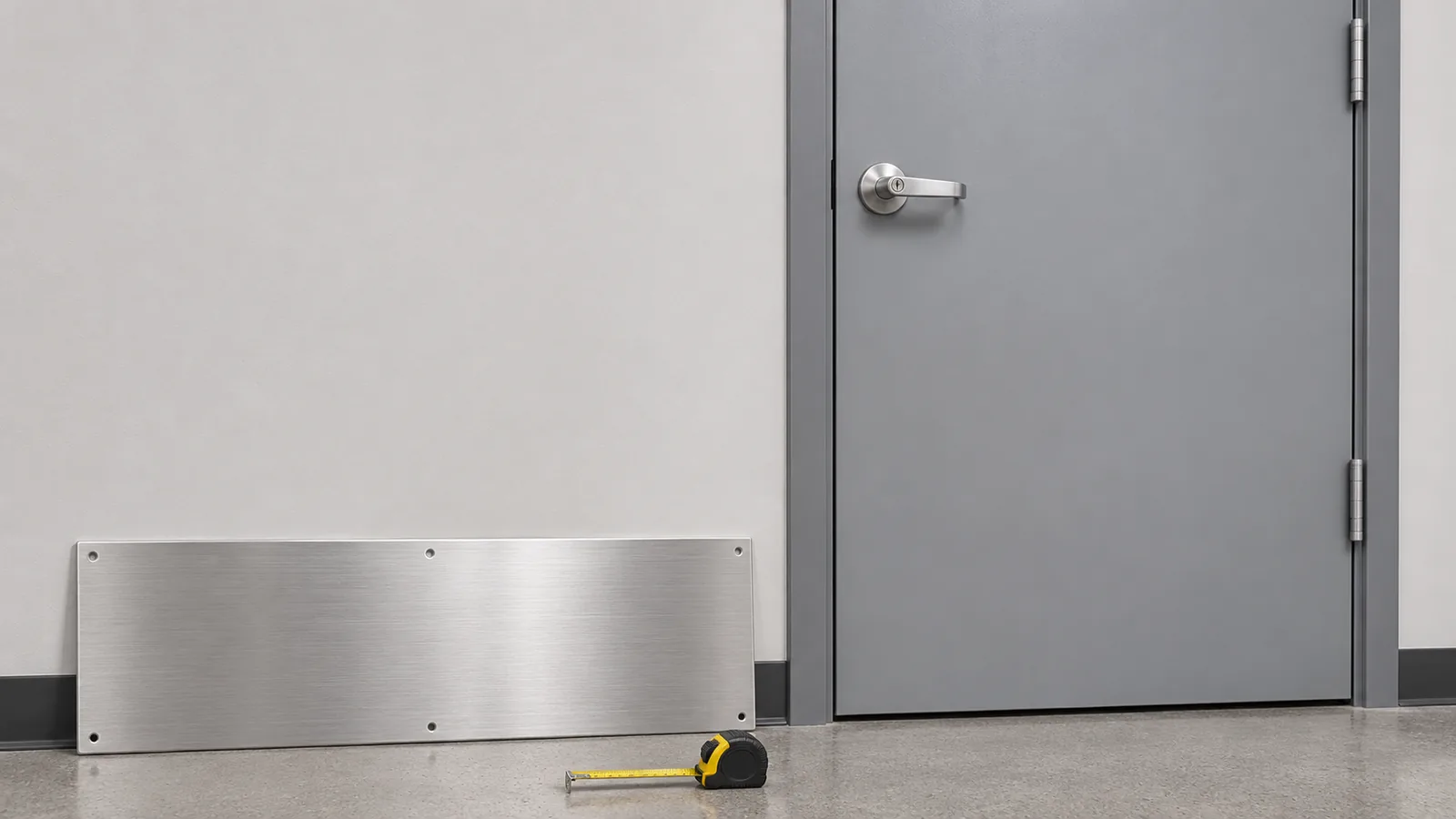
A door kick plate sizing mounting specification should separate the door reference, the plate’s finished cut dimensions, corner shape, hole pattern and attachment method. These values describe different things. A buyer who sends only the nominal door size may receive a plate that covers the wrong area or has fastener locations that do not match the intended door preparation. Confirm the exact door and hardware context before a custom plate is released for production.
What should a door kick plate sizing mounting specification include?
The door is the reference surface; the kick plate is a separate component with its own width, height, shape and placement. A buyer may choose a plate that covers a defined portion of the door, aligns with rails or stiles, avoids existing hardware, or follows a project drawing. There is no single deduction from door size that applies to all projects. Manufacturer guides can provide product-specific suggestions, but the approved project drawing should govern the order.
Before asking for a quote, collect the door leaf dimensions and the proposed plate dimensions separately. Identify whether the plate is for one door or a family of door widths. Record the edge gaps, vertical position, hinge side, lock side, rail or panel locations, and any existing handle, push plate or fastener that may conflict. Attach a face view with the plate outline and critical features called out.
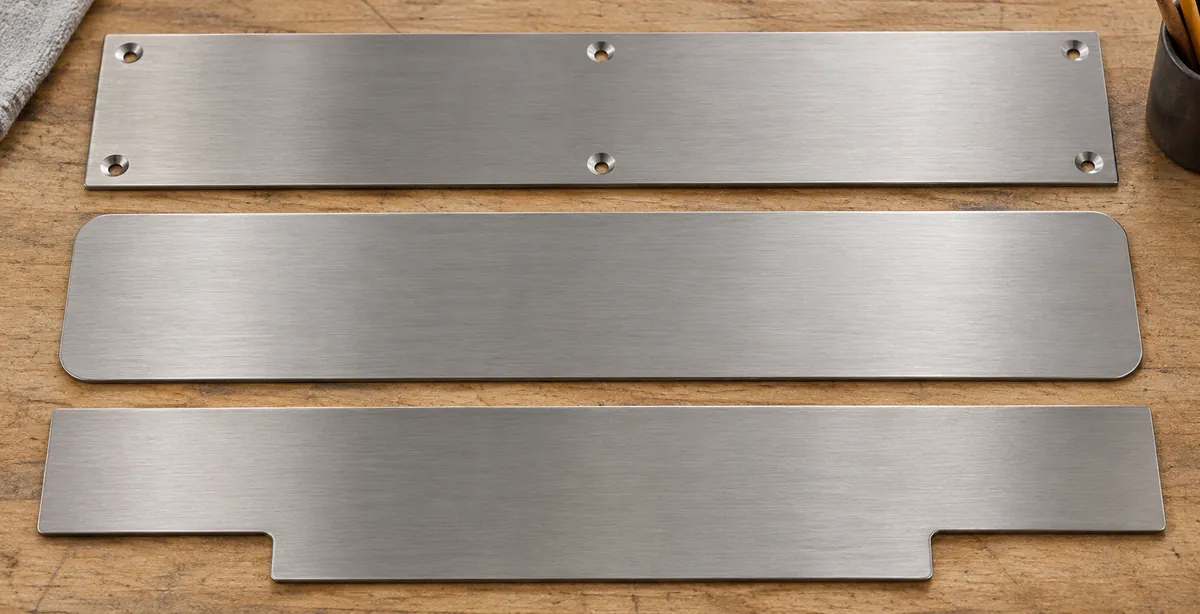
If the plate has a custom shape, show corner radii, notches, cutouts and any edge treatment. State whether dimensions refer to the finished outside edge, a blank before forming or another datum. The supplier should confirm the dimension convention before producing a sample. A number without a datum can be interpreted differently by the buyer, drafter and factory.
Do not use fire-rating, egress, accessibility or code assumptions as a substitute for project review. Door construction and local requirements can affect product choice, but those are outside a generic kick-plate sizing rule. The buyer should verify applicable requirements with the responsible project professional and source current official guidance where necessary.
Which mounting option should be specified?
Specify one mounting approach for each quoted SKU and state exactly what parts and preparation it includes. Common commercial product variations can include visible screw attachment, countersunk fasteners, other screw patterns, adhesive-backed or no-hole designs, and project-specific cutouts. Availability, substrates and restrictions vary by model. Do not assume that a no-hole option is suitable for every door or that the plate can be changed from one method to another without a redesign.
Ask the manufacturer to show the hole pattern against the finished plate outline. Record hole centers, edge distances, fastener type, countersink or clearance requirements, and whether screws are supplied. If an adhesive option is proposed, identify the exact product specification and conditions relevant to the project; a word such as “adhesive” alone is not a performance guarantee. The buyer must confirm that the selected method is permitted for its door and use.
The IVES protection-plate guide relates plate selection to a door face, rail and existing hardware and lists model-specific edge and hole choices. Its sizing deduction is a maker guideline, not a universal standard. Hager’s published trim pricebook distinguishes countersunk and non-countersunk fasteners, rounded corners, holeless adhesive configurations and custom cutouts. These references are useful because they show how configurations differ, not because their options can be copied onto every project. Review the IVES protection plate guide, its product range y el Hager trim pricebook.
Use the project drawing to confirm whether the door has a compatible screw-receiving structure and whether existing hardware affects the plate location. Do not provide drilling or installation instructions based on a generic article. Door material, core, finish and hardware may require the responsible installer’s direction.
What should a drawing show before a kick plate is cut?
An approval drawing should show the door face and the kick plate outline in the same view, with dimensions referenced to clear datums. Include the cut size, plate thickness if specified, corner treatment, cutouts, hole count and centers, mounting method, finish, visible surface and revision. If the part is formed or has a return, add a section view so the finished envelope is unambiguous.
Use a feature table to prevent measurement terms from collapsing into one value:
| Característica | Buyer should state | Por qué es importante |
|---|---|---|
| Door reference | Leaf width/height and relevant face details | Establishes the project context, not the plate size |
| Finished plate outline | Width, height, corner shape and datum | Controls coverage and appearance |
| Position | Offsets from named door edges or rails | Places the plate relative to the door layout |
| Mounting holes | Pattern, centers, fastener and countersink detail | Aligns the plate with the specified preparation |
| Cutouts | Shape, size and location | Avoids collision with hardware or features |
| Material/finish | Buyer-selected material and appearance criteria | Defines procurement and visual expectations |
| Embalaje | Protection and identity by SKU | Reduces mix-ups and surface contact during handling |
Dimension the hole pattern from the same datum as the plate outline. A drawing that places hole centers from different edges without a clear origin can create avoidable interpretation errors. If the buyer sends a photograph, add a scale reference and verify all controlling dimensions separately. Photos can help identify a door condition, but perspective distortion makes them a poor substitute for measurements.

For repeat orders, keep the approved drawing, sample and packing configuration under one revision. If a plate is offered in several finishes or sizes, each SKU should reference its own controlled drawing or a master drawing with a clear variant table. Avoid handwritten changes that do not make it into the released file.
How do existing door hardware and edges affect plate fit?
Existing door features can constrain the plate’s width, height, position and cutouts. Push plates, pulls, locks, vision panels, rails, glazing, seams and edge clearances should be shown if they are near the proposed plate. The buyer should identify which features are fixed and which may vary across the door population. A single reference door might not represent every door in a building or distributor assortment.
Ask the project team to provide measurements from the actual door schedule or a representative physical sample. Where several door constructions are included, group them by verified dimensions and mounting preparation. Do not assume that a plate designed for one leaf can transfer to another merely because the nominal door size matches; hardware position, edge details and preparation may differ.
At sample review, place the plate against the reference face without forcing it into position. Check its perimeter alignment, cutouts, fastener positions and visual relationship to nearby hardware. Record gaps and mismatches rather than making an informal fit judgment. If the project has a defined visual line or allowable offset, write that into the approval criteria instead of relying on “looks centered.”
This review is a dimensional coordination step, not a determination that a plate meets a building or fire requirement. The manufacturer’s guide is a source for that manufacturer’s models. The door supplier, project designer and responsible installer remain relevant parties for project-specific requirements.
What does a sample approval record need?
The record should connect a physical plate with the project door reference, drawing revision, material and finish selection, mounting preparation and package label. Keep separate records for distinct door groups if their dimensions or hole locations differ. A photograph should show the entire plate and a close view of its corners and hole pattern; a scale or dimensioned drawing should make controlling values reviewable.
Use this approval list:
- Door reference or schedule group is named.
- Finished plate width and height are stated independently of the door.
- Position is referenced to defined edges or features.
- Cutouts, corners and edge conditions are dimensioned.
- Mounting type and hole pattern are shown in the released drawing.
- Material and visible finish reference are identified.
- Supplied fasteners, if any, are listed without implying installation suitability.
- Sample and production drawing revisions are linked.
- Label and pack identify the correct size, finish and mounting variant.
- Any code or safety review is handled by the responsible project authority.
If the sample has a mismatch, record the feature and proposed correction, then issue a new controlled revision. Do not tell production to “make the plate slightly smaller” without a dimension and datum. That can produce a change that is hard to repeat or check later.
What should a distributor send with an RFQ?
Provide a door face drawing or schedule, the desired plate outline, mounting approach, cutouts, finish, expected quantity by size and packaging needs. Note whether the quote is for a stock-style item, a custom cut shape or a repeat project program. If the buyer does not yet know the exact plate dimensions, ask the door or project team to confirm them before requesting a production price.
For custom metal hardware, Koitor’s company materials confirm a family-owned bathroom and home storage hardware manufacturing scope, but do not confirm that Koitor currently makes door kick plates. This article is specification guidance for an adjacent category, not a catalog listing. A buyer can share a drawing to ask whether the design fits Koitor’s current capability through the contact page. The custom bathroom hardware page describes broader company context, not a promise to produce every door fitting.
When comparing supplier offers, normalize plate size, corner treatment, hole pattern, mounting method, finish, fasteners, packaging and sample scope. A quote that includes a custom cutout is not directly comparable to a standard rectangle. Ask suppliers to list assumptions and exclusions so that the buyer can evaluate equivalent specifications.
For a project with repeated doors, build the quantity schedule from the door groups rather than multiplying one plate size across the full project. Record how many leaves belong to each size or hardware arrangement and note any field-verified exceptions. This makes the quote useful for assortment and replenishment planning while keeping a mismatch from being hidden inside a combined total. If the customer later changes the door schedule, revise the plate matrix and check whether the existing samples still represent the updated group. Store the revision. Retain the reference.
Buyer checklist before ordering
- Confirm door measurements and define the relevant door group.
- Specify plate cut size separately from door size.
- Show position using consistent edge or feature datums.
- Include corner shape, thickness and cutouts on a controlled drawing.
- Choose a mounting method and specify the complete hole pattern.
- Verify door construction and requirements with the responsible project team.
- State material, finish, cosmetic surface and visible-edge criteria.
- Identify fasteners and packaging included in the quote.
- Approve a sample against the door reference, not a generic size rule.
- Link the approved drawing revision to the SKU and future order.
A door kick plate sizing mounting specification should bind the plate outline and fastener pattern to one measured door reference.
Preguntas frecuentes
Is the kick plate the same width as the door?
Not necessarily. The plate has its own finished cut dimensions and placement. The buyer should define those separately on the drawing and avoid relying on an assumed universal deduction.
Are screw holes standard across kick plate suppliers?
No. Hole patterns, countersinks and fasteners can vary by model and project. Show the required centers and confirm the mating door preparation before release.
Can a buyer order a plate with no holes?
Some makers offer no-hole or adhesive configurations, but they are model-specific and may have restrictions. Confirm suitability for the exact project and door with the responsible supplier and installer.
Does a manufacturer’s sizing guide set a mandatory standard?
Not by itself. A maker guide can explain its own product recommendations. The project drawing and applicable requirements should govern the actual order.
Can a photograph be used to measure a replacement plate?
A photograph is useful for identification, but perspective can distort size. Obtain actual dimensions, hole centers and reference edges before approving a replacement part.
Trabaja con Koitor Hardware
Review a Custom Metal Hardware Drawing
Share the part outline, interface, finish reference and expected quantity. Koitor can confirm whether the concept fits its current bathroom and home storage hardware scope before quotation.
OEM / MARCA BLANCA
Convierte esta guía de abastecimiento en un resumen del producto
Indícanos el producto que deseas, el tamaño, el acabado, la cantidad del pedido y los requisitos de embalaje. Tu equipo recibirá un análisis práctico de la viabilidad de fabricación antes de recibir el presupuesto.


 English
 Español
 Português
 Français
 Deutsch
 العربية