
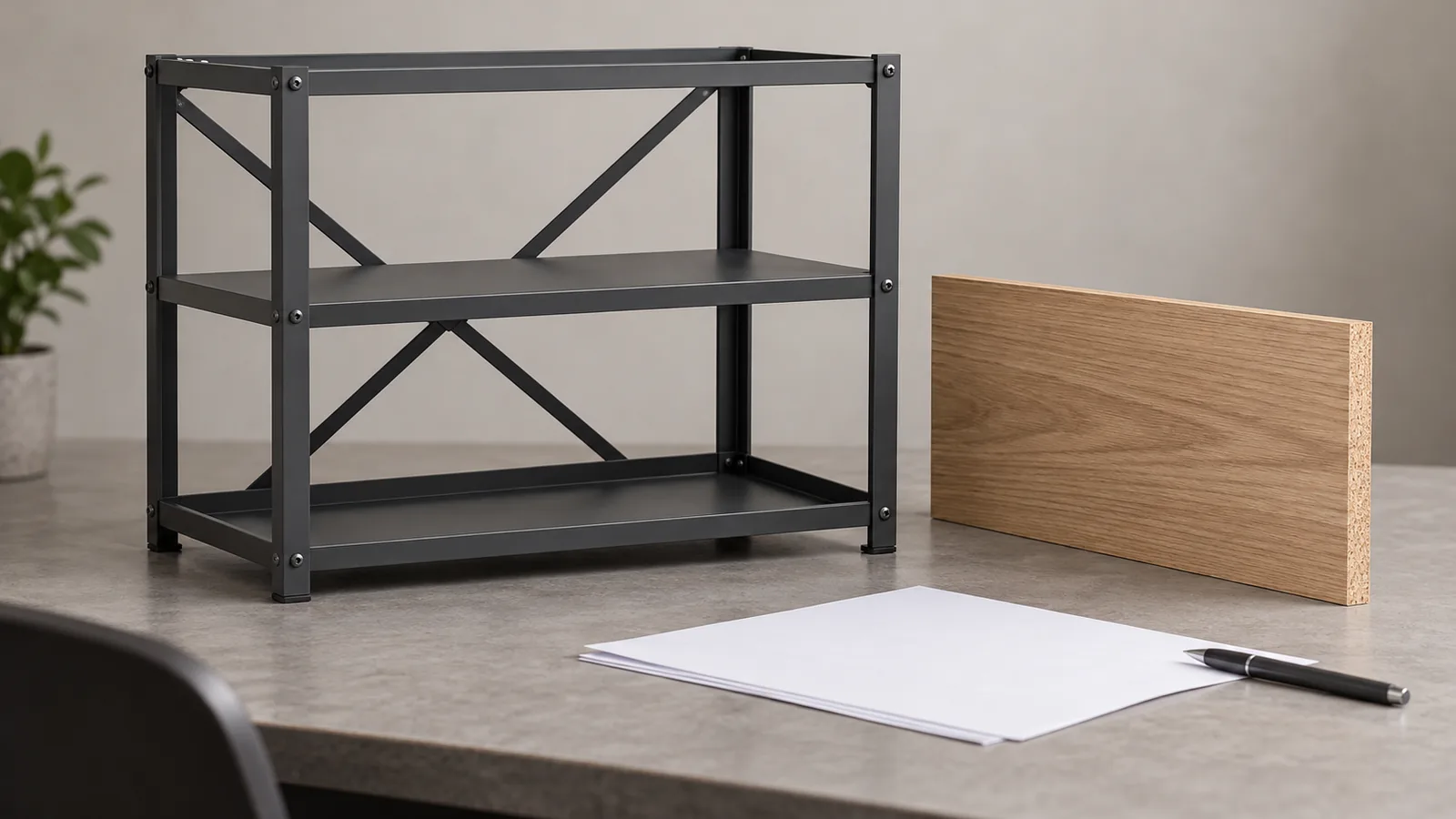
For an EU formaldehyde furniture restriction review, the first task is to identify the exact article being placed on the market. A metal storage frame with a wood-based shelf, a metal hook with a paper insert, and a metal-only product may have different material facts and may fall into different legal categories. The product name alone does not decide the applicable REACH Annex XVII Entry 77 limit, any exception, or the evidence needed for a release decision.
Since 6 August 2026, Entry 77 restricts placing covered articles on the EU market when formaldehyde emissions exceed the applicable limit under the test conditions in Appendix 14. The regulation sets 0.062 mg/m³ for furniture and wood-based articles and 0.080 mg/m³ for other articles. The rule says the lower limit for furniture and wood-based articles applies to the whole complex product. A buyer therefore should not treat a panel-level report as an automatic answer for every finished metal-and-wood configuration. The exact product category, test configuration and applicability need a qualified review against the current legal text.
These values are emissions limits under specified test conditions. They are not a generic room-air measurement, not a conversion target for any laboratory method, and not a declaration that a product has no formaldehyde. Ask the responsible regulatory specialist and laboratory to explain what the result covers.

Start with the marketed article and the material configuration
Create a product record for the configuration that will actually be supplied. Include the SKU, sales unit, assembly state, intended use, product dimensions, BOM revision, and every material that may release formaldehyde during the relevant test. For mixed-material storage, distinguish the metal structure from a shelf, backing, drawer bottom, decorative panel, adhesive, coating or other added component. Do not infer wood-panel content from the appearance of a finished surface: a wrapped edge, veneer, laminate or solid-wood appearance may represent different constructions.
A concrete product map gives the compliance reviewer something to assess. For an illustrative wall or floor organizer, the record might show a metal frame, a purchased shelf panel, a small backer, and the way those parts are assembled. It should also show whether the item is sold assembled or as a kit, whether multiple panel options exist, and whether the pack contains separate accessories. This example does not assert that Koitor currently makes a particular wood-and-metal SKU.
The buyer should identify who is responsible for placing the article on the EU market and who will make the product-scope decision. That responsibility can depend on the actual supply-chain roles and transaction. A supplier’s promise to “provide a certificate” does not settle who checks the restriction or whether the document describes the final product. Put the accountable reviewer and release owner in the product file.
The regulation includes scope provisions and exceptions. Some are based on the article’s use, material or relationship to another covered rule. This means “contains wood” is not a complete legal test, but “mostly metal” is not a safe shortcut either. The product’s classification and evidence must be assessed against the current Entry 77 text, its Appendix 14 test conditions and applicable official guidance. If the configuration does not fit a clear category, record the open question and obtain qualified advice before market release.
Understand the two limit categories without classifying by headline
Entry 77 distinguishes furniture and wood-based articles from other articles. The first category has a 0.062 mg/m³ emission limit, and the second has a 0.080 mg/m³ limit under the relevant reference test conditions. The Commission’s regulation explains that the lower value applies to the whole complex product for furniture and wood-based articles. A multi-material item cannot be assigned a limit merely by looking at its most visible material or by counting metal and wood parts.
For example, a metal shelving frame with a panel might be described commercially as a storage rack, a piece of furniture, a wood-based article, or another article depending on the product facts and regulatory interpretation. This article does not assign that classification. The importer should ask the compliance reviewer to record the category considered, the facts supporting it, the applicable limit, the test method and the legal source version used.
The limit values also do not imply that every product needs the same test or that a particular type of report is universally mandatory. Appendix 14 establishes reference conditions for measuring emissions from articles. A different test condition may only be used where a scientifically valid correlation to the reference conditions is applied. Test duration and measurement conditions matter; a number from an unspecified method cannot be compared to the legal threshold by matching units alone.
Keep the vehicle rule separate. The regulation sets a later date for formaldehyde in road-vehicle interiors. That timing is not an extension for ordinary furniture or storage articles placed on the EU market. Product teams should not transfer vehicle dates or test approaches to household storage without a specific legal basis.
| Review question | Evidence to assemble | What the evidence cannot establish on its own |
|---|---|---|
| What is the marketed article? | SKU, drawings, assembly instructions, BOM revision, product photos and intended-use description | A legal category based only on a marketing name |
| Which plant-based or adhesive components are present? | Material statements, panel type, supplier identity, adhesive or finish information and change history | The finished article’s emission result |
| Which Entry 77 category is being applied? | Written scope rationale tied to the exact construction and current official text | A universal classification for the entire product family |
| What test supports the conclusion? | Full report, sample description, test method, reference conditions, date, lab identity and any justified correlation | Evidence for untested revisions or different assemblies |
| Who releases the EU-market product? | Named importer or responsible compliance owner and approval record | Transfer of all legal responsibility to a factory or broker |
Match the report to the finished product and current test conditions
A buyer should not collect a report just because it says “formaldehyde.” First check what was sampled. Was it a raw panel, a coated panel, a cut component, a complete assembled article, or a different product that the supplier says is representative? Record the exact sample name, construction, dimensions, surface treatment, adhesive, edge treatment, assembly state and date. Then compare that information with the current production BOM and the marketed article.
For a complex furniture product, the regulation’s lower threshold applies to the whole product. A panel report may still be relevant evidence about a component or supplier, but it should not be silently represented as a result for the complete article. Ask the reviewer whether the report is sufficient for the applicable legal route, what additional information is needed, and why any test configuration represents the shipped product. If the team relies on a scientifically valid correlation from a non-reference test, retain the method and the basis for that correlation.
Check the report’s method and conditions, not only its pass statement. Appendix 14 provides a chamber-based reference method with conditions such as temperature, humidity, air exchange and loading factor, along with repeated measurements to determine a steady-state concentration. If the report used different conditions, ask for the written correlation and its scope. Do not convert a result from a different test standard by applying a simple ratio unless a qualified technical source supports the conversion for the actual method and sample.
A strong evidence package connects the report to the article through controlled identifiers:
- Report number, issue date and laboratory.
- Tested sample name, model or component identifier.
- Material and supplier details, including panel type and relevant adhesive or finish.
- Sample preparation, conditioning and assembly state.
- Test method and the reference or alternative conditions used.
- Reported result, units, applicable threshold and reviewer interpretation.
- Product revision and SKU coverage, including any limits on related configurations.
- Change record showing whether the production article still matches the tested one.
When a report covers a family of products, request the basis for family grouping. Panel thickness, exposed surface area, edge treatment, adhesive, coating, enclosure and assembly can affect what a tested sample represents. The buyer should not assume that one test extends to all variations just because the products share a supplier or category name. Have the laboratory or qualified compliance reviewer identify which features are critical to representativeness.

Separate EU Entry 77 evidence from U.S. panel records
A U.S. TSCA Title VI file may help identify a composite wood panel and its supplier chain, but it does not automatically prove that the finished EU article meets Entry 77. The regimes answer different questions and may use different product boundaries, roles, test conditions, labels and evidence. Likewise, a general REACH statement or a supplier’s broad “compliant” declaration is not a substitute for assessing the current formaldehyde entry and the final product configuration.
Use existing documents as inputs, not conclusions. A panel certificate can support material identity or panel-level controls. A laboratory report can support a result for the sample and method it documents. A supplier declaration can state what the supplier believes about its component. The importer still needs to determine whether these records together support the actual marketed article under the applicable EU requirement.
For each document, make a simple coverage note: product or component covered, supplier and site, SKU or panel identity, revision, test method, jurisdiction, issue date and known exclusions. If the evidence does not cover a changed adhesive, new panel source, altered finish or different assembly, open a review rather than carrying the previous approval forward.
The related EU Digital Product Passport readiness guide for metal home-storage importers discusses structured product data and supplier records. A DPP data exercise can help organize identifiers and revisions, but it is not an Entry 77 test report or legal approval. Keep the records cross-referenced while preserving each file’s purpose.
Put supplier changes and market release under change control
Emission evidence can become stale after a small-looking engineering or sourcing change. Treat the material and test scope as part of the product revision. Before approving a change, ask whether it affects the article’s category, the specimen that should be tested, the applicable test method, or the supplier records used for the release decision.
A change review is particularly important when the buyer:
- Switches from one panel supplier or panel construction to another.
- Changes a laminate, veneer, coating, edge band or exposed surface.
- Adds or removes a panel, backer, drawer, shelf, or adhesive-bonded component.
- Changes dimensions or assembly in a way that changes exposed surface area.
- Changes the retail unit, SKU set, assembly state or intended use.
- Introduces a new private-label version with a different BOM.
- Relies on a test report that was issued for an earlier sample or method.
The request for change should identify the old and new configuration, affected purchase orders and lots, supporting supplier data, required reviewer, retest or correlation decision, and effective date. Do not let a factory substitute a panel and assume that an earlier test remains representative. Equally, do not require a new chamber test automatically for every minor edit without technical review; the relevant question is whether the existing evidence remains valid for the exact rule and configuration.
Before market release, place the review outcome in the product file. A useful approval record states the Entry 77 scope conclusion, the official text or guidance consulted, the applicable category and limit if covered, the evidence relied upon, any exception considered, open conditions, and the person who approved the decision. If the outcome is “not covered” or “not applicable,” record the product facts and reasoning rather than leaving the field blank.
For the manufacturing facts Koitor can confirm, buyers can use the documented OEM home-storage hardware information and share the current drawing and BOM through the project contact page. Koitor’s metal-product discussion does not establish wood-panel composition, emissions, laboratory competence or regulatory compliance. The responsible supplier, qualified laboratory and importer-side compliance owner must provide and interpret those records.
Importer checklist before placing a mixed-material storage article on the EU market
Use the following checklist at product approval and repeat it after material, supplier or design changes:
- Freeze the marketed configuration. Capture the product photographs, SKU, BOM, drawing revision, assembly state, pack contents and intended use. Make sure the evidence describes the product sold, not just a development sample.
- Identify all relevant materials. List wood-based panels, solid wood, adhesives, coatings, laminates and other components that may matter. Keep the metal parts and shipping packaging distinct in the BOM.
- Assign the scope reviewer. Identify who will determine whether Entry 77 covers the actual article and which category applies. Do not delegate this conclusion by implication to a panel supplier.
- Record the legal basis. Link the conclusion to the current REACH Annex XVII Entry 77, Appendix 14 and current authority guidance. Older national FAQs may not describe the post-August 2026 EU-wide framework.
- Check evidence boundaries. For every report or certificate, note the tested sample, method, test conditions, supplier, revision and limitations.
- Confirm representativeness. If component evidence or a non-reference test is used, keep the written reasoning showing how it supports the actual article under the applicable route.
- Resolve gaps before release. Name the missing document, supplier owner, reviewer and deadline. Do not treat “certificate pending” as evidence that the product passes.
- Control production changes. Route supplier, material, adhesive, finish and assembly changes to the same review before the revised product is released.
- Retain the decision trail. Keep the final BOM, supplier records, reports, change approvals and market-release decision under the relevant SKU and date.
- Keep regimes separate. Use U.S. TSCA records as relevant background, but do not label them as automatic EU Entry 77 approval.
Frequently asked questions about the EU formaldehyde furniture restriction
Does a metal frame automatically put a storage product in the “other articles” category?
No. The frame’s material alone does not determine how the finished article is categorized. A product containing a wood-based panel may still require a whole-article scope review. The importer should have the exact construction and use assessed against current Entry 77.
Are the 0.062 mg/m³ and 0.080 mg/m³ limits interchangeable?
No. They correspond to different categories under the restriction. The applicable limit depends on the article classification and the specified test conditions. A buyer should not choose the higher value simply because a product has a metal frame or apply the lower one to every item without reviewing scope.
Does a panel certificate prove that the finished storage article passes?
Not automatically. A panel document describes the panel and its defined scope. For a furniture or wood-based complex product, the regulation’s lower limit applies to the whole complex product. A qualified reviewer must determine whether component records, a finished-article test, or another technically supported route is sufficient.
Can a U.S. TSCA Title VI report replace an EU Entry 77 review?
No automatic equivalence should be assumed. The scope, test method, reference conditions and product boundary may differ. The report can be reviewed as supporting evidence, but the responsible EU compliance reviewer must decide whether it supports the applicable EU question.
Is a “formaldehyde-free” supplier statement enough?
No. A broad marketing statement does not identify the tested sample, method, result, material revision or legal scope. Ask for product-linked technical evidence and an explicit review of the actual article.
Does every importer need the same laboratory report?
The regulation sets the restriction and test conditions; the required evidence path depends on the article, its scope and the technical basis accepted for the case. The importer should have a qualified laboratory or compliance professional determine what evidence is appropriate rather than copying another product’s report.
Official references and related guidance
- Commission Regulation (EU) 2023/1464 amending REACH Annex XVII — Entry 77, its dates, categories, limits, exceptions and Appendix 14 test conditions.
- German Environment Agency: Formaldehyde — Current national-authority summary of the EU-wide restriction and stated emission limits.
- ECHA: Entry 77 restriction text — Official presentation of the restriction; recheck the current consolidated text and guidance before making a product-specific decision.
This EU formaldehyde furniture restriction review should be recorded against the specific finished article, its intended use and the applicable current legal requirements.
Align the Product Revision With Its Evidence
Share the current storage-product drawing and BOM revision so manufacturing facts can be confirmed within scope. Have the responsible supplier, laboratory and importer-side compliance owner assess the applicable EU formaldehyde requirement and evidence.
OEM / MARCA BLANCA
Convierte esta guía de abastecimiento en un resumen del producto
Indícanos el producto que deseas, el tamaño, el acabado, la cantidad del pedido y los requisitos de embalaje. Tu equipo recibirá un análisis práctico de la viabilidad de fabricación antes de recibir el presupuesto.


 English
 Español
 Português
 Français
 Deutsch
 العربية